
The Shift from Search to Synthesis
Generative SEO techniques are strategies to optimize content for AI-powered search engines like ChatGPT and Google’s AI Overviews. These tools synthesize answers rather than just listing links. Here’s what you need to know:
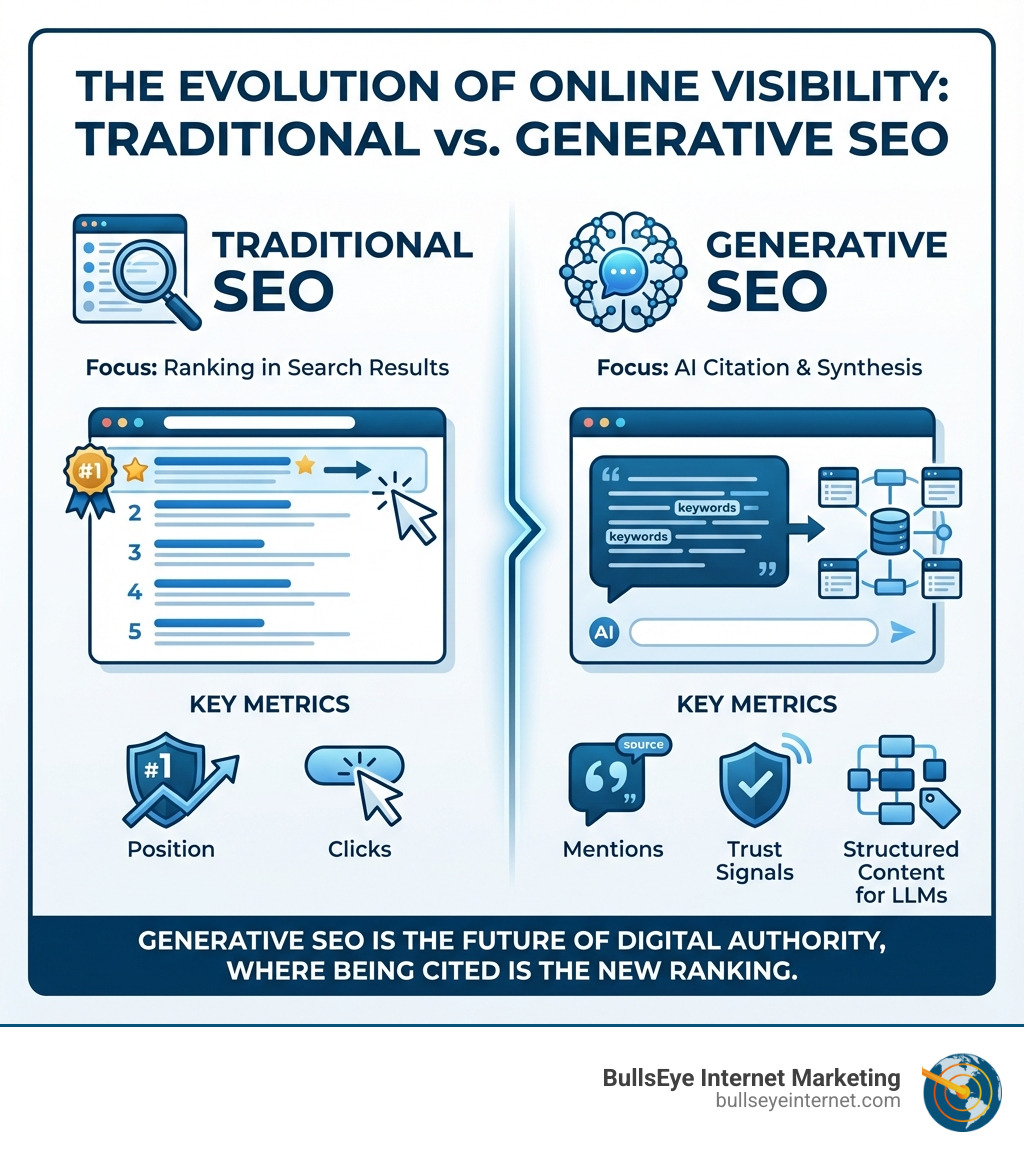
- Traditional SEO aims to rank your page in a list of search results
- Generative SEO aims to get your content cited within AI-generated answers
- Success means being quoted, referenced, or mentioned when AI tools respond to user queries
- It requires structured, authoritative, citation-worthy content that AI systems trust
Search behavior is shifting. Users increasingly get synthesized answers from AI tools instead of clicking through links. If your business isn’t cited in these AI responses, you’re invisible to a rapidly growing customer segment.
Research shows over 71% of people use AI for search, and AI Overviews appear in over 50% of Google searches. With traditional search volume predicted to drop 25% by 2026, this shift is happening now.
The old SEO playbook of keywords and rankings is evolving. The new reality demands content AI can understand, trust, and cite. Your website must become a primary source—an authoritative resource AI models reference to answer industry questions.
I’m Ronnie Katz, founder and CEO of BullsEye Internet Marketing, and I’ve spent over 20 years helping businesses adapt to major shifts in online visibility—including the current evolution toward Generative SEO techniques. This guide will show you exactly how to optimize your content for AI citation, build the authority signals that matter in this new landscape, and measure your success in ways that actually drive calls and sales.
Handy Generative SEO techniques terms:
Understanding the New Search Paradigm: SEO vs. GEO
The digital landscape is undergoing a monumental shift, driven by advancements in Artificial Intelligence (AI). This new era of AI-powered search is changing how users find information. At the heart of this change are Large Language Models (LLMs), the brains behind services like Google’s AI Overviews (formerly SGE), ChatGPT, and Perplexity.
Unlike traditional search engines that return a list of links, these generative AI systems provide direct, synthesized answers. They process information from numerous sources and use Natural Language Processing (NLP) to understand context, ultimately generating a comprehensive response.
How AI Surfaces and Cites Content
How do these AI powerhouses decide which content to cite? The process differs from traditional ranking. AI models look for contextual relevance, trustworthiness, and clarity.
- Google AI Overviews (SGE) blend generative answers with web links, often citing high-authority websites, YouTube content, and pages eligible for featured snippets. They prioritize content that directly answers questions.
- ChatGPT and similar AIs synthesize information and often cite sources like Wikipedia, Reddit, and well-structured comparative listicles, which make up 32.5% of all sources cited by LLMs.
- Perplexity is designed to show numbered citations in every answer, emphasizing the importance of being a citable source.
The key takeaway is that AI-powered search engines ground their answers in indexed, high-quality pages. While classic SEO still matters, the goal has shifted from merely ranking to being cited.
This shift has real-world implications. Gartner predicts that traditional search volume will drop by 25% by 2026 as generative engines take over. If you’re not optimizing for AI citation, you’re becoming invisible.
| Feature | Traditional SEO | Generative SEO (GEO) |
|---|---|---|
| Primary Goal | Rank on SERPs (Search Engine Results Pages) | Get content cited/referenced in AI-generated answers |
| Focus | Keywords, backlinks, technical optimization | Trust signals, structure, clarity, entity optimization |
| Metrics | Rankings, organic traffic, CTR, bounce rate | AI visibility, citation frequency, brand mentions |
| Content Type | Optimized for search engine crawlers | Optimized for LLM understanding and synthesis |
| User Journey | Click a link, visit page for information | Receive direct answer, potentially click for depth |
| Competition | Outrank competitors on SERP | Be the authoritative source AI chooses to cite |
| Key Principle | Relevance (keyword matching) | Credibility, context, comprehensive answers |
The Core Differences: SEO, SGE, and GEO Explained
Let’s clarify the alphabet soup of search optimization:
Search Engine Optimization (SEO): This is the traditional practice of increasing traffic from organic search results. It focuses on ranking pages in conventional SERPs using tactics like keyword research, technical SEO, and link building to get users to click through to your site.
Search Generative Experience (SGE): This refers to Google’s integration of generative AI into its search results. SGE (now AI Overviews) provides an AI-generated summary at the top of the page, often with links to its sources. It’s a hybrid approach, blending AI-synthesized answers with traditional SERP features to provide more immediate answers.
Generative Engine Optimization (GEO): GEO is the process of optimizing your content to be understood, extracted, and cited by AI-driven engines like ChatGPT and Google’s AI Overviews. It’s less about ranking and more about becoming the source material for AI-generated answers. The goal is citation, not just a click.
The fundamental difference is the outcome: traditional SEO aims for a high ranking, leading to a click. GEO aims for your content to be incorporated into an AI-generated answer, where the user might get their answer directly or click through for more depth.
Why Generative SEO is Crucial for Future Visibility
AI search adoption is skyrocketing. A study by Higher Visibility showed that 71.5% of people use AI for search activities. This represents a fundamental change in user behavior, not just a tech trend.
- Zero-Click Searches: When AI systems provide direct answers, users often don’t need to click through to a website. If your content isn’t part of that answer, you lose visibility and brand exposure.
- Competitive Advantage: Early adopters of Generative SEO techniques are already seeing results. Companies implementing GEO strategies achieve 185% higher brand authority scores and a 240% improvement in pipeline quality within 8-12 months. This is a chance to get ahead of the curve in Florida, South Florida, or any of our service areas.
- Revenue Impact: The financial impact is significant. Influencer Marketing Hub reported a 525% jump in revenue from AI-driven search engines between January and August 2024. This is about direct business growth.
- Risk of Inaction: Sticking solely to traditional SEO risks becoming invisible to a growing segment of your audience.
Implementing Generative SEO techniques is a must-have for future visibility. We need to adapt our strategies to capture this evolving audience. Dive deeper into how we approach this with our AI search marketing strategies.
Core Principles of Generative Engine Optimization (GEO)
Succeeding with Generative SEO techniques requires a new mindset. Instead of gaming an algorithm, the focus is on providing value that AI can easily understand, trust, and reproduce. These core principles guide our approach:
- Trust Over Rank: In the AI era, trust is paramount. AI models prioritize well-structured, objective, and trustworthy sources. We focus on building inherent credibility so AI chooses to reference our clients’ content.
- Entity Optimization: AI understands the world through entities—people, places, organizations. We ensure consistent naming, clear definitions, and proper schema markup for key entities to help AI grasp context.
- Contextual Relevance: AI understands the intent and context behind a query. We optimize content to be contextually rich, providing comprehensive answers that align with user intent.
- User Intent: This is even more crucial in GEO. AI aims to provide the best answer, meaning our content must directly address the underlying user intent.
- Primary Source Value: AI loves original data and unique insights. Content that offers novel information is more likely to be cited. We strive to make our clients the authoritative voice in their niche.
These principles form the backbone of our AI Search Best Practices.
The Central Role of E-E-A-T in the AI Era

Google’s E-E-A-T (Experience, Expertise, Authoritativeness, Trustworthiness) framework is more critical than ever for Generative SEO techniques. AI models are designed to value high-quality, helpful content, and E-E-A-T is the benchmark for that quality.
- Experience: Does the creator have experience with the topic? For example, a Miami Beach resident writing about local attractions carries more weight than content from online research alone.
- Expertise: Is the content from someone with recognized knowledge or skill? A financial advisor writing about investment strategies for Floridians demonstrates expertise.
- Authoritativeness: Is the website or author a recognized authority? A local law firm in Palm Beach County writing about legal advice is an authoritative source.
- Trustworthiness: Is the content accurate, transparent, and safe? This includes clear sourcing and a secure website.
For our clients, this means showcasing their credentials and unique insights through:
- Comprehensive Author Bios: Clearly stating the author’s background and qualifications.
- Verifiable Credentials: Linking to certifications, awards, or professional organizations.
- Transparent Sourcing: Citing reputable sources for all claims and statistics.
- Consistent Branding: Maintaining a professional and consistent online presence.
Google’s own E-E-A-T guidelines confirm that content created with AI can perform well if it aligns with these standards. Our job is to infuse our clients’ unique experience into every piece of content.
Becoming a Primary Source with Original Data
One of the most powerful Generative SEO techniques is to become a primary source. This means creating content that AI systems use as an original reference point for information.
AI systems love unique, verifiable data. Publishing original research, conducting surveys, or sharing proprietary insights creates content that AI models are eager to pull from.
- Original Research: Publish studies or analyses that offer new insights. For example, a South Florida real estate agency could publish a report on local housing market trends.
- Unique Data: Share proprietary data or statistics that aren’t available elsewhere.
- Case Studies: Document client successes with detailed case studies.
- Demonstrations: Provide clear, step-by-step demonstrations, especially with multimedia.
- Multimedia Content: Videos, infographics, and interactive tools can present information in a highly citable format.
Research found that GEO methods like including citations, quotes, and statistics boosted source visibility by over 40% across various queries. By producing this kind of content, we build authority and increase the likelihood of our clients’ content being cited by AI.
Actionable Generative SEO Techniques for AI Visibility

Implementing effective Generative SEO techniques requires a multi-faceted approach to content, technical optimization, and authority building. The goal is to create content so clear and credible that AI cites it. For a deeper dive into these strategies, check out our LLM SEO Best Practices Guide.
Implement These Content-Focused Generative SEO Techniques
Content is paramount in generative AI. Here’s how we make it AI-friendly:
- LLM-Friendly Formatting: Make content easy for AI to parse and extract information from. This means:
- Short, Direct Sentences and Paragraphs: Get to the point quickly.
- Bullet Points and Numbered Lists: Perfect for summarizing key information.
- Tables: Great for comparisons or structured data.
- Definitions and Summaries: Provide clear definitions for key terms and summaries for sections.
- Direct Answers First: Provide the answer to a question immediately, within the first one or two sentences, before elaborating. This “answer-first” structure is ideal for AI snippet extraction.
- Q&A Format: Structure sections or entire articles in a question-and-answer format. This mirrors how users interact with AI and makes it easy for LLMs to extract information.
- Conversational Language: Write naturally, as if you’re speaking to a person. AI models are designed to understand human-like language.
- Topic Clusters for Resilience: Build comprehensive topic clusters instead of isolated articles. A central “pillar page” (e.g., “Digital Marketing in Florida”) should link to supporting content on specific sub-topics (e.g., “SEO for Plumbers in Broward County”). This interconnected content signals deep expertise to AI, making the cluster more resilient to algorithm shifts.
Technical and Structural Generative SEO Techniques
Technical SEO is a vital foundation for Generative SEO techniques, as AI models must access and understand your pages efficiently.
- Structured Data: Implement schema markup to give AI a ‘cheat sheet’ for your content. Use
Article,Product, and especiallyFAQPageor Q&A schema markup to help AI models extract information easily. - Page Speed and Mobile-Friendliness: AI algorithms need to visit pages quickly. A slow website will deter both users and AI. We aim for optimal Core Web Vitals scores and ensure sites are fast and mobile-friendly.
- Crawlability and Indexability: Your content can’t be cited if AI can’t find it. We ensure a clean website structure, proper
robots.txtfiles, and sitemaps so AI crawlers can access and index all valuable content. - Internal Linking: Thoughtful internal linking guides AI models through your site’s content hierarchy. It reinforces topical authority and helps AI understand the relationships between different pieces of content.
For a thorough review of your site’s technical health and AI readiness, consider an LLM SEO Audit Best Practices.
Measuring Success and Utilizing Tools in the AI Era
With Generative SEO techniques, traditional metrics like rankings and click-through rates (CTR) are insufficient. New ways to measure success are needed to reflect the unique nature of AI-driven search.
- Traditional vs. Generative Metrics: While traditional SEO focuses on clicks and bounce rates, Generative SEO introduces a new set of KPIs. We’re not just looking at whether a user clicked a link; we’re looking at whether AI used our content.
- AI Visibility: How often is our content featured in AI-generated responses?
- Citation Frequency: How many times is our brand or content referenced by AI?
- Brand Mentions and Sentiment Analysis: What is AI saying about our clients’ brands? Is it positive or neutral?
- Assisted Conversions: How does AI visibility contribute to calls and sales, even if it’s not a direct click?
Understanding and tracking these new metrics is crucial for proving ROI. For a comprehensive overview, explore our LLM SEO Services Ultimate Guide.
Key Performance Indicators (KPIs) for Generative SEO
To effectively measure the impact of our GEO strategies, we track several key performance indicators:
- Impressions in AI Overviews: This tells us how often our clients’ content appears in Google’s AI-generated summaries.
- Click-Through Rate (CTR) from Citations: Even with direct answers, AI Overviews often include clickable sources. We track the CTR from these citations to understand how compelling our content is.
- Assisted Conversions: Analyze how AI visibility indirectly contributes to conversions. A user might get an answer from AI, then visit your website directly or call, rather than clicking a cited link. This is key for businesses focused on calls and sales.
- Brand Query Growth: An increase in users searching directly for our clients’ brand names after engaging with AI-generated answers indicates successful brand building through GEO.
- Share of Voice in AI: We compare how often our clients’ brand is cited by AI relative to their competitors. This provides a clear picture of their authority in the AI search landscape.
Essential Tools for Your GEO Toolkit
To implement and monitor Generative SEO techniques effectively, we leverage a suite of tools:
- AI Search Monitoring Tools: These platforms track how AI agents interpret and cite your brand, helping measure AI visibility and citation frequency.
- Content Optimization Platforms: We use tools that assist in creating LLM-friendly content, helping identify content gaps and ensure proper structure.
- “People Also Ask” Research Tools: Tools that map out related questions are invaluable for structuring content to answer the precise questions users are asking.
- AI-Powered Analytics: Beyond standard analytics, we use custom tracking in platforms like Google Analytics 4 to segment traffic from AI sources and uncover trends.
Frequently Asked Questions about Generative SEO
We know this is a new and evolving field, so let’s answer some common questions about Generative SEO techniques.
Is Generative Engine Optimization (GEO) replacing traditional SEO?
No, GEO is an evolution and complement to traditional SEO, not a replacement. Foundational SEO is still crucial, as AI often sources from top-ranking pages. A dual strategy is best: maintain strong SEO practices while optimizing for AI citation to ensure visibility in both traditional results and AI answers.
How do I optimize for specific AI engines?
While different LLMs have slight preferences, the core principles of Generative SEO techniques are universal:
- Clarity and Structure: All AI models benefit from well-organized, easy-to-read content with clear headings and bullet points.
- Authoritativeness and Trustworthiness: E-E-A-T signals are universally important. AI looks for credible sources and verifiable information.
- Focus on Recent and Relevant Sources: AI models prefer up-to-date information. Ensure your content is regularly reviewed and updated.
- Understanding How AI Models Use Data: ChatGPT often favors encyclopedic content, while Google AI Overviews might prioritize YouTube for demos. Adhering to universal best practices positions you for most platforms.
Can local businesses benefit from Generative SEO?
Yes, local businesses in areas like Miami, Fort Lauderdale, and West Palm Beach can significantly benefit from Generative SEO techniques.
- Location-Based Entities: We optimize content for specific local entities (e.g., “best Italian restaurant in Coral Gables,” “emergency plumber in Broward County”). This helps AI connect user queries with relevant local businesses.
- Local Structured Data: Implementing local business schema is crucial. This tells AI your business’s name, address, phone number, and services, making it easier for AI to recommend you.
- Authoritative Local Content: Creating content that answers common local questions (e.g., “What are the zoning laws in Palm Beach County?”) positions your business as a local authority.
By focusing on these strategies, local businesses can ensure they are cited by AI when users ask for local recommendations. This is a powerful way to drive new leads and sales through Generative AI Lead Generation.
Conclusion: Future-Proofing Your Digital Strategy
The era of AI-powered search is a fundamental shift redefining online visibility. At BullsEye Internet Marketing, we view Generative SEO techniques as the essential evolution of traditional SEO. It’s about adapting, embracing human-AI synergy, and delivering high-quality, trustworthy content.
By implementing the Generative SEO techniques discussed, you can future-proof your digital strategy. This ensures your business remains visible, cited, and authoritative to both human users and advanced AI systems.
The future of search is generative, and the businesses that adapt now will be the ones that thrive. We’re here to help our clients in Florida, South Florida, and all our service areas steer this exciting new landscape, turning AI-driven search into a powerful engine for calls and sales. Let’s work together to make your business the authoritative source that AI loves to cite.
