
Why Businesses Are Shifting to Outcome-Based Payments
Pay for results is a contracting strategy where payment is made only when specific, measurable outcomes are achieved—not for activities, effort, or deliverables alone. Instead of paying upfront for services that might work, you pay when they do work.
Quick Definition:
- Traditional payment: You pay for time, effort, or completion of tasks
- Pay for results: You pay only when agreed-upon outcomes are verified
- Key difference: Risk shifts from client to service provider
- Common names: Pay for Success (PFS), Performance-based contracting, Outcomes-based payment
This model represents a fundamental shift from paying for inputs (like hours worked or ads run) to paying for outputs (like leads generated, sales closed, or rankings achieved). It’s gaining traction across industries—from government social programs to digital marketing—because it aligns everyone’s interests around what actually matters: measurable business results.
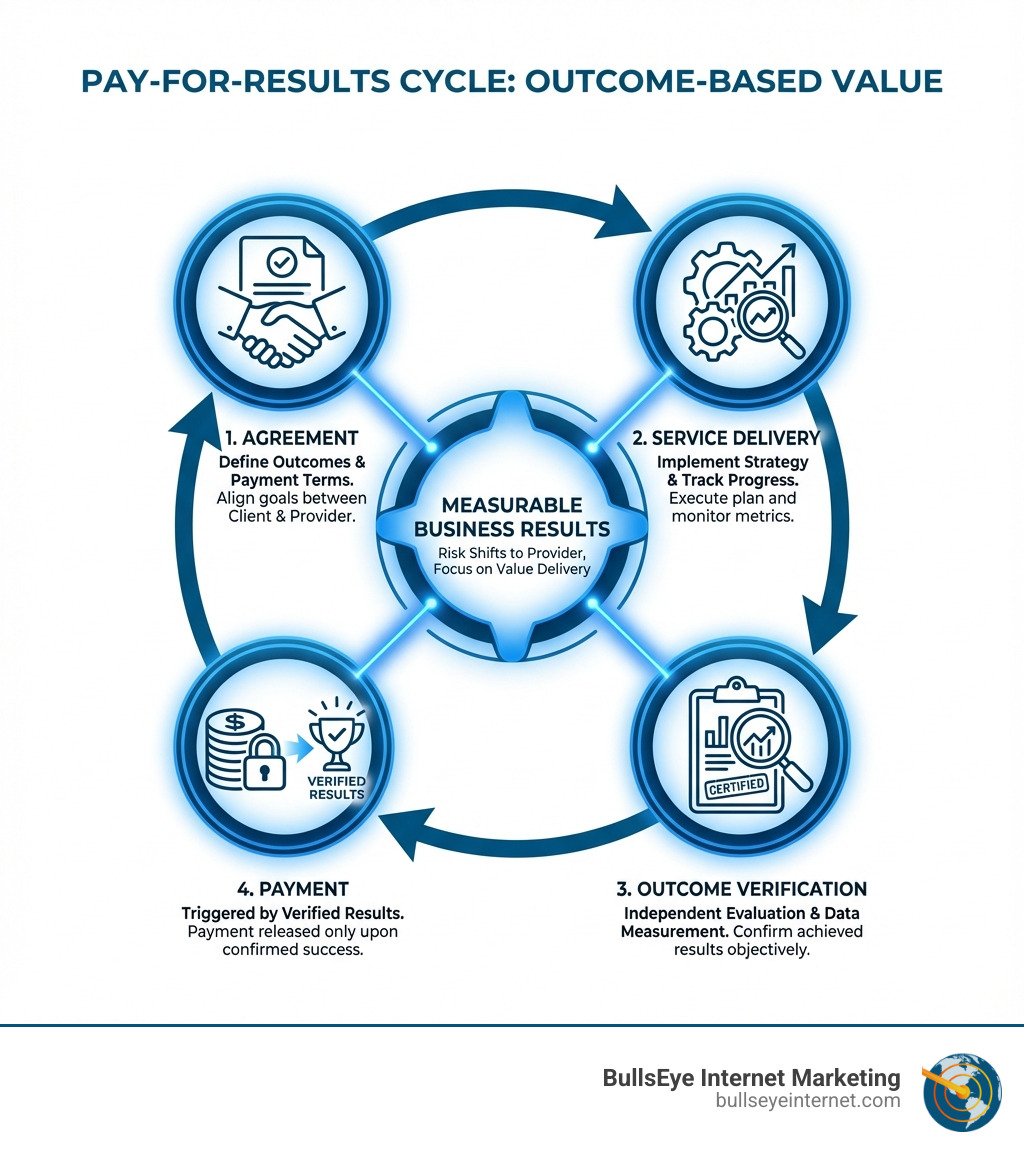
The concept is straightforward. The parties define the result upfront, agree on a baseline, work out how confident the organization is in delivering the result, and then specify the expectation and payment in the contract. In digital marketing, this might mean paying only when your phone rings with qualified leads, when your website ranks on page one, or when you see a documented increase in sales.
Why is this becoming popular? Because business owners are tired of throwing money at marketing efforts that produce unclear returns. They want accountability. They want transparency. They want their investment tied directly to growth—not just activity reports and vanity metrics.
I’m Ronnie Katz, and since 2006 I’ve built BullsEye Internet Marketing around the principle of Pay for results—helping businesses make money online through measurable visibility, traffic, and conversions that directly impact their bottom line. My mission has always been getting your phone ringing with cutting-edge techniques while providing transparent, measurable reporting of your return on investment.
Quick look at Pay for results:
- search engine optimisation companies
- search engine optimization company
- search engine optimization consultants
What is the Core Concept of a Pay-for-Results (P4R) Contract?
At its heart, a Pay for results (P4R) contract is an agreement where payment is directly contingent upon the achievement of predefined, measurable outcomes. It’s a powerful framework that shifts the focus from simply delivering services to delivering tangible, agreed-upon results. In U.S. Government contracting and grants, P4R—also known as “Pay for Success” (PFS)—represents a fundamental shift from paying for activities and inputs to paying only when measurable, policy-relevant outcomes are achieved. This principle extends to the private sector, where businesses like ours accept it to ensure our clients see real value.

The core principles of P4R are:
- Outcome-based payment: The payment is tied exclusively to the successful delivery of specific, verifiable outcomes. If the outcomes aren’t met, payment isn’t made (or is reduced).
- Accountability: This model inherently demands greater accountability from the service provider, as their compensation directly reflects their ability to achieve the promised results.
- Value for money: For the client, P4R ensures that their investment is tied to actual value creation, minimizing wasted expenditure on ineffective efforts.
You might hear Pay for results referred to by several names, including Pay for Success (PFS), Performance-based contracting, or Outcomes-based payment. While the terminology can vary, the underlying concept remains consistent: payment for demonstrable results.
We believe this approach is not just a trend but a strategic evolution in how services are procured, especially in performance-driven fields like digital marketing. It moves us away from vague promises and towards concrete achievements.
| Feature | Traditional Contracts (e.g., Cost-Reimbursement, Fixed-Price) | Pay-for-Results Contracts |
|---|---|---|
| Risk | Primarily borne by the client | Primarily borne by the service provider/investor |
| Payment Trigger | Effort, time spent, completion of activities or deliverables | Achievement of predefined, independently verified outcomes |
| Focus | Inputs, activities, processes | Measurable, policy-relevant outcomes, impact |
| Innovation | Limited incentive for innovation | High incentive for innovation to achieve outcomes efficiently |
| Flexibility | Often prescriptive on methods | Allows provider flexibility in how outcomes are achieved |
How P4R Differs from Traditional Contracts
To truly appreciate the power of Pay for results, it’s crucial to understand how it stands apart from more traditional contracting models.
Consider cost-reimbursement contracts. These agreements cover allowable expenses incurred by the service provider, regardless of whether the program achieves meaningful results. The client pays for the effort, even if that effort doesn’t lead to the desired outcome. It’s like paying a chef for buying ingredients and spending time in the kitchen, even if the meal is inedible.
Then there are fixed-price contracts. While these seem more outcome-oriented on the surface—payment is tied to the delivery of a specific product or service—they often still focus on deliverables rather than verified results. For instance, a fixed-price contract might pay for the creation of a marketing campaign, but not necessarily for the success of that campaign in generating leads or sales. Payment is tied to effort, progress, or deliverables, not solely to verified outcomes.
The fundamental difference with Pay for results is the shift in focus from activities to outcomes. Unlike cost-reimbursement contracts, which cover expenses regardless of success, or fixed-price contracts, which pay for deliverables, true P4R instruments link the entire payment to the verified achievement of specific, measurable outcomes.
This redefines risk allocation. In traditional models, the client typically bears the financial risk if the service doesn’t produce the desired impact. With P4R, that risk is primarily absorbed by the service provider or an investor. If the agreed-upon results aren’t achieved, the provider doesn’t get paid, or their payment is significantly reduced. This aligns incentives powerfully and ensures that our interests are fully aligned with yours—we only succeed when you succeed.
The Financial and Risk-Sharing Mechanism
The financial and risk-sharing mechanisms are central to the Pay for results model. It’s an innovative approach that fundamentally alters who shoulders the financial burden in a service agreement.
P4R shifts financial risk away from the client and onto the service provider or, in some cases, an intermediary investor. This means that the provider often makes an upfront investment in delivering the services, bearing the cost until the agreed-upon outcomes are achieved and verified. If the outcomes are met, the client then pays for those results, potentially including a return on the provider’s investment. If the outcomes are not met, the provider (or investor) takes the financial loss.
This dynamic creates a strong alignment of incentives. Both the client and the provider are motivated by the same goal: achieving the specified results. For us, it means we are deeply invested in the success of your digital marketing campaigns. Our return on investment is directly tied to your success, ensuring we deploy the most effective strategies and continuously optimize to deliver those measurable outcomes. This model is particularly compelling for businesses in South Florida, Broward County, Miami Dade County, Palm Beach County, and other areas we serve, as it provides a clear pathway to growth with reduced upfront risk.
How to Structure a Successful Pay for Results Agreement
Structuring a successful Pay for results agreement requires careful planning, clear communication, and a shared understanding of objectives. It’s not just about setting a price; it’s about defining success itself.

A successful P4R contract begins with absolute clarity. The parties must define the result upfront, agree on a baseline, and then work out how confident the organization is in delivering that result. This then translates into specifying the expectation and payment terms directly in the contract. This negotiation period is critical to ensure that metrics are achievable yet impactful, avoiding situations where one side’s desired results are “darn near impossible to achieve or attributable.” We strive to make this process transparent and collaborative, ensuring both our goals and yours are perfectly aligned.
Key contractual elements include:
- Clearly defined outcomes: What specific, measurable results will trigger payment?
- Baseline data: What is the starting point against which progress will be measured?
- Measurement methodologies: How will outcomes be tracked and verified?
- Payment structure: What is the payment amount for each achieved outcome, and when will payments be made?
- Risk allocation: Explicitly state who bears the financial risk for non-achievement.
- Roles and responsibilities: Clearly outline the duties of both parties.
The ultimate goal is to create a framework that fosters a true partnership, where both parties are incentivized to achieve the best possible outcomes.
Essential Components for a Successful Framework
For a Pay for results framework to truly shine, several essential components must be in place. These elements ensure fairness, transparency, and the accurate measurement of success:
- Defining Clear Outcomes: This is perhaps the most critical step. Outcomes must be specific, measurable, achievable, relevant, and time-bound (SMART). Instead of “improve website performance,” we define “increase qualified leads by 20% within six months” or “achieve top 3 ranking for five key local search terms in Miami-Dade County.” Ambiguity here leads to disputes and undermines the entire model.
- Establishing a Baseline: Before we can measure improvement, we need to know where we started. A clear baseline provides the point of comparison for measuring progress and determining if outcomes have been met.
- Setting Measurable Metrics: Each outcome needs specific metrics for tracking progress. For digital marketing, this could include conversion rates, cost per acquisition (CAC), customer lifetime value (CLTV), return on ad spend (ROAS), organic traffic growth, or specific keyword rankings relevant to your local market in places like Palm Beach County or Broward County.
- Transparent Reporting: Robust, data-driven evaluation frameworks are non-negotiable. Both parties need access to clear, timely, and accurate reports on progress against the agreed-upon metrics. This builds trust and allows for agile adjustments if needed. We establish unified dashboards and integrate data from marketing platforms, CRM systems, and financial software to create a complete view of performance.
- Data-Driven Frameworks: Decisions about strategy and payment must be based on verifiable data. This often involves independent evaluation or automated tracking systems that leave no room for doubt about whether outcomes have been achieved.
Understanding these components is vital before entering into any such agreement. For more in-depth insights into the contractual aspects, we recommend reading What to Know Before You Sign a Payment-by-Results Contract.
Common Pay for Results Models in Digital Marketing
The digital marketing landscape is a natural fit for Pay for results models, as so much of what we do is inherently measurable. This is where we at BullsEye Internet Marketing truly excel, focusing on strategies that directly correlate with your business growth in locations like Broward County and Palm Beach County.
Here are some common P4R models we use or see in the industry:
- Performance Marketing: This is an umbrella term for digital marketing where advertisers only pay when specific actions are completed, such as clicks, leads, or sales. It ties costs directly to measurable outcomes, making it data-driven, Pay for results, and measurable in ROI. Performance marketing provides unprecedented visibility into effectiveness, reduces financial risk, and improves budget efficiency.
- Pay-Per-Click (PPC): In PPC advertising, you pay only when someone clicks on your ad. This is a direct Pay for results model where your budget is spent only on engaged users. Strategies like optimizing for high-intent, low-competition keywords and using manual bids are crucial for maximizing ad spend, especially for businesses with limited budgets. We help our clients in areas like Miami Dade County make their PPC campaigns work harder, ensuring every click has the potential to convert.
- Pay-Per-Lead: This model involves paying for each qualified lead generated. For businesses that rely on inbound inquiries, such as service providers in Martin County or Indian River County, this is a highly effective P4R approach, ensuring you’re only paying for potential customers who meet specific criteria.
- Affiliate Marketing: Here, businesses pay commissions to affiliates for sales or leads generated through their promotional efforts. It’s a clear Pay for results model where the affiliate is incentivized to drive conversions. For B2B services, affiliate commissions typically range from 10-30% of the initial sale or a fixed amount per qualified lead.
- SEO Conversion Rate: While SEO (Search Engine Optimization) is often seen as a long-term strategy, its impact on conversions is undeniable. SEO brings in a 14.6% conversion rate from organic leads, significantly higher than traditional methods. For B2B SaaS businesses, the average ROI from SEO is an impressive 702%. Our SEO strategies focus on not just rankings, but on driving high-quality organic traffic that converts into calls and sales for our local Florida businesses.
- Email Marketing ROI: Email marketing is another powerhouse for Pay for results. It generates between $36 and $40 for every dollar spent, translating to a staggering 3,600% to 4,000% return on investment. Automated emails alone drive 37% of all email-generated sales despite accounting for just 2% of email volume. We design email campaigns that nurture leads and drive sales, ensuring a measurable return on your investment.
How Pay for Results is Applied at BullsEye Internet Marketing
At BullsEye Internet Marketing, Pay for results isn’t just a buzzword; it’s the foundation of our entire business model. We understand that businesses in South Florida, from the busy streets of Miami to the serene communities of Palm Beach County, need marketing that delivers tangible growth, not just promises.
Our approach is deeply rooted in tying SEO and all our digital marketing efforts directly to measurable business outcomes. We don’t believe in long-term contracts because we’re confident that our results will speak for themselves. This commitment to performance means:
- Focus on Your Bottom Line: Our strategies are designed to generate calls and sales. Whether it’s through optimizing your Google Business Profile for local searches in Doral or running targeted PPC campaigns in Fort Lauderdale, our goal is to increase your revenue.
- Transparent Reporting: We provide clear, digestible reports that show you exactly how our efforts are translating into leads, conversions, and ultimately, sales. We use comprehensive analytics to track every dollar spent and every result gained, ensuring you always know your ROI.
- Competitive Advantage: We work with only one client per industry per geographic area. This exclusive partnership ensures that your business receives our undivided attention and a competitive edge in your local market, whether you’re in Coral Springs, Kendall, or West Palm Beach. Your success is our singular focus.
- Continuous Optimization: Because we operate on a Pay for results philosophy, we are constantly analyzing data, refining strategies, and optimizing campaigns to maximize your outcomes. If something isn’t working, we pivot quickly to ensure your investment is always driving towards your goals.
We are your partners in growth, dedicated to ensuring that every marketing dollar you spend with us directly contributes to your business’s success.
The Benefits and Risks of the Pay for Results Model
Embracing a Pay for results model is a strategic decision that carries significant advantages, but also requires a clear understanding of its potential challenges. It’s about finding the right balance and assessing suitability for your specific project or business needs. For us, the benefits far outweigh the risks when applied to measurable digital marketing outcomes.
The Major Benefits of Paying for Outcomes
The shift to Pay for results offers a compelling suite of benefits for clients, service providers, and the overall effectiveness of initiatives:
- Encourages Innovation: When providers are paid for outcomes, they are incentivized to find the most efficient and innovative ways to achieve those results. This fosters creativity and pushes the boundaries of traditional approaches, especially in dynamic fields like digital marketing. It helps address uncertainty about what works by focusing on proven strategies.
- Improves Marketing Effectiveness: This model provides unprecedented visibility into marketing effectiveness. By linking payment directly to performance, it transforms marketing from a nebulous cost center into a transparent, results-driven investment. This leads to improved budget efficiency, improved forecasting accuracy, and optimized resource allocation.
- Ensures Client Budgets are Spent Well: For clients, P4R means your money is only spent on what works. It aligns our interests with yours, ensuring that your budgets are allocated to strategies that deliver measurable impact, reducing waste and maximizing value. This is particularly valuable for businesses in competitive markets like Miami and Fort Lauderdale.
- Spreads Financial Risk: A core tenet of P4R is the shifting of financial risk from the client to the service provider. We bear the upfront investment and the risk of non-performance, providing you with a safer path to achieving your goals.
- Fosters Flexibility: Unlike rigid, input-focused contracts, P4R often grants providers greater flexibility in how they achieve the agreed-upon outcomes. This allows for agile adaptation and optimization throughout the project lifecycle, which is essential in the ever-changing digital landscape.
- Drives Accountability and Transparency: P4R inherently demands higher levels of accountability. Payments are triggered only upon verified results, demanding precise performance indicators and meticulous measurement. This fosters a culture of transparency, where progress is clearly communicated and verified.
Key Challenges of a Pay for Results Contract
While the benefits of Pay for results are substantial, it’s important to acknowledge and mitigate the potential challenges and risks:
- Unintended Consequences and “Gaming the System”: Without careful design, P4R can sometimes lead to providers focusing only on easily achievable outcomes, potentially neglecting more complex but equally important objectives. There’s a risk of “gaming” the system if metrics are not robustly defined and verified.
- High Design & Monitoring Costs: Developing a comprehensive P4R contract, defining precise outcomes, establishing baselines, and setting up robust monitoring and evaluation systems can be more complex and costly upfront than traditional contracts. This requires significant investment in data infrastructure and analytical capabilities.
- Measurement Challenges: Defining and accurately measuring complex outcomes can be difficult. For instance, in social programs, attributing a specific improvement in a person’s life to one intervention can be challenging. In digital marketing, while many metrics are clear, understanding the quality of a lead or the long-term value of a conversion requires sophisticated tracking. As one expert noted, achieving measurable metrics that are “darn near impossible to achieve or attributable” can lead to significant negotiation challenges.
- Attribution Conflicts: In digital marketing, users often interact with multiple channels (e.g., social media, search ads, email) before converting. Attribution conflicts occur in 35% of conversions when campaigns run on multiple platforms simultaneously. Determining which touchpoint deserves credit for an outcome can be complex, especially with data silos where isolated data sets exist for 50% of channels. This necessitates sophisticated attribution modeling.
- Defining Complex Outcomes: While some outcomes are straightforward (e.g., a sale), others, especially in areas like brand building or long-term customer loyalty, can be harder to quantify with the precision required for a P4R model.
Overcoming these challenges requires clear outcome definitions, robust measurement systems, and a collaborative partnership approach, which we prioritize in our work with clients across Florida.
Frequently Asked Questions about Pay for Results
We understand that adopting a Pay for results model might raise some questions, especially if you’re accustomed to traditional contracting. Here, we address some common queries to provide further clarity.
How does P4R differ from a simple performance bonus?
This is a great question, and it highlights a crucial distinction. A simple performance bonus is typically an additional payment or incentive offered on top of a base fee when certain targets are exceeded. The base fee is still paid regardless of whether the bonus targets are met.
In contrast, a Pay for results contract fundamentally shifts the entire payment structure. The primary payment itself is contingent upon the achievement of pre-agreed outcomes. If those outcomes aren’t met, the provider doesn’t receive the payment. This means the service provider takes on a significant portion of the financial risk. It’s not about exceeding expectations for an extra reward; it’s about meeting the core expectations to be paid at all. This difference creates a much stronger alignment of risk and reward, ensuring that our efforts are always focused on delivering your desired results.
What is the role of transparent reporting in P4R?
Transparent reporting is absolutely foundational to any successful Pay for results contract. It’s the bedrock of trust and accountability. Without it, the entire model falls apart.
Transparent reporting ensures that both client and provider have a clear, objective view of progress toward agreed outcomes, building trust and triggering the payment process. We believe in complete openness. This means:
- Shared Understanding: Both parties clearly see what’s working, what’s not, and why.
- Objective Verification: Reports provide the verifiable data needed to confirm whether outcomes have been achieved, directly triggering payments.
- Agile Adjustments: Real-time, transparent data allows for quick strategic adjustments. If a campaign isn’t performing as expected in, say, Biscayne Gardens, we can identify the issue and pivot our strategy without delay.
- Accountability: It holds us accountable for our performance and gives you full visibility into your investment’s return.
Our commitment to transparent reporting means you always know exactly where your marketing dollars are going and what results they are generating for your business.
Is a pay-for-results model suitable for every project or business?
While we are passionate advocates for the Pay for results model, it’s important to acknowledge that it’s not a universal solution for every single project or business.
No, P4R is most effective for projects with clearly definable and measurable outcomes, an evidence-based strategy, and available data to track progress. It is less suitable for purely experimental or exploratory work where outcomes are uncertain, or where the impact is difficult to isolate and quantify.
For example, a project focused purely on abstract brand awareness without any measurable engagement or conversion metrics might be harder to structure under a strict P4R model. However, even brand awareness can often be tied to measurable outcomes like increased organic search volume for branded terms, social media engagement rates, or direct traffic.
In digital marketing, where data is abundant and actions are highly trackable, P4R is exceptionally well-suited. We find it works best for businesses that have clear goals for lead generation, sales increases, or specific market penetration targets in their local Florida markets. If you have a clear idea of what “success” looks like for your business, then a Pay for results model is likely an excellent fit.
Conclusion
The Pay for results model represents a powerful evolution in how businesses procure services, moving beyond the traditional transactional approach to one built on shared success. It’s a testament to accountability, efficiency, and a deep commitment to delivering tangible value.
For businesses in Florida, from the busy cities of Broward County to the growing communities in Martin County, this model offers a clear pathway to growth with minimized upfront risk. It aligns the incentives of both client and provider, ensuring that every effort is directed towards achieving your specific, measurable business goals. At BullsEye Internet Marketing, this philosophy is at the core of everything we do. We believe in earning your business through demonstrable results, not just promises. Our focus is on tying your marketing efforts directly to tangible business growth, ensuring you get paid for what you deliver.
Ready to see how a Pay for results approach can transform your digital marketing and drive real growth for your business? Learn how our SEO services deliver measurable results.
