
Why Enterprise SEO Solutions Are the Growth Engine You Can’t Ignore
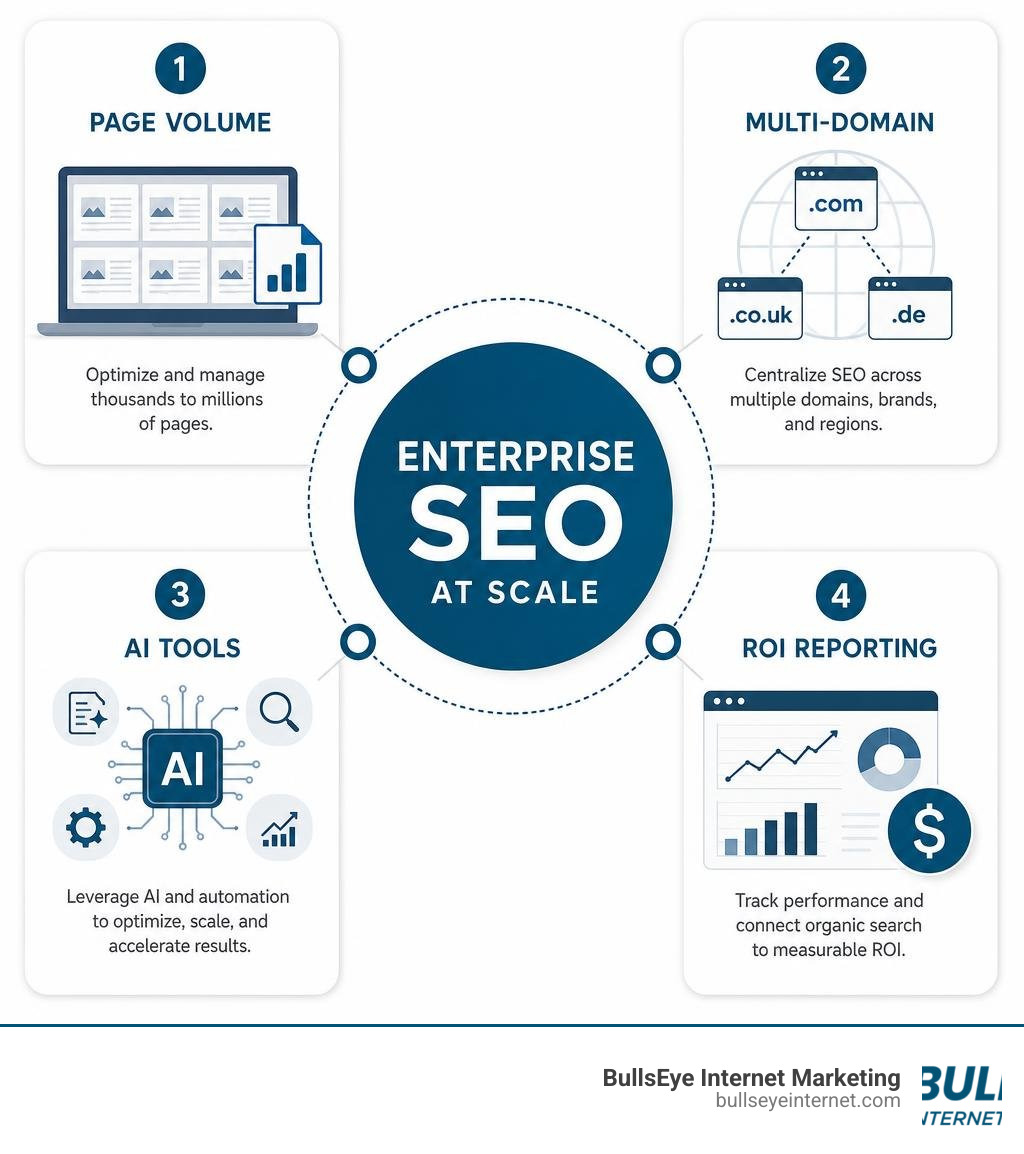
Enterprise SEO solutions are specialized platforms, services, and strategies designed to manage SEO across large, complex websites with thousands or millions of pages, multiple domains, and teams spanning many departments.
Here’s a quick breakdown of what enterprise SEO solutions typically include:
- Technical SEO at scale — crawling and auditing millions of pages, fixing site architecture issues
- Multi-domain and international management — centralized tracking across brands, regions, and languages
- AI and automation — automated content optimization, reporting, and implementation across properties
- Cross-team workflow tools — collaboration features for SEO, dev, legal, and content teams
- Advanced reporting and ROI attribution — connecting organic search performance to revenue
The stakes are real. 90% of enterprise organizations now call SEO a must-have strategy. And with organic search driving 300% more traffic than social media, the brands that invest in the right infrastructure can see up to 120% traffic growth in a single year. Those that don’t risk leaving millions of dollars on the table.
I’m Ronnie Katz, founder of BullsEye Internet Marketing, and since 2006 I’ve helped businesses of all sizes navigate the full spectrum of enterprise SEO solutions — from technical audits to large-scale content strategy and multi-channel integration. In the guide below, I’ll walk you through everything you need to know to evaluate, implement, and scale enterprise SEO the right way.
Enterprise SEO solutions terms to know:
- search engine optimisation companies
- search engine optimization consultants
- search engine optimization expert
What is Enterprise SEO and How Does It Differ From Traditional SEO?
To understand how enterprise SEO solutions function, we first have to draw a clear line between traditional search engine optimization and enterprise-level operations. Many people assume that enterprise SEO is simply standard SEO with a larger budget. In reality, it requires a completely different operational framework, methodology, and mindset.
Traditional SEO typically focuses on optimizing individual pages, targeting a narrow list of keywords, and driving local or niche traffic for small-to-medium businesses (SMBs). Enterprise SEO, on the other hand, deals with the sheer scale of websites containing tens of thousands, millions, or even billions of pages. These massive sites often span multiple subdomains, international directories, and distinct brand properties.
At this level, we aren’t just optimizing a single blog post; we are establishing scalable content templates, optimizing complex internal linking architectures, and ensuring that search engine bots can crawl and index high-value pages efficiently.
Furthermore, enterprise SEO involves a massive amount of stakeholder alignment. Instead of working directly with a single business owner, an enterprise SEO strategist must collaborate with product managers, web developers, legal compliance teams, brand managers, and executive leadership. Every technical change has a ripple effect across the entire organization, meaning that project management and cross-functional communication are just as critical as technical knowledge.
Despite the complexity, the rewards are immense. Consider these industry facts:
- 94% of clicks in search engine results go to organic listings rather than paid ads.
- 53% of US consumers use search engines to conduct thorough research before making a purchase.
- The number one organic spot on Google captures roughly 32% of all clicks.
To help visualize these differences, let’s look at how traditional and enterprise SEO compare across key operational pillars:
| Feature/Pillar | Traditional / SMB SEO | Enterprise SEO |
|---|---|---|
| Website Scale | Tens to hundreds of pages | Thousands to millions of pages across multiple domains |
| Primary Focus | Individual keyword optimization & local reach | Scalable templates, site architecture, and brand authority |
| Stakeholder Dynamics | Single point of contact (owner or marketing manager) | Multi-department alignment (Dev, Legal, PR, Product, Execs) |
| Tech Stack | Simple, point-solution tools (Ahrefs, Moz, local plugins) | All-in-one enterprise SEO solutions with custom APIs |
| Link Building | Direct outreach, guest blogging, local directories | Brand equity leverage, digital PR, domain acquisitions |
| Crawl Budget | Rarely an issue; search engines easily index the site | Critical; search engines can get lost in massive site structures |
Key Challenges in Scaling Enterprise SEO

Scaling organic search across a massive corporate framework is rarely a walk in the park. In our years of providing digital marketing services, we have seen that the biggest roadblocks to enterprise success are rarely about understanding search engine algorithms. Instead, they are almost always rooted in internal organizational friction and technical debt.
According to the Search Engine Land: Enterprise SEO Guide, successfully scaling organic visibility requires deeply integrating search strategy into the core operational systems of the company. When this integration fails, several common challenges arise:
- Organizational Silos: Different departments often operate in isolation. The content team might write articles without keyword data, the development team might launch code that accidentally blocks search crawlers, and the PR team might secure major press coverage without securing backlink equity. Breaking down these silos is the first step to scaling.
- Legacy Technology and “Frankenstein” CMS Frameworks: Many large enterprises run on outdated content management systems or a patchwork of different platforms built over decades. This makes deploying simple technical fixes—like updating schema markup or implementing redirect rules—a nightmare that can take months of development time.
- Legal and Regulatory Compliance: For enterprises in highly regulated spaces (such as finance, healthcare, or legal), every word of content and every external link must pass through legal review. This compliance bottleneck can slow down content deployment, preventing the brand from capitalizing on emerging search trends in real time.
- Securing Developer Buy-In: Enterprise developers have massive backlogs filled with security patches, product updates, and bug fixes. SEO recommendations often get pushed to the bottom of the queue unless they are translated into clear, actionable user stories that demonstrate a direct impact on business revenue.
- Link Equity Dilution and Microsite Mania: Large organizations often launch separate microsites for temporary campaigns, new product lines, or regional events. This fragments the brand’s overall authority and dilutes valuable link equity that should be concentrated on the primary domain.
- Duplicate Content at Scale: E-commerce giants and multi-location enterprises frequently battle massive duplicate content issues. Whether it is thousands of product variations or overlapping local landing pages, search engines can easily get confused, leading to keyword cannibalization and wasted crawl budget.
Key Criteria for Evaluating Enterprise SEO Solutions
When your website grows to millions of pages, basic point-solution tools simply cannot keep up. To maintain a competitive edge, organizations must transition to dedicated enterprise SEO solutions that offer the infrastructure, scale, and security required by modern corporations.
According to the Search Engine Journal: Enterprise SEO Platform Evaluation, selecting the right platform requires looking beyond basic keyword tracking. You need an infrastructure-level solution that protects your brand and streamlines your workflows.
Here are the key criteria you should evaluate when choosing an enterprise SEO platform:
- Data Integrity and Platform Scalability: The platform must be capable of processing trillions of data points without lagging. Look for platforms that offer unlimited crawls, track billions of keywords daily, and maintain historical data context (ideally 10+ years of trend data).
- Enterprise-Grade Security & Compliance: Security is a major blocker for enterprise tool adoption. Any platform you integrate into your corporate network should carry SOC 2 Type II certification, support Single Sign-On (SSO) via SAML 2.0 or OIDC, offer comprehensive audit logs, and provide flexible data residency options to comply with global privacy regulations (like GDPR).
- 99.99% Platform Uptime: For global, 24/7 operations, you cannot afford tool outages. Enterprise platforms must guarantee high-availability SLAs to ensure your teams can monitor site health and search trends around the clock.
- Custom SEO Policies and Automated Quality Checks: Rather than relying on manual audits, the platform should allow you to set custom rules to automatically detect issues unique to your business—such as broken links, missing canonical tags, or branding non-compliance.
- Consolidated Reporting and Data Customization: Executives do not want to see raw keyword lists; they want to see how search performance connects to business outcomes. Your platform must allow you to build custom, templated dashboards that translate complex technical data into clear, executive-ready visualizations.
To explore some of the top-performing platforms in this space, you can review BrightEdge | Enterprise SEO and AI Search Platform or check out the capabilities offered by Semrush Enterprise – The AI launchpad for elevated digital marketing . For brands seeking highly customized deployments, Enterprise SEO Solution | seoClarity and The #1 Enterprise AEO Platform provide excellent all-in-one frameworks built for massive data environments.
How Enterprise SEO Solutions Manage Multi-Domain and Global Sites
For multinational organizations, managing search visibility across dozens of country-specific domains, subdomains, and languages is a massive logistical challenge. Enterprise SEO solutions solve this by providing centralized multi-domain tracking and reporting from a single, unified dashboard.
Instead of logging into fifty different Google Search Console accounts, global teams can monitor organic health across all brand properties simultaneously. These platforms assist with:
- Hreflang Code Management: Ensuring that search engines serve the correct language and regional version of a page to users based on their location.
- Localized Content Audits: Automatically scanning regional sites to ensure content is culturally relevant, properly translated, and compliant with local regulations.
- Global Market Intelligence: Tracking competitor movements across 140+ international markets and adjusting local search strategies accordingly.
Integrating Enterprise SEO Solutions with Your MarTech Stack
An enterprise SEO tool should never exist in a vacuum. To maximize its value, it must integrate seamlessly with your existing marketing technology (MarTech) stack, business intelligence (BI) systems, and development pipelines.
Modern enterprise solutions utilize robust REST APIs and webhooks to connect search data directly to tools like Google Analytics, Adobe Analytics, Salesforce, and Tableau. This allows you to combine search intent data with customer conversion metrics for deeper business insights.
Additionally, advanced organizations are now embedding automated SEO checks directly into their CI/CD (Continuous Integration/Continuous Deployment) pipelines. This ensures that whenever developers push new code to production, the system automatically runs a pre-deployment audit to prevent code changes from accidentally tanking your organic rankings.
Key Components of a Successful Enterprise SEO Strategy

A successful enterprise SEO strategy is built on repeatable systems, structured workflows, and a relentless focus on technical health. Because enterprise sites have so many moving parts, we recommend starting with a structured, multi-phase methodology that ensures no detail is overlooked.
First, you must establish a deep technical foundation. This begins with a comprehensive Enterprise SEO Audit to evaluate crawl efficiency, site architecture, and mobile usability. If you have never conducted a large-scale review before, our SEO Audit Complete Guide provides an excellent roadmap for identifying critical issues that could be holding your site back.
Once the technical foundation is secure, a winning enterprise strategy incorporates these key components:
- Scalable Content Templates: Instead of creating unique pages from scratch, design optimized templates that can scale across thousands of product, category, or location pages automatically.
- Entity Relationship Mapping: Move beyond basic keyword matching. Modern search engines rely on semantic understanding, meaning you must build clear topical authority by mapping out the relationships between different entities, concepts, and search intents.
- Strategic Internal Linking: Use programmatic internal linking to distribute link equity from high-authority pages (like your homepage) down to deeper, high-value conversion pages.
- Continuous Monitoring & Audit Trails: Establish 24/7 monitoring with automated alerts to detect sudden traffic drops, server errors, or indexing issues before they impact your bottom line.
If you are looking to partner with experienced professionals to design and execute this roadmap, you can explore specialized services like Enterprise SEO Services – Design Moves Marketing Studio .
The Role of AI, Automation, and Advanced Technology in Modern SEO
As we navigate through June 2026, the search landscape is undergoing a massive transformation. Search is no longer confined to traditional blue links on a results page; it has expanded into a complex ecosystem of AI Overviews, conversational search engines, and answer-engine platforms.
To win in this new era, enterprise SEO solutions must incorporate advanced artificial intelligence, automation, and machine learning into their core strategies.
Here is how modern technology is reshaping enterprise organic growth:
- Generative Engine Optimization (GEO) & AEO: Brands must optimize their content not just for Google, but to be cited as trusted sources in AI environments like ChatGPT, Gemini, and Perplexity. Platforms like Enterprise SEO Platform | Custom Deployment at Scale – AI SEO Agents help organizations track their “share of voice” inside LLM conversations.
- Server-Side Rendering (SSR) for AI Crawlers: Many modern enterprise sites are built on JavaScript frameworks (like React or Angular) that search and AI bots struggle to read. Advanced tools allow you to serve pre-rendered, static HTML directly to AI crawlers, ensuring your modern web applications are fully visible to search bots without slowing down human visitors.
- Automated Implementation Overlays: To bypass slow developer queues, some enterprises are utilizing edge SEO solutions. By installing a secure code snippet or overlay, SEO teams can deploy critical technical fixes—like meta tags, schema markup, and redirect rules—across millions of pages instantly without modifying the backend CMS.
- Predictive Forecasting & Trend Intelligence: Utilizing machine learning models trained on years of search data, enterprises can forecast future search demand, predict competitor movements, and prioritize content creation for high-value topics before they peak.
Proving ROI and Driving Measurable Business Results
At the corporate level, vanity metrics like “increased keyword rankings” or “higher organic impressions” do not move the needle. To secure ongoing budget and executive buy-in, you must connect your search performance directly to bottom-line business results: traffic, leads, pipeline, and revenue.
To do this effectively, we must establish clear revenue attribution models. By linking organic search data with your customer relationship management (CRM) platform, you can track a searcher’s journey from their initial query all the way to a closed sale.
This allows you to calculate critical business metrics, such as:
- Customer Acquisition Cost (CAC): How much you spend on SEO to acquire a single customer.
- Customer Lifetime Value (LTV): The total revenue a customer generates over their relationship with your brand.
- LTV to CAC Ratio: A healthy enterprise marketing goal is to maintain an LTV:CAC ratio of at least 3:1.
The financial impact of organic search is clear. SEO leads boast an average 14.6% close rate, compared to a meager 1.7% close rate for outbound marketing leads. Furthermore, organizations that make highly data-driven decisions see 81% higher SEO revenue growth compared to the industry average.
To maximize your positions and ensure your site is built to convert this high-value traffic, explore our comprehensive guide on SEO Ranking Best Practices Factors Tips Tools to Improve Your Positions.
Frequently Asked Questions about Enterprise SEO
What makes a website “enterprise” for SEO?
An enterprise website is defined by its scale, structural complexity, and organizational footprint. Typically, these sites contain tens of thousands to millions of pages, operate across multiple subdomains or international directories, and generate significant brand-name search volume. From an organizational standpoint, an enterprise involves multiple stakeholders, strict brand guidelines, and complex legal compliance requirements.
How long does it take to see results from enterprise SEO?
While traditional SEO can show results within a few months, enterprise SEO timelines depend heavily on implementation speed and crawl efficiency. Because large sites already possess massive historical authority, technical fixes—such as resolving crawl blocks or optimizing internal links—can sometimes drive significant traffic spikes in as little as a few weeks. However, large-scale content strategies and site migrations typically take 6 to 12 months to show their full revenue potential.
When should a company upgrade to enterprise SEO services?
A company should upgrade to enterprise-level services when they outgrow traditional point-solution tools, find themselves managing multiple domains or international versions of their site, or face intense competition for high-value commercial keywords. If your internal marketing team is spending 80% of their time on repetitive execution rather than strategy, or if your legacy CMS is blocking basic technical optimizations, it is time to invest in a scalable enterprise solution.
Conclusion
Navigating enterprise SEO solutions requires a unique blend of deep technical expertise, robust data infrastructure, and strategic organizational alignment. When executed correctly, a scaled organic search strategy serves as a permanent, compounding revenue engine for your brand.
At BullsEye Internet Marketing, we do things differently than traditional corporate agencies. We specialize in driving real business growth—generating direct calls and sales through pay-per-lead models, Google Business Profile optimization, technical SEO, PPC, and conversion rate optimization.
Our unique selling proposition is built on true competitive advantage:
- No long-term contracts — we earn your business month after month through measurable results.
- Strict exclusivity — we work with only one client per industry per geographic area, ensuring our undivided attention and strategic focus are dedicated entirely to helping you dominate your local and regional markets.
Whether you are looking for a trusted Florida SEO Company to manage your regional presence or need comprehensive, multi-channel BullsEye Internet Marketing Search Engine Optimization Services, we are here to help you scale.
Ready to unlock massive organic growth and outpace your competition? Let’s build a custom search strategy that delivers real, measurable revenue to your bottom line. Contact us today to schedule your consultation!
