
Why the Google 3-Pack Is Prime Real Estate for Local Businesses
Google 3-pack tips are essential for any local business trying to get found online. When someone searches for “dentist near me” or “best pizza in Chicago,” Google shows a map with three top business listings right at the top of the search results. That’s the Google 3-Pack (also called the Local Pack or Map Pack), and it appears before the regular organic search results.
Here are the core Google 3-pack tips you need to know:
- Claim and verify your Google Business Profile – This is your foundation
- Get more customer reviews – Quality and quantity both matter
- Keep your business information consistent – Same name, address, and phone number everywhere
- Add photos regularly – Businesses with photos get 42% more direction requests
- Target local keywords – Use location-specific terms on your website
- Build local citations – Get listed on relevant directories
- Respond to all reviews – Show customers you care
- Optimize for relevance, distance, and prominence – Google’s three main ranking factors
The Google 3-Pack matters because 46% of all Google searches are locally focused, and 44% of those searchers click on a Local Pack result. If you’re not in those three spots, you’re missing out on phone calls, website visits, and foot traffic that your competitors are getting.
Getting into the 3-Pack isn’t about luck or who pays the most. It’s about sending the right signals to Google that your business is relevant, nearby, and trustworthy. The strategies work, but they require consistency and attention to detail.
I’m Ronnie Katz, founder and Principal CEO of BullsEye Internet Marketing, and I’ve been helping businesses dominate their local markets since 2006 through strategic Google 3-pack tips and Local SEO optimization. After working with hundreds of local businesses and earning certifications from Google and Semrush, I’ve seen how the right approach can transform a struggling business into a local market leader.

Google 3-pack tips terms to know:
Understanding Google’s Local Ranking Algorithm
When it comes to local search, Google acts like a digital matchmaker, connecting users with the best local businesses for their needs. To do this, Google uses a sophisticated algorithm that considers three primary factors: Relevance, Distance, and Prominence. Understanding these pillars is one of the most crucial Google 3-pack tips you’ll ever receive.
- Relevance: This measures how well your Google Business Profile (GBP) matches what someone is searching for. If a user searches for “best Italian restaurant in Miami,” Google wants to show them an Italian restaurant, not a French bakery. That means your business categories, description, and website content all need to clearly communicate what you do.
- Distance: This is exactly what it sounds like – how far your business is from the searcher’s location. Google’s goal is to provide local results, so businesses closer to the searcher often get preference. This factor is highly dynamic, as it changes with every user’s location. For instance, a search for “plumber in Fort Lauderdale” will prioritize businesses within or very close to Fort Lauderdale.
- Prominence: This refers to how well-known and authoritative your business is, both online and offline. Think of it as your business’s overall reputation. Factors contributing to prominence include the number and quality of your online reviews, how many other websites link to your business, mentions in local articles, and your overall web presence. As Google itself states, there’s no way to request or pay for a better local ranking; it’s earned through these signals.
Google constantly refines its algorithms to provide the most accurate and helpful results. Updates, like the December 2021 rebalancing, can shift the weight given to these factors. For example, recent changes have sometimes placed a greater emphasis on proximity. Even Google’s integration of AI capabilities into Maps is designed to improve the user experience by analyzing map data and community insights to suggest relevant destinations.
It’s also important to distinguish between two types of local searches:
- Direct Search: This happens when a customer specifically searches for your business by name or address, like “BullsEye Internet Marketing in Palm Beach County.”
- Findy Search: This is when a user searches for a category, product, or service you offer, without specifying your business name, such as “SEO agency in Broward County” or “Pay Per Lead services in Miami Dade County.” This is where the Google 3-Pack truly shines as a lead generator.
For more official guidance on how Google approaches local rankings, we always refer to their own documentation: How to improve your local ranking on Google.
Foundational Google 3-Pack Tips: Mastering Your GBP

Your Google Business Profile (GBP) is the cornerstone of your local online presence and arguably the most vital of all Google 3-pack tips. Think of it as your digital storefront on Google Search and Maps. Google considers GBP optimization heavily, accounting for roughly 25% of your ranking potential in the local pack. Complete and accurate profiles are not just more visible; they’re also 3X more likely to be viewed as reputable by customers.
The key is completeness and accuracy. Every piece of information helps Google understand your business and match it with relevant searches.
Claim, Verify, and Complete Your Profile
Owning your GBP is the non-negotiable first step to leveraging Google 3-pack tips.
- Claim or Create Your Profile: Visit google.com/business and sign in. Search for your business name. If it appears and is unclaimed, claim it. If not, create a new listing.
- Verification is Key: This confirms you’re the legitimate owner. Verification methods vary (phone, email, postcard, video) and can take up to 5 days for review. A handy shortcut: using the same Gmail for Google Analytics and Search Console might grant instant verification.
Fill Everything Out – Accurately!: Completing your profile fully is essential. The more complete, the better.
- Business Name: Use your exact business name. Don’t add keywords or locations like “Best Plumber in Fort Lauderdale” unless it’s your legal name. This violates Google’s guidelines and can hurt your ranking.
- Address: Provide your precise address. If you’re a service-area business (SAB) without a storefront, you must hide your address on GBP per Google’s guidelines. Brick-and-mortar locations should display their address.
- Phone Number & Website: Ensure these are up-to-date and functional.
- Business Hours: Keep these updated, including special holiday hours. Nothing frustrates a customer more than showing up to a closed business.
- Categories: This is a critical Google 3-pack tip. Choose the most specific primary category (e.g., “Italian Restaurant” not just “Restaurant”). Add up to 10 additional categories. We often use tools like GMB Everywhere or Pleper to see what categories top competitors in Miami or West Palm Beach are using.
- Service Areas: For SABs, set up to 20 specific service areas, ideally within a two-hour drive of your business. This helps Google understand where you serve customers.
- Business Description: Write a compelling, keyword-rich description (under 750 characters) highlighting your unique value. Avoid prohibited content or excessive promotions; focus on user benefits.
- Attributes: These are special features like “wheelchair accessible,” “free Wi-Fi,” or “women-led.” They provide valuable information and help you stand out.
- Profile Strength Widget: Google’s “profile strength” widget on your GBP dashboard shows how complete your profile is and what needs attention. Aim for 100%!
Essential Google 3-Pack tips for reviews and reputation
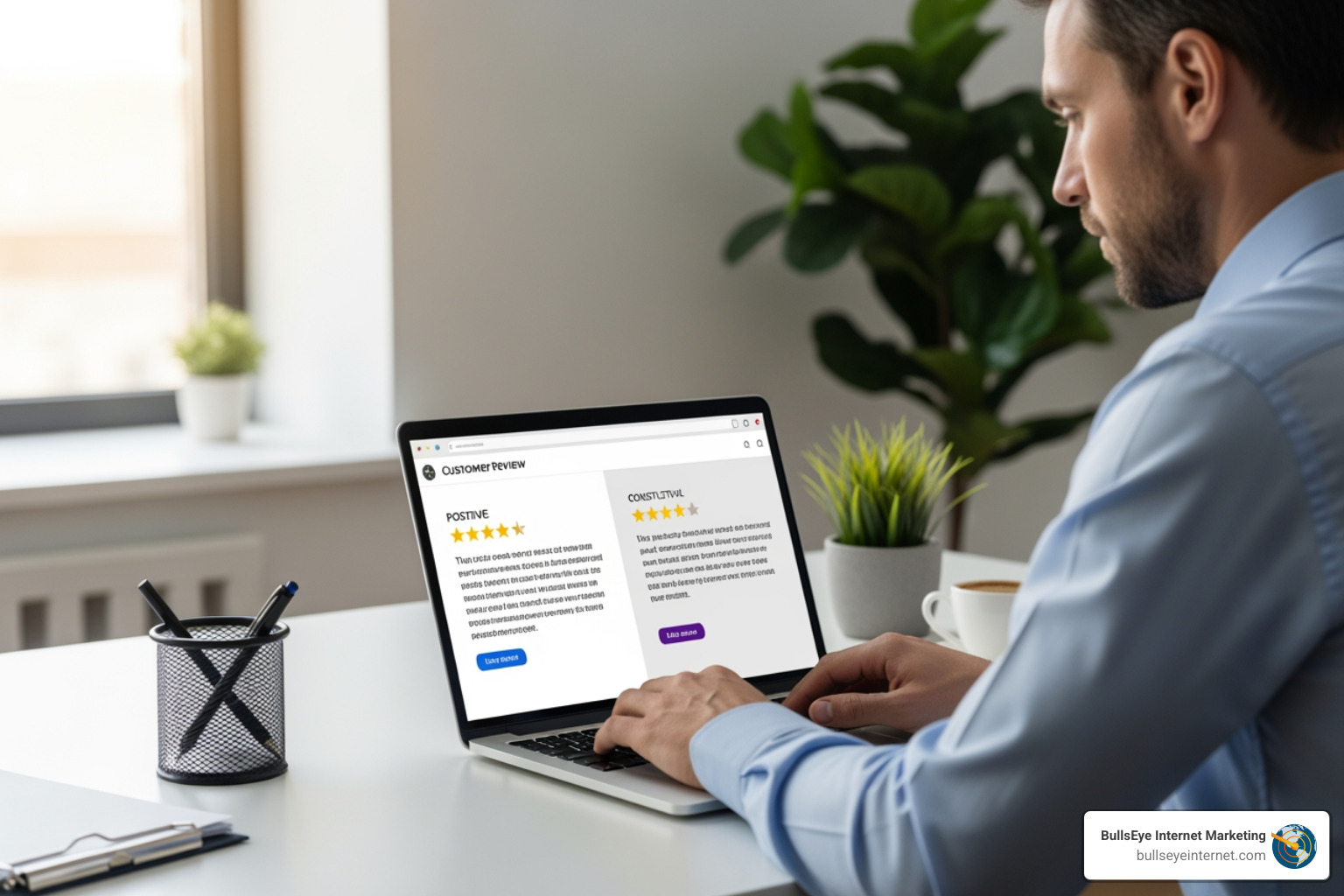
Reviews are powerful social proof and one of the most impactful Google 3-pack tips. Google uses reviews as a key signal for prominence, a major ranking factor in the local pack.
Consider these statistics:
- 82% of consumers read online reviews for local businesses.
- 75% of users look for reviews before visiting a business.
- 89% will choose a business that responds to all reviews.
- 45% of consumers are more likely to support a business that responds to negative reviews. Restaurants that respond regularly can see a 30% bump in their average star rating!
To leverage reviews for your 3-Pack ranking, focus on quantity, quality, recency, and responses.
Encouraging Reviews (the Right Way):
Google prohibits review incentives, so ask naturally and without pressure.
- Ask at the Right Time: When a customer is happy with your service in Jupiter or Delray Beach, politely ask for a review.
- Make it Easy: Share a direct link to your GBP review page via email, text, or a QR code.
- Quality over Quantity: Encourage detailed text reviews, especially with photos, as Google ranks these higher.
Responding to Reviews (All of Them!):
- Positive Reviews: Thank the customer, personalize your response, and invite them back. For example, “Thank you, Jane! We loved helping with your AC repair in Coconut Creek and look forward to serving you again.”
- Negative Reviews:
- Apologize and Empathize: “We’re truly sorry you had a negative experience, John.”
- Take it Offline: “Please contact us directly at [phone number] so we can make this right.”
- Don’t Argue: Maintain professionalism. A polite response can turn a negative into a positive impression for others.
Managing your online reputation is a crucial Google 3-pack tip that directly supports your ranking.
Engage Customers with Photos, Posts, and Q&A
Beyond basics and reviews, your GBP has dynamic features to boost visibility. These are powerful Google 3-pack tips for engaging customers.
- Impact of Photos and Videos: Visuals are powerful. Businesses with photos on their GBPs get 42% more requests for driving directions and 35% more clicks to their websites.
- What to Post: Include a high-quality logo, cover photo, and various business photos/videos (exterior, interior, products, team, events). For a restaurant in Fort Lauderdale, food shots are a must. For a service business in Doral, photos of your team build trust.
- Quality Matters: Use high-resolution photos (10KB-5MB) and videos (up to 30s, 720p+, up to 75MB) that comply with Google’s policy. Avoid heavy filters; Google wants realistic representations.
- Leverage Google Posts: Google Posts are like mini-updates on your GBP. They appear in your profile and can influence branded search results.
- What to Post: Share updates, offers, events, new products, or links to blog content. We often schedule posts about holiday specials for our clients in advance.
- Engagement: Google Posts help control what people see when they search your brand, driving immediate action.
- Use the Q&A Section: The Q&A section is a goldmine for engagement and keywords. Customers can ask questions on your GBP, and anyone can answer.
- Proactive Q&A: Proactively add FAQs and provide thorough answers. This addresses common concerns and lets you incorporate relevant keywords, like a Coral Gables spa answering, “Do you offer couples massages?”
- Monitor and Respond: Answer new questions promptly to show responsiveness and provide valuable information.
- Messaging Feature: If you can respond promptly, enable messaging on your GBP. This lets customers text your business directly from your profile for quick info or bookings.
By actively using these features, you build a dynamic, informative, and trustworthy profile that Google loves to show in the 3-Pack.
Advanced Strategies: Website & Off-Page Signals
Your GBP is crucial, but it’s just one piece of the local SEO puzzle. To dominate the 3-Pack, you must also optimize your website (on-page signals) and build authority across the web (off-page signals). These advanced Google 3-pack tips help Google see your business as a prominent, reliable local entity.
Ensure NAP Consistency with Local Citations
NAP (Name, Address, Phone Number) consistency is a foundational Google 3-pack tip. It means your core business information is identical everywhere online. Google uses this data from many sources to validate your business, so consistency is key.
- Why it Matters: Inconsistencies confuse Google and erode trust. If your address differs on Yelp or Facebook, Google may question its accuracy, hurting your ranking. It also frustrates customers with conflicting contact details.
- Local Citations: These are mentions of your business’s NAP on other websites, such as online directories (Yellow Pages, Yelp), review sites, and local business listings.
- Data Aggregators: Companies like Marqii help distribute your business data to dozens of online directories and search engines, ensuring widespread consistency.
- Citation Cleanup: Over time, inaccuracies can creep in. We recommend periodic audits and cleanup of your citations to correct any discrepancies. This ensures Google always sees a consistent, trustworthy profile for your business, whether you’re in Miami or Palm Beach County. Even “nofollow” links from these directories can serve as hints to Google about your website’s authority.
Advanced Google 3-Pack tips for your website
Your website is another powerful tool in your local SEO arsenal that sends strong relevance signals to Google.
- Mobile-Friendly Website: This is a necessity, as most local searches happen on mobile devices. A mobile-friendly site improves user experience, keeps visitors on your site longer, and is a strong positive ranking signal. If your site isn’t fast and easy to use on a phone, you’re losing customers.
- Local Keywords: Integrate location-specific keywords naturally throughout your website.
- Location-Specific Service Pages: Create dedicated pages for services in specific areas, like “Emergency Plumber Fort Lauderdale” or “Water Heater Repair Pompano Beach.”
- Local-Focused Blog Content: Write blog posts on local topics, such as “Tips for Hurricane Preparedness in South Florida” from a local roofer in Martin County.
- GBP Integration: Ensure your website keywords align with your GBP categories and description.
- On-Page SEO: Ensure your website has a solid technical foundation:
- Fast Load Times: Optimize images and code for speed.
- Secure (HTTPS): Encrypted connections are a must.
- Clear Navigation: Make it easy for users and search engines to understand.
- Schema Markup for Local Business: This code helps search engines understand your business NAP, hours, and services. It doesn’t directly boost rankings but helps Google display your business more effectively.
- Internal Linking: Strategically link relevant pages within your website to distribute “link equity” and guide users and search engines, reinforcing your local relevance.
Build Local Prominence with Backlinks
Backlinks—links from other websites to yours—are a powerful signal of authority. For local SEO, local link building is paramount. A single high-quality backlink from a respected local source can outweigh dozens of low-quality links.
- Sponsoring Local Events: Sponsor a local charity run in Miami or a community festival in Jupiter to get your business name and website listed on their pages.
- Local Partnerships: Collaborate with complementary local businesses, like a bakery in Lake Worth Beach partnering with a coffee shop, with each linking to the other’s site.
- Guest Posting on Local Blogs: Write for a local news site, community blog, or industry-specific blog serving your area.
- Local Mentions: Get your business mentioned in local news articles or community forums. As Dmytro Sokhach, CEO of Editorial.Link, notes, getting a local plumber mentioned on a neighborhood blog and listed in a local directory significantly increased their local relevance.
- Quality over Quantity: Focus on earning links from reputable, relevant local sources to pass “link juice” and drive referral traffic from an engaged local audience.
Frequently Asked Questions about the Google 3-Pack
We often get asked similar questions about the Google 3-Pack. Here are some of the most common ones, along with our expert answers.
Can I pay to get into the Google 3-Pack?
No, you cannot pay for a spot in the organic Google 3-Pack. Google states that rankings are earned through optimization for relevance, distance, and prominence, not payment.
However, there are paid options that can influence your visibility around the 3-Pack:
- Local Service Ads (LSAs): These are paid ads for specific service providers (plumbers, electricians) that appear above the organic 3-Pack and are marked with a “Google Guaranteed” badge. They are a separate program and don’t directly impact organic 3-Pack ranking.
- Google Ads with Location Extensions: You can run traditional Google Ads (PPC) with location extensions. These ads might appear near the 3-Pack, increasing your overall visibility. While paid ads can help, they don’t bypass the organic ranking factors for the 3-Pack itself. Our team at BullsEye Internet Marketing specializes in setting up effective PPC campaigns to complement your local SEO.
What are the most common mistakes businesses make?
Businesses often make common mistakes when trying to rank in the 3-Pack. Here are the most frequent pitfalls:
- Inconsistent NAP: Having different names, addresses, or phone numbers across online listings confuses Google and erodes trust.
- Keyword Stuffing the Business Name: Adding keywords like “Best HVAC Repair Fort Lauderdale” to your GBP name (if it’s not your legal name) violates Google’s guidelines and can lead to penalties.
- Ignoring Negative Reviews: Responding professionally to negative feedback shows you care and can turn a bad experience into a positive impression for others.
- Not Completing the GBP Profile: A partially filled-out GBP signals your business isn’t fully engaged or authoritative. Every section matters.
- Setting Unrealistic Service Areas: Claiming an entire state is unrealistic and dilutes your local relevance. Focus on the actual geographic areas you serve, like Broward or Palm Beach County.
- Using a Virtual Office for a Physical Location: Google requires a staffed physical office to display an address on GBP. Using a virtual office address can lead to suspension.
- Failing to Update Hours: Not updating hours, especially for holidays, can lead to frustrated customers and negative reviews.
- Not Adding Photos/Videos: Neglecting to add high-quality visuals means missing out on significant clicks and direction requests.
How long does it typically take to see results from local SEO efforts for the 3-Pack?
The answer varies, but consistency is key. Local SEO is an ongoing strategy, not a one-time fix.
Factors Influencing Timeline:
- Competition: Highly competitive markets like Miami take longer than less competitive areas in Martin County.
- Starting Point: An unoptimized GBP will see quicker initial gains from basic completion.
- Consistency: Regular GBP updates, review generation, and link building yield results over time.
- Google Updates: Algorithm changes can also impact rankings.
Managing Expectations: While some see immediate visibility, most businesses should expect noticeable improvements within 3-6 months of consistent effort. Dominating a market can take 6-12 months or more. It’s a marathon, not a sprint, focused on building a sustainable foundation for long-term success.
Conclusion: Win Your Local Market
Dominating the Google 3-Pack is no longer an option; it’s a necessity for any local business aiming to thrive in today’s digital landscape. By consistently applying these Google 3-pack tips – optimizing your Google Business Profile, actively managing your online reputation, ensuring NAP consistency, and building a strong web presence – you’re sending clear signals to Google that your business is relevant, prominent, and worthy of those top three spots.
Local SEO is an ongoing process. It requires dedication, attention to detail, and a commitment to providing the best possible information to both Google and your potential customers. The competitive advantage you gain from ranking in the 3-Pack translates directly into more calls, more website visits, and more foot traffic through your doors.
At BullsEye Internet Marketing, we pride ourselves on helping businesses like yours achieve local market leadership. We offer no long-term contracts and work with only one client per industry per geographic area, ensuring you have a true competitive edge in locations like Broward County, Miami Dade County, Palm Beach County, and beyond.
Ready to stop getting lost in the search results and start winning your local market? Get expert help with your Google Business Profile today.
