
Why Google Ads for Dentists Can Drive More New-Patient Calls
Google Ads for dentists can bring in patients who are actively searching for care, but only when the campaign connects the right search, ad, landing page, and phone call. A poorly built account can burn through a budget fast. One suburban practice, for example, spent $14,000 over eight months and gained only 11 patients because its ads used broad targeting, lacked call tracking, and sent visitors to its homepage.
Here is the quick answer:
- Separate campaigns by service, such as general dentistry, emergency care, implants, and cosmetic procedures.
- Target high-intent local searches, including “dentist near me” and “[city] dental implants.”
- Use dedicated service pages instead of your homepage. These pages commonly convert at 6-12%, compared with 1-3% for homepage traffic.
- Track every form and phone call, then verify whether the front desk scheduled the lead.
- Judge success by cost per new patient, not clicks or impressions alone.
Competition is unlikely to get easier. The Bureau of Labor Statistics projects about 4,500 dentist job openings each year through 2034, while roughly one-third of adults skip dental visits annually. That creates a large opportunity, but it also means more practices will compete for the same high-value searches.
I am Ronnie Katz, founder and Principal CEO of BullsEye Internet Marketing, with more than 20 years of experience in digital marketing, PPC, conversion strategy, and lead tracking. In this guide, I will show you how to evaluate Google Ads for dentists based on the numbers that matter most: qualified calls, booked appointments, and profitable new patients.
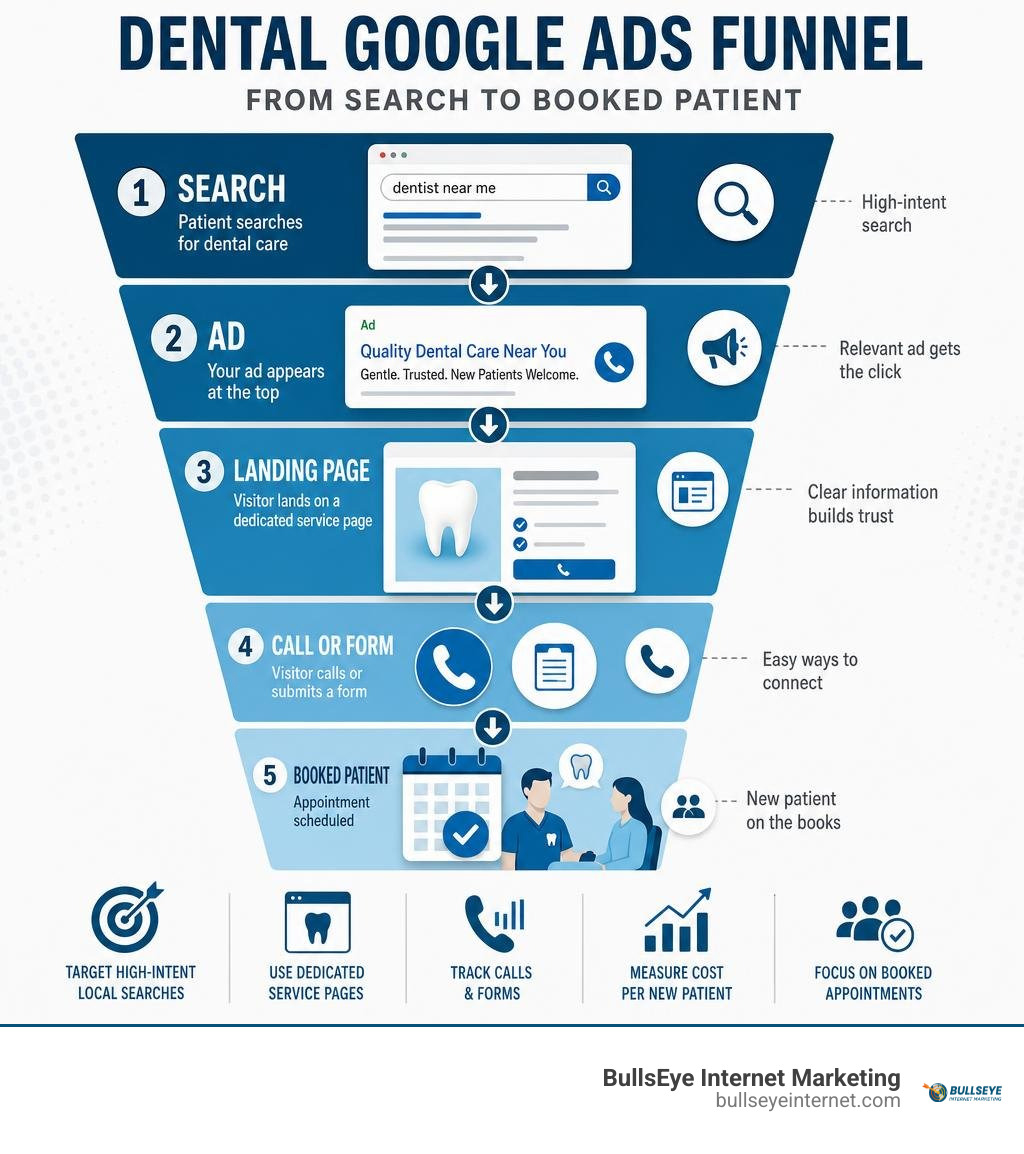
Easy Google Ads for dentists word list:
Campaign Structure for Google Ads for Dentists
To build a high-performing account, we must treat different dental procedures as distinct businesses. A patient looking for a routine cleaning has completely different urgency, financial expectations, and intent than someone searching for full-mouth dental implants or emergency tooth extraction.
When we group all services into a single campaign, Google struggles to serve relevant ad copy. Worse, your ad budget gets consumed by broad searches rather than high-margin services. Research and clinical case studies highlight that organizing accounts by clear clinical verticals is the foundation of profitable patient acquisition.
Service Line Segmentation and Match Types
We structure dental campaigns into hyper-focused service lines. Each service line gets its own daily budget, targeted ad groups, specific keyword match types, and dedicated landing pages:
- General Dentistry: Focuses on high-frequency, preventative intent (e.g., “dental checkup near me”, “teeth cleaning [city]”).
- Emergency Dentistry: Requires 24/7 or extended ad scheduling with immediate call extensions for patients experiencing severe pain or trauma (e.g., “emergency dentist open now”, “urgent dental care”).
- Dental Implants & Restorative: Targets high-revenue, long-sales-cycle intent (e.g., “all on 4 implants [city]”, “implant dentist cost”).
- Cosmetics & Orthodontics: Focuses on elective, high-ticket services like veneers, clear aligners, and teeth whitening.
By isolating these categories, we gain complete control over daily spend. If your schedule for hygiene is full for the next six weeks, we can instantly dial down the general dentistry budget while scaling up high-value implant campaigns. For practices looking to capture immediate local search real estate alongside search ads, integrating Google Local Services Ads for Dentists offers an additional layer of local trust and direct call volume.
Standard Search vs Performance Max Campaigns
Google frequently encourages advertisers to adopt Performance Max (PMax) campaigns, which use machine learning to serve ads across Search, Display, YouTube, Gmail, and Discover. However, for dental practices, jumping straight into automated multi-channel campaigns often results in wasted ad spend.
We enforce a strict 90-day rule: run standard Google Search campaigns exclusively for the first 90 days of launch.
Standard Search gives us total transparency into search terms, keyword match types, negative keyword additions, and exact bid management. Machine learning models require significant conversion volume—typically 30 to 50 verified conversions per month per campaign—to optimize effectively. Until your campaign establishes this reliable baseline of conversion data, automated networks like Performance Max will spend your budget on low-intent banner impressions and spam leads across non-search placement networks.
Selecting High-Intent Keywords and Eliminating Budget Waste

Keyword selection for Google Ads for dentists is not about capturing as much search traffic as possible; it is about filtering out unqualified traffic before it costs you money. McKinsey research indicates that roughly one-third of consumers under age 45 used digital health content to find a healthcare provider over the last two years. Those prospective patients search with high specificity, using geo-targeted modifiers and procedural terms.
Target Match Types for Google Ads for Dentists
Using broad match keywords without precise controls is the fastest way to waste a dental ad budget. For instance, bidding on the broad match term dentist can trigger your ad when someone searches “dental assistant salary,” “how to get into dental school,” or even “tooth fairy ideas.” We once reviewed an account where a practice accidentally paid for clicks on “tooth fairy implant”—a term with zero commercial value!
To lock down budget waste, we focus primary bidding on Phrase Match (e.g., "implant dentist near me") and Exact Match (e.g., [emergency dentist in miami]).
Average cost-per-click (CPC) rates in the U.S. vary depending on competitive density:
- General Dental Keywords: $4.00 to $15.00 per click.
- Specialty & Implant Keywords: $12.00 to $45.00+ per click.
Because specialty terms command high cost-per-click rates, every click must reflect immediate local patient intent. We also approach competitor targeting (bidding on neighboring practice names) cautiously. While competitor conquesting can generate brand awareness, it yields significantly lower conversion rates because users searching for a practice by name are usually looking to call their existing doctor.
Negative Keyword Lists for Dental Campaigns
A proactive negative keyword list is your strongest defense against wasted spend. Negative keywords explicitly prevent your ads from showing when specific terms are included in a user’s search query.
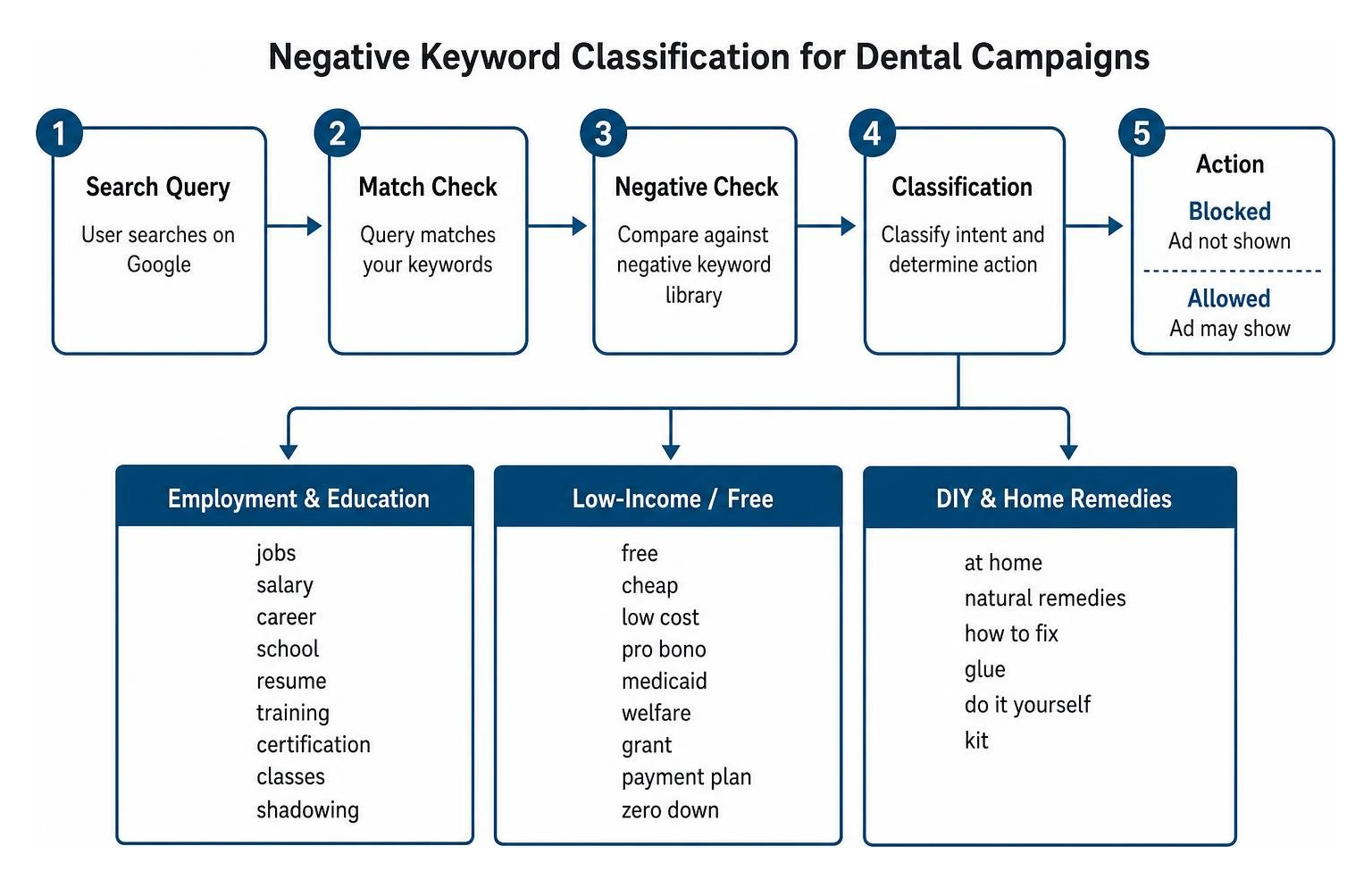
Before launching any dental campaign, we install a pre-built master negative keyword library containing hundreds of non-converting terms across distinct categories:
- Employment & Education: jobs, salary, career, school, resume, training, certification, classes, shadowing.
- Low-Income / Free: free, cheap, low cost, pro bono, medicaid, welfare, grant, payment plan zero down.
- DIY & Home Remedies: at home, natural remedies, how to fix, glue, do it yourself, kit.
- Non-Human / External: veterinary, dog, cat, equine, supplies, wholesale, equipment repair, lab.
- Unrelated Clinical: dentures for dogs, pediatric research, dental board, licensing.
By auditing search term reports weekly, we continuously expand this negative list, ensuring your budget only funds clicks from prospective local patients who have both the intent and financial capability to accept treatment.
Landing Page Requirements and Call Tracking Strategy
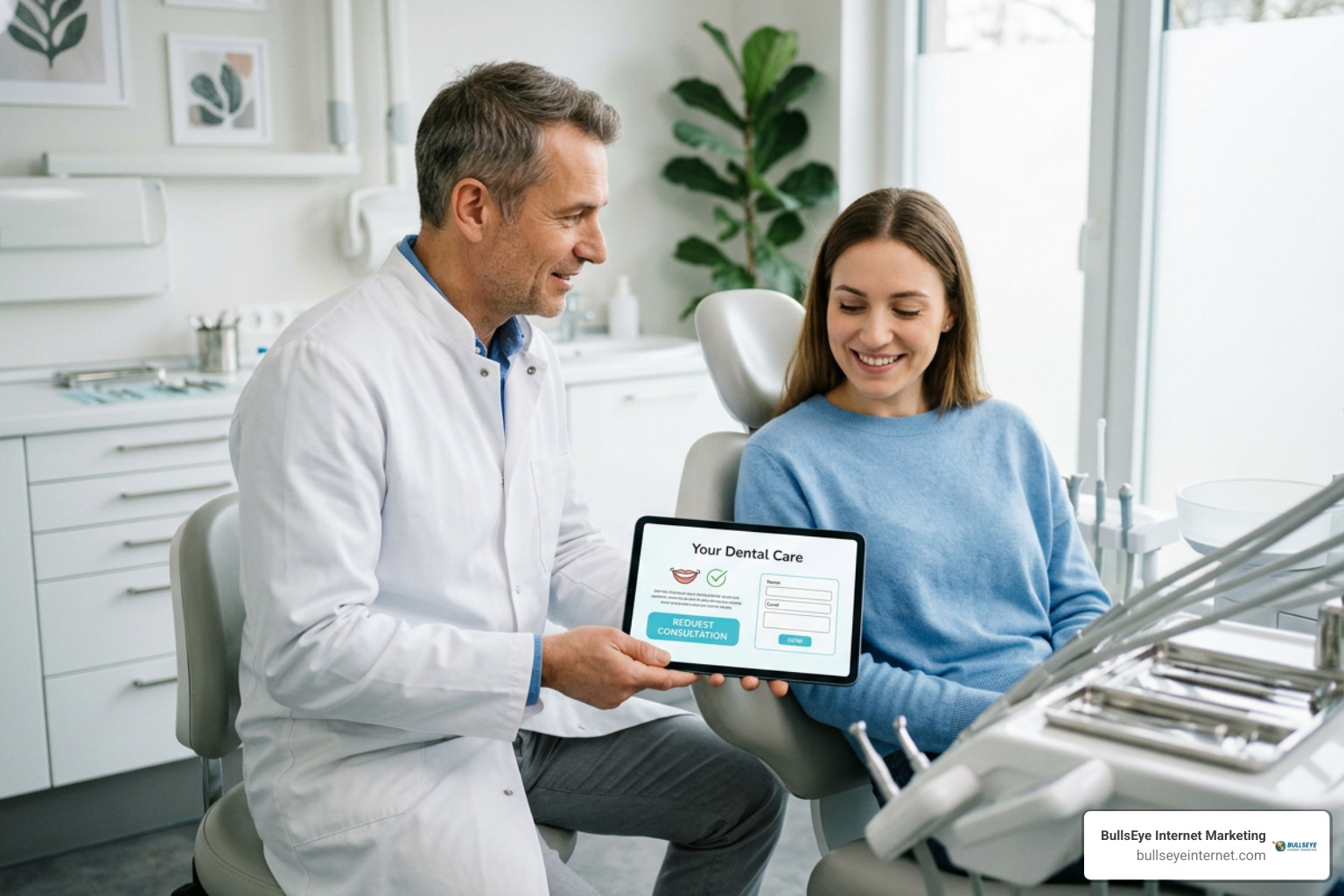
Driving qualified ad traffic to your practice website is only half the battle. What happens after the click determines whether your campaign generates a high return on investment or empty bank account balances.
Dedicated Landing Pages vs Practice Homepages
Sending paid ad traffic to a general practice homepage is the single most common reason dental Google Ads campaigns fail.
A homepage is designed to serve multiple audiences: existing patients looking for patient portals, job applicants reading team bios, and people looking for office directions. It features dozens of navigation links, general practice overviews, and competing calls to action. This creates choice overload. As a result, standard practice homepages convert ad traffic at a low 1% to 3%.
In contrast, dedicated procedure-specific landing pages convert at 6% to 12% (and often higher for emergency dental campaigns).
A dedicated page strips away top site navigation and focuses entirely on the specific service the user searched for. Key elements of a high-converting dental landing page include:
- Direct Headline Match: If the ad promises “Emergency Tooth Extraction in Fort Lauderdale,” the landing page headline must restate that exact service immediately above the fold.
- Visible Trust Signals: Position 2 to 3 prominent trust indicators above the fold, such as total years in practice, 5-star Google review count, verified patient testimonials, and professional awards.
- Click-to-Call Buttons: Sticky, easily tappable phone links for mobile users, accompanied by a simple 3-to-4 field appointment request form.
- Clear Office Location & Maps: Embedded Google Maps showing your exact physical address, cross-streets, and parking details to alleviate local friction.
For additional insight into optimizing local landing environments, review our breakdown on Dentist Google Local Ads: Proven Tips to Convert More Clicks Into Patients.
Implementing Call Tracking for Google Ads for Dentists
You cannot optimize what you do not measure. Because over 70% of high-intent dental leads convert via telephone rather than online form submissions, dynamic call tracking is mandatory.
We implement call tracking platforms (such as CallRail) using Dynamic Number Insertion (DNI). When a visitor clicks your Google Ad, the telephone number on your landing page dynamically updates to a unique tracking number tied to that user’s specific search term, ad headline, and session.
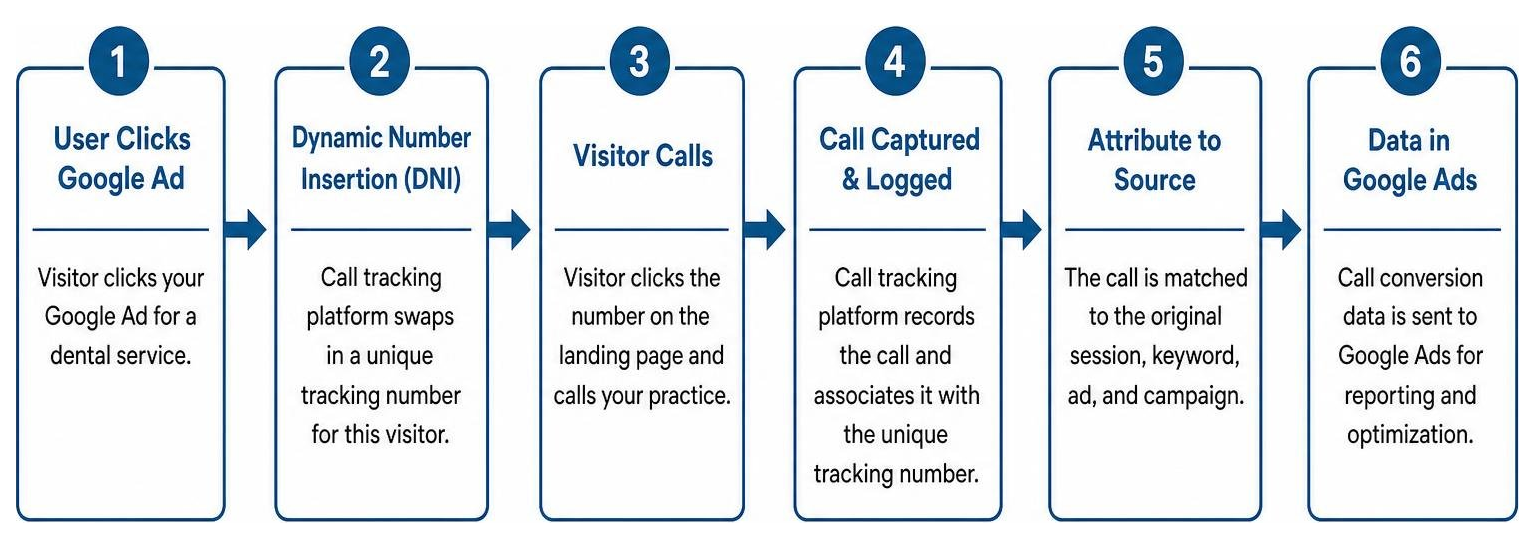
This closed-loop system allows us to track the lead source down to the precise keyword level. However, ad tracking software only measures whether a phone call occurred—not whether your front desk converted that caller into a scheduled patient.
As demonstrated in this Dental Practice Marketing + Google Ads for Dentists 30 Day Case Study, auditing call recordings is critical. We regularly review front-desk call performance alongside online click data. If your ad campaigns generate 40 qualified phone calls a month but your receptionist only schedules 10 appointments due to long hold times or poorly handled cost inquiries, fixing front-desk conversion protocols will instantly double your marketing ROI without spending an extra dollar on ads.
Cost Per New Patient Benchmarks and ROI Calculations
To evaluate whether your marketing spend is succeeding, you must measure your Cost Per New Patient (CPnP)—the total ad spend divided by the total number of actual new patients who walked through your doors and received treatment.
The table below outlines realistic cost-per-click and CPnP benchmarks across competitive market types:
| Procedure Category | Average CPC (U.S.) | CPnP (Suburban / Low Comp) | CPnP (Major Metro Area) | Target Conversion Rate |
|---|---|---|---|---|
| General Dentistry (Cleanings, Fillings) | $4.00 – $15.00 | $80 – $150 | $150 – $300 | 8% – 12% |
| Emergency Dental (Extractions, Root Canals) | $8.00 – $22.00 | $100 – $200 | $200 – $400 | 12% – 20% |
| Dental Implants (Single & Full-Arch) | $12.00 – $45.00+ | $150 – $300 | $300 – $600 | 5% – 10% |
| Cosmetics / Veneers | $10.00 – $30.00 | $150 – $250 | $250 – $500 | 6% – 10% |
Calculating Maximum Acceptable CPnP
Before launching or adjusting a budget, every practice owner must calculate their maximum acceptable CPnP based on procedure economics, average treatment value, and case acceptance rates.
Here is the exact formula we use:
$$\text{Max Acceptable CPnP} = (\text{Average First-Year Patient Revenue} \times \text{Case Acceptance Rate}) \times \text{Target Marketing Margin \%}$$
Example Calculation for a Dental Implant Campaign:
- Average Case Value: $3,500
- Case Acceptance Rate: 50% (half of consultation leads proceed with treatment)
- Target Marketing Cost Margin: 15% of revenue generated
- Calculation: $(\$3,500 \times 0.50) \times 0.15 = \$262.50$
In this scenario, spending up to $262.50 to acquire a single started implant patient produces a predictable, highly profitable return. Because dental patients also carry significant Patient Lifetime Value (LTV) through multi-year recall visits and family referrals, initial acquisitions often prove even more lucrative over a 3-to-5 year period.
Knowing When to Optimize vs Pause Campaigns
A common frustration for practice owners is determining when to adjust bid tactics versus when to halt a failing campaign entirely. Explore our guide on Google Local Services Ads for Dentists & Orthodontists to see how search campaigns pair with Google Verified badges.
We apply clear numerical rules to guide these decisions:
- When to OPTIMIZE: If your campaign is generating phone leads and form submissions within your target CPnP range, but search impression share is low (under 50%), keep the campaign active. Optimize by raising bids on high-converting exact match keywords, adding new negative terms, testing ad headlines, or refining landing page layout elements.
- When to PAUSE: If a campaign has run for 60+ consecutive days, spent at least $3,000, and generated zero trackable new patient appointments (despite verified call tracking and landing page setup), pause the campaign immediately.
Pausing under these conditions signals a fundamental flaw in market demand, aggressive regional price competition, front-office scheduling breakdowns, or offer positioning that simple keyword tweaks cannot fix.
Frequently Asked Questions About Dental PPC
Why do homepages fail as landing pages for dental ads?
Homepages fail because they offer too many navigation paths, generic practice information, and diluted calls to action. A prospective patient clicking an ad for “dental implants” expects to land on a page focused exclusively on implants, featuring immediate pricing details, before-and-after photos, and direct booking forms. Routing ad traffic to a homepage creates friction, dropping conversion rates down to 1–3% compared to 6–12% on dedicated landing pages.
How much budget is needed for general vs specialty dental ads?
In most markets across the U.S., a general dentistry campaign requires a starting budget of $1,500 to $3,000 per month to secure adequate click volume and conversion data. Specialty campaigns—such as dental implants or full-mouth restorations—require minimum budgets of $3,000 to $6,000+ per month due to higher competition and average CPCs ranging from $12 to $45+. Spending $400 a month in a competitive metropolitan region spreads your budget too thin to gather statistically meaningful data.
When should a practice owner pause a campaign versus optimizing it?
You should optimize a campaign continuously if it generates phone leads near your target benchmark but needs refinements in ad copy, match types, or landing page layout. However, you should pause a campaign entirely if it has ran for at least 60 days, spent upwards of $3,000, and delivered zero booked patient appointments despite properly installed call tracking and working landing pages.
Conclusion
Running profitable Google Ads for dentists is not about outspending every practice in your metropolitan area. It is about applying strict structure, controlling keyword intent, driving traffic to high-converting dedicated landing pages, and enforcing accountability at the front desk.
To build an ad engine that scales your dental practice:
- Structure separate campaigns for general, emergency, implant, and cosmetic services.
- Rely on phrase and exact match high-intent local keywords while aggressively maintaining negative keyword lists.
- Direct all ad clicks to dedicated procedure pages loaded with clear trust signals and clear calls to action.
- Track every call using dynamic number insertion, and audit your front-desk conversion performance regularly.
- Evaluate campaign performance using concrete Cost Per New Patient benchmarks rather than superficial vanity metrics.
If you are choosing an agency partner to build and manage your campaigns, take time to review our insights on Picking the Best Marketing Agency for Dentists. At BullsEye Internet Marketing, we operate with no long-term contracts and strictly enforce geographic exclusivity—working with only one dental practice per market area to ensure your competitors never gain access to your proprietary strategies.
Ready to fill your patient schedule with high-value cases? Explore our specialized Google Ads Services today, or visit our comprehensive Google Ads Strategy Pillar to request a custom campaign evaluation for your practice.
