
Google Ads for Landscapers: Turn Local Searches Into Booked Jobs
To make Google Ads for landscapers work, start with separate Search campaigns for each service you sell, target only the cities or ZIP codes you can serve profitably, and send each ad to a matching mobile-friendly landing page. Track calls and estimate forms from day one, then review search terms weekly to block wasted clicks.
A simple starting plan:
- Create separate campaigns for lawn maintenance, hardscaping, landscape design, and commercial work.
- Use high-intent keywords such as “patio installation near me” or “lawn care [city].”
- Add negative keywords for DIY advice, jobs, equipment, and services you do not offer.
- Use call and location assets, and make the phone number easy to tap on mobile.
- Increase budget when demand and crew capacity rise, especially in spring.
This matters because local searchers are often ready to act. Nearly half of Google searches have local intent, and mobile searches frequently lead to a call or visit within 24 hours. But clicks alone do not create revenue. A focused campaign, fast follow-up, and a landing page built for one clear next step are what turn ad spend into estimates and booked yards.
I am Ronnie Katz, founder and Principal CEO of BullsEye Internet Marketing, with more than 20 years of experience helping businesses improve visibility, traffic, and conversions. In the sections ahead, I will break down Google Ads for landscapers into a practical system for generating measurable calls and qualified leads.
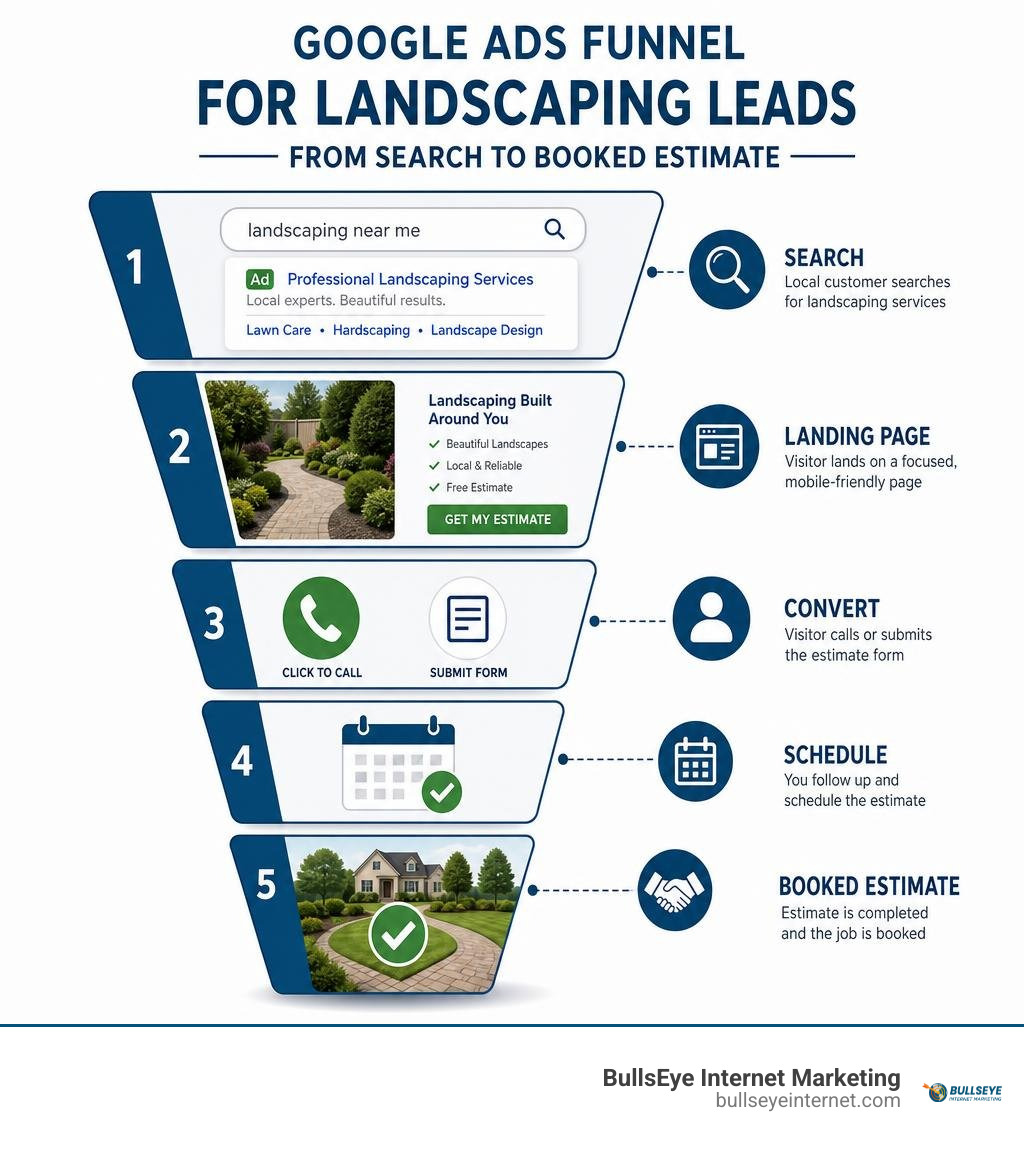
Google Ads for landscapers terms to know:
Setting Up High-Converting Google Ads for Landscapers
Building a profitable paid search system requires intentional architecture. When setting up campaigns, you cannot simply lump weekly mowing, tree trimming, drainage systems, and paver installations under one generic budget. Doing so confuses Google’s bidding algorithms and tanks ad relevance.
Instead, a proper setup aligns user intent directly with dedicated campaign buckets, ad copy, and conversion actions. We recommend consulting our Google Ads Complete Guide to master core account fundamentals. Every campaign needs distinct conversion actions tracked within the dashboard, including unique phone calls generated from call assets, on-page form submissions, and direct click-to-call taps on mobile devices.
Campaign Segmentation: Maintenance vs. High-Ticket Hardscaping
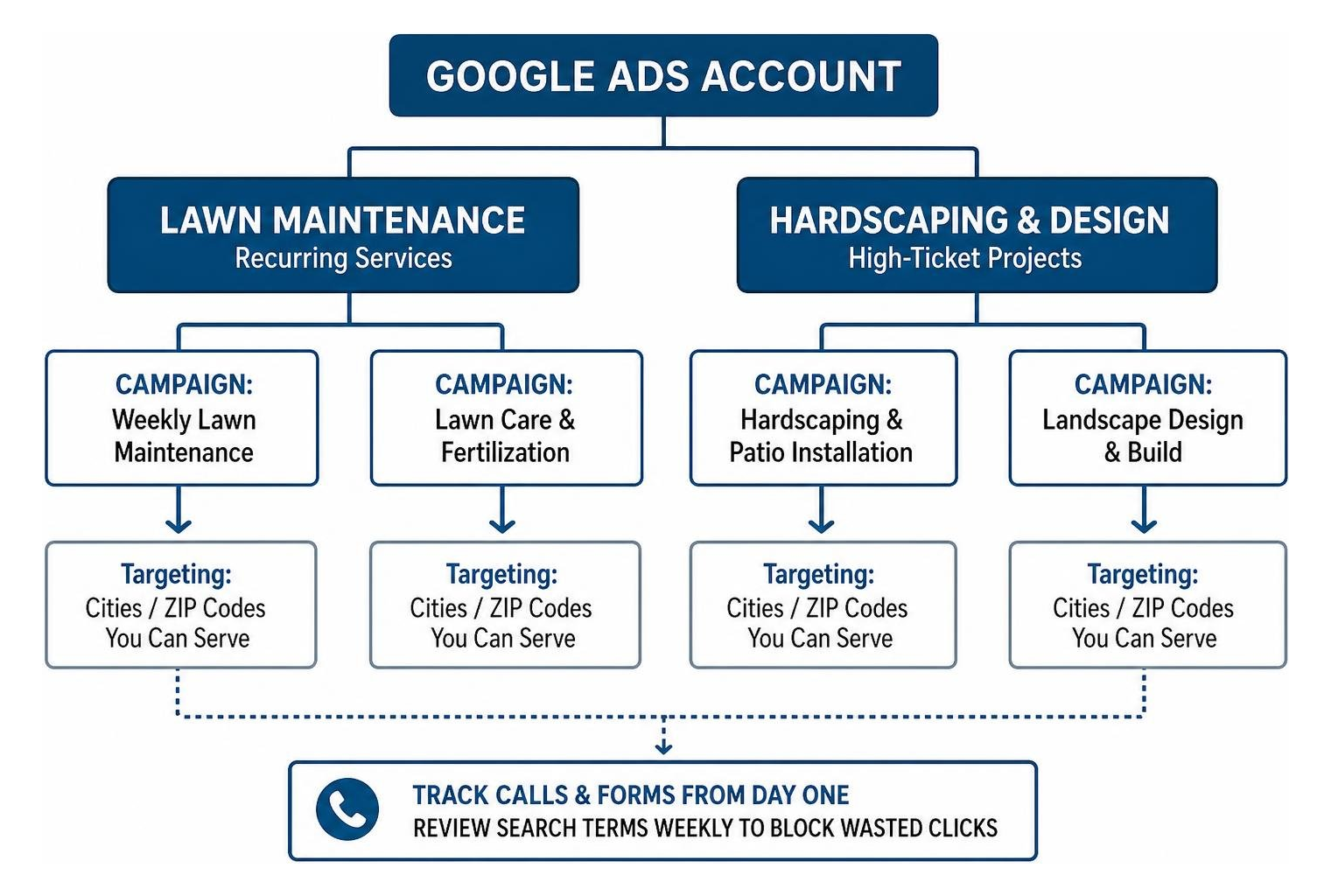
The most profitable landscaping accounts segment low-ticket recurring maintenance away from high-ticket design and construction services. Residential work represents roughly 59% of total landscaping industry revenue, but the profit profiles across services differ drastically.
- Recurring Lawn Maintenance: Weekly mowing, edging, fertilization, and weed control. These services carry lower ticket sizes per visit (e.g., $45–$85) but generate steady lifetime revenue. The median landscaping company generates $14,682 per customer over time, making client retention the primary goal.
- High-Ticket Hardscaping & Design: Paver patios, outdoor kitchens, retaining walls, and custom pergolas. These are one-off projects ranging from $15,000 to $50,000+. You can afford a higher cost per lead because a single closed job covers months of ad spend.
- Commercial Landscape Contracts: Commercial maintenance and corporate groundskeeping yield 2–3x higher profit margins than basic residential mowing. These searches require separate messaging focused on reliability, scale, and compliance.
Essential Match Types in Google Ads for Landscapers
Selecting the right keyword match types keeps your budget focused on active buyers. Broad match can rapidly exhaust ad spend on unrelated search terms like “how to fix brown lawn spots” or “cheap lawn mower repair.”
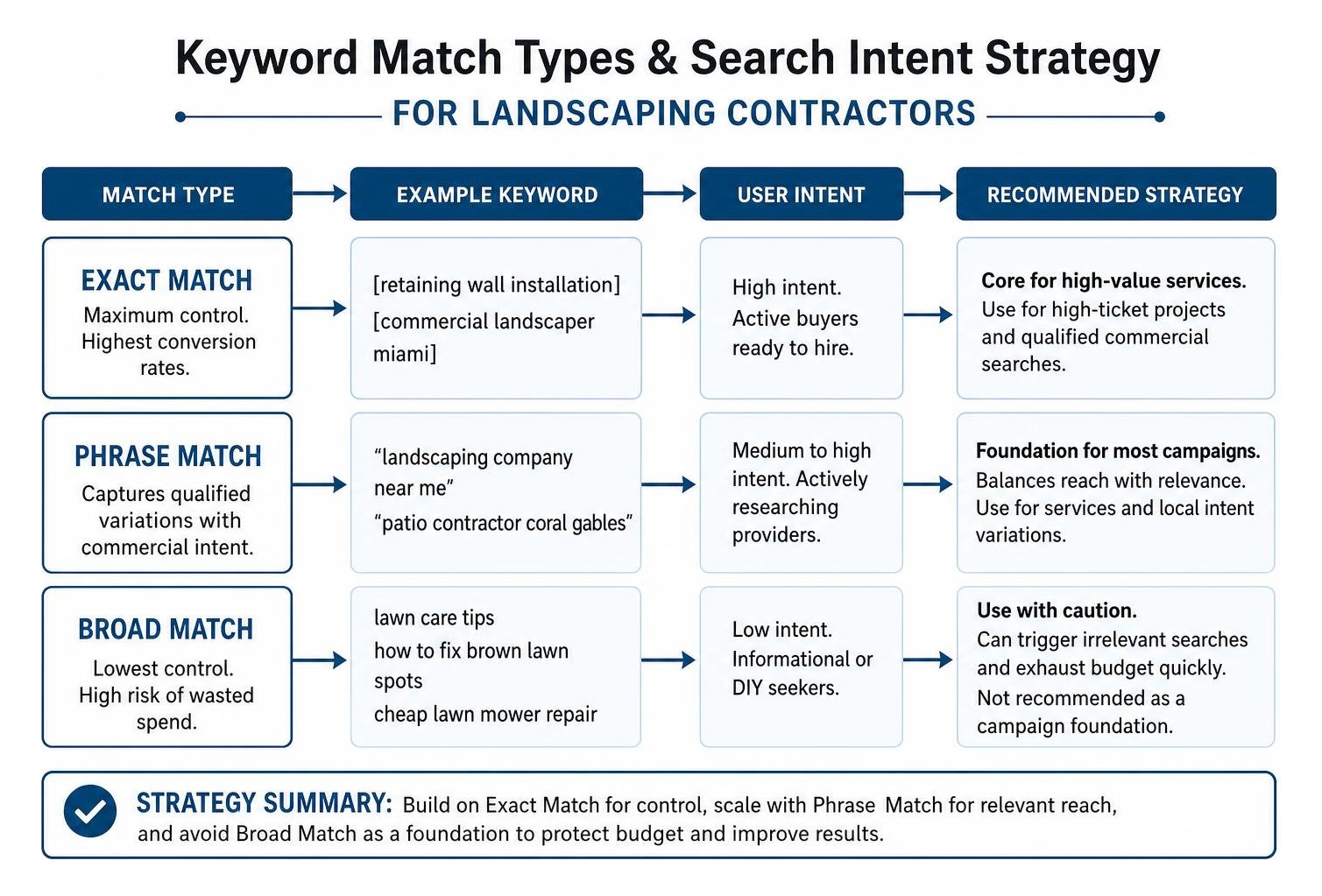
Instead, build your foundation on Phrase Match (e.g., "landscaping company near me", "patio contractor coral gables") and Exact Match (e.g., [retaining wall installation], [commercial landscaper miami]). Exact match delivers maximum control and higher conversion rates, while phrase match captures qualified variations with commercial intent. For a comprehensive overview of client acquisition tactics, check out our Contractors Blueprint: How to Generate Leads and Land More Jobs.
Geo-Targeting and Radius Bid Adjustments
Landscaping is inherently hyper-local. You should never set your campaign location to a broad state or county level without granular radius adjustments. Long drive times eat into your labor margins, and travel radius directly impacts profitability.
Focus on your most profitable service areas—such as high-income communities like Pinecrest, Coral Gables, or Palm Beach—and apply positive bid adjustments (+15% to +30%) to those high-value ZIP codes. Conversely, exclude low-density neighborhoods or areas outside your immediate operating routes. For commercial contractors handling large municipal or residential transformations, always adhere to local permitting and compliance standards to ensure your advertised services match regional licensing requirements.
Controlling Costs: Negative Keywords and Quality Score Optimization
Many landscape contractors struggle with paid search because they pay too much per click. In fact, industry data reveals that unoptimized home service campaigns often bid on broad, irrelevant search queries that inflate CPCs. You can eliminate this waste by reviewing our insights on Internet Marketing for Contractors: Stop Burning Cash on Bad Ads.
Building Robust Negative Keyword Lists
Negative keywords prevent your ads from appearing when users search for terms unrelated to hiring a professional contractor. Adding a comprehensive negative keyword list can reduce your cost per click by 30% to 50% within the first month.
Key negative keyword themes include:
- DIY & Instructional: “how to”, “diy”, “tutorial”, “youtube”, “plans”, “ideas”, “magazine”
- Employment & Career: “jobs”, “salary”, “hiring”, “resume”, “careers”, “pay scale”
- Supplies & Equipment Rental: “home depot”, “lowes”, “rental”, “used mower”, “trailer”, “parts”
- Irrelevant Services: “tree removal” (if you only do turf), “snow plowing” (in southern climates), “indoor plants”
Audit your Search Term Report weekly to spot unwanted search queries and continuously expand your negative lists.
Lowering CPC Through Quality Score and Ad Relevance
Quality Score (graded 1 to 10) directly dictates what you pay per click. Increasing your score from a 5 to an 8 can cut your CPC by 20% to 30% while securing top ad positions.
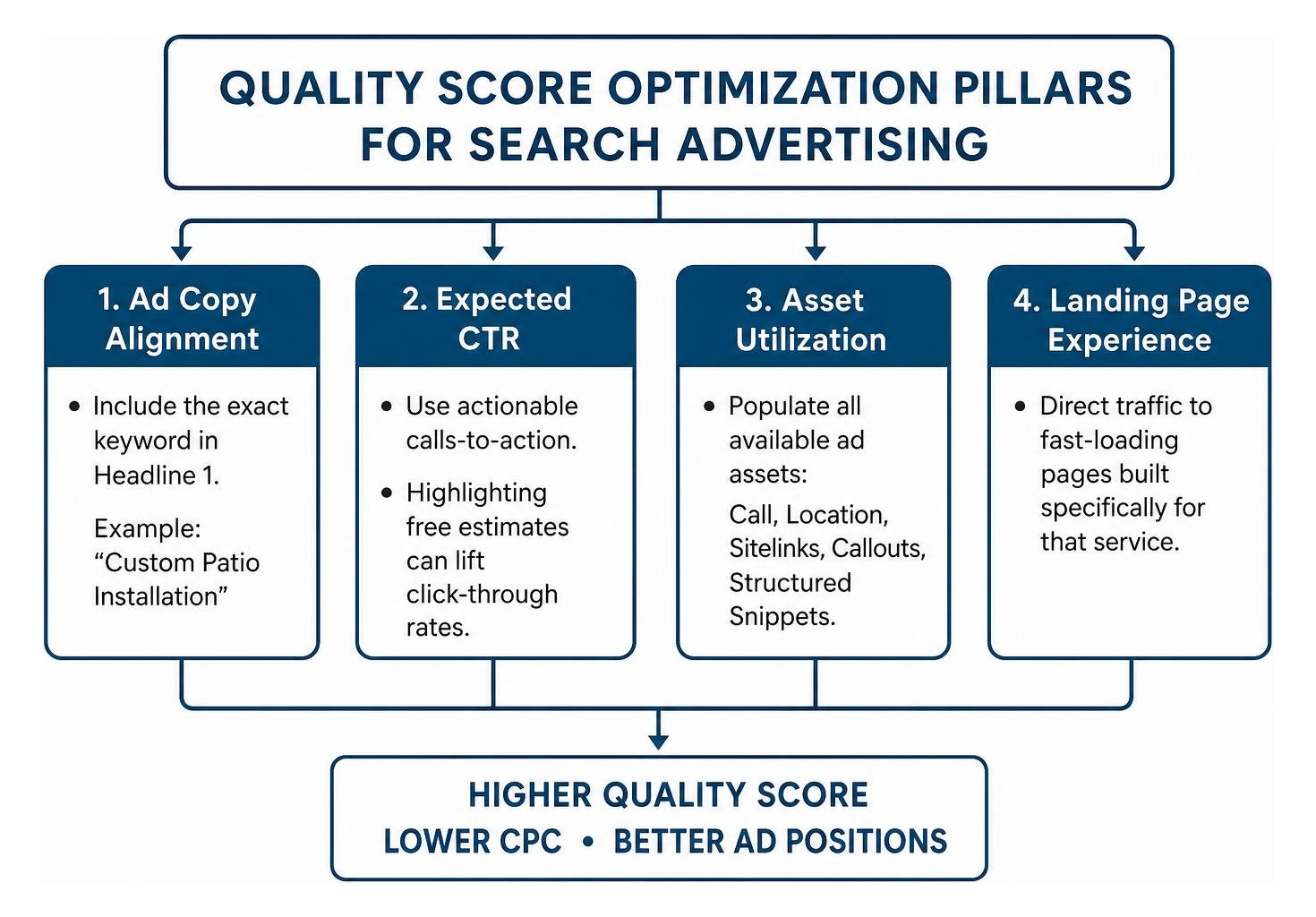
To maximize Quality Score:
- Ad Copy Alignment: Ensure your Responsive Search Ads feature the exact keyword in Headline 1 (e.g., “Custom Patio Installation”).
- Expected CTR: Use actionable calls-to-action like “Get A Free Estimate” or “View Our Recent Projects.” Ad copy highlighting free estimates frequently sees up to a 20% lift in click-through rates.
- Asset Utilization: Populate all available ad assets—Call Assets, Location Assets, Sitelinks, Callouts, and Structured Snippets.
- Landing Page Experience: Direct traffic to fast-loading pages specifically built for that service rather than a generic homepage. For broader implementation strategies across service trades, read The Definitive Guide to Advertising for Home Services Companies.
Google Search Ads vs. Google Local Services Ads (LSAs)
A common question for contractors is whether to run traditional Google Search Ads or Google Local Services Ads (LSAs). Both appear at the very top of Google search results, but their billing mechanics and lead generation pathways differ.
Learn how to leverage both effectively by reviewing our Google Local Services Ads Complete Guide and our breakdown on the Google Guaranteed Ads Complete Guide.
Comparing Lead Costs, Booking Rates, and ROAS
| Metric / Feature | Google Local Services Ads (LSAs) | Traditional Google Search Ads | Organic SEO / Map Pack |
|---|---|---|---|
| Pricing Model | Pay-Per-Lead (Direct call/message) | Pay-Per-Click (CPC) | Fixed monthly investment |
| Average Cost per Lead | ~$39.00 | $50.00 – $150.00 (Avg ~$87.80) | $10.00 – $30.00 (at maturity) |
| Average Booking Rate | ~31% | ~15% – 25% | ~25% – 35% |
| Average ROAS | ~4x – 5x | ~2x – 4x | Highly scalable compounding ROI |
| Trust Signal | Google Guaranteed Badge | Ad Label / Reviews Extensions | Reviews & Organic Rank |
| Lead Dispute Ability | Yes (Invalid/Wrong service leads) | No (You pay for every click) | N/A |
| Time to Results | Immediate (Once verified) | Immediate (Within 24–48 hours) | 3 to 6 months to mature |
LSAs provide pre-screened phone calls at a lower average cost per lead. However, traditional search ads provide complete control over exact service positioning, custom landing pages, and high-ticket targeting.
Balancing PPC and SEO for Sustainable Lead Flow
Paid advertising captures immediate market demand, but relying solely on ads makes your pipeline vulnerable if ad spend pauses. Combining search ads with local search engine optimization provides sustainable, long-term growth.
Approximately 42% of searchers click on Google Map Pack results for local queries. An optimal marketing budget allocates 40% to paid advertising (PPC and LSAs) for immediate job bookings and 60% toward organic SEO and Google Business Profile optimization to reduce customer acquisition costs over time.
Turning Clicks into Booked Jobs: Landing Page & Conversion Architecture
The average cost per click for landscaping keywords sits between $3.65 and $5.47, and it takes roughly 24 clicks to generate a single qualified lead. If your landing page fails to convert, your cost per lead will quickly escalate.
You can learn more about conversion optimization in our guide From Clicks to Customers: Mastering PPC for Lead Generation.
Above-the-Fold Landing Page Essentials
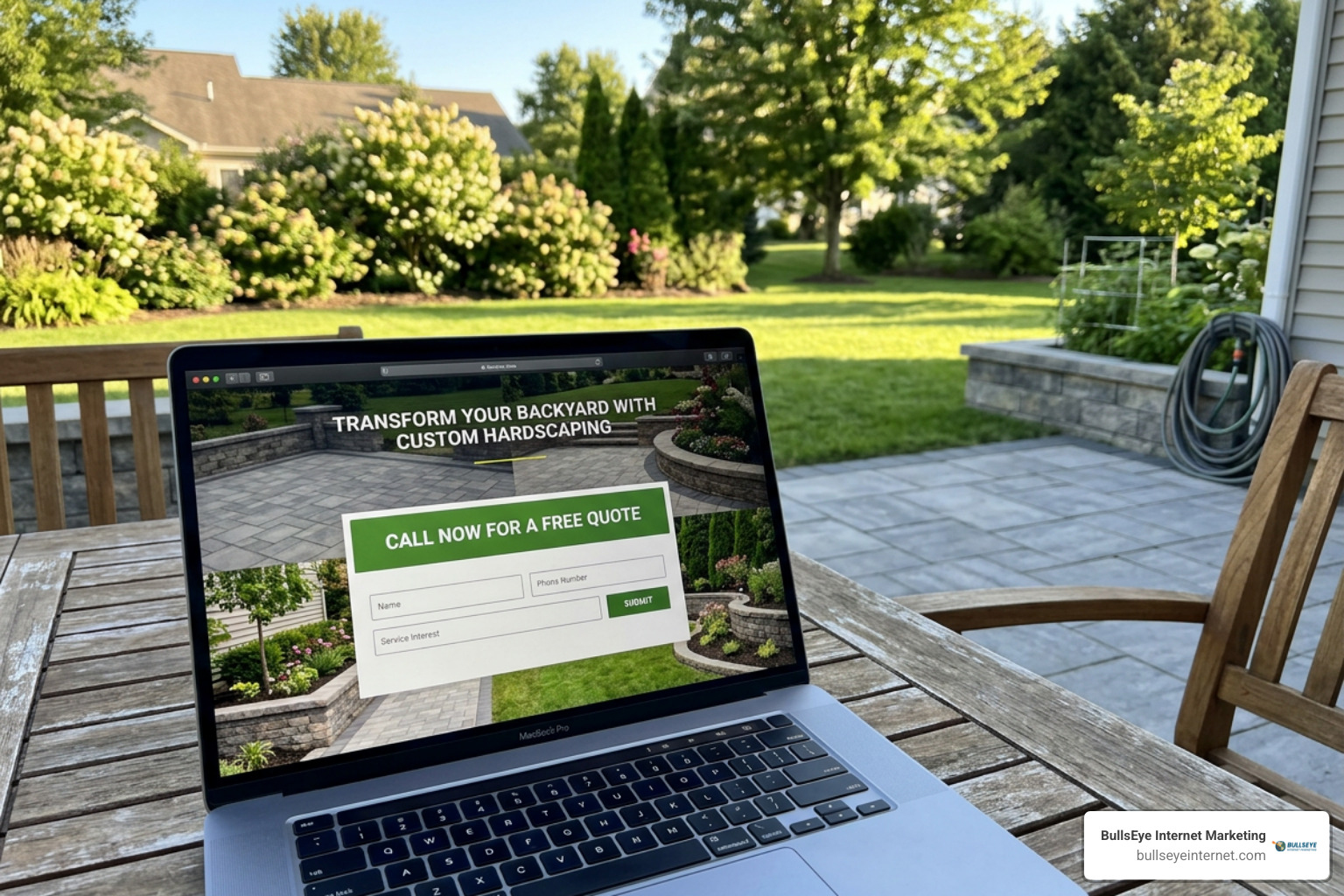
When a homeowner clicks your ad, they must immediately see what you offer, proof of quality, and how to contact you without scrolling.
- 1:1 Headline Match: If the ad promotes “Hardscaping & Paver Patios,” the page headline must read “Premier Paver Patio Installation in [City].”
- Prominent Click-to-Call Buttons: Over 63% of organic search traffic and up to 80% of local ad clicks happen on mobile devices. Feature a large, sticky “Call Now” button at the top of the page.
- Short Estimate Form: Keep initial quote forms simple (Name, Phone, ZIP, Service Needed).
- Trust Markers: Prominently display Google review ratings, licensing, insurance badges, and warranty guarantees.
- High-Quality Project Galleries: Feature crisp before-and-after imagery of recent local projects.
Dynamic Call Tracking and Lead Routing
You cannot optimize what you do not measure. Setting up Dynamic Number Insertion (DNI) allows you to track exactly which campaigns, ad groups, and keywords produce inbound phone calls.
Integrate your call tracking software with your CRM to automate missed call text-backs. Contacting a new lead within 5 minutes increases conversion rates dramatically compared to waiting an hour or more.
Seasonal Budget Planning and Year-Round Scaling
Landscaping demand fluctuates throughout the year. Industry ad spend data shows massive swings—January budgets average roughly $315 per account, while peak spring demand in April jumps to $1,070 per account (a 240% swing).
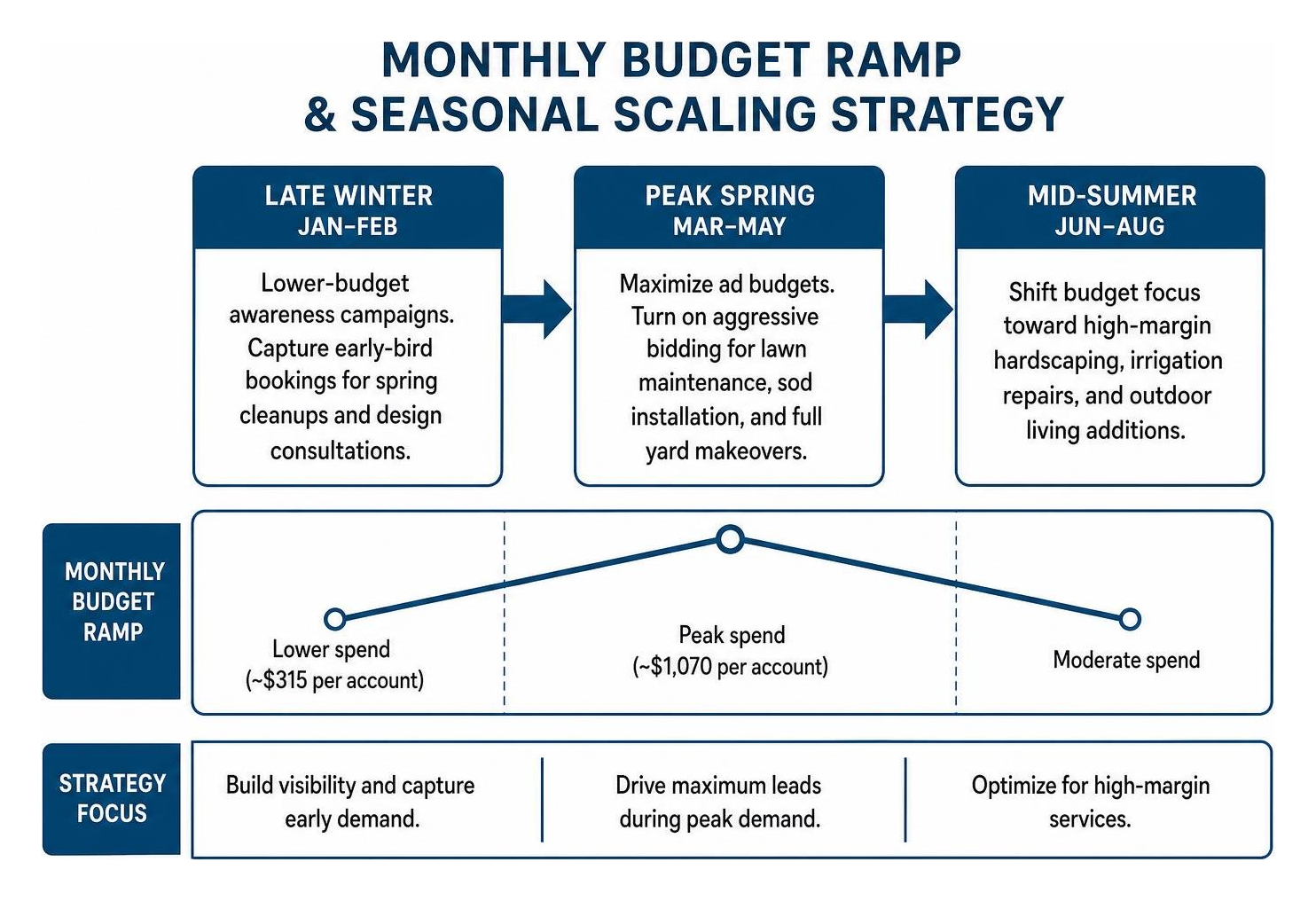
Seasonal Budget Management in Google Ads for Landscapers
- Late Winter (Jan–Feb): Run lower-budget awareness campaigns and capture early-bird bookings for spring cleanups and design consultations.
- Peak Spring (Mar–May): Maximize ad budgets. Turn on aggressive bidding for lawn maintenance, sod installation, and full yard makeovers.
- Mid-Summer (Jun–Aug): Shift budget focus toward high-margin hardscaping, irrigation repairs, and outdoor living additions.
- Fall (Sep–Nov): Focus campaigns on aeration, overseeding, fall cleanups, and commercial winter maintenance agreements.
Common Landscaping PPC Pitfalls to Avoid
- Running Ads 24/7: Unless you have an after-hours answering service, shut ads off outside business hours to prevent paying for clicks when no one is available to answer the phone.
- Routing Clicks to a Generic Homepage: Sending paid clicks to a broad homepage increases bounce rates and wastes ad spend.
- Ignoring Untracked Phone Calls: Neglecting call tracking makes it impossible to determine which keywords drive real revenue.
- Overusing Broad Match: Letting broad match keywords run without negative filters burns budget on DIY queries and unrelated job seekers.
- Slow Lead Follow-up: Failing to contact estimate requests within 15 minutes causes high-intent leads to hire a competitor.
Frequently Asked Questions About Landscaping Google Ads
What is the average cost per lead for landscaping Google Ads?
The average cost per lead (CPL) for landscaping search ads is approximately $87.80. Basic residential lawn care leads generally range from $30 to $80 per lead, while high-ticket hardscaping and custom landscape design leads range from $60 to $150 per lead. Commercial maintenance leads typically fall between $100 and $250 due to higher long-term contract values.
How do Local Services Ads compare to traditional PPC for landscapers?
Google Local Services Ads operate on a pay-per-lead model rather than pay-per-click, with average leads costing around $39. LSAs feature the Google Guaranteed badge and appear at the very top of search results. Traditional search ads cost more per lead but provide complete control over ad copy, keyword targeting, and dedicated landing pages for specialized high-ticket jobs.
Why are my ads getting clicks but no calls?
Ads generate clicks without phone calls when there is an intent mismatch between the search query and the ad, when landing pages lack clear click-to-call buttons, or when mobile page load speeds are too slow. Auditing your search terms for negative keywords and testing your mobile landing page experience will resolve most conversion bottlenecks.
Conclusion
Google Ads is one of the most reliable channels to scale a landscaping business when campaigns are structured with clear service segmentation, high-intent keywords, disciplined negative matching, and dedicated landing pages.
At BullsEye Internet Marketing, we provide complete transparency with no long-term contracts and maintain strict market exclusivity by working with only one contractor per industry per geographic area. If you want to stop wasting ad spend and fill your schedule with profitable jobs, explore our specialized Google Ads management services today.
