
Why Google Ads for Plastic Surgery Is the Fastest Path to New Patients
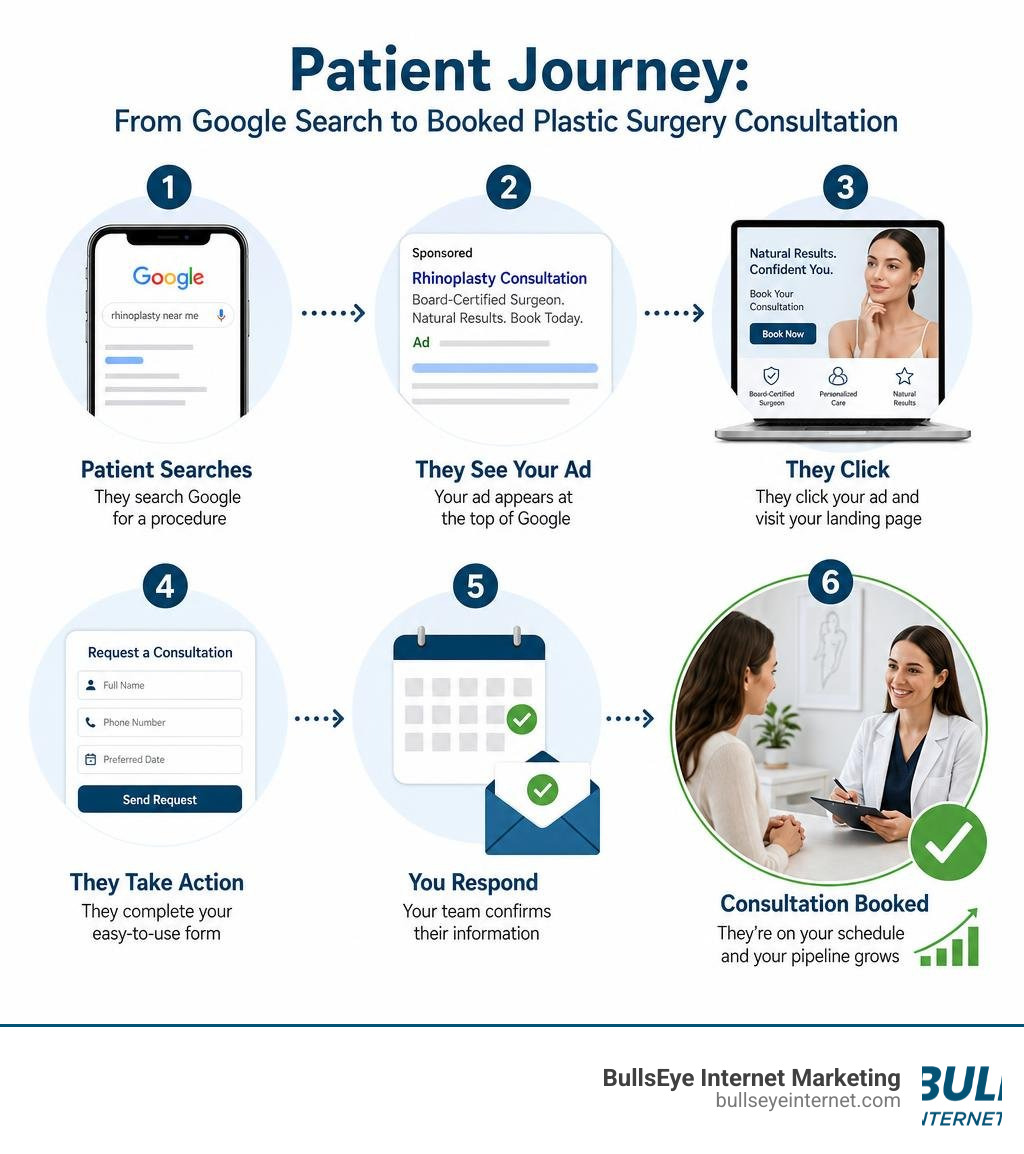
Google Ads for plastic surgery is one of the most direct ways to put your practice in front of patients who are actively ready to book a consultation — right now, today.
Here’s a quick summary of how it works and what to expect:
| Topic | Quick Answer |
|---|---|
| How it works | Your ads appear at the top of Google when patients search for procedures like “rhinoplasty near me” |
| Why it’s effective | You reach people already looking for surgery, not cold audiences scrolling social media |
| Typical starting budget | $2,000–$5,000/month depending on location and competition |
| Time to first leads | As fast as a few weeks after launch |
| Full optimization timeline | 90 days to gather data; 6–12 months to fully refine |
| Key success factors | Procedure-specific keywords, dedicated landing pages, and conversion tracking |
Right now, thousands of people in your area are typing things like “best breast augmentation surgeon near me” or “rhinoplasty cost [city]” into Google. They’ve already decided they want a procedure. They’re just choosing which surgeon to call.
The question is whether your practice shows up — or your competitor’s does.
The U.S. cosmetic surgery market hit $22.6 billion in 2024 and is still growing. Patients are searching. The opportunity is real. But running Google Ads for a plastic surgery practice isn’t the same as running ads for a clothing store. It requires a specialized approach, the right campaign structure, and a clear understanding of what actually drives booked consultations.
I’m Ronnie Katz, founder of BullsEye Internet Marketing, and since 2006 I’ve helped practices use Google Ads for plastic surgery and other high-value medical services to generate consistent, measurable patient flow. In this guide, I’ll walk you through exactly how to build campaigns that turn clicks into consultations — without wasting your budget.
Google Ads plastic surgery vocab to learn:
How Google Ads Plastic Surgery Campaigns Work
To understand why Google Ads is so incredibly powerful for cosmetic surgery, we have to look at the anatomy of a Google search engine results page (SERP). When a user searches for a commercial phrase like “tummy tuck surgeon in Miami,” the top three to four results they see are sponsored ads.
Google Ads operates on a Pay-Per-Click (PPC) model. This means you only pay when an interested user actually clicks on your ad to visit your website or calls your clinic directly from the search page.
But winning those top spots isn’t just about who has the deepest pockets. Google uses an auction system governed by three major components:
- The Maximum Bid: The highest amount you are willing to pay for a single click on a given keyword.
- Quality Score: An automated rating from 1 to 10 that measures how relevant your ad, keywords, and landing page are to the person seeing your ad.
- Ad Rank: The mathematical score Google uses to determine where your ad appears on the page.
By prioritizing your Quality Score through highly relevant ad copy and fast-loading, procedure-specific landing pages, you can actually pay less per click than your competitors while securing a higher ad position.
This process relies heavily on procedure-specific targeting. Rather than bidding on broad, expensive, and vague terms like “plastic surgeon,” a high-performing campaign targets specific procedures. This aligns beautifully with geographic search trends. In fact, peer-reviewed data on Patient demand for plastic surgeons for every US state based on Google … reveals that patient search volume and specific procedure demands vary widely by region and state.
To master the foundational principles of how this platform operates under the hood, check out our Google Ads Complete Guide.
Pull vs. Push: Why Google Ads Outperforms Social Media
Many aesthetic practices pour thousands of dollars into social media advertising on platforms like Facebook and Instagram, only to wonder why their consultation calendars aren’t filling up. The answer lies in the fundamental psychological difference between “pull” and “push” advertising.
Social media is push advertising. Users are on those platforms to look at photos of their friends’ vacations, watch funny videos, or catch up on news. Your ad interrupts their experience. Even if they have a mild interest in a mommy makeover, they are a “cold” audience. They are in a passive discovery phase, meaning the lead quality is often low and the close rate is incredibly slow.
Google Search, on the other hand, is the ultimate form of pull advertising. When someone types “rhinoplasty surgeon near me” into Google, they are actively pulling information to solve a specific desire. They have high buyer intent. They are already convinced they want the surgery; they are simply looking for the right board-certified expert to perform it.
While social media is great for long-term brand awareness, Google Ads is the undisputed king of immediate, high-quality patient acquisition. For a deeper dive into how this fits into your broader marketing mix, read our Advertising Plastic Surgeons Ultimate Guide.
Capturing High-Intent Leads with Google Ads Plastic Surgery Strategies
To make your ad dollars count, you must understand the difference between procedure-aware and procedure-naive searchers.
- Procedure-Naive Searchers: These users are in the early research phase. They search for broad terms like “how to get rid of loose belly skin” or “what is a tummy tuck.” Bidding on these keywords is incredibly expensive and highly inefficient because these searchers are months—or even years—away from booking a consultation.
- Procedure-Aware Searchers: These users know exactly what they want. They search for bottom-funnel, high-intent keywords like “tummy tuck cost Miami,” “best breast augmentation surgeon Broward County,” or “rhinoplasty consultation West Palm Beach.”
By structuring your campaigns around bottom-funnel keywords, you capture patients at the exact moment they are ready to take action. This targeted strategy dramatically increases your conversion rates and ensures you aren’t wasting money on informational clicks. To learn more about structuring your patient acquisition funnel, read our guide on Cosmetic Surgery Lead Generation.
Key Components of a Successful Cosmetic Surgery Campaign
A profitable campaign requires a highly structured architecture. You cannot simply throw all your procedures into one giant ad group with a single budget and expect it to work.
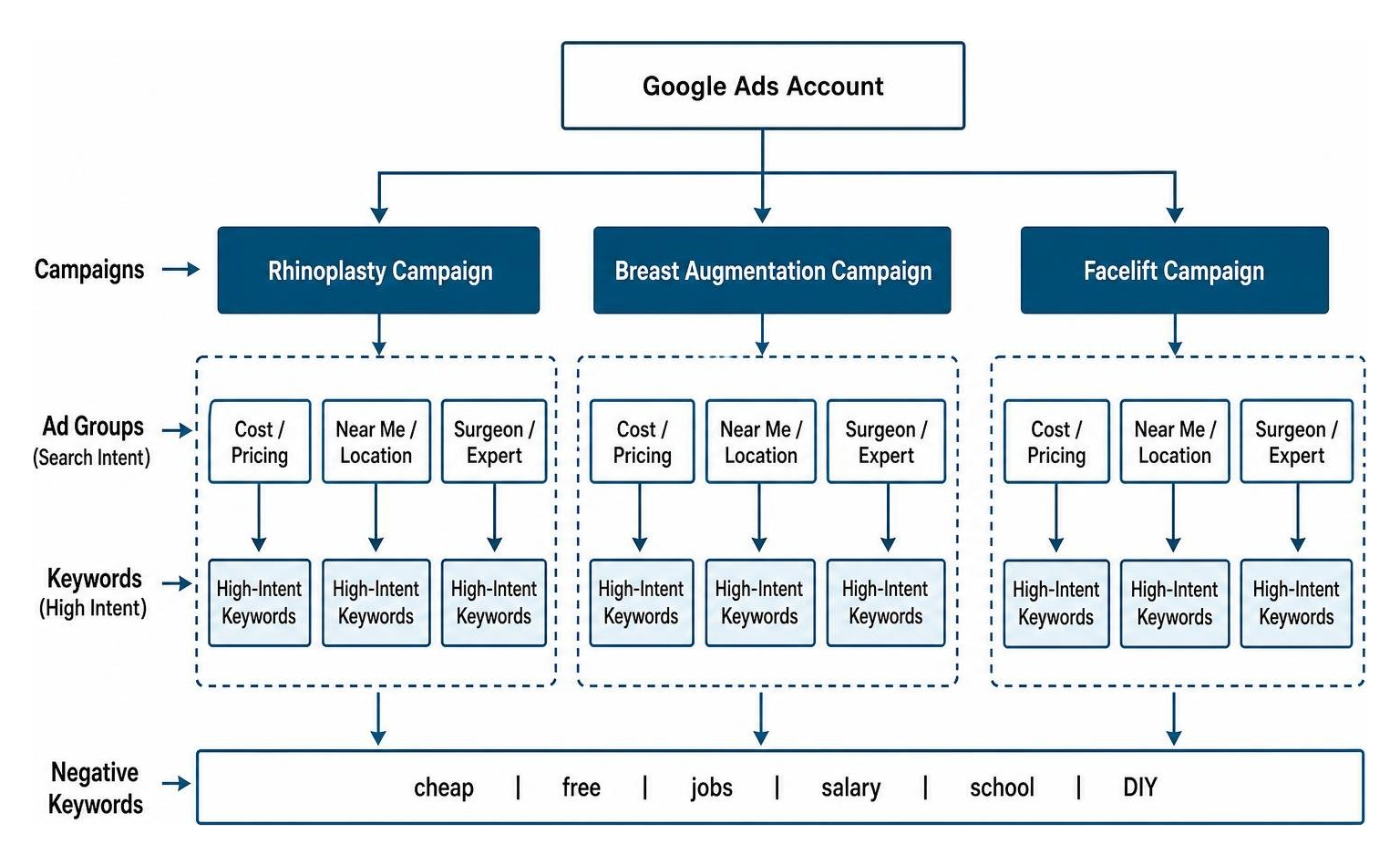
To prevent your budget from being spent on the wrong clicks, we utilize procedure-level segmentation. This means we build separate, dedicated campaigns for each major procedure you want to promote (e.g., a Rhinoplasty Campaign, a Breast Augmentation Campaign, and a Facelift Campaign). Inside each campaign, we create tightly themed ad groups based on specific search intents, such as “cost/pricing,” “near me/location,” and “surgeon/expert.”
Additionally, a successful campaign relies heavily on two often-overlooked features:
- Negative Keywords: These are terms you explicitly tell Google not to show your ads for. By adding negative keywords like “cheap,” “free,” “jobs,” “salary,” “school,” and “DIY,” you ensure your ads never appear to people looking for discount services or career information, saving you thousands of dollars in wasted clicks.
- Ad Assets (Extensions): These allow your ads to take up more physical real estate on the search results page. By utilizing call assets, sitelink assets (linking to before-and-after galleries), location assets, and structured snippets, you make your ad highly clickable and increase your click-through rate (CTR).
To understand the core mechanics of setting up these paid search structures, explore our comprehensive breakdown of ppc.
Designing Landing Pages for Maximum Conversion Optimization
The single biggest mistake plastic surgery practices make is sending their paid ad traffic directly to their website’s homepage.
When a user clicks an ad for “rhinoplasty” and lands on a homepage featuring breast implants, facelifts, and a welcoming blog post, they get confused and leave. Your conversion rate plummets, and your money is wasted.
Instead, you must send traffic to dedicated, conversion-optimized landing pages designed for each specific procedure.
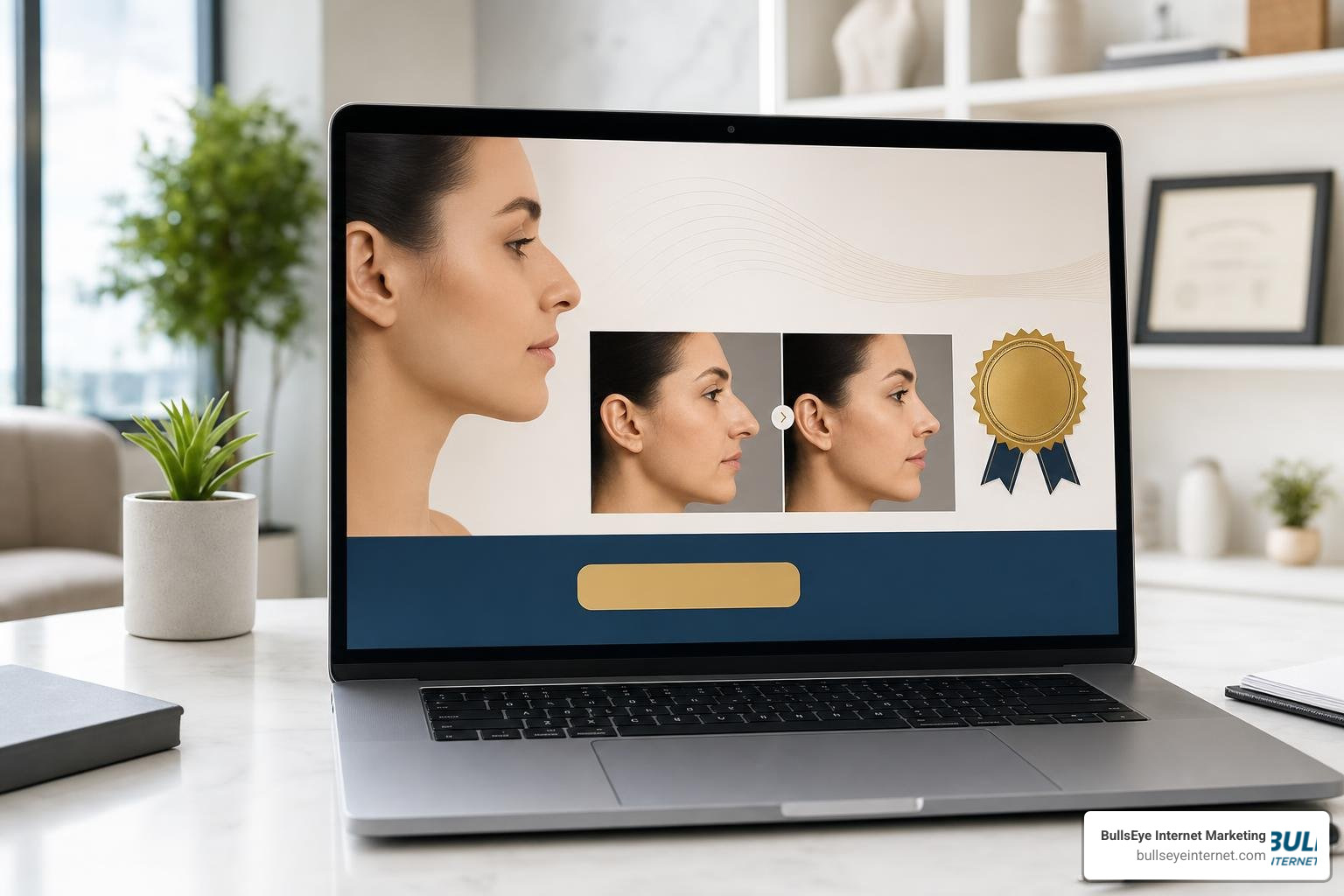
A high-converting landing page must include:
- A Matching Headline: If the ad promised “Natural-Looking Rhinoplasty in South Florida,” the landing page headline must say exactly that.
- ABMS Board Certification: Highlight your board certification from the American Board of Plastic Surgery prominently. This is the single most important trust signal for prospective patients.
- Before-and-After Previews: Patients want to see proof. Include a small, high-quality, clinical gallery of your best results with clear disclaimers that individual results may vary.
- A Single, Clear Call-to-Action (CTA): Do not distract users with social media links or main site navigation. Strip away the header menu. The only things they should be able to do on this page are call your office directly or fill out a simple, HIPAA-compliant consultation request form.
- Mobile Optimization: Over 70% of plastic surgery searches happen on mobile devices. Your landing page must load in under three seconds and be effortless to navigate on a smartphone.
Implementing these conversion-focused designs can boost your landing page conversion rates to 12% to 20%. To master these design principles, review our guide on Conversion Optimization.
Compliance, HIPAA, and Google’s Healthcare Policies
Advertising in the medical space requires navigating a strict minefield of regulatory and platform-specific policies. Google takes healthcare very seriously, and failing to comply can lead to immediate ad disapproval or permanent account suspension.
First, before-and-after photos are strictly prohibited in standard Google Search ad creatives. While you can mention your galleries in your ad text, you cannot feature these images in your actual ad assets. However, they are permitted and highly encouraged on your dedicated landing pages, provided they feature realistic clinical outcomes and clear disclaimers.
Second, Google places strict limitations on personalized advertising (remarketing) for clinical medical procedures. Because cosmetic surgery is considered a sensitive health category, you cannot run traditional retargeting ads that follow users around the web showing them breast implants or facelifts. Instead, you must focus on capturing them on their initial search or use highly compliant, non-sensitive educational retargeting on permitted channels.
Finally, your lead capture forms must remain HIPAA-compliant. Keep your online forms simple. Only ask for basic contact information (name, email, phone number) to schedule a call. Never ask for detailed medical history, symptoms, or private health information directly through an unencrypted landing page form. Protecting patient privacy is vital to your account’s longevity and your practice’s reputation.
Budgeting and Timeline Expectations for Plastic Surgeons
Because plastic surgery is a high-ticket, cash-pay medical specialty, competition for the top advertising spots is fierce. Your starting budget, average cost-per-click (CPC), and timeline will depend heavily on your local market size and competition.
| Market Size | Example Locations (Florida) | Recommended Monthly Budget | Average CPC | Expected Time to First Stable Leads |
|---|---|---|---|---|
| Highly Competitive Metro | Miami, Fort Lauderdale, West Palm Beach | $5,000 – $12,000+ | $15 – $45 | 2 – 4 Weeks |
| Moderately Competitive | Boynton Beach, Delray Beach, Hollywood | $3,000 – $5,000 | $8 – $20 | 1 – 3 Weeks |
| Local / Suburban | Martin County, St. Lucie County, Vero Beach | $2,000 – $3,000 | $5 – $12 | 1 – 2 Weeks |
Before launching your campaign, it is vital to understand the basic economics of pay-per-click advertising. To prepare your practice for these investments, read our guide on What Every Business Owner Should Know Before Running A Google Ads Campaign.
What to Expect in the First 90 Days of Your Campaign
A successful Google Ads campaign is not a “set-it-and-forget-it” project. It requires an intentional, data-driven timeline to mature into a highly profitable patient acquisition system.
During the first 30 days, we focus on launching the campaign and gathering raw search query data. We recommend starting with Manual CPC bidding to control exactly what we pay for each click, preventing Google’s automated bidding algorithms from overspending on low-intent terms.
By day 90, your campaign will have gathered enough conversion data to transition safely to automated Smart Bidding (like Maximize Conversions or Target CPA). This allows us to stabilize your cost-per-lead and establish a predictable flow of new patient consultations.
Navigating High Click Costs in Competitive Metro Areas
In highly competitive South Florida markets like Miami, Palm Beach, and Broward County, click costs can easily exceed $30 to $45 for premium keywords like “mommy makeover” or “facelift surgeon.”
While these numbers might seem intimidating at first, they make perfect sense when you look at case value asymmetry.
A single facelift or mommy makeover procedure can easily generate $10,000 to $20,000+ in revenue for your practice. If you spend $1,500 on Google Ads to generate 50 highly targeted clicks, and just one of those clicks converts into a booked surgery, your return on ad spend (ROAS) is outstanding.
To maximize this asymmetry, we use highly precise geo-targeting. Instead of targeting the entire state of Florida, we target specific high-income zip codes and a tight 15-to-20-mile radius around your physical clinic locations, such as Coral Gables, Pinecrest, Fort Lauderdale, or Wellington. This ensures your ad budget is spent exclusively on local, affluent prospects who can afford your premium services.
Highly reputable regional groups, such as the Miami Plastic Surgery Center, Top Plastic Surgeons and Plastic Surgery and Med Spa Services West Palm Beach and …, demonstrate how capturing local, high-intent search traffic is the key to maintaining market dominance.
With plastic surgery continuously dominating South Florida culture—often making headlines from high-profile Miami transformations to bizarre local stories like the Florida property manager on the run accused of HOA … embezzlement case where funds were spent on lavish trips and cosmetic procedures in Martin County—it’s clear that local demand is incredibly high.
Partnering for Success: Professional Campaign Management
To run a truly profitable Google Ads campaign, you must have perfect attribution. You cannot optimize what you do not measure.
Many agencies will send you reports filled with “vanity metrics” like impressions, clicks, and click-through rates. But you cannot pay your staff or your rent with clicks.
At BullsEye Internet Marketing, we focus on the only metric that actually impacts your bottom line: booked consultations. To track this accurately, we build a multi-layered conversion tracking system:
- Call Tracking: We implement dynamic number insertion (DNI) call tracking. When a user clicks your ad, the phone number on your landing page changes to a unique tracking number. When they call, we track exactly which keyword, ad, and campaign generated that phone call.
- Server-Side Tracking: Browser-side tracking (cookies) now misses up to 40% of conversions due to modern ad blockers, privacy extensions, and Safari restrictions. We set up advanced server-side tracking using Google Tag Manager to recover this lost data, feeding accurate conversion signals back to Google’s bidding algorithm.
To understand how professional tracking protects your marketing investments, explore our Pay Per Click Management Service Complete Guide.
What to Expect from Professional Google Ads Plastic Surgery Management
When you partner with a specialized agency like BullsEye Internet Marketing, you aren’t just paying for someone to set up an account. You are investing in a continuous, active optimization process.
Our professional management services include:
- Rigorous Keyword Research: Identifying high-converting, consumer-friendly search terms (e.g., “tummy tuck”) over complex medical jargon (e.g., “abdominoplasty”).
- Compliant, High-Impact Ad Copy: Writing trust-focused headlines that highlight your board certifications, years of experience, and patient satisfaction ratings without violating Google’s strict medical policies.
- Continuous A/B Testing: Weekly testing of different landing page headlines, button colors, and contact form lengths to steadily push your conversion rates higher.
- Active Negative Keyword Management: Reviewing real-time search term reports to identify and block irrelevant queries before they waste your budget.
Frequently Asked Questions About Cosmetic Surgery PPC
How long does it take to see results from Google Ads?
Unlike organic SEO, which compounds over four to six months, Google Ads is highly immediate. Once we build and launch your customized campaign—which typically takes less than 30 days—your ads go live instantly. You should expect a steady stream of highly targeted leads to begin coming in within the first few weeks. However, it takes roughly 90 days of continuous data gathering to fully optimize your campaign, lower your cost-per-lead, and achieve maximum profitability.
Should plastic surgeons use Google Local Services Ads alongside PPC?
Yes, absolutely! Google Local Services Ads (LSAs) appear at the absolute top of the search page, even above standard PPC text ads. They operate on a Pay-Per-Lead model rather than Pay-Per-Click. Combining LSAs with traditional PPC search ads and organic SEO allows your practice to dominate the search results, capturing multiple spots on the page and squeezing out your competitors.
To learn how to utilize LSAs, review our guide on Google Local Services Ads and see how they integrate with your local organic presence in our guide on Local Seo.
How much should a plastic surgery practice budget for Google Ads?
For most local and suburban areas, a starting budget of $2,000 to $5,000 per month is highly reasonable to target specific procedures. In highly competitive metro areas like Miami or Fort Lauderdale, mature practices typically spend between $5,000 and $12,000+ per month to maintain dominant visibility. We always recommend starting with a comfortable budget, proving your return on investment, and then scaling your budget upward using your generated profits.
Conclusion
Google Ads for plastic surgery remains one of the most powerful and scalable patient acquisition systems available in 2026. But to succeed, you need more than just a generic marketing setup. You need a specialized campaign architecture, highly optimized landing pages, and bulletproof conversion tracking.
At BullsEye Internet Marketing, we do things differently to give your practice a massive competitive advantage:
- No Long-Term Contracts: We earn your business month after month based on real, measurable results—not restrictive legal agreements.
- Strict Geographic Exclusivity: We work with only one client per industry per geographic area. When you partner with us in your local Florida market, we focus 100% of our energy on helping you dominate your local competitors. We will never represent the plastic surgeon down the street.
If you are ready to stop wasting money on low-intent social media clicks and start filling your consultation calendar with high-value, cash-pay patients, let’s talk.
Explore our dedicated advertising for plastic surgeons page today to schedule your complimentary strategy call and live market analysis!
