
The AI Search Revolution That’s Changing Everything
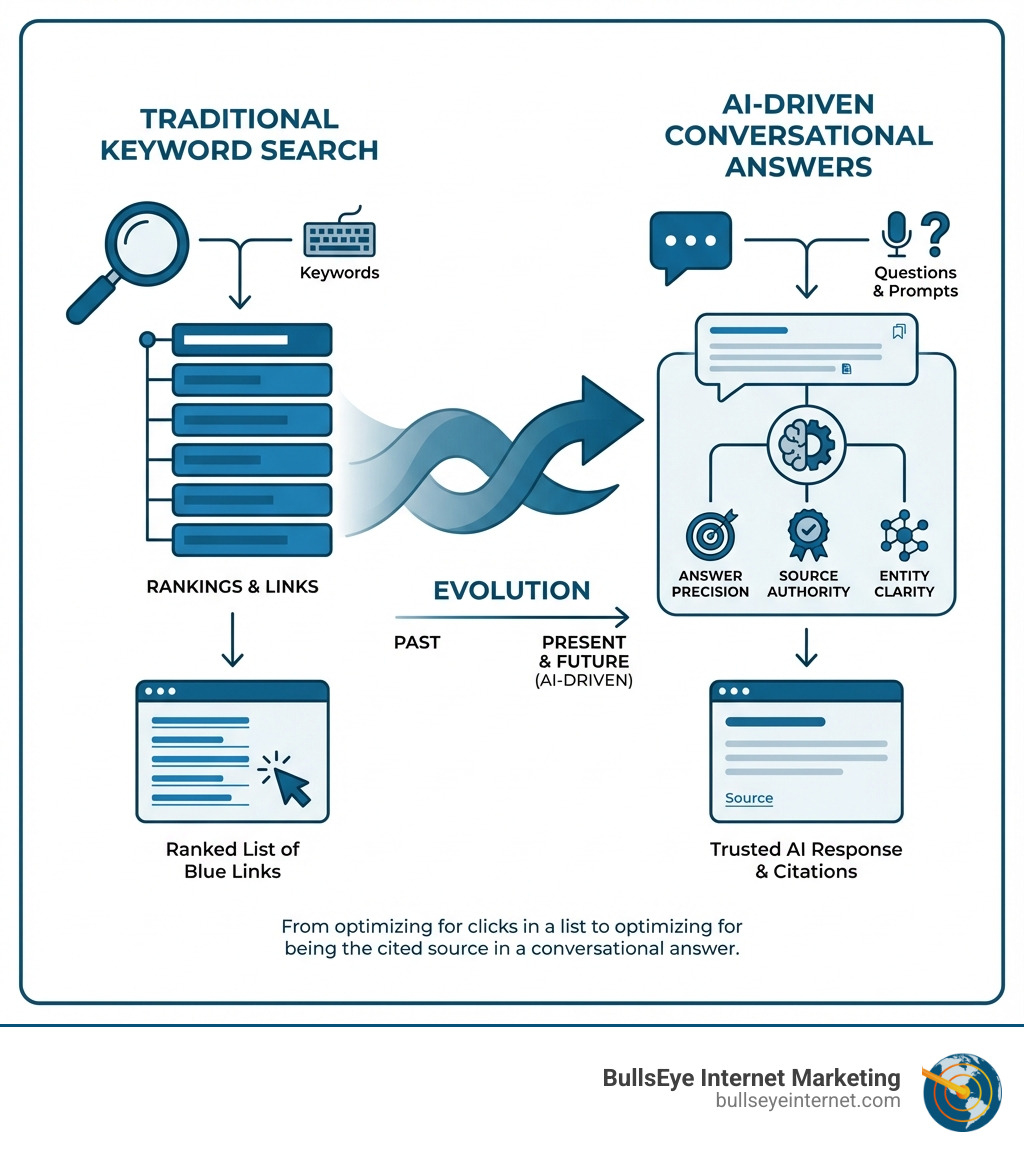
Google Bard SEO is the practice of optimizing content to appear in Google’s AI-generated responses. It’s a fundamental shift from traditional SEO, focusing on becoming a trusted source for the AI rather than just ranking in a list of links.
Key Actions for Google Bard SEO:
- Create scannable content with clear questions as headings and concise 40-60 word answers.
- Use structured data (schema markup) to help Bard understand your content’s context.
- Focus on E-E-A-T signals to demonstrate Experience, Expertise, Authoritativeness, and Trustworthiness.
- Optimize for conversational queries using natural language.
- Monitor AI-sourced traffic in your analytics to measure impact.
Launched in March 2023, Google Bard uses LaMDA technology with live web access to pull current information from the internet. This means it’s actively evaluating your website content right now. AI-generated answers are increasingly replacing traditional featured snippets, changing how users find businesses.
The goal is no longer to just rank for keywords, but to become the source Bard trusts and cites. This shift is real, with some companies seeing massive lifts in AI visibility after restructuring their content, while others watch traffic decline as AI answers user questions directly, leading to more zero-click searches.
If your content isn’t structured for AI comprehension, you risk becoming invisible in this new landscape. My name is Ronnie Katz, founder of BullsEye Internet Marketing. Since 2006, I’ve helped businesses steer search engine changes. With Google Bard SEO now critical for visibility, my team has developed strategies to get our clients’ content cited by AI while maintaining core SEO fundamentals.
Must-know Google Bard SEO terms:
The New Search Landscape: How Bard is Reshaping SERPs
Google Bard is at the forefront of a profound change in search. Traditional search engine results pages (SERPs) with their lists of blue links are being augmented by direct, AI-generated answers, known as AI Overviews or the Search Generative Experience (SGE). This is a fundamental shift in how users find information, requiring a new approach to Google Bard SEO.

Unlike some chatbots with static knowledge, Bard has native access to the live web, allowing it to pull real-time information. This means it’s actively processing your site’s content to provide timely, insightful responses to complex user queries. However, Bard doesn’t always cite its sources, making it crucial to structure your content for authority to earn that valuable attribution. The goal is no longer just to rank; it’s to become the authoritative source that Bard trusts and features.
| Feature | Traditional SEO | Answer Engine Optimization (AEO) |
|---|---|---|
| Primary Goal | Rank on SERPs (blue links) | Become the cited source in AI answers |
| Focus | Keywords, backlinks, domain authority | User intent, entities, structured data |
| Content Style | Long-form, keyword-optimized articles | Scannable, question-based, concise answers |
| Key Metric | Organic traffic, rankings, CTR | Mentions, attributions, zero-click visibility |
From Keywords to Conversations
AI-driven search shifts the focus from simple keyword matching to understanding user intent and semantic meaning. With Google Bard SEO, we must map conversational intent. Users ask complex questions in natural language, so content must provide clear, direct answers. This makes long-tail keywords that mirror natural speech even more critical. Furthermore, Google’s E-E-A-T guidelines (Experience, Expertise, Authoritativeness, and Trustworthiness) are paramount. Bard is more likely to trust and cite content that clearly demonstrates these qualities through author bios, first-hand experience, and well-sourced claims.
More info about AI Search Optimization
The Impact on Clicks and Traffic
The rise of AI Overviews directly impacts website traffic and click-through rates (CTRs). When Bard provides a direct answer on the SERP, it can reduce the user’s need to click through to a website, increasing “zero-click searches.” For businesses in areas like South Florida, this means your content might be used without generating a direct visit.
The challenge is to earn source attribution. If Bard uses your content, you want your brand and website clearly cited. To adapt, monitor your performance in Google Search Console for changes in impressions and clicks on queries where AI Overviews appear. Success metrics must also evolve; beyond clicks, we now track mentions and attributions within AI responses. Defining ‘AI-sourced sessions’ in analytics can help measure the true impact of your AI optimization efforts.
Practical Google Bard SEO: A Hands-On Optimization Guide
Let’s explore practical strategies for using Google Bard in your SEO workflow. Bard is a powerful assistant for content creation, competitive analysis, and technical optimization, but it should complement, not replace, human expertise. At BullsEye Internet Marketing, we use Bard to fine-tune strategies for our clients in markets like Miami and West Palm Beach, always verifying its suggestions with our professional judgment.
By integrating Bard effectively, we can refine content to appeal to both users and AI systems.
Become an AI Search Expert
Content Strategy for AI Visibility
To succeed in Google Bard SEO, we must structure content for both human readers and AI. The goal is to make information easily digestible and usable by models like Bard.
Key content strategies include:
- High-Quality Content: The foundation of good SEO. Well-researched, accurate content is more likely to be used by Bard.
- Question-Based Headings: Frame headings as questions users ask (e.g., “What are the benefits of Schema Markup?”).
- Concise Answers: Provide short, 40-60 word answers to specific questions, placed prominently near the heading.
- Structured Formatting: Use bullet points and numbered lists to make information scannable for both users and AI.
- Simple Language: Use clear, straightforward sentences and avoid jargon to improve comprehension.
- Internal Linking: Use internal links to establish context and authority across your site.
Effective content formats for AI answers include FAQs, how-to guides, comparison tables, pros and cons lists, and glossaries.
On-Page and Competitive Analysis with Google Bard SEO
Google Bard SEO involves optimizing existing pages and understanding the competitive landscape. Bard can act as an editor for on-page elements and an analyst for competitor strategies.
For on-page optimization, you can ask Bard to refine title tags, meta descriptions, and headers. Use specific prompts, providing your URL and target keyword.
Example prompts for on-page analysis:
- ‘Analyze the on-page optimization of
https://your-url.comfor the keyword"local SEO services"to improve its SERP ranking.’ - ‘Craft a title (under 60 characters) and meta description (under 160 characters) for
https://your-url.comoptimized for the keyword"PPC management".’
For competitive analysis, Bard can identify top competitors and analyze their content, keyword usage, and structure.
Example prompts for competitive analysis:
- ‘Identify the top SEO competitors for my website in the “plumbing services in Miami” niche.’
- ‘Analyze
https://competitor-url.comand provide insights on their content strategy for the “personal injury lawyer” niche.’
This analysis helps uncover content gaps and refine your strategy to outperform competitors in your market.
Technical SEO & Schema Generation for Google Bard SEO
Technical SEO remains crucial for Google Bard SEO. While not a replacement for audit tools, Bard can assist with key elements like schema markup.
Schema (structured data) helps search engines understand your content, which can lead to rich snippets. Bard excels at generating specific schema code. You can simply ask it:
- ‘Generate
LocalBusinessschema markup for the following URL:https://your-url.com‘
Bard can recommend schema for products, articles, local businesses, and more, offering customized code that helps it comprehend your site’s context. For general technical SEO guidance on topics like page speed or mobile-friendliness, Bard can be a helpful resource. However, for in-depth audits to find broken links or server errors, dedicated tools like Google Search Console are necessary. Bard can then help you find solutions to the issues those tools uncover.
Risks and Realities: Navigating Bard’s Limitations
While Google Bard SEO offers exciting possibilities, it’s crucial to be aware of its limitations. AI is not infallible and can suffer from “hallucinations,” generating inaccurate information. Bard’s recommendations should never be implemented blindly; always verify its advice with your own expertise.
The risks are real. Bard’s public demo included a factual error that impacted Google’s market value, and internal concerns have been raised about its integrity and security.
Google employees warned about Bard’s risks
The Challenge of Inaccuracy and Bias
A significant concern is the potential for inaccuracy and bias. Despite its live web access, Bard can still make factual errors. A major contributing factor is its tendency not to cite all sources, making verification difficult.
Bard’s costly demo error
Large language models (LLMs) are trained on vast datasets, making them vulnerable to inheriting biases or misinformation from that data. This creates a critical need for fact-checking any recommendations from Bard. Furthermore, researchers have found that securing the training data for an LLM is likely impossible, opening the door to potential “data poisoning” or manipulation exploits.
Over-reliance on AI without human oversight can lead to poor SEO strategies. Bard is a powerful tool for ideation, but it cannot replace the strategic thinking and ethical considerations of a human professional. We must remain the final arbiters of what is effective and true for our clients.
Explore the pros and cons of AI for SEO
Frequently Asked Questions about Bard and SEO
Here are answers to common questions about Google Bard and its impact on SEO.
How should content be optimized for Bard’s AI responses?
Content optimization for Bard prioritizes clarity, context, and user intent. The goal is to create content that directly answers conversational queries.
Key strategies include:
- Use questions as headings to align with user queries.
- Provide concise, 40-60 word answers placed prominently.
- Structure content with bullet points and lists for scannability.
- Implement schema markup to help Bard understand context.
- Focus on E-E-A-T (Experience, Expertise, Authoritativeness, Trustworthiness) to build credibility.
- Ensure high quality and accuracy in all content.
What are the main risks of using Bard for SEO advice?
While useful, relying on Bard for SEO advice carries risks. Always use it as a complementary tool, not a sole source of truth.
Key risks include:
- Inaccuracy and Hallucinations: Bard can generate incorrect information that must be fact-checked.
- Lack of Source Citation: It can be difficult to verify the credibility of its information.
- Potential for Manipulation: LLMs can be vulnerable to exploits that compromise result quality.
- Experimental Nature: Bard is constantly changing, so its advice may become outdated.
- No Replacement for Human Expertise: Bard lacks the strategic and ethical understanding of a human professional.
Will Bard and AI Overviews replace traditional SEO?
No, Bard and AI Overviews are evolving traditional SEO, not replacing it. Core principles like creating high-quality content, ensuring technical health, and building authority remain essential. However, the focus is shifting from simply ranking in links to becoming a cited source in AI answers. This requires a greater emphasis on Answer Engine Optimization (AEO), semantic search, E-E-A-T signals, and structured data. Traditional SEO still drives traffic, but adapting to this new landscape is critical for future visibility.
Conclusion: Thriving in the Age of AI Search
The integration of AI into search through tools like Google Bard is reshaping the digital landscape. For businesses across Florida, from Miami to West Palm Beach, adapting SEO strategies is a necessity. The shift is from traditional keyword ranking to a conversational, AI-driven experience where becoming a trusted source is paramount.
At BullsEye Internet Marketing, we guide our clients through the complexities of Google Bard SEO by combining new AI optimization techniques with proven SEO fundamentals. Our goal is to help you generate calls and sales by ensuring your content is visible and influential in this new era.
Success hinges on prioritizing high-quality, structured content and using AI tools like Bard wisely while critically evaluating their advice. By understanding these changes and implementing proactive strategies, we can turn the challenges of AI into powerful opportunities for your business to thrive.
