
Why Understanding What Are Citations SEO Can Transform Your Local Visibility
What are citations in SEO? Here’s the quick answer:
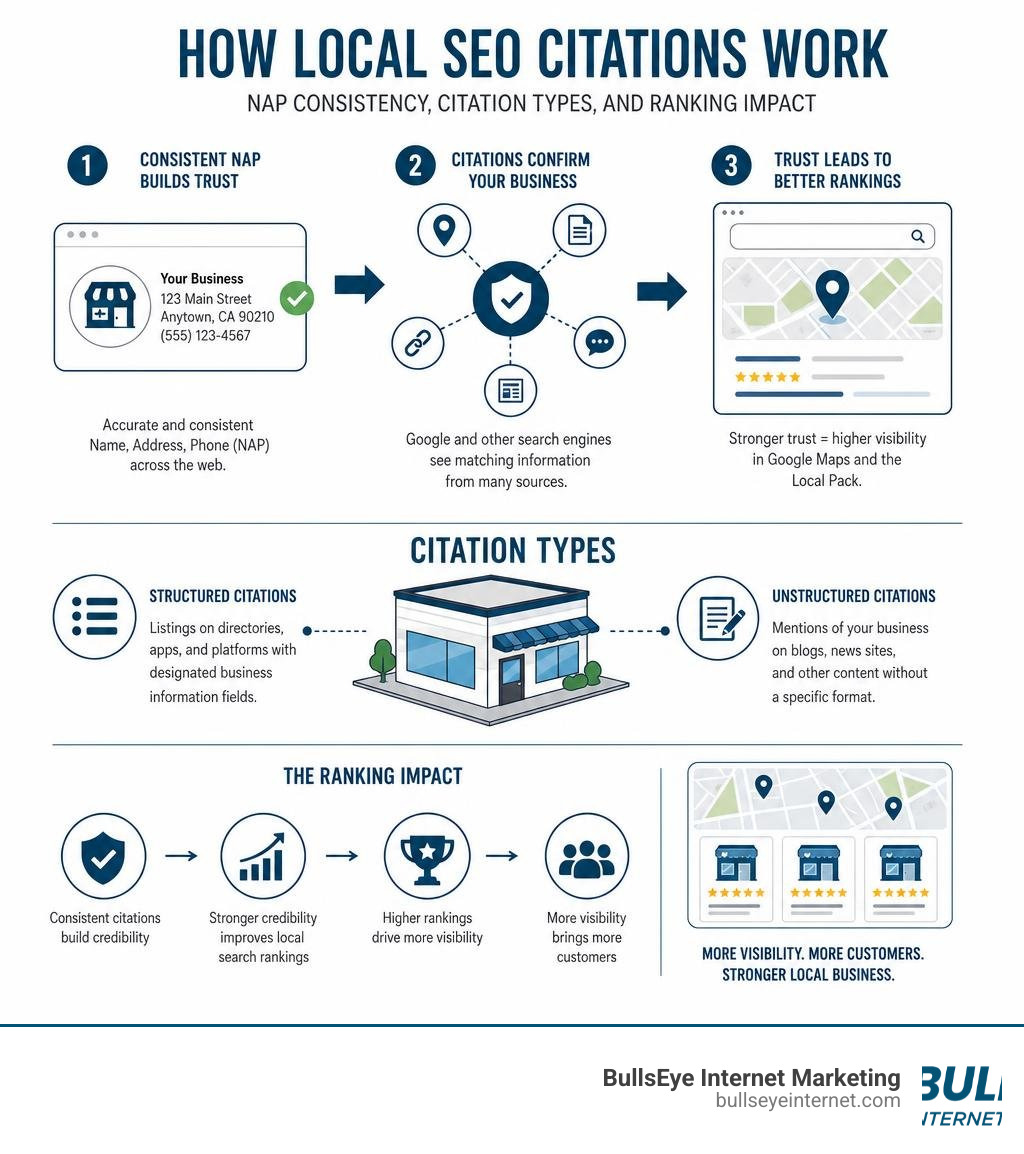
SEO citations are online mentions of your business’s Name, Address, and Phone number (NAP) on websites other than your own — like Google Business Profile, Yelp, or industry directories.
At a glance:
- They tell Google your business is real, trustworthy, and located where you say it is
- They appear as both structured listings (directories) and unstructured mentions (blogs, press)
- They are the sixth most important ranking signal for local search results
- More consistent citations = stronger local visibility in Google Maps and the Local Pack
- The average local business has around 80 citations
Citations don’t just help Google find you. They help customers find you — on Yelp, Apple Maps, Bing, and dozens of other platforms people use every day.
When your business details match everywhere, Google gains confidence that you’re a legitimate local business worth showing to searchers. When they don’t match — even small things like “St.” vs. “Street” — that confidence erodes, and so do your rankings.
I’m Ronnie Katz, founder of BullsEye Internet Marketing, and since 2006 I’ve helped hundreds of businesses improve their local visibility through smarter what are citations SEO strategies. In this guide, I’ll walk you through exactly how citations work, why they matter, and how to build them the right way.
Explore more about what are citations SEO:
What Are Citations SEO and How Do They Work?
To understand how local search engines determine which businesses to display in the coveted Local Pack, we must first look at how they verify information. In the digital world, trust is built through corroboration. Search engines like Google do not just take your website’s word for it; they scour the web to see if other reputable sources agree with your declared location, contact details, and business name.
This is where the concept of what are citations SEO comes into play. Every time your business is mentioned on a third-party platform, directory, or media site, it leaves a digital footprint. Google’s algorithm collects these footprints to build a profile of your business’s prominence, relevance, and physical location.
When you establish a strong network of consistent listings, you are essentially feeding search engines the data they need to verify your business’s legitimacy. To read more about how these listings build your brand’s digital presence, explore The SEO Power of Citations: How Business Listings Build Authority.
Understanding the Core Definition of What Are Citations SEO
At its most fundamental level, an SEO citation is any online reference to your business’s Name, Address, and Phone number (commonly referred to as NAP). Some citations will also include your website URL, business hours, email address, and photos, but the core NAP is what search engines use for geographical verification.
To clarify, let’s look at what we mean by these mentions. As detailed in What are Local Search Citations?, these references act as a digital directory listing.
A quick piece of humor: when we discuss citations in SEO, we are definitely not talking about the annoying Parking Citations – Miami-Dade Clerk of Courts you might get while parking your car near Coconut Grove or Fort Lauderdale! Instead, these are positive, trust-building signals that put your brand on the map.
For a business operating in South Florida—whether you are a personal injury attorney in Miami, a commercial roofer in West Palm Beach, or a pediatric dentist in Boynton Beach—your local search citations are the bedrock of your local SEO strategy. They prove to search engines that you physically exist in Broward, Miami-Dade, or Palm Beach County, making you a safe and highly relevant option to show to nearby searchers.
How Citations Differ from Traditional Backlinks
Many business owners confuse citations with traditional backlinks, but they serve different roles in search engine optimization:
- Traditional Backlinks: These are hyperlinks from one website to another. Their primary purpose is to pass “link equity” (or “domain authority”) to your site. Google views backlinks as editorial votes of confidence. If a high-authority blog links to your homepage, your overall organic authority rises.
- SEO Citations: While many citations do include a link to your website, their primary value lies in the mention of your NAP data. Google uses citations to verify your business’s physical identity and location. Even if a directory uses a “no-follow” link (which does not pass traditional search authority), the citation still holds immense value for local SEO because it verifies your NAP consistency.
In the evolving search landscape of July 2026, the distinction between links and citations has expanded even further. With the rise of Answer Engine Optimization (AEO) and conversational search, citations have become the primary method for AI models to attribute sources. As highlighted in The role of citations in AEO: Why citations matter more than backlinks for AI visibility, AI systems prioritize structured entity data and factual accuracy over raw backlink counts when generating answers for users.
The Different Types of Local SEO Citations
Not all citations are created equal. To build a balanced and effective local SEO strategy, you need to understand the different formats these mentions can take. Broadly, citations are split into two categories: structured and unstructured.
Getting both types of listings right is essential for complete coverage. If you want to dive deeper into how to submit your business details across these formats, check out Citation Submissions for Local SEO.
Here is a quick comparison of how these two citation types differ:
| Feature | Structured Citations | Unstructured Citations |
|---|---|---|
| Primary Location | Dedicated business directories & map apps | Blogs, news sites, community forums, social media |
| Data Format | Standardized, structured fields (NAP) | Natural, paragraph-style text |
| Ease of Creation | Simple to submit manually or via aggregators | Requires content creation, PR, or community outreach |
| SEO Signal | High geographic verification & category relevance | High brand prominence, trust, and contextual authority |
| Examples | Yelp, Bing Places, Apple Maps, YellowPages | Local news feature, neighborhood blog post, Reddit thread |
Structured Citations in Business Directories
Structured citations are the most common type of local listing. They exist within dedicated online directories where business information is displayed in a standardized, machine-readable format.
When you build structured citations, you fill out specific form fields for your business name, street address, phone number, website, and business category. Because the data is structured, search engine crawlers can easily parse and catalog it.
The journey of building structured listings starts with the most critical platforms: Google Business Profile, Apple Maps, Bing Places, and Yelp. From there, you want to expand to the most authoritative general directories. You can find a curated list of these foundational platforms in The 50 Best Local Business Listing Directories.
However, general directories are only half the battle. To maximize your local relevance, you must prioritize category-specific and location-specific directories. For example:
- A medical clinic in Delray Beach should be listed on Healthgrades and Zocdoc.
- A home contractor in Fort Lauderdale should have robust profiles on Angi and Houzz.
- A business in Palm Beach County should seek listings on local chamber of commerce directories.
These niche-specific directories carry immense weight because they signal to Google that you are an active, recognized participant in your specific industry and local community.
Unstructured Citations in Digital Media
Unstructured citations occur when your business’s NAP information is mentioned naturally within non-directory web content. This includes blog posts, local news articles, digital press releases, community forums, and social media platforms.
For instance, if a South Florida lifestyle blog writes an article about the “Best Coffee Shops in Coral Gables” and lists your shop’s name, address, and phone number within the body of the paragraph, that is an unstructured citation.
While unstructured citations are harder to acquire than structured directory listings, they are incredibly powerful. They signal to Google that your business has real-world prominence and that people are actively talking about your brand.
In July 2026, unstructured mentions have become even more vital as search engines place a greater emphasis on brand authority and off-site corroboration. According to research on modern search signals, including 8 citation signals for SEO examples 2026, repeated brand mentions on trusted third-party sites are highly correlated with top rankings in both traditional local packs and AI-generated search summaries.
Why NAP Consistency is Critical for Local Search Success
If there is one golden rule in local search engine optimization, it is this: your NAP data must be completely consistent across the entire web.
Google’s algorithm is essentially a trust engine. It wants to provide searchers with the most accurate, reliable information possible. If Google finds your business listed with three different phone numbers or two different addresses, it gets confused. And in SEO, a confused algorithm is an algorithm that will not rank your business.
Maintaining this data integrity is not just about pleasing search engines; it directly impacts your overall optimization health. To understand how clean data sets the stage for successful search campaigns, read How Accurate Local Citations Improve Your SEO Audit Results.
How Inconsistent Data Hurts Your Local Rankings
When search engines crawl the web and encounter conflicting information about your business, several negative things happen:
- Loss of Algorithmic Trust: If your address on Yelp says “123 Miracle Mile, Coral Gables” but your Google Business Profile says “123 Miracle Mile Suite A”, Google’s algorithm cannot verify which is correct. This minor discrepancy lowers the algorithm’s confidence in your physical location, which can push you out of the Google Maps Local Pack.
- Diluted Ranking Signals: Instead of all your citations pointing to and strengthening a single, unified business entity, your ranking power is split among duplicate or incorrect listings.
- Customer Frustration: Imagine a potential customer finding an outdated phone number on an old directory listing, calling it, and reaching a disconnected line. They will immediately move on to your competitor.
Ensuring your business details are flawless across the web is a direct driver of conversion rates and customer satisfaction. We discuss this connection in detail in How Accurate Business Listings Can Improve Customer Trust and Boost Sales.
Best Practices for Maintaining Accurate Business Listings
To keep your business listings clean, organized, and highly effective, we recommend implementing the following best practices:
- Create a Master NAP Sheet: Before you build a single new citation, document your exact business details in a master spreadsheet. This includes the precise spelling of your business name (avoid stuffing it with extra keywords), your exact address (including suite numbers), your primary local phone number, and your target landing page URL. Use this exact formatting for every single submission.
- Fix Your Core Listings First: Start by claiming and optimizing your profiles on Google Business Profile, Apple Maps, and Bing Places. These are the primary sources that other directories and search engines reference.
- Run a Comprehensive Scan: You cannot fix what you do not know is broken. Use a dedicated tool to scan the web for old, duplicate, or incorrect listings. You can get an instant look at your current listing health by using our Local Business Listings Scan.
- Monitor for Changes: Third-party directories often update their databases using public records or user suggestions. This means your clean listings can occasionally be overwritten with incorrect data. Schedule a quarterly audit to review and lock in your listings.
How to Build and Optimize Your Business Citations
Now that you know what citations are and why consistency is paramount, let’s look at the actual process of building and optimizing them.
Developing a streamlined workflow is the easiest way to scale your local presence without getting overwhelmed by the sheer volume of directories. For a deeper look at the tools that can simplify this process, read Beyond the Basics: How to Build Citations with Ease Using Online Tools.
Step-by-Step Guide to Manual and Automated Citation Building
When it comes to distributing your business data across the web, you have two primary paths: manual building and automated distribution.
The Manual Approach
Manual citation building involves visiting directories one by one, searching to see if your business already has an unclaimed listing, and either claiming it or creating a new one from scratch.
- The Pros: It is completely free (aside from your time), and it gives you 100% control over the exact information, photos, and categories selected for each profile.
- The Cons: It is incredibly time-consuming. Manually building 80+ consistent listings can take dozens of hours of repetitive work.
The Automated/Aggregator Approach
Automated citation building utilizes listing management tools and data aggregators to distribute your NAP data across hundreds of directories simultaneously. Major data aggregators (like Data Axle, Foursquare, and Neustar Localeze) maintain massive databases of business information. They license this data to search engines, GPS navigation systems, in-car maps, and smaller directory sites.
- The Pros: It is fast, efficient, and ensures wide-scale distribution. By submitting your master NAP data to the major aggregators, you can establish hundreds of citations with minimal manual effort.
- The Cons: Automated systems can sometimes miss niche-specific directories, and they require ongoing subscriptions to keep the listings locked in.
For most businesses, a hybrid approach works best. We recommend manually claiming your most important core profiles (Google, Bing, Apple, Yelp) to ensure they are fully optimized, and then using a professional service to handle the wider distribution. If you want a hands-off solution that handles the heavy lifting for you, explore our Business Directory Listing Service.
Optimizing Your Profiles Beyond Basic NAP Information
Many business owners make the mistake of filling out only the required NAP fields and leaving the rest of the profile blank. To stand out from your competitors and gain maximum SEO value, you need to fully optimize every listing.
To turn basic directory listings into active lead-generation assets, you must treat them as extensions of your website. Learn how to maximize your profile strength in Business Listing Optimization.
Make sure to optimize these key areas on your profiles:
- Write Compelling Business Descriptions: Craft a unique, professional description of your business. Include your primary local keywords naturally (e.g., “South Florida personal injury law firm”) and clearly state what services you offer. Avoid duplicate descriptions across all platforms; write a few variations to keep things fresh.
- Select Accurate Categories: Choose your primary business category with care. This is one of the strongest relevance signals for Google’s local algorithm. If you are a plumbing company that also does HVAC, set your primary category to “Plumber” and add “HVAC Contractor” as a secondary category.
- Upload High-Quality Photos: Listings with photos receive significantly more clicks and driving direction requests than those without. Upload professional photos of your office, your team, your completed work, and your logo. Optimize the image file names before uploading (e.g.,
miami-roofing-contractor-team.jpg) to provide additional search context. - Generate and Respond to Reviews: Reviews are a massive ranking factor for the Google Maps Local Pack. Encourage your satisfied customers to leave feedback on your major citation profiles (like Google and Yelp). Always respond to reviews—both positive and negative—in a polite, professional manner.
The Evolution of Citations: From Local Maps to AI Search in 2026
As we navigate through July 2026, search engine optimization is undergoing a massive paradigm shift. The rise of Generative AI, Large Language Models (LLMs), and Answer Engine Optimization (AEO) has fundamentally changed how users find information online.
Instead of typing a query and clicking through a list of “blue links,” millions of searchers are now asking conversational questions to AI assistants like ChatGPT, Perplexity, Gemini, and Google’s AI Mode, receiving direct, synthesized answers.
This evolution has not made citations obsolete; in fact, it has made them more important than ever. However, the definition of a citation has expanded. Today, we must optimize for both traditional local SEO citations and AI search engine citations. To understand how these two worlds connect, explore What Actually Gets You Cited in AI Search (2026 Data).
How AI Models and LLMs Use What Are Citations SEO
AI models do not generate answers out of thin air. To avoid “hallucinations” and provide accurate information, modern AI search engines use a process called Retrieval-Augmented Generation (RAG). When a user asks a question, the AI system searches the web in real-time to retrieve authoritative sources, synthesizes the information into a cohesive answer, and provides clickable citations back to the source documents.
In this new environment, AI citations are the gatekeepers of digital visibility. If your business or content is not cited in the AI’s response, you are practically invisible to that user.
Interestingly, AI models rely heavily on the same trust signals that power traditional local SEO. They use structured data, directory listings, and off-site brand mentions to verify the legitimacy of a business before recommending it. To understand the mechanics of how these systems choose their sources, read AI Citations Explained: How they work and how cited by AI models • Yoast.
Strategies to Get Your Content Cited by AI Search Engines
Earning citations in AI search results requires a shift in how you structure and write your online content. According to a meta-analysis of AI search studies, detailed in I Analyzed 23 Studies on AI Citations, there are several highly effective strategies you can implement to increase your chances of being cited:
- Build Strong Topical Authority: AI engines favor websites that demonstrate deep, comprehensive knowledge on a specific subject. Instead of writing isolated blog posts, build highly organized topic clusters with comprehensive pillar pages and tightly linked supporting articles.
- Optimize for Passage-Level Answerability: AI retrieval systems often pull information from specific passages rather than entire pages. Structure your content so that it answers target questions directly and concisely within the first few sentences of a section. Use clear, declarative language and avoid vague or hedged statements.
- Leverage Schema Markup: Use advanced structured data—such as Organization, LocalBusiness, Product, and FAQ schema—to make your content easily readable for AI crawlers. This helps search engines understand the exact entities, relationships, and facts on your pages.
- Earn Unlinked Brand Mentions: AI models analyze the entire web to determine brand trust. Having your business mentioned consistently across industry blogs, local news sites, and community forums (even without a direct hyperlink) builds the “entity authority” that AI systems look for when selecting sources to cite.
Frequently Asked Questions about Local SEO Citations
For many business owners, local SEO can feel like a moving target. To help clear up any remaining confusion, we have compiled answers to some of the most common questions we receive about what are citations SEO and how to manage them effectively.
If you are looking for a comprehensive blueprint on how to align your listings with a broader search strategy, refer to our Local SEO Complete Guide.
How many citations does my business need to rank?
There is no single magic number that guarantees a top spot on Google Maps. The number of citations you need depends entirely on your industry and the competitiveness of your local market.
On average, a local business maintains around 80 citations. If you are in a highly competitive niche—like a personal injury lawyer in Miami or a roofing contractor in Fort Lauderdale—your competitors may have over 100 high-quality listings.
The key is to focus on quality and relevance over raw quantity. Having 40 consistent, highly authoritative citations on major directories and industry-specific platforms will do far more for your rankings than having 150 low-quality listings on spammy, irrelevant directory sites.
How long does it take for citations to impact my SEO?
Local citation building is a long-term investment. Unlike paid advertising, which turns on instantly, search engines need time to crawl, index, and verify new listings across the web.
Generally, you can expect to see initial indexing and a gradual lift in your local search visibility within 4 to 8 weeks of submitting your citations. For highly competitive markets or businesses with a history of severe NAP inconsistencies, it can take 3 to 6 months of consistent cleanup and building to see major ranking improvements.
Can incorrect citations actively hurt my Google Maps rankings?
Yes, absolutely. Inconsistent or duplicate citations are one of the most common reasons businesses experience sudden drops in their Google Maps rankings.
If Google’s algorithm encounters conflicting information about your business name, address, or phone number, its confidence in your physical location drops. To protect the user experience, Google will prioritize competitors who have clean, verified, and highly consistent data across the web. This is why regular citation audits and duplicate suppression are so critical to long-term local SEO success.
Conclusion: Put Your Business on the Map with BullsEye Internet Marketing
In the competitive digital landscape of South Florida—stretching from the bustling streets of Miami-Dade to the growing communities of Broward, Palm Beach, Martin, St. Lucie, and Indian River counties—local visibility is the lifeblood of your business. Understanding what are citations SEO and implementing a rigorous citation management strategy is no longer optional; it is the infrastructure that drives phone calls, store visits, and revenue.
But keeping track of dozens of directories, clean databases, and the rapid evolution of AI search is a full-time job. That is where we come in.
At BullsEye Internet Marketing, we specialize in helping local businesses dominate their market. Our digital marketing agency focuses on one thing: generating calls and sales through expert Google Business Profile Optimization, local SEO, PPC, and conversion optimization.
We do things differently to give you a true competitive advantage:
- No Long-Term Contracts: We earn your business month after month through real, measurable results.
- Strict Exclusivity: We work with only one client per industry per geographic area. When you partner with us, we focus 100% of our local search expertise on helping you beat your competitors.
Ready to clean up your listings, build powerful digital prominence, and claim your spot at the top of the local map pack? Explore our BullsEye Internet Marketing Business Listings Service or call us today to schedule your free consultation. Let’s put your business on the map together!
