
Evaluating Channel Fit and Initial Setup
Before spending endless hours creating graphics or filming videos, you must determine whether Instagram marketing for startups aligns with your broader go-to-market plan. Instagram is an incredible visual engine, but treating it as a default requirement without audience validation will drain your runway fast.
Determining Channel Fit: Is Instagram Marketing for Startups Right for You?
Startups operating on limited capital need to validate channel-audience fit early. Ask yourself: does your Ideal Customer Profile (ICP) actively use Instagram to discover solutions, evaluate products, or connect with brands?
- Consumer Startups (B2C & E-Commerce): Instagram is almost always a primary channel. Visual storytelling, product usage demos, and micro-influencer reviews align naturally with how consumer products are discovered and purchased.
- Business Startups (B2B & SaaS): B2B founders often assume Instagram is useless, but that is a misconception. While decision-makers might not log on explicitly to buy enterprise software, visual workflow demonstrations, case studies, and founder commentary can build strong brand affinity. Check out our guide on B2B Startup Marketing for a deeper look at business-to-business acquisition frameworks.
If you are unsure, run short, 2-to-3-week test sprints before committing heavily. Treat early social initiatives as low-cost customer discovery experiments to gather real engagement data.
Profile Optimization: Preparing Your Account for Instagram Marketing for Startups
Your Instagram profile functions as a high-converting landing page. When a user taps through to your profile, you have less than 5 seconds to convince them to hit “Follow” or tap your link.
- Searchable Username and Name Field: Use a clean handle. Crucially, add primary search keywords into your “Name” field (e.g., “Jane Doe | AI Code Reviewer”). Instagram indexes this field, so adding your category makes you discoverable in search results.
- Keyword-Rich Bio: You have 150 characters to communicate your core wedge proposition. Structure it with one line stating what you do, one line providing social proof, and a clear call-to-action (CTA).
- Link-in-Bio Tool: Never link to a static homepage. Use a link-in-bio page pointing visitors to dedicated landing pages, lead magnets, or specific offer URLs.
- Pinned Posts: Pin three high-value posts to the top of your grid:
- The Origin Story: Who you are and why you built the product.
- The Core Product Demo: A short Reel showing your solution in action.
- Customer Proof: A carousel of real user reviews, results, or case studies.
- Highlight Architecture: Organize your permanent Story Highlights into clean buckets such as “Features,” “Reviews,” “FAQs,” and “Behind the Scenes.”
Developing a Cost-Effective Strategy for Instagram Marketing for Startups
Bootstrapping a brand requires high creative leverage. You don’t need a full production crew or five-figure creative budgets to stand out on social media; you need consistency, clear messaging, and smart workflows.

Budget Allocation and Lean Experimentation
When starting out, treat your marketing spend as a runway-aware learning budget. Allocate small test amounts—say, $5 to $10 a day—to amplify top-performing organic posts rather than launching expensive, cold ad campaigns from scratch.
By monitoring key metrics like Cost Per Click (CPC) and initial engagement early, you can evaluate true conversion potential before scaling spend. For an in-depth look at setting up your early paid strategy, read our article on Why Your Startup Needs a Digital Ad Strategy Yesterday.
Formulating the 3-Type Content Strategy
To avoid running out of ideas, structure your content creation using a proven 3-type framework that balances engagement, brand affinity, and direct conversion:
- Value Content (40%): Practical tips, visual frameworks, industry insights, and step-by-step solutions that solve direct problems for your target customer. This type drives saves and shares.
- Story Content (30%): Founder commentary, behind-the-scenes struggles, product development updates, and core company values. This humanizes your startup and builds real trust.
- Proof Content (30%): Customer testimonials, before-and-after results, product usage clips, and explicit product call-outs that convert interested viewers into qualified leads.
High-Impact Content Creation and Algorithm Optimization
Instagram’s ranking algorithm prioritizes content based on user interest, relationships, and direct retention signals. To capture organic reach in 2026, you must craft content designed for the algorithm’s main indicators: completion rates, saves, and direct message (DM) shares.
| Content Format | Primary Algorithmic Goal | Target Publishing Cadence | Key Success Metric |
|---|---|---|---|
| Reels | Discovery / Cold Reach | 3 to 5 per week | 3-Second Hold Rate (>60%), Shares |
| Carousels | Retention / Education | 1 to 2 per week | Save Rate, Swipe-Through Rate |
| Stories | Nurturing / Conversion | Daily (5 to 10 frames) | Poll Responses, Sticker Taps, DMs |
Mastering Short-Form Reels and Visual Hooks
Reels remain the single strongest engine for reaching non-followers on Instagram. Because short-form video gets heavy distribution preference, focusing on video structure is essential.
- The 3-Second Rule: The first 3 seconds determine if a user scrolls past or stays. Open with a strong verbal hook, on-screen text, or visual pattern interrupt (e.g., sudden movement, zoom, angle change).
- Keep It Concise: Aim for video durations between 15 and 30 seconds to maintain high completion rates.
- On-Screen Captions: Over 80% of users watch social videos with the sound off. Always include dynamic on-screen text captions.
- End with Engagement Drivers: Encourage viewers to share the video with a founder, save it for later, or drop a specific keyword in the comments for a lead magnet.
Driving Engagement via Stories and Interactive Features
While Reels draw in new viewers, Stories convert existing followers into loyal customers. Stories let you build authentic, personal touchpoints without worrying about grid aesthetic perfection.
Use interactive stickers—polls, questions, quiz modules, and slider meters—daily. These features invite immediate viewer interaction, signaling to the algorithm that your account maintains strong relationships with its audience.
Furthermore, setting up automated direct-message responses for specific keyword triggers in Stories allows you to convert interested viewers into pipeline leads effortlessly.
Amplifying Reach with UGC, Micro-Influencers, and Targeted Ads
As your organic foundation stabilizes, expanding reach requires tapping into external networks and leveraged channels.

Harnessing Micro-Influencers and User-Generated Content
Partnering with massive creators is often far too expensive for early-stage companies, and massive followings rarely translate to targeted sales. Instead, target micro-influencers (1,000 to 50,000 followers) and nano-influencers (under 10,000 followers) within your specific industry niche.
- High Engagement: Smaller creators frequently maintain much tighter bonds with their audience, resulting in significantly higher trust and engagement rates.
- Cost-Effective Deals: Micro-creators are often open to product exchange models, affiliate commission structures, or modest flat fees.
- Repurposing User-Generated Content (UGC): Authentic content filmed by real users converting in everyday settings routinely outperforms high-budget corporate commercials. Always request formal permission to repost customer UGC on your primary feed and ad campaigns.
Transitioning to Paid Instagram Advertising
Once you identify organic posts that consistently drive high engagement, comment inquiries, or bio link clicks, consider amplifying them using Meta’s advertising tools.
Start simple. Boost top-performing Reels directly in the app to warm up lookalike and interest-based audiences. As your budget expands, set up Meta Ads Manager to run targeted retargeting campaigns aimed at users who visited your website or interacted with your Instagram profile over the past 90 days.
Learn more about building structured digital campaigns in our overview of Advertising for Startups.
Key Metrics, Channel Integration, and Pitfalls to Avoid
It is easy to get caught up in follower counts and simple “likes.” However, true marketing success comes from connecting social engagement directly to business growth.
Essential Metrics: Tracking What Matters Beyond Followers
To measure real impact, focus on engagement metrics that signal true interest and intent:
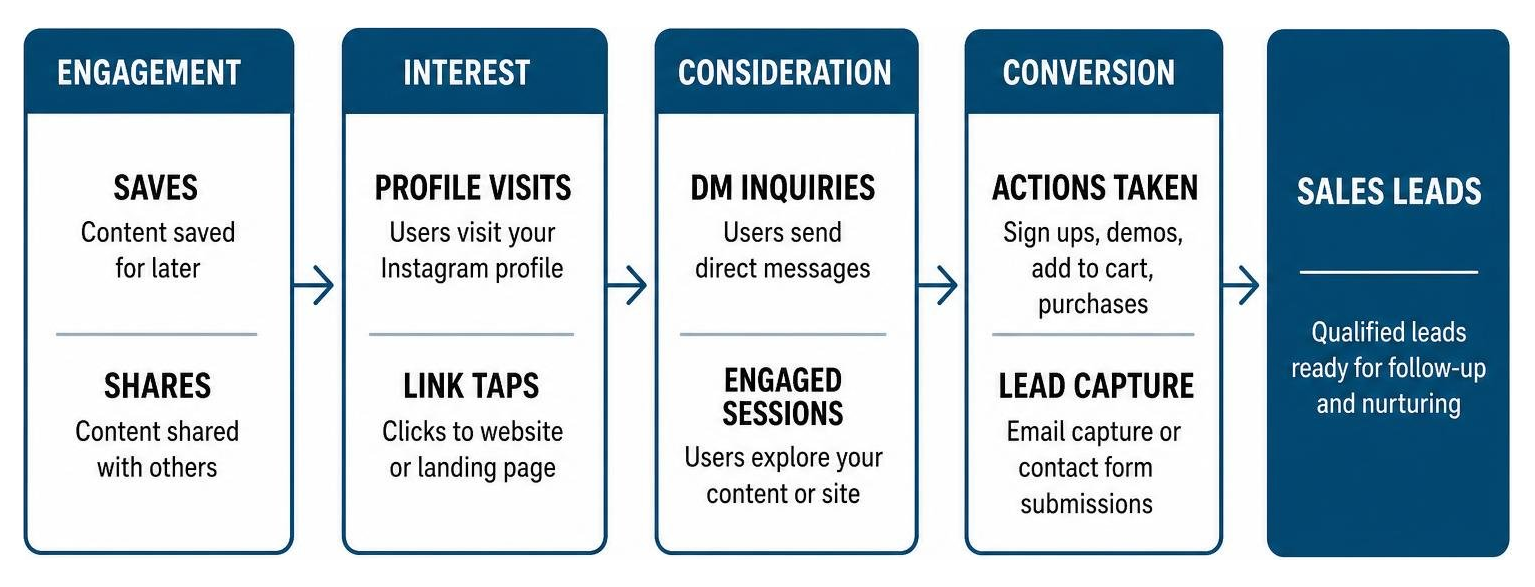
- Saves and Shares: High save rates indicate high educational value, while shares indicate strong viral relevance. Both signal high visual quality to the algorithm.
- Profile Visits and Link Taps: Measures how effectively your content drives curiosity back to your main account page and website.
- Direct Message Inquiries: Tracking DM conversations initiated by content helps evaluate mid-funnel prospect interest.
For a deeper dive into measuring social media ROI accurately, read our guide on From Likes to Leads: Measuring the Real Impact of Social Media Marketing.
Common Mistakes Startups Make and Multi-Channel Integration
Avoid these critical missteps that frequently trap new startups:
- Over-Polishing Everything: Raw, behind-the-scenes founder videos almost always outperform rigid, corporate visual graphics.
- Inconsistent Publishing: Posting 10 times in one week and then disappearing for three weeks tanks algorithmic trust and audience reach.
- Ignoring the DM Funnel: Treat your direct messages like a direct sales line. Respond to comments and inbound messages within hours to capture qualified interest while it’s fresh.
- Channel Isolation: Connect your Instagram presence to your overall stack. Install Meta pixels on your website, sync leads with your CRM, and cross-promote top video content across short-form channels.
Frequently Asked Questions About Instagram Marketing for Startups
How much budget should a startup allocate to Instagram marketing in 2026?
Startups can begin with zero paid ad budget by focusing purely on organic Reels, carousels, and founder storytelling. If you decide to run paid experiments, allocate a modest learning budget of $150 to $500 per month. Use this capital exclusively to amplify top-performing organic posts and test custom retargeting lists before committing to larger monthly spends.
Can B2B startups effectively generate leads using Instagram?
Yes. B2B startups win on Instagram by humanizing their brand and visually demonstrating value. Share screen recordings of your product solving real problems, post carousels showing metric-driven case studies, and feature founder commentary on industry trends. Using Instagram DMs as a direct networking line allows B2B founders to start low-pressure conversations with targeted decision-makers.
How long does it take to see real business results from Instagram?
With a consistent publishing cadence of 3 to 5 video Reels per week, daily Stories, and proactive community engagement, most startups begin seeing meaningful traction—such as consistent profile visits, inbound DM inquiries, and steady traffic—within 3 to 6 months.
Scalable Growth with BullsEye Internet Marketing
Executing a winning social media growth strategy requires strategy, consistency, and continuous optimization. While organic tactics help build initial community, combining them with targeted digital channels ensures long-term customer acquisition.
At BullsEye Internet Marketing, we help companies scale efficiently by implementing high-converting digital marketing systems. From SEO and pay-per-click management to total campaign conversion optimization, our team delivers predictable business growth. We operate with no long-term contracts and maintain a strict one client per industry per geographic market policy, giving your business a distinct competitive advantage in your local area.
Ready to take your startup’s digital strategy to the next level? Explore our Social Media Marketing Services or contact us today to Explore Digital Growth Services tailored specifically to your business goals.
