
Why Behavioral Data Matters for Legal Client Acquisition
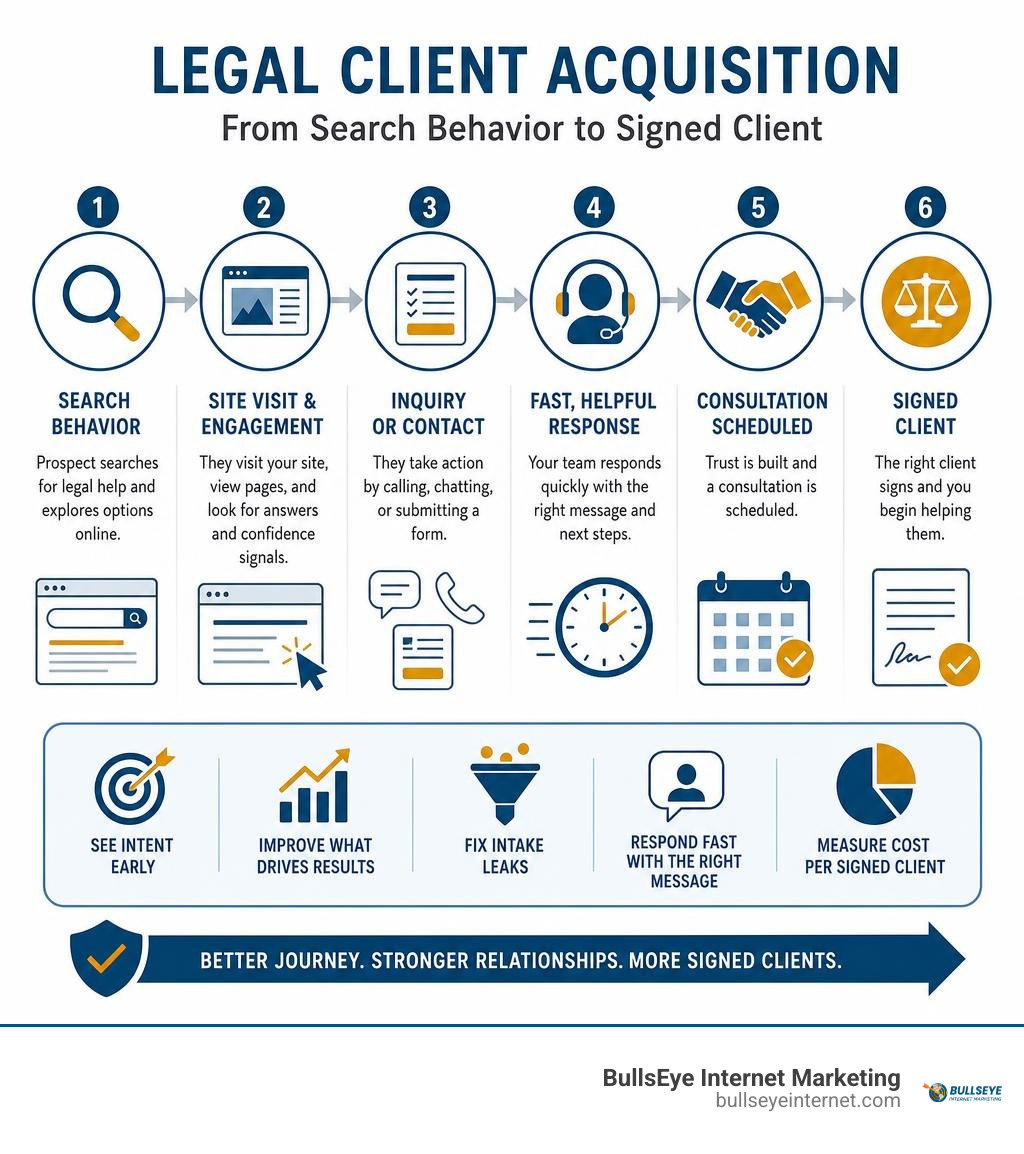
Legal client acquisition works best when a firm understands what prospective clients do before they call, chat, or submit a form. Behavioral data shows those signals: which services people search for, which pages they visit, where they stop, and how quickly they receive a helpful response.
For a quick answer, law firms can win more clients by using behavioral data to:
- Identify high-intent searches and pages that drive qualified inquiries.
- Improve Google visibility, ads, landing pages, and calls to action based on real visitor actions.
- Spot intake leaks, including missed calls, slow follow-up, and abandoned forms.
- Route and respond to leads quickly with the right practice-area message.
- Measure cost per signed client, not just clicks or raw leads.
This matters because 81% of people research legal services online before contacting an attorney, and 42% contact more than one firm at once. The firm that sees intent early, responds well, and makes the next step easy has a meaningful advantage.
I am Ronnie Katz, founder and Principal CEO of BullsEye Internet Marketing, with more than 20 years of experience helping businesses improve online visibility, traffic, and conversions. In legal client acquisition, I focus on turning measurable search and visitor behavior into more qualified calls, consultations, and signed matters.
Legal client acquisition helpful reading:
Step 1: Track Digital Intent Signals Across High-Value Marketing Channels
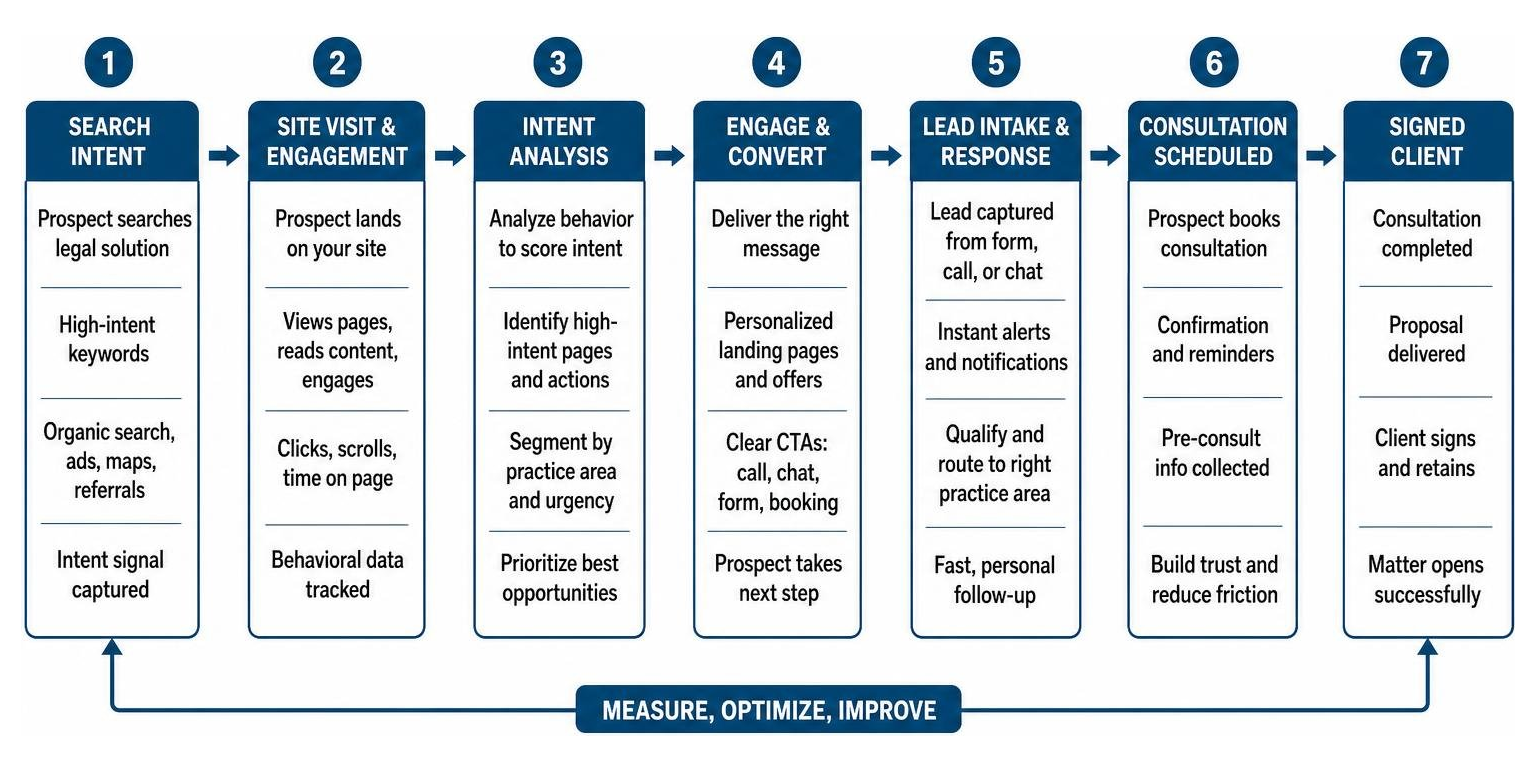
To transform legal client acquisition into a predictable engine, we must first look at how prospects express intent online. Modern legal consumers rarely choose a firm at random. Instead, 74% of people research a firm’s website before ever picking up the phone. By observing how users move through digital channels, we can pinpoint exactly when someone shifts from casual research to urgent commercial intent.
Understanding user intent begins with capturing user activity across search engines, landing pages, and content hubs. When a user in South Florida searches for “business litigation attorney near me” or “commercial lease dispute lawyer,” their behavioral signal indicates high urgency. Implementing robust tracking tools allows us to analyze click paths, time spent on practice pages, scroll depth, and call-to-action interactions.
Combining search analytics with strategic website design yields critical insights. For instance, if visitors frequently navigate from an article about partnership disputes straight to attorney bio pages, that path signals high interest in personal credentials and trust factors. We can refine user journeys by placing direct calendar booking tools or instant chat features on those high-intent transition points.
When firms combine organic search intent with targeted local strategies, conversion rates increase significantly. Implementing a comprehensive local attorney SEO framework ensures that local map listings, Google Business Profiles, and localized landing pages capture prospects right when their legal need peaks. Furthermore, mastering How Attorneys Get Clients: What Works Beyond Word of Mouth means building a continuous feedback loop where analytics directly inform content updates, keyword targeting, and user interface design.
Optimizing Paid Search Channels for Behavioral Conversion
Paid search campaigns represent one of the fastest ways to intercept prospects displaying immediate legal intent. In fact, Google Ads represents the largest single paid channel for most law firms, accounting for roughly 28% of all digital legal leads. However, because cost-per-click for competitive legal terms ranges from $20 to well over $100 depending on the market and practice area, driving paid clicks without analyzing user behavior leads to wasted ad spend.
To maximize paid search performance, firms must track post-click behavior meticulously. If a prospect clicks an ad for personal injury representation but bounces within five seconds, the disconnect usually stems from ad-to-landing-page messaging friction or slow page load speeds. By reviewing click-through rates (CTR) and user session replays, we can tailor landing page content to match the exact search phrase and emotional state of the searcher.
Running Google Local Services Ads (LSAs) alongside Google Pay-Per-Click (PPC) campaigns creates a dual-presence strategy that captures prime real estate at the top of search results pages. To ensure every dollar yields results, continuous legal PPC management is vital. Monitoring behavioral signals such as call duration and chat completions ensures that ad budgets shift toward high-converting search terms while suppressing non-converting negative keywords.
Leveraging Employee Advocacy and B2B Thought Leadership
For B2B legal practices—such as corporate law, commercial litigation, employment law, and intellectual property—the buyer’s journey differs significantly from consumer legal marketing. Corporate decision-makers, general counsel, and HR directors do not typically respond to aggressive mass-media ads. Instead, they evaluate authority, track record, and deep domain expertise.
Behavioral data on platforms like LinkedIn shows that corporate audiences interact much more readily with individual professionals than with corporate brand pages. Official company pages on LinkedIn generally reach only 2% to 3% of their followers organically. In contrast, individual attorney posts achieve a 10% to 15% baseline reach. When firm members coordinate engagement during the first hour of posting, content reach can expand by 300% to 400%.
B2B practices can capitalize on this behavior by establishing structured employee advocacy programs. Equipping attorneys to share educational case studies, legal updates, and downloadable gated resources allows the firm to track which corporate prospects open emails, download whitepapers, or view lawyer profiles. Incorporating proven strategies from Lead Generation for Lawyers: What Actually Works enables firms to combine thought leadership with targeted outbound cold email campaigns, reaching mid-market executives right when compliance shifts or regulatory changes demand legal counsel.
Step 2: Systematize Intake and Speed-to-Lead Response Workflows
Capturing high-intent traffic is only half the battle in legal client acquisition. The true bottleneck for many law firms lies in the intake process. Research reveals a startling reality across the legal industry: 35% of all law firm inquiries—combining phone calls and web forms—never receive a response. Furthermore, 42% of potential clients contact multiple law firms simultaneously when seeking legal representation.
When a prospective client reaches out, the clock starts ticking immediately. Contacting a lead within 5 minutes makes them 21 times more likely to convert compared to waiting 30 minutes. Conversely, waiting several hours virtually guarantees that the prospect will hire a competing firm.

Law firms that measure intake behavioral metrics often uncover massive leaks in their conversion funnel. Studies show that multi-attorney firms lose an average of $200,000 or more each year purely from unanswered calls, while solo practitioners lose between $50,000 and $100,000. By modernizing phone intake scripts, introducing dedicated intake staff, and deploying a streamlined client acquisition machine, firms ensure that every incoming inquiry is met with immediate empathy and rapid qualification.
Building an AI-Driven System for Legal Client Acquisition
Integrating modern AI tools into the legal intake workflow addresses the speed-to-lead challenge head-on. Prospective clients often experience legal emergencies outside standard office hours. When someone searches for legal assistance at 9:00 PM, an automated response system can bridge the gap between initial interest and formal engagement.
24/7 AI-driven conversational software installed on practice area landing pages can interact with visitors instantly, answer baseline questions, screen for prospective case eligibility, and capture critical contact details. This eliminates after-hours drop-off and keeps prospects engaged with your practice.
AI intake automation delivers several clear operational advantages:
- Instant Engagement: Answers visitor questions within seconds, securing the prospect before they navigate to a competitor’s website.
- Automated Lead Qualification: Asks customized pre-screening questions to filter out non-viable matters, saving valuable attorney billing hours.
- Direct Calendar Integration: Allows qualified leads to self-schedule an initial consultation directly into the firm’s master calendar.
- Seamless CRM Integration: Automatically generates structured client intake files with detailed chat transcripts pushed directly into firm management software.
- Digital Fee Agreements: Transmits automated e-signature documents immediately following successful qualification calls, dramatically shortening retention timeframes.
Systematic Referral Networks and Specialization
While digital channels drive scalable inbound traffic, referrals remain an important foundation for legal growth, with 62% of law firms listing referrals as a major source of new cases. However, relying on informal word-of-mouth creates unpredictable revenue cycles. To turn referrals into a reliable client pipeline, firms must build systematic, tracked referral networks.
Niche specialization acts as the catalyst for continuous legal referrals. Generalist firms struggle to stand out in crowded markets, whereas specialized practices build focused brand recognition. For example, a lawyer who concentrates strictly on partnership disputes for middle-market corporate entities becomes the natural choice for general business attorneys seeking a conflict-free co-counsel. Selecting a sharp practice focus—such as acting as a specialized Mergers and Acquisitions Lawyer in Florida—gives professional peers a clear reason to refer complex matters.
Building a structured “Relationship Ladder” ensures that potential referral sources—including CPAs, wealth managers, real estate brokers, and out-of-state attorneys—are engaged consistently:
- Initial Identification: Map strategic advisors in adjacent industries serving your target client demographic.
- Value-First Outreach: Share educational materials, niche guides, or market reports rather than requesting client referrals directly.
- Structured Follow-Up: Maintain a systematic 30-day touchpoint schedule to stay top-of-mind.
- Reciprocal Alignment: Track outbound referrals sent to network partners to foster balanced professional relationships.
Overcoming Common Pitfalls in Legal Client Acquisition
Even well-funded legal marketing campaigns fail if operational blind spots sabotage lead conversion. One pervasive gap in law firm operations is the failure to capture contact information during initial inquiries. Statistics show that law firms fail to record a prospective lead’s email address 86% of the time, eliminating any opportunity for strategic email nurturing or remarketing.
Another critical factor is staff demeanor during the initial phone call or chat interaction. Over 50% of legal consumers state they will refuse to hire a firm if their initial contact with staff is perceived as cold, distant, or unhelpful. Legal intake requires balancing administrative efficiency with genuine human empathy.
To help identify operational gaps, the following table compares high-converting law firm intake systems against underperforming traditional approaches, referencing modern benchmarks detailed in our comprehensive law firm marketing guide 2026:
| Intake Dimension | Underperforming Practice | High-Converting Data-Driven Practice |
|---|---|---|
| Response Time | 4+ hours or next business day | Under 5 minutes (24/7 automated & live response) |
| Data Capture | Collects basic phone call notes; misses email 86% of the time | Captures 100% of contact data into integrated CRM |
| Lead Qualification | Attorneys handle initial unvetted screening calls | AI-assisted workflows & trained intake specialists screen leads |
| Follow-Up Discipline | Single call attempt with no systematic retries | Multi-channel automated text, email & phone follow-up sequences |
| Retainer Signing | Mailed contracts or in-person consultation required | Instant e-signatures sent via SMS/email during consultation |
| Staff Engagement | Rushed administrative intake focused on transactional data | Empathetic, client-centric conversations driving immediate trust |
Measuring ROI in Modern Legal Client Acquisition
To build a sustainable client acquisition machine, firms must move beyond surface metrics like impressions or website clicks and track true financial returns. Calculating Customer Acquisition Cost (CAC) across each marketing channel provides the clarity needed to reallocate budgets toward top-performing initiatives.
Across the legal industry, the average cost to acquire a new client ranges between $500 and $1,500 when factoring in ad spend, software tools, marketing agency retainers, and internal intake labor costs. However, CAC varies dramatically by practice area and competitive landscape. While estate planning or traffic law clients might carry a CAC of $300 to $600, high-stakes personal injury or commercial litigation cases can reach $3,000 to $8,000+ per signed retainer in competitive metro areas.
To accurately track Return on Investment (ROI), law firms should monitor five core metrics:
- Cost Per Lead (CPL): Total spend divided by total raw inquiries generated.
- Qualified Lead Rate: Percentage of raw inquiries that meet minimum case criteria.
- Intake Conversion Rate: Percentage of qualified leads that convert into signed clients.
- Cost Per Signed Retainer (CAC): Total channel acquisition investment divided by signed matters.
- Lifetime Value (LTV) to CAC Ratio: Comparison of average gross fee revenue per case against the cost incurred to secure that client.
By establishing rigorous tracking frameworks, law firms eliminate guesswork and scale their practices with confidence.

Frequently Asked Questions About Legal Client Acquisition
How do law firms get clients beyond word-of-mouth referrals?
Law firms generate predictable client flow by building multi-channel digital acquisition systems. Key strategies beyond word-of-mouth include:
- Optimizing local search rankings through Google Business Profiles and targeted geo-focused SEO.
- Running high-intent Google Ads and Google Local Services Ads (LSAs) for immediate pay-per-click lead generation.
- Publishing authoritative, educational content and authoring practice-specific digital resources.
- Deploying structured B2B outreach via LinkedIn and cold email campaigns targeting corporate decision-makers.
- Utilizing automated intake tools and 24/7 AI chatbots to capture and convert web traffic instantly.
Why is response time critical for legal client conversion?
Speed-to-lead is the single most important operational metric in legal client conversion because 42% of legal consumers contact multiple firms simultaneously. Reaching out to a prospective lead within 5 minutes increases conversion odds by 21 times compared to waiting 30 minutes.
Additionally, research shows that law firms that reduce response times from 4+ hours down to under 1 hour achieve revenue increases of 20% or more without increasing their ad spend. In contrast, delayed responses guarantee that prospects will sign with a faster-responding competitor.
What is the average cost to acquire a new law firm client?
The average cost to acquire a new law firm client (CAC) generally falls between $500 and $1,500 across all practice areas. However, acquisition costs depend heavily on practice area competition and geographic location:
- Consumer Law (Estate Planning, Bankruptcy, Family Law): Typically ranges from $300 to $800 per signed client.
- Corporate & B2B Law: Often ranges from $800 to $2,500 per signed matter, offset by higher average retainers.
- High-Competition Personal Injury / Mass Torts: High-competition PPC channels can push cost per signed case from $2,500 to over $8,000 in saturated legal markets.
Conclusion
Mastering modern legal client acquisition requires turning real-time behavioral data into actionable growth strategies. By optimizing paid and organic search channels, maintaining rapid speed-to-lead response times, deploying AI intake workflows, and measuring cost per signed case, your law firm can build a scalable client pipeline.
At BullsEye Internet Marketing, we help law firms dominate their local markets through targeted Pay Per Lead, Google Business Profile optimization, strategic SEO, and high-converting PPC campaigns. We back our results with an exclusive competitive advantage: we offer no long-term contracts and work with only one client per industry per geographic location. Contact us today to learn how our specialized Professional Service Ads can help your firm win more clients and drive predictable growth.
