
Why AI Search Challenges Matter
AI search challenges come down to a hard trade-off: finding useful answers quickly without losing accuracy or trust. Search systems must narrow huge sets of possible results, understand unclear questions, check changing sources, and avoid biased or made-up answers. More advanced models can help, but they also add costs and make it harder to see why an answer was chosen.
These challenges matter to businesses because an AI answer may shape what a customer believes before they ever visit a website. The sections ahead break down the technical limits, trust risks, and resource costs behind those answers.
I’m Ronnie Katz, founder and Principal CEO of BullsEye Internet Marketing. Since 2006, I’ve helped businesses improve their online visibility and measure results; today, that work includes helping clients navigate AI search challenges through AEO, GEO, and SEO.
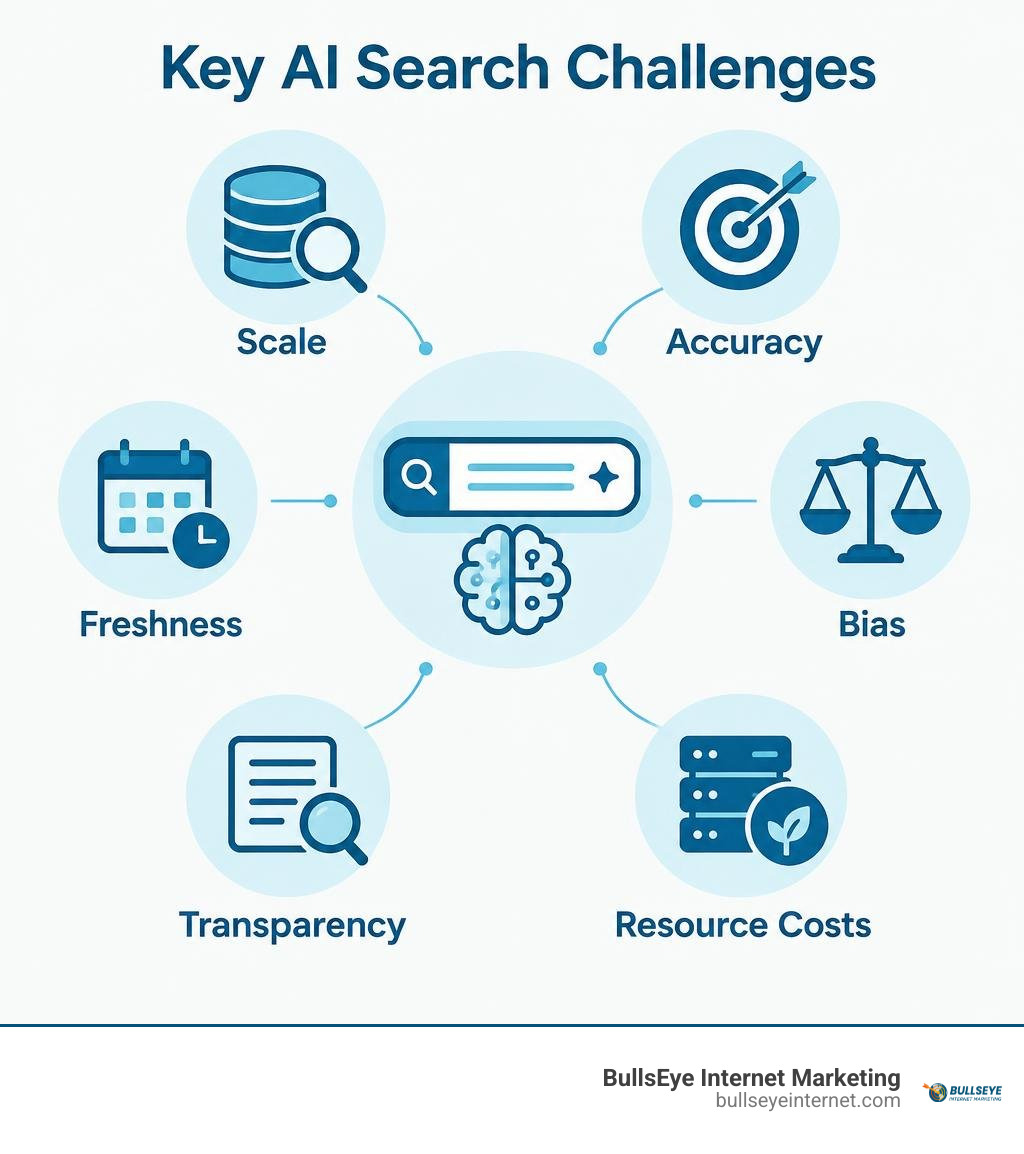
Important AI search challenges terms:
Core Algorithmic and Computational AI Search Challenges
Behind every seamless conversational interface lies a messy computational battlefield. Traditional search engines crawl documents, build inverted indices, and rank matches based on link graphs and text relevance. In contrast, artificial intelligence systems must parse unstructured natural language queries, navigate vast conceptual state spaces, and synthesize coherent responses on the fly.
To bridge this gap, engineers rely on techniques like demystifying retrieval augmented generation in search algorithms. However, combining neural networks with classical retrieval methods exposes foundational algorithmic bottlenecks.
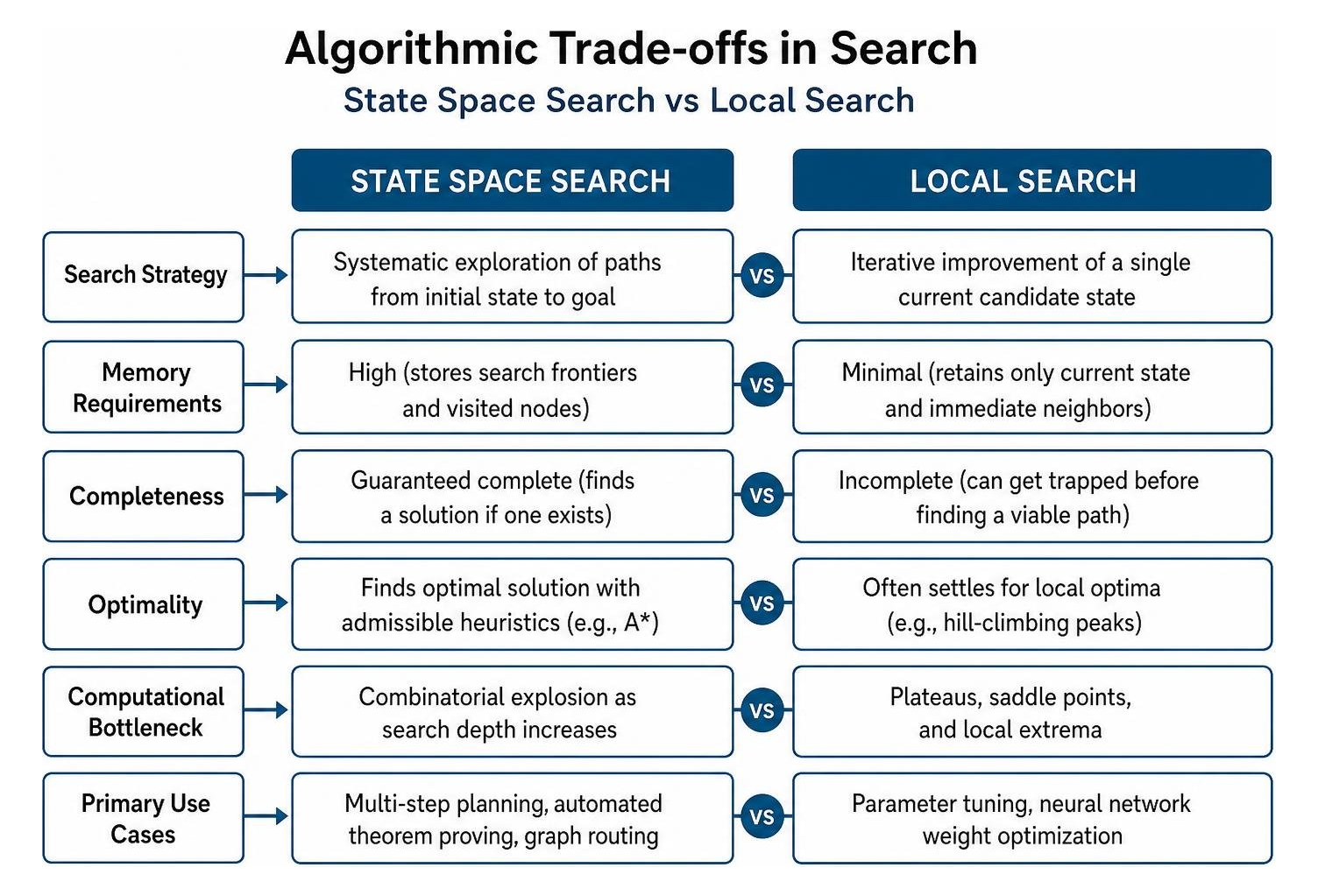
| Dimension | State Space Search | Local Search |
|---|---|---|
| Search Strategy | Systematic exploration of paths from initial state to goal | Iterative improvement of a single current candidate state |
| Memory Requirements | High (stores search frontiers and visited nodes) | Minimal (retains only current state and immediate neighbors) |
| Completeness | Guaranteed complete (finds a solution if one exists) | Incomplete (can get trapped before finding a viable path) |
| Optimality | Finds optimal solution with admissible heuristics (e.g., $A^*$) | Often settles for local optima (e.g., hill-climbing peaks) |
| Computational Bottleneck | Combinatorial explosion as search depth increases | Plateaus, saddle points, and local extrema |
| Primary Use Cases | Multi-step planning, automated theorem proving, graph routing | Parameter tuning, neural network weight optimization |
Resolving Combinatorial Explosion and Heuristic Pruning in AI Search Challenges
When an algorithm searches for an optimal answer across multi-step paths, the number of possible decision branches multiplies exponentially at each step. This phenomenon, known as combinatorial explosion, turns simple search trees into computational labyrinths. If an agent must choose among 10 actions over a sequence of 8 decisions, it faces $10^8$ possible paths—a volume that exhausts standard computing resources in milliseconds.
To keep these systems responsive, AI relies heavily on heuristic functions that prune unpromising branches before exploration. While heuristics make large-scale problem-solving possible, modern machine learning approaches cannot replace structured exploration entirely.
Research published in How Far Are LLMs from Real Search: Rethinking the Complementary Roles of Search and Learning highlights this limitation. Current large language models (LLMs) struggle with autonomous systematic exploration when isolated from external search routines. However, hybrid frameworks such as SeaL (Search via Learning) use neural models to generate accurate heuristic estimates, reducing effective search spaces by up to 99.1% across real-world planning benchmarks while preserving solution completeness through systematic verification.
Probabilistic Reasoning and Context Management in High-Entropy Search
Real-world web queries rarely present clean, deterministic logic. Users ask vague questions, web documents offer contradictory data, and facts shift constantly. AI search platforms must therefore apply probabilistic reasoning and Bayesian inference to evaluate confidence across competing assertions.
This uncertainty introduces severe context management challenges for autonomous search agents. As agents execute sequential retrieval loops, their context windows fill rapidly with retrieved snippets, tool call logs, and reasoning traces.
Studies such as Climbing to the Search Frontier demonstrate that context management strategies dictate system accuracy. Long-horizon agents frequently suffer performance drops due to context pollution, where irrelevant data drowns out vital clues. Implementing structured context pruning—such as discarding intermediate query residue while keeping verified core facts—delivers double-digit performance gains on multi-hop benchmarks.
Simultaneously, evaluating these models reveals structural hurdles. As highlighted in Breaking the Evaluation Paradox: Evaluating High-Entropy Search with Computationally Irreducible Constraints, measuring high-entropy search completeness using partial human-annotated answer pools penalizes agents that uncover valid answers beyond manual datasets. Incorporating verifiable, non-optimizable constraints provides a more objective benchmark for true autonomous retrieval. For businesses monitoring these shifting algorithmic patterns, applying a practical guide to ai search analytics helps measure how search engines parse their digital assets.
Information Retrieval and Generative Verification Bottlenecks

Synthesizing a direct answer requires far more algorithmic effort than displaying a ranked list of ten blue links. Modern search engines must retrieve multiple sources, evaluate factual consistency across disparate domains, and build a unified answer. Understanding key ai search ranking factors is essential for maintaining digital visibility as these ranking mechanics evolve.
Multi-Hop Reasoning and Long-Horizon Agent Failures
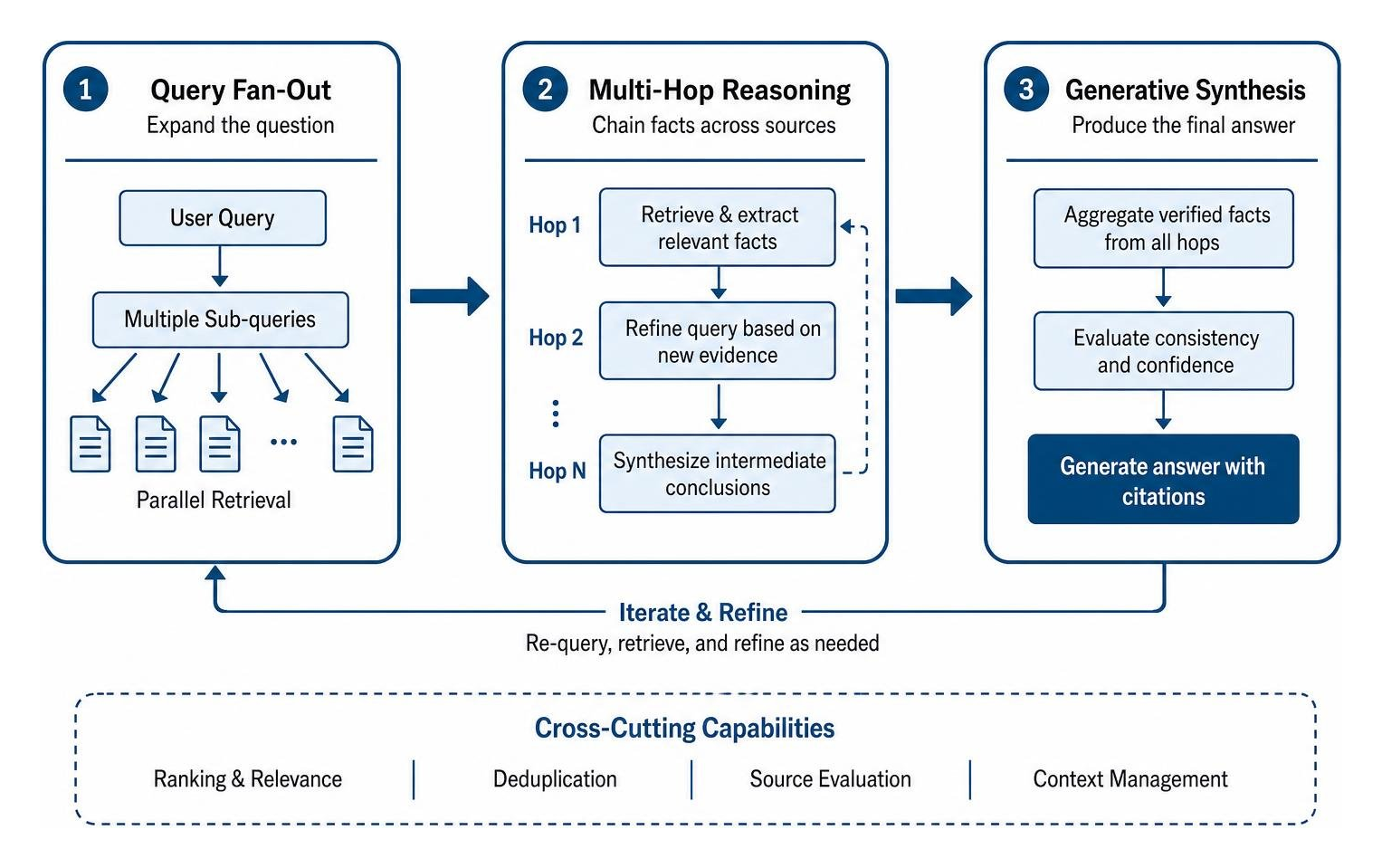
A major challenge in contemporary AI retrieval is answering complex multi-hop queries—questions where finding the solution requires chaining together multiple distinct facts across disparate web pages. When a user asks, “Which company acquired the startup founded by the winner of the 1998 Turing Award?”, an agent must execute a sequence of dependent actions:
- Identify the 1998 Turing Award winner.
- Locate the specific startup founded by that individual.
- Discover the acquiring corporation.
- Verify whether the corporate entity remains active under that name.
While top commercial models score over 85% on simpler, shallow benchmarks, their performance degrades when faced with deep reasoning chains. The LoHoSearch: Benchmarking Long-Horizon Search Agents Beyond the Human Difficulty Ceiling study found that state-of-the-art models achieved only a 34.74% accuracy rate on high-complexity, graph-structured search tasks.
These tasks averaged 61 tool interactions per successful query—a 74% surge in retrieval actions compared to standard tests. When autonomous search engines wander into deep reasoning loops, compounding error rates across intermediate steps frequently cause complete hallucination or task failure. Companies navigating this environment must reference the ultimate guide to generative engine optimization and ai search visibility to ensure their brand data remains easily interpretable for multi-hop extractors.
Source Volatility, Answer Freshness, and Verification Traps
Unlike traditional search indices that update documents in structured batches, generative search platforms deploy dynamic “query fan-out” routines, issuing multiple sub-queries simultaneously to gather real-time data.
An extensive academic analysis detailed in Characterizing Web Search in the Age of Generative AI revealed critical instabilities across generative engines:
- Variable Retrieval Depth: Retrieval behaviors fluctuate dramatically, with some systems scraping zero external links for factual queries while others retrieve up to 14 pages per request.
- Citation Drift: When tracking automated AI overviews over a two-month period, only 18% of cited web pages overlapped between identical query executions.
- Broad Domain Selection: Over 53% of web domains cited within generative syntheses were not present in the top-10 traditional organic search results.
This volatility introduces verification traps. When models balance internal parametric memory with real-time web scrapes, stale internal parameters can overwrite fresh information, resulting in confident yet outdated summaries. To safeguard digital presence against these dynamic retrieval patterns, businesses must grasp what is aeo and structure site content for immediate machine validation.
Ethical, Legal, and Transparency Hurdles in Machine Reasoning

As AI engines evolve from content curators into authoritative answer engines, mistakes carry significant real-world liabilities. Because deep neural models process patterns sub-symbolically across billions of parameters, explaining precisely why an engine selected a specific answer remains a persistent challenge. The legal industry has experienced these pitfalls firsthand, showing why legal practices must adapt to generative search immediately to avoid unverified automated research.
Mitigating Bias, Misinformation, and Hallucinations in AI Search Challenges
Because generative models generate text based on probabilistic token sequences rather than verified factual databases, they often invent plausible falsehoods.
These hallucination risks have created severe real-world fallout:
- Judicial Sanctions: By 2026, state and federal judges across the United States issued formal sanctions and bar associations released urgent warnings after attorneys submitted briefs citing non-existent court precedents invented by generative AI tools.
- Medical Research Contamination: A landmark 2026 Nature investigation revealed that unreliable and fabricated training data had infiltrated AI predictive models across 125 published research articles evaluating stroke and diabetes treatments.
- Algorithmic Bias: Search engines ingest systemic cultural biases present within raw internet training corpora, reinforcing skewed results during demographic or professional queries.
Mitigating these errors requires robust data governance and authority modeling, as outlined in the blueprint for building lasting brand authority in llm training sets.
The Black-Box Dilemma and Lack of Optimization Transparency
Traditional search optimization relies on clear web signals: crawling status, backlink authority, metadata definitions, and site speed. Deep neural networks, however, operate as non-linear mathematical black boxes. They represent language as dense vector embeddings in high-dimensional spaces, obscuring the clear pathways between site optimizations and search visibility.
This opacity complicates troubleshooting for software engineers and digital marketers alike. When an AI answer engine misinterprets a brand’s offerings or cites incorrect business details, pinpointing the corrupted neural node or biased data slice is practically impossible.
Establishing clear technical clarity requires modern auditing frameworks, such as those covered in a comprehensive guide to ai visibility seo llm optimization strategies.
The Escalating Energy and Infrastructure Costs of Neural Search
The transition from keyword-matching databases to dense transformer models has triggered unprecedented compute and electrical demands across global utility grids.
Generating real-time conversational answers requires continuous tensor matrix multiplications across high-performance GPUs, multiplying infrastructural resource consumption:
- Energy Multiplication: A single generative AI query consumes roughly 10 times the electrical power of a traditional keyword search.
- National-Scale Power Usage: In 2025, global data centres consumed more electricity than the entire nation of Saudi Arabia. Projections indicate total power demand for AI and computing could double by late 2026, with the added consumption matching the total electrical capacity of Japan.
- Cooling Demands: Keeping hyperscale data clusters operational requires intensive cooling. An AI platform’s operational cycle consumed an amount of fresh water equivalent to the survival needs of 500,000 individuals across Sub-Saharan Africa.
- Projected Grid Impact: Data centres in the United States accounted for 3% of national energy consumption in 2022. By 2030, that share is projected to reach 8%.
- Capital Expansion: A 2025 analysis by McKinsey & Company estimated that $2.7 trillion will be invested into American AI infrastructure and data centers by 2030—a monthly capital expenditure exceeding the cost of the World War II Manhattan Project.
- Carbon Footprint Trajectory: In 2025, an International Energy Agency (IEA) report calculated annual greenhouse gas emissions from AI computing at 180 million metric tons, with estimates projecting up to 300 to 500 million tons annually by 2035.
To secure reliable, low-carbon baseload power, tech companies are acquiring specialized energy assets directly. A prominent example occurred when Amazon acquired a Pennsylvania nuclear-powered data centre campus for $650 million, securing dedicated atomic generation to sustain its computational footprint.
Frequently Asked Questions About AI Search Complexities
How do state space search and local search differ in modern AI systems?
State space search systematically tracks pathways from a defined starting position toward an explicit objective, evaluating candidate solutions using path costs and heuristics to guarantee completeness. Local search operates by maintaining a single working candidate state, iteratively modifying variables to climb toward local efficiency peaks (such as gradient descent during model training). While local search uses minimal memory, it can become trapped in local optima, whereas state space search avoids these plateaus at the expense of high computational overhead.
Why do large language models struggle with exhaustive search independently?
LLMs are next-token prediction engines trained on semantic likelihood rather than discrete combinatorial solvers. When evaluating high-entropy queries requiring exhaustive enumeration across wide data sets, LLMs fail to establish strict mathematical termination boundaries. Without structured external search loops or explicit verification logic, their output relies on loose semantic associations that frequently omit valid items or fabricate unverified details.
What environmental impacts are driven by large-scale AI search operations?
Running large-scale neural search infrastructure accelerates water consumption for cooling systems, spikes local electrical grid loads, and drives high carbon emissions from fossil-fueled power plants. Meeting these energy demands has required massive capital investment in dedicated renewable grids, transmission line upgrades, and on-site nuclear generation assets.
Conclusion
Overcoming these AI search challenges requires balanced technical architectures. The future of search lies not in choosing between symbolic algorithms and neural models, but in uniting them: using large language models to interpret human nuances while relying on structured search indices to guarantee factual accuracy and operational efficiency.
At BullsEye Internet Marketing, we help businesses maintain visibility through these technical shifts. Our team delivers targeted organic growth across modern AI overviews, conversational engines, and traditional search results. By operating with no long-term contracts and partnering with only one client per industry within any geographic market, we provide our partners with an exclusive digital advantage.
Explore our comprehensive Answer Engine Optimization and Generative Search services to ensure your business remains visible, accurate, and authoritative across the evolving AI search landscape.
