
Why Most Law Firms Struggle to Grow — and What a Real Lawyer Marketing Strategy Actually Looks Like
A solid lawyer marketing strategy is the difference between a practice that grows predictably and one that depends on luck and referrals.
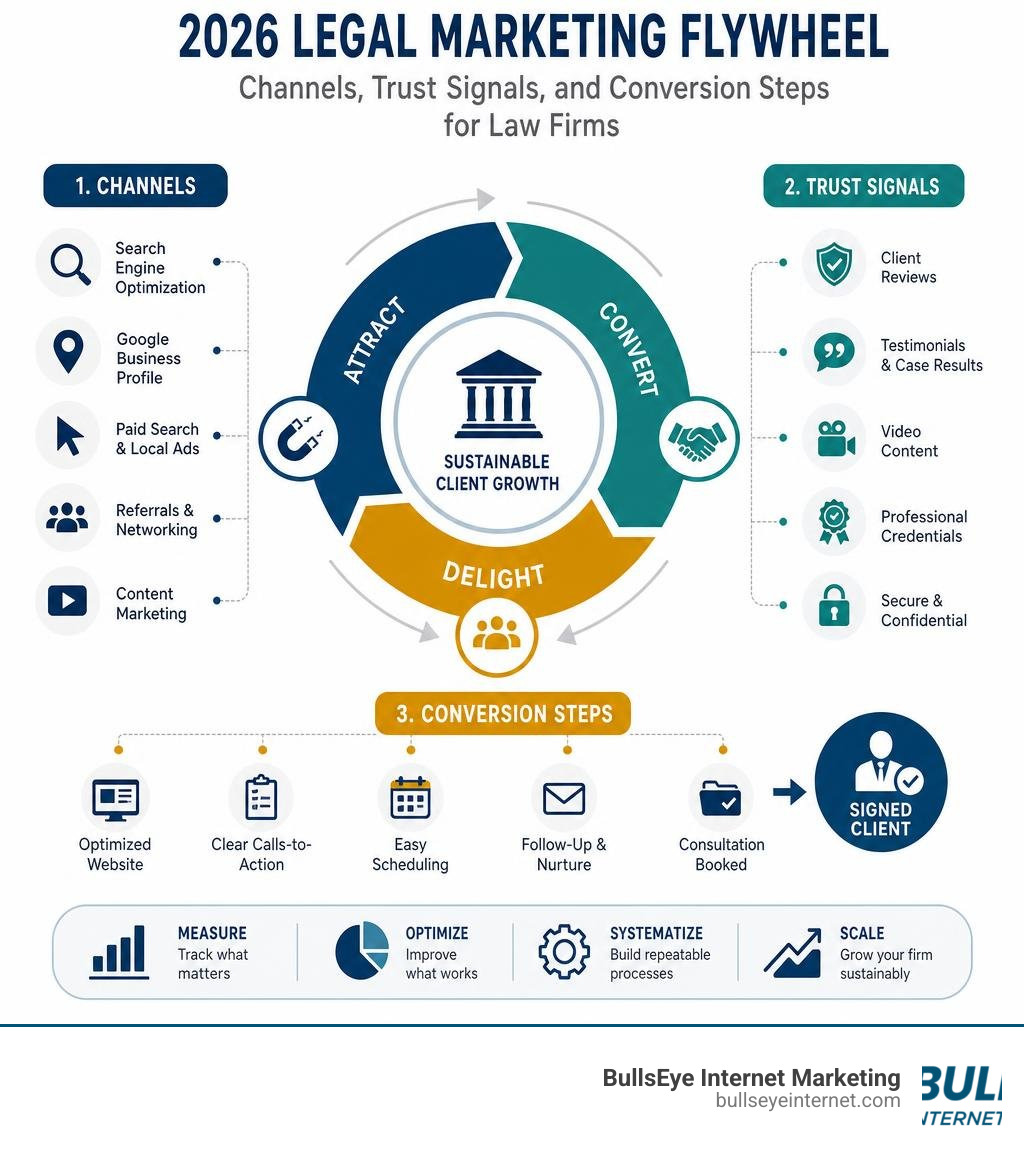
Here’s a quick answer if you’re looking for the core steps:
- Define your niche and ideal client — Know exactly who you serve and what problems you solve.
- Build a high-performance website — Mobile-optimized, fast, and built to convert visitors into consultations.
- Dominate local search — Optimize your Google Business Profile and target location-based keywords.
- Choose 2–3 core channels — SEO, Google Local Services Ads, and referrals are the highest ROI starting points for most small firms.
- Create trust signals — Reviews, video content, and testimonials convert skeptical prospects into signed clients.
- Track what matters — Measure cost-per-signed-case, not just clicks or traffic.
- Review and adjust quarterly — Marketing is a system, not a one-time task.
The legal market in 2026 is more competitive than ever. Top-tier firms are already capturing 72% of high-value digital leads, and 92% of high-intent legal consumers now bypass third-party directories entirely — going straight to search engines instead. Meanwhile, most small and solo firms are still relying on word-of-mouth alone, or worse, paying for marketing they can’t measure.
The gap between firms that grow and firms that stagnate isn’t budget. It’s strategy.
Without a clear plan for how to attract, convert, and retain clients, even the best attorneys lose business to competitors who simply show up first online — and look more trustworthy when they get there.
I’m Ronnie Katz, founder and Principal CEO of BullsEye Internet Marketing, and since 2006 I’ve helped law firms build measurable, results-driven lawyer marketing strategies that generate real case volume — not just website traffic. In this guide, I’ll walk you through exactly how to build a client acquisition machine for your law practice, from defining your niche to tracking your return on every dollar spent.
Discover more about lawyer marketing strategy:
Strategy vs. Plan: The Foundation of a Lawyer Marketing Strategy

Many small firm owners use the terms “marketing strategy” and “marketing plan” interchangeably. However, treating them as the same thing is a recipe for wasted ad spend and flatlining lead volume. We must first understand how they differ to build a sustainable system.
As highlighted in the Law Firm Marketing Plan: Top Strategies for Lawyers in 2026 | Clio , a marketing strategy defines the “why” and the “who” of your business development efforts. It outlines your firm’s overarching goals, your target audience, your core brand messaging, and your competitive differentiators.
Conversely, a marketing plan defines the “how” and “when.” It is the tactical roadmap that maps out your monthly calendar, specific campaign executions, and budget allocations.
If you attempt to run marketing campaigns (the plan) without a clear strategic foundation (the strategy), you will find yourself throwing money at random channels hoping something sticks. For a deeper look at establishing this foundation, check out our guide on How to Market a Law Practice Like a Pro.
Why Small Firms Need a Unified Lawyer Marketing Strategy
For solo practitioners and small law firms in highly competitive markets—like Broward County, Miami-Dade County, and Palm Beach County—relying strictly on passive word-of-mouth is no longer viable. Today’s prospective clients complete roughly 78% of their buyer journey before they ever reach out to an attorney.
A unified lawyer marketing strategy bridges the gap between passive waiting and active client acquisition. It ensures that every piece of content, every local ad, and every social media post works together to build client trust.
According to Growth and retention: Marketing tactics for small firms, small firms have a unique competitive advantage: the ability to offer personalized, compassionate, and highly focused client service that massive, multi-state firms cannot replicate. Your strategy must highlight this agility and local expertise.
By building a structured framework, you transition your practice from a transactional model to a high-authority brand. To explore how modern legal practices are shifting their client acquisition systems, read our analysis on Beyond Word of Mouth: Modern Marketing for Legal Services.
Translating Strategy into an Actionable Marketing Plan
Once your strategic parameters are locked in, you must translate them into a concrete, repeatable marketing plan. For small firms, consistency is the ultimate growth driver.
According to Effective Marketing Ideas for Small Law Firms in 2026 , an effective tactical execution plan should include:
- Niche Identification: Condensing your primary value proposition into a simple, 10-to-20-second elevator pitch.
- SMART Goal Setting: Outlining specific, measurable objectives for the next 3, 6, and 12 months (e.g., signing 5 new estate planning retainers per month).
- Calendar Scheduling: Color-coding business development activities on your calendar as non-negotiable appointments.
- Structured Referral Systems: Actively scheduling quarterly touchpoints with local professionals, past clients, and non-competing firms in your geographic area.
It generally takes six to seven distinct contacts before a prospect takes action. A documented plan ensures you stay top-of-mind throughout that entire journey without suffering from administrative burnout.
Defining Your Niche, Target Market, and Ideal Client Profile

The fastest way to burn through a marketing budget is to try to be everything to everyone. If you run a general practice firm in West Palm Beach or Delray Beach, advertising as a generic “lawyer for all your needs” pits you against massive advertising budgets. To win, you must narrow your focus.
Defining your niche and creating a detailed Ideal Client Profile (ICP) allows you to speak directly to the specific pain points of your target market. Instead of writing generic content, you craft highly targeted messages that resonate deeply with someone experiencing a specific legal crisis.
Aligning Your Practice Niche with a Lawyer Marketing Strategy
Niche specialization does not limit your growth; it accelerates it. When you focus on a specific practice niche, you build brand authority rapidly.
For example, instead of marketing general family law, a firm in Fort Lauderdale might focus exclusively on high-net-worth divorce cases or contested custody disputes. This specialized positioning allows you to command higher retainers and dramatically lowers your client acquisition costs because your marketing messages are highly relevant.
This approach is particularly powerful when executing search engine optimization. For instance, our specialized strategy for SEO for Family Law Attorneys demonstrates how targeting hyper-specific, long-tail search terms yields far higher conversion rates than bidding on broad, highly competitive keywords.
Mapping the Legal Consumer Journey in 2026
Understanding how a legal consumer searches for help in 2026 is critical. The modern buyer journey is highly digital, emotional, and .
When people face a legal issue—whether it is a car accident in Miami or drafting an estate plan in Boca Raton—they begin by seeking immediate, clear answers online.

This search behavior highlights a massive shift: 62% of users find their answers directly on the search results page (often referred to as zero-click searches). If your content does not immediately address their search intent with clear, plain-English explanations, they will move on.
To convert these high-intent searchers, your digital presence must act as an automated trust builder. We discuss how to structure your online assets to capture these prospects in Attorney Marketing Solutions: How to Stop Chasing Clients and Start Attracting Them.
High-Performance Channels for Small and Solo Law Firms
Small and solo law firms must allocate their marketing resources aggressively but strategically. To maximize your return on investment (ROI), we recommend balancing short-term, high-intent lead generation channels with long-term, compounding organic authority.
The table below outlines the core differences between the two primary digital marketing pillars:
| Metric / Feature | Organic Search Engine Optimization (SEO) | Paid Search Advertising (PPC & LSAs) |
|---|---|---|
| Time to First Lead | 90 to 120 Days | Immediate (Within Hours of Launch) |
| Long-Term ROI | Compounding (Cost-per-lead drops over time) | Fixed (You pay for every click or lead) |
| Asset Ownership | You own the rankings, content, and traffic | Rented space (Traffic stops when budget stops) |
| Conversion Intent | High (Users seeking information and experts) | Extremely High (Users ready to hire immediately) |
| Primary Focus | Local SEO, Map Pack, and Topical Authority | Google Local Services Ads and Search Ads |
Implementing a Multi-Channel Lawyer Marketing Strategy
An elite lawyer marketing strategy does not rely on a single channel. Instead, it utilizes a multi-channel approach where organic SEO, Local Services Ads (LSAs), and pay-per-click (PPC) campaigns feed into one another.
For example, when a prospective client in South Florida sees your Local Services Ad at the very top of Google, searches your brand name, reads your Google Business Profile reviews, and visits your highly optimized website, the compounding trust makes them far more likely to call.
For small firms, we recommend prioritizing conversion optimization before scaling your ad spend. Sending paid traffic to an outdated homepage that lacks clear calls-to-action is simply lighting money on fire. To learn how to structure profitable paid campaigns, explore our comprehensive guide on PPC Advertising for Law Firms.
Dominating Local Search and Google Maps
For local practices, the Google Map Pack is the single most valuable piece of digital real estate. Because 51% of legal consumers stop looking after the fifth search result, appearing in the top three local map listings is critical for survival.
To dominate local search in your geographic market, we must focus on:
- Google Business Profile (GBP) Optimization: Ensure your firm’s name, address, and phone number (NAP) are 100% consistent across all online directories. Fill out every single field in your GBP, upload high-resolution office photos, and publish weekly updates.
- Local Content Clusters: Write content targeting hyper-local issues, such as navigating the local courthouse processes in Broward County or Palm Beach County.
- Active Review Acquisition: Consistently asking satisfied clients for feedback.
For a step-by-step breakdown of how to optimize your local presence, see our Step-by-Step Guide to Local Attorney SEO. You can also learn more about regional search dominance in The Sunshine State of Search: Boosting Your Florida Law Firm’s Online Visibility.
Leveraging Paid Search and Local Services Ads
If you need signed cases immediately, Google Local Services Ads (LSAs) and traditional PPC are your best tactical options.
LSAs appear at the very top of the Google search results page, even above traditional paid search ads. They operate on a pay-per-lead model rather than pay-per-click, meaning you only pay when a prospect calls or messages your firm directly. On October 20, 2025, Google updated this program by replacing the “Google Screened” badge with the “Google Verified” badge, making trust and verification even more central to the platform.
To run a highly profitable paid search system, you must measure your success by cost-per-signed-case, not just cost-per-click. While average CPCs in competitive niches like personal injury are rising by 24% annually, a highly optimized landing page and rapid intake process can keep your acquisition costs highly profitable.
Discover how to leverage these high-intent leads in our guide to Google Local Services Ads for Lawyers, and read about securing Exclusive Attorney Leads That Actually Convert.
Content, Video, and Reputation Management
In 2026, content marketing is no longer about churning out generic, high-volume blog posts. In fact, 71% of firms using generic, high-volume content saw a 22% drop in conversion rates due to Google’s strict helpful content algorithms and the rise of AI-generated noise.
Instead, firms must focus on high-authority, authentic content that demonstrates E-E-A-T (Experience, Expertise, Authoritativeness, and Trustworthiness).
Video content has become a non-negotiable asset for modern firms:
- 52% of potential clients look for videos explaining a firm’s services before making a hiring decision.
- 55% of legal consumers read six or more reviews before making a decision.
- 53% of legal consumers will not consider any firm rated below 4 stars.
Your reputation must be managed like the multi-million dollar asset it is. We dive deep into compliant review acquisition and ethical marketing rules in Lawyer Advertising Rules: Solutions for Modern Firms.
Frequently Asked Questions
How much should a small law firm spend on marketing in 2026?
High-growth law firms typically allocate 15% to 20% of their gross annual revenue to marketing. For established firms looking to maintain their market share in competitive areas like South Florida, a budget of 7% to 10% of gross revenue is standard.
If you are a solo practitioner or a newer firm, we recommend starting with a disciplined budget focused strictly on high-converting local channels—such as Google Business Profile optimization and Local Services Ads—before scaling into broader organic SEO campaigns.
How long does it take to see results from legal SEO?
While paid search campaigns can generate leads on day one, organic legal SEO is a long-term strategic investment. Most law practices begin seeing a steady increase in qualified organic lead flow within 90 to 120 days of implementing a technical and content-focused SEO strategy.
The true, compounding ROI of SEO typically materializes between 6 and 12 months, as your firm builds deep topical authority and earns high-quality backlinks.
What are the biggest mistakes firms make when hiring marketing partners?
The single biggest red flag in the legal marketing industry is asset ownership. Historically, 64% of law firms did not actually own their own tracking numbers or domain assets because their marketing agency registered them under the agency’s name.
Always ensure that you retain 100% ownership of your website domain, Google Business Profile, ad accounts, and tracking numbers. Other common mistakes include signing long-term, restrictive contracts and working with agencies that represent your direct competitors in your local market.
Driving Law Firm Growth: A Data-Driven Strategy by BullsEye Internet
Building a scalable, consistent client acquisition machine is not about chasing every new digital marketing trend. It is about implementing a proven, measurement-first lawyer marketing strategy that connects your marketing spend directly to signed cases.
At BullsEye Internet Marketing, we do things differently to give our clients a true competitive advantage:
- No Long-Term Contracts: We earn your business month after month based on real, measurable results.
- Strict Exclusivity: We work with only one client per practice area within a specific geographic territory. If we partner with you in Fort Lauderdale or West Palm Beach, we will never represent your local competitors.
- Full Asset Ownership: You own 100% of your website, GBP, tracking lines, and data from day one.
If you are ready to stop chasing leads and start attracting high-value clients, read An Essential Guide to Advertising for Lawyers to understand your options, or contact us today to see how we can help you dominate your local market.
