
Why Car Accident Lawyer SEO Is the Most Competitive Race in Legal Marketing
Car accident lawyer SEO is the practice of optimizing your law firm’s website and online presence so injured people find you — not your competitors — when they search for legal help after a crash.
Here’s a quick breakdown of what effective car accident lawyer SEO involves:
- Keyword targeting — ranking for terms like “car accident lawyer” (76,000 monthly searches) and “car accident attorney near me” (6,500 monthly searches)
- Local SEO — appearing in Google’s Map Pack for searches in your city or region
- Content strategy — creating pages and articles that match what potential clients are actually searching for
- On-page optimization — placing the right keywords in the right spots on your website
- Performance tracking — measuring rankings, calls, and signed cases to know what’s working
The personal injury legal market tops $50 billion annually in the United States. That means the competition for the top Google spots is fierce — and expensive. More than 75% of personal injury searches now happen on mobile devices, and “near me” queries have surged over 500% since 2015. If your firm isn’t showing up when and where injured people are searching, you’re leaving cases on the table every single day.
The good news? Most law firm websites aren’t fully optimized. That creates a real opportunity for firms willing to invest in the right strategy.
I’m Ronnie Katz, founder of BullsEye Internet Marketing, and I’ve been helping law firms win more clients through car accident lawyer SEO and other digital marketing strategies since 2006. In this guide, I’ll walk you through exactly what works in 2026 — from keyword research to local optimization to tracking your ROI.
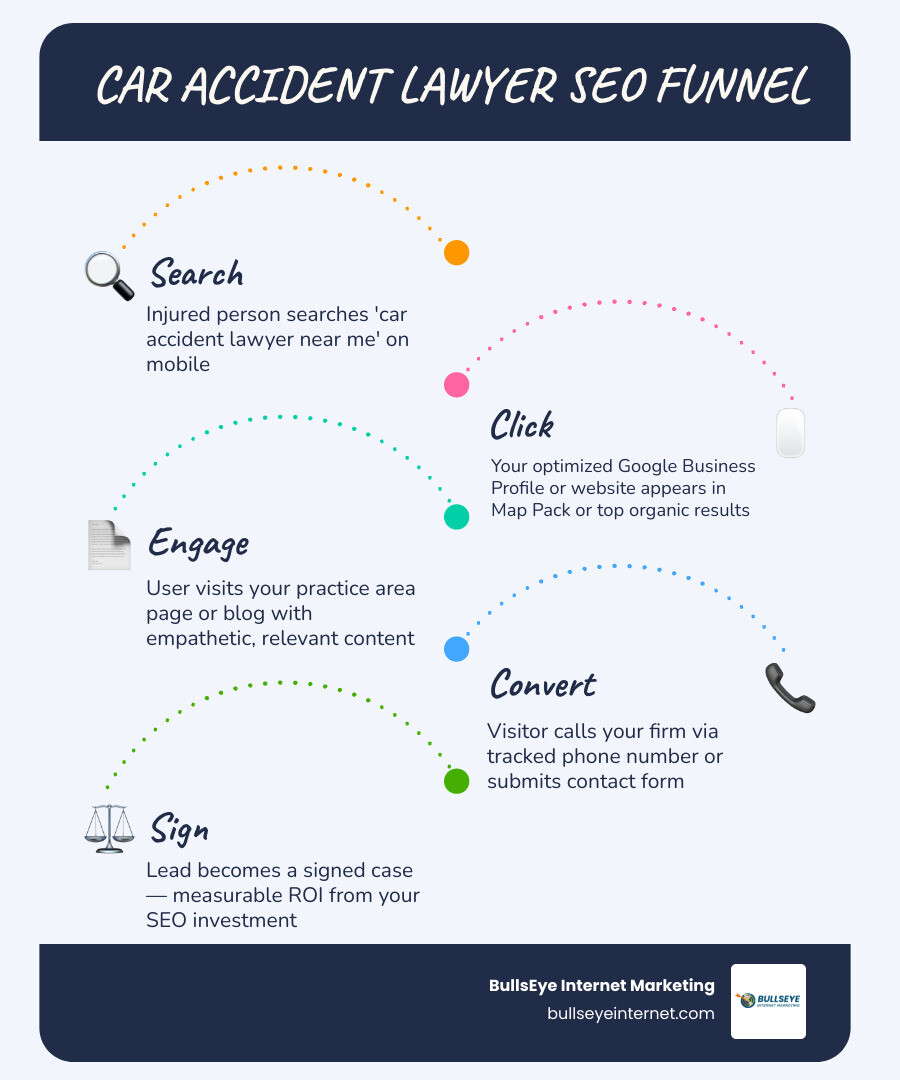
Car accident lawyer SEO basics:
Understanding the Core of Car Accident Lawyer SEO
To succeed in this hyper-competitive space, we must first understand how search engines process legal queries. When someone is involved in a collision on Florida’s busy roads, whether in Miami, Fort Lauderdale, or West Palm Beach, their search behavior is driven by immediate, high-stress needs.
Google uses highly sophisticated algorithms to evaluate websites in the “Your Money or Your Life” (YMYL) category. Because legal advice directly impacts a person’s financial stability and physical well-being, search engines demand the absolute highest standards of Experience, Expertise, Authoritativeness, and Trustworthiness (E-E-A-T).
We cannot simply throw keywords onto a page and hope for the best. To win the ranking war, we must build a comprehensive digital footprint. This requires a deep understanding of search volumes and user behavior. For instance, the keyword “car accident lawyer” commands a massive monthly search volume of 76,000, while “car accident attorney” brings in 44,000 monthly searches. Knowing how to capture this traffic is the foundation of any successful campaign, as outlined in the ultimate guide to personal injury lawyer marketing.
Head Terms vs. Long-Tail Keywords in Car Accident Lawyer SEO
When planning our car accident lawyer SEO strategy, we must balance high-volume “head terms” with highly specific “long-tail keywords.”
- Head Terms: These are short, broad phrases with massive search volumes. Examples include “car accident lawyer” (76,000 monthly searches) and “car crash lawyer” (3,000 monthly searches). While ranking for these terms is highly lucrative, they are also the most competitive and expensive keywords to target.
- Long-Tail Keywords: These are longer, more specific phrases that searchers use when they have a highly precise need. An example is “lawyer for car accident that was not my fault” or “average settlement for herniated disc from car accident.”
While long-tail keywords have lower individual search volumes, they often convert 2x to 5x better than head terms. Why? Because the searcher has a highly specific scenario and is much closer to making a hiring decision. Furthermore, targeting localized head terms like “car accident lawyer near me” (15,000 monthly searches) or “car accident attorney near me” (6,500 monthly searches) bridges the gap between broad appeal and immediate local intent.
High-Intent vs. Informational Search Queries
Not all searches are created equal. We divide our keyword strategy into two primary buckets based on user intent:
- High-Intent (Transactional) Queries: These searchers are ready to hire an attorney right now. They use terms like “best auto accident lawyer,” “car accident law firm” (2,200 searches), or “top personal injury attorney in Miami.” They have been in an accident, they know they need legal representation, and they are actively looking for the right firm.
- Informational Queries: These searchers are in the research phase. They are asking questions like “What should I do immediately after a car accident?” or “How are personal injury settlements calculated?”
While informational searchers might not be ready to sign a retainer agreement today, capturing their attention early allows us to build trust. When they do realize they need a lawyer, our firm is already at the top of their mind.
How to Conduct Keyword Research for Your Law Firm
Keyword research is the foundation of our entire SEO campaign. If we target the wrong terms, we waste months of effort and thousands of dollars attracting traffic that never converts into signed cases.
We begin our research by analyzing search intent, keyword difficulty, and estimated case value. While tools like Google Keyword Planner, Ahrefs, and SEMrush provide excellent baseline data, we must filter these metrics through a legal lens. For example, a keyword like “commercial truck accident lawyer” may have a lower search volume than “car accident lawyer,” but the potential case value is exponentially higher. We dive deeper into these strategic choices in our guide on attorney marketing solutions how to stop chasing clients and start attracting them.
Mining Client Language and Intake Transcripts
Some of the most valuable long-tail keywords don’t come from expensive SEO software—they come directly from our clients.
We recommend reviewing your firm’s intake call transcripts, contact form submissions, and email inquiries. How do real people describe their accidents? They rarely use formal legal terms like “tort liability” or “negligent motorists.” Instead, they say:
- “A distracted driver rear-ended me at a red light.”
- “Can I sue if the other driver was texting?”
- “Who pays my medical bills after a hit-and-run?”
By mapping our content to the exact conversational queries real people use, we position our firm to capture highly motivated leads. This approach also prepares our website for the rise of voice search and conversational AI assistants, which we cover extensively in no objections allowed the complete guide to online marketing for attorneys.
Mapping Keywords to Specific Car Accident Case Types
To maximize our search visibility, we should never rely on a single, generic “car accident” page. Instead, we must build a structured website architecture with dedicated service pages for different accident types.
Creating separate, high-quality pages for specific case types allows us to target niche keywords with high conversion potential. We should build dedicated pages for:
- Commercial truck accidents (high case value, complex regulations)
- Motorcycle accidents (severe injuries, unique bias issues)
- Pedestrian and bicycle accidents
- Uber and Lyft rideshare collisions
- Rear-end collisions and intersection accidents
Each page must offer unique, authoritative content that addresses the specific legal and medical challenges associated with that crash type.
On-Page Optimization and Avoiding Keyword Stuffing
Once we have our target keywords, we must integrate them strategically across our website. However, gone are the days of repeating “Miami car accident lawyer” fifty times in a single paragraph. Today’s search engines easily detect and penalize over-optimization.
Instead, we focus on natural language integration and Latent Semantic Indexing (LSI) keywords—synonyms and related terms that search engines expect to see on a page about car accidents (such as “insurance adjuster,” “police report,” “medical records,” and “compensation”). For a complete breakdown of modern on-page standards, read our search engine optimization company guide.
Strategic Keyword Placement for Maximum Visibility
To signal relevance to search engines without triggering keyword stuffing penalties, we must place our primary keywords in high-value HTML elements:
- Title Tags: This is the single most important on-page SEO element. We place our primary keyword near the beginning of the title (e.g., “Miami Car Accident Lawyer | Free Consultation 24/7”).
- H1 Headers: Every page must have exactly one H1 header containing our primary target keyword or a close variation.
- Meta Descriptions: While meta descriptions do not directly affect rankings, they act as your organic ad copy. Including keywords here highlights them in bold on the search results page, improving click-through rates.
- URL Slugs: Keep URLs clean, short, and keyword-rich (e.g.,
firmname.com/miami-car-accident-lawyer). - The First 100 Words: We naturally introduce our primary keyword early in the body copy to immediately establish the page’s topic.
For technical best practices on structuring these elements, refer to the official Google Search Central on Title Link Best Practices.
Writing Empathetic Content Without Over-Optimization
Car accident victims are often stressed, injured, and overwhelmed. If they arrive on our page and find a cold, robotic text written solely for search engines, they will hit the “back” button immediately.
We must write empathetic, clear, and highly readable copy. Instead of dense legalese like “Our personal injury attorneys vigorously litigate vehicular negligence claims,” we write: “We understand how overwhelming the days after a car crash can be. Our team is here to handle the insurance companies so you can focus on recovering.”
This approach satisfies Google’s YMYL and E-E-A-T guidelines by demonstrating genuine care and clear expertise, which ultimately keeps users on our site longer and improves conversion rates. Learn more about this in our digital marketing for law complete guide.
Local SEO and Google Business Profile Optimization
For personal injury law firms, local search is where cases are won or lost. When a user searches for “car accident attorney near me,” Google displays the “Local 3-Pack”—the map results featuring three local businesses.
To appear in these coveted spots, we must execute a rigorous local SEO strategy. This involves optimizing our physical office signals, managing reviews, and maintaining perfect consistency across our online directory listings. For a complete blueprint, read our local seo complete guide.
Dominating the Map Pack with Local Car Accident Lawyer SEO
Our Google Business Profile (GBP) is the heart of our local SEO campaign. To optimize it for maximum visibility:
- Complete Every Section: Ensure our business name, physical address, and local phone number (NAP) exactly match the details on our website.
- Select the Right Primary Category: Set your primary category to “Personal Injury Attorney” or “Lawyer.”
- Gather Authentic Reviews: Implement a systematic process for requesting reviews from satisfied clients. Respond to every review professionally and promptly.
- Post Regular Updates: Use the GBP updates feature to share blog posts, firm news, and helpful local safety tips.
Proximity, relevance, and prominence are the three pillars of local rankings. By optimizing these factors, we can significantly increase our visibility in high-competition areas, as detailed in our guide on how to increase your law firms online presence with local seo.
Building a Location Keyword Matrix for Multi-City Firms
If our firm serves multiple markets—such as Broward County, Miami-Dade County, and Palm Beach County—we cannot rely on a single homepage to rank everywhere. We must build a location keyword matrix and create dedicated local landing pages for each major city we serve.
| Practice Area | Primary Location | Target Keyword |
|---|---|---|
| Car Accident | Miami | Miami Car Accident Lawyer |
| Car Accident | Fort Lauderdale | Fort Lauderdale Car Accident Attorney |
| Car Accident | West Palm Beach | West Palm Beach Car Accident Lawyer |
Each local page must feature unique content, local driving directions, local client testimonials, and references to regional landmarks or courts to establish geographic relevance. Avoid duplicating text across these pages, as search engines will filter out repetitive content. For a step-by-step walkthrough, check out our step by step guide to local attorney seo.
Voice Search, AI Queries, and Future-Proofing in 2026
As we navigate July 2026, the way users find legal help continues to undergo a massive shift. With the widespread adoption of AI-driven search overviews and voice-activated mobile assistants, search queries have become conversational, long-tail, and highly specific.
If a driver is involved in an accident on the highway, they might tap their phone and ask Siri or Google Assistant a question, rather than typing short keywords into a browser. To capture this emerging traffic, our content must adapt to these differences:
| Traditional Search Query | AI & Voice Search Query |
|---|---|
| “Miami car accident lawyer” | “Siri, who is the best-rated car accident lawyer near me right now?” |
| “car accident statute of limitations Florida” | “How long do I have to sue for a car accident in Florida?” |
| “rear-end accident settlement value” | “What is the average settlement for getting rear-ended by a commercial truck?” |
To future-proof our SEO, we must structure our content using Q&A formats, schema markup, and clear headers that directly answer these conversational questions. For official guidance on how local relevance influences these results, see the Google Business Profile Help on Local Rankings.
Tracking Performance, Timelines, and Ethical Considerations
SEO is an investment, and we must treat it as one. We do not measure the success of a car accident lawyer SEO campaign simply by tracking keyword rankings or organic traffic. The only metric that truly matters to our bottom line is the number of signed, high-value cases generated.
By utilizing advanced call-tracking software, CRM integrations, and conversion-tracking pixels, we can trace every single signed case back to the specific organic keyword and landing page that brought the client to our firm.
How Long Does It Take to Rank and Measure ROI?
One of the most common questions we receive is: How long will it take to see results?
The timeline depends heavily on your market’s competition and your website’s existing domain authority. Personal injury firms typically start seeing meaningful keyword traction and lead generation within 4 to 9 months.
However, in highly competitive major metro areas like Miami or Fort Lauderdale, ranking on page one for core service terms like “car accident attorney” can take 6 to 12 months or longer of consistent, high-quality optimization. To learn how to navigate this timeline and build a sustainable marketing plan, read our guide on how to market a law practice like a pro.
Navigating State Bar Rules and Ethical Compliance
Legal marketing is subject to strict ethical guidelines. When optimizing our websites, we must remain fully compliant with state bar rules (such as the Florida Bar’s advertising regulations).
To protect our firm and maintain compliance:
- Avoid Misleading Superlatives: Never refer to your firm as the “best,” “cheapest,” or “top-rated” unless you have verifiable, independent accolades that support the claim.
- Include Clear Disclaimers: When showcase past case results or settlements, we must include prominent disclaimers explaining that past success does not guarantee future outcomes.
- Keep Content Truthful: Ensure all informational legal content is accurate, up-to-date, and does not create an attorney-client relationship.
For a deeper look at compliant, modern marketing strategies, read beyond word of mouth modern marketing for legal services.
Frequently Asked Questions
Do I need separate pages for each city and accident type?
Yes. Creating separate, highly focused pages for each major city (location pages) and each accident type (practice area pages) is far more effective than trying to target everything on a single homepage. It allows us to match user intent precisely and provide highly relevant, unique content for each search query.
Can I use the same keywords for SEO and Google Ads?
Yes, the core search terms used by potential clients are identical. However, paid search campaigns require a completely different execution strategy, including negative keyword lists, precise bidding, and highly transactional landing pages. For more details on running paid campaigns alongside SEO, see our pay per click advertising for lawyers guide.
How often should I update my car accident keyword list?
We recommend reviewing and updating your keyword list at least quarterly. This allows us to adapt to shifting search behaviors, new local competitor movements, and legislative updates (such as changes to Florida’s tort laws) that alter what clients search for online.
Conclusion
Winning the race in car accident lawyer SEO requires a data-driven, consistent, and highly localized approach. Because the personal injury space is so competitive, you cannot afford to waste time on generic strategies or agencies that lock you into long-term contracts without delivering results.
At BullsEye Internet Marketing, we do things differently. We specialize in generating actual calls and signed cases through tailored SEO, Google Business Profile optimization, and Pay Per Lead strategies. Our unique selling proposition is simple: we offer no long-term contracts and work with only one client per industry per geographic area. This gives our clients an exclusive, unmatched competitive advantage in their local market.
If you are ready to stop chasing cases and start attracting them, we are here to help. Learn more about advertising for lawyers and contact us today to secure your territory.
