
When Patients Search, Does Your Practice Show Up?
Local SEO for dentists is the process of optimizing your online presence so patients in your area find your practice first — specifically in Google’s Map Pack, Google Maps, and local organic results.
Quick answer: How to improve your local search rankings as a dentist
- Optimize your Google Business Profile — set the right category, add photos, post weekly
- Build a steady stream of reviews — aim for 3-5 new Google reviews per month
- Keep your NAP consistent — same Name, Address, Phone across every directory
- Create dedicated service pages — one page per major treatment, with local keywords
- Add schema markup — help Google understand exactly what you offer and where
- Build local citations — list your practice on Healthgrades, Zocdoc, Yelp, and more
- Earn local backlinks — sponsor events, join your chamber, get mentioned by local sites
Here is the reality most dentists don’t see until it costs them patients.
When someone in your city types “dentist near me,” three map listings appear at the top of the page. Those three practices capture roughly 68% of all clicks from that search. Everyone below them splits what’s left.
90% of people search online before booking a dental appointment. And around 75% never scroll past the first page. If your practice isn’t in the top three map results, you are essentially invisible to most of those potential patients — no matter how good your clinical skills are.
The gap between a fully booked schedule and empty chairs often isn’t talent. It’s visibility.
This guide will show you exactly how to close that gap.
I’m Ronnie Katz, founder of BullsEye Internet Marketing, and I’ve spent over 20 years helping local businesses — including dental practices — win on local search through Local SEO for dentists, Google Business Profile optimization, and reputation management. I’ll walk you through what actually moves rankings in 2026, so you can spend less on ads and fill more chairs from organic search.
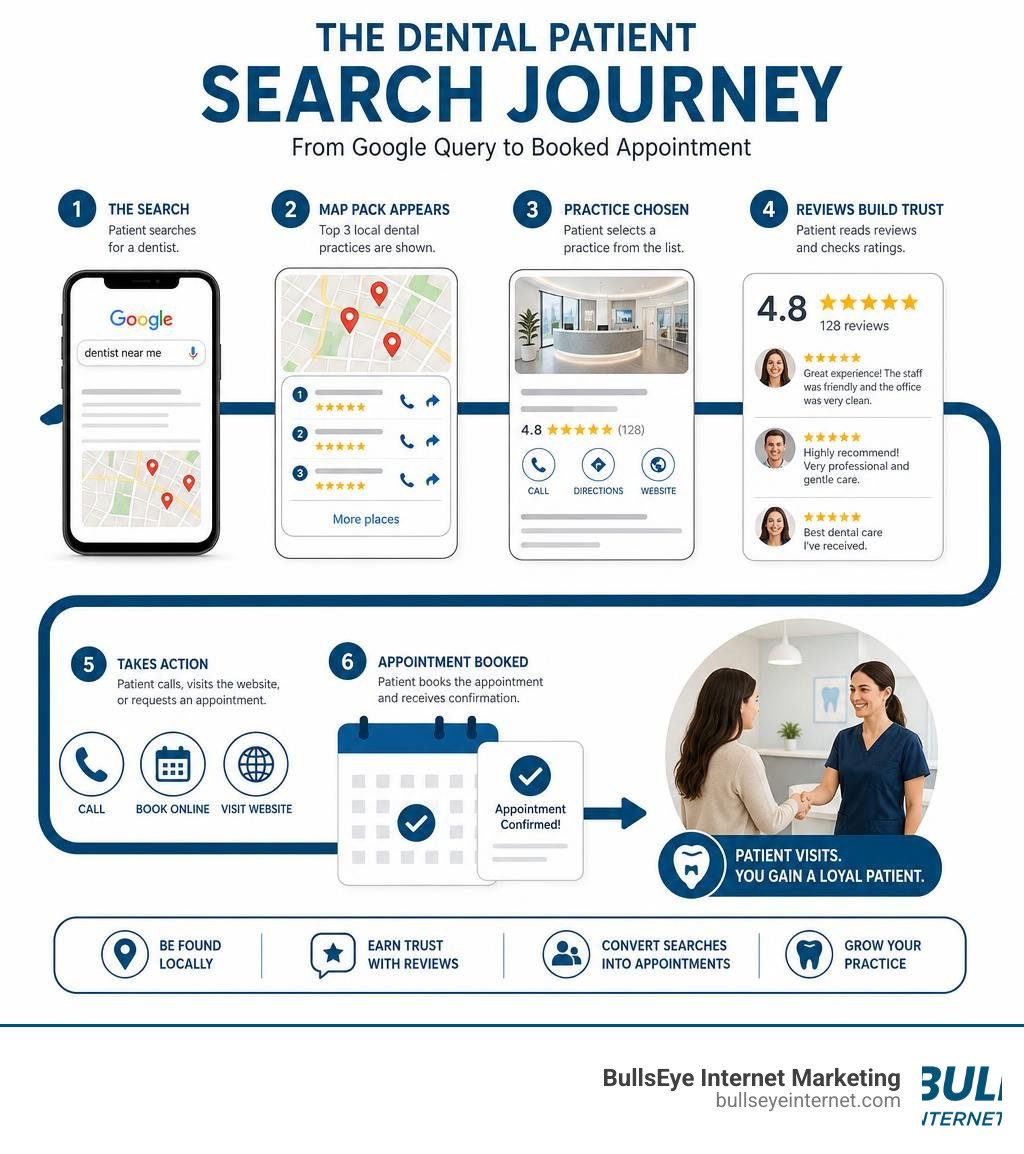
Local SEO for Dentists terms to learn:
Why Local SEO for Dentists is Your Most Valuable Marketing Channel
When you run a dental practice in South Florida — whether in Fort Lauderdale, Boca Raton, or West Palm Beach — you aren’t competing with dentists in New York or Los Angeles. Your market is strictly local. Your patients live or work within a 5-to-10-mile radius of your office.
This hyper-localized reality is why traditional, broad SEO strategies fail. You do not need to rank for “how does Invisalign work” on a national scale. You need to rank for “Invisalign dentist in Coral Springs” or “emergency dental repair Boca Raton.”
Investing in local search creates a compounding marketing asset. Unlike pay-per-click advertising, where the patient flow stops the second you turn off your ad spend, local SEO builds a permanent geographic moat around your practice. Once you establish prominence in your local market, you earn a steady stream of high-intent patients at a fraction of the cost of paid ads.
The Difference Between Local SEO and Traditional SEO
Traditional SEO is designed to build authority for broad, non-geographical terms. It focuses on national search results, informational blog posts, and high-volume keywords.
Local SEO, on the other hand, is built entirely around geographic proximity, local search intent, and physical location signals. When a user searches for a dentist, Google’s algorithm shifts to local search mode, pulling data from three distinct search surfaces:
- The Local Pack (Map Pack): The highly coveted top three map listings displayed at the very top of Google search results.
- Local Organic Results: The traditional website links listed beneath the Map Pack, heavily filtered by geographic relevance.
- Google Maps Standalone: The map app where patients actively search for nearby clinics while on the move.
While traditional SEO relies heavily on domain authority and global backlink profiles, local SEO is driven by physical proximity, Google Business Profile (GBP) optimization, local citation consistency, and local review velocity.
Why Local SEO for Dentists is Crucial in 2026
The search landscape has shifted dramatically. In July 2026, we are navigating an environment where AI search engines, zero-click searches, and mobile-first user behaviors dictate patient acquisition.
- The Rise of Mobile Searches: Over 60% of all dental searches happen on mobile devices. When a user searches on a smartphone, they want immediate action. In fact, 76% of local mobile searches lead to a physical visit within 24 hours.
- The Zero-Click Search Reality: Zero-click search rates for dental queries have climbed past 40% in 2026. This means searchers are finding phone numbers, hours, and addresses directly on the search results page without ever clicking through to a website. If your Google Business Profile isn’t fully optimized, you lose these patients instantly.
- AI Overviews and GEO: Google’s AI Overviews now appear for roughly 60% to 75% of informational dental queries. To be cited by these generative engines, your practice must have structured schema markup, clean citations, and authoritative local content.
By focusing on Local SEO Strategies for Small Business Success, independent dental practices can easily outrank massive corporate Dental Support Organizations (DSOs). Google’s algorithm naturally prioritizes physical proximity and authentic local trust over massive corporate budgets.
Dominating the Map Pack: Google Business Profile Optimization
Your Google Business Profile (GBP) is the single most valuable local SEO asset you own. According to industry data, GBP signals account for 32% of the total ranking weight in the Google Local Pack.
An optimized, complete profile can lead to 18x more visibility in discovery searches, 7x more clicks to your website, and a 70% increase in in-person visits to your South Florida clinic. To get started, you can read our comprehensive Google Business Profile Optimization Guide.
To win the map pack, you must treat your GBP as a dynamic, living asset rather than a “set-and-forget” business listing.
Step-by-Step Google Business Profile Setup
To build a flawless foundation, follow this step-by-step optimization process:
- Claim and Verify Your Profile: Go to business.google.com to claim your listing. Complete the verification process (usually via video verification or postcard) without changing any core business details during the process to avoid suspension.
- Select the Perfect Primary Category: This is the single most critical setting. Set your primary category to “Dentist” (or your exact specialty, such as “Orthodontist” or “Pediatric Dentist”). Selecting “Dentist” opens up eligibility for the widest range of general dentistry searches.
- Add Strategic Secondary Categories: Maximize your search footprint by adding up to nine secondary categories, such as “Cosmetic Dentist,” “Emergency Dental Service,” “Teeth Whitening Service,” or “Dental Implants Periodontist.”
- Write a High-Intent Business Description: Use all 750 characters. Write a natural, patient-focused description highlighting your location (e.g., “serving patients in Fort Lauderdale and Lauderdale-by-the-Sea”), key procedures, and unique qualifiers (e.g., weekend hours, family-friendly). Avoid stuffing keywords.
- Set Exact Business Hours: Keep your hours 100% accurate, including holiday hours. Inconsistencies between your GBP hours and your website hours will damage your rankings.
- Integrate Your Appointment Booking Link: Activate Google’s built-in booking button by integrating your practice management scheduling software. This removes friction, allowing high-intent searchers to book directly from the search results.
- Use GBP Services as a Keyword Bank: Do not rely solely on predefined services. Add custom service listings for every treatment you offer (e.g., “Invisalign clear aligners,” “porcelain veneers,” “emergency tooth extraction”). Write a 2-to-3 sentence description for each service. Do not add city names to service titles, but keep the descriptions natural and informative.
For deeper insights into maximizing your local reach, check out our guide on How to Optimize Your Google Business Profile for Maximum Local Reach.
Winning the Google Local Pack for Dental Searches
Google ranks local dental practices based on three primary dimensions: Relevance, Distance, and Prominence.
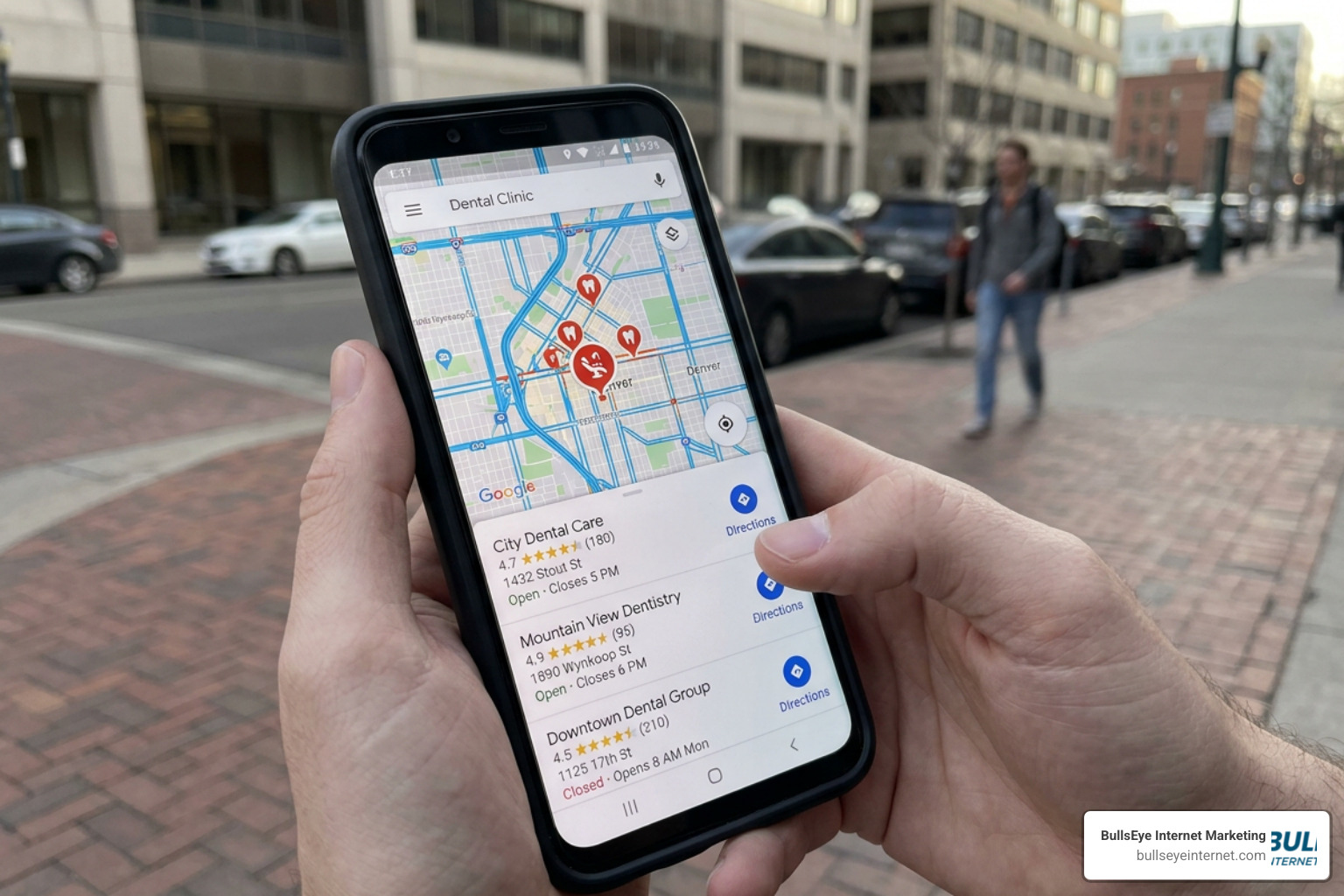
- Relevance: How well your business profile matches the searcher’s query. This is driven by your categories, services, and website content.
- Distance: How far your physical office is from the searcher or the location term used in the query. While you cannot change your physical address, you can maximize your reach within your geographic radius.
- Prominence: How well-known and trusted your business is. This is heavily influenced by your review signals, website authority, and citation consistency.
To signal active management and boost prominence, you must upload high-quality photos weekly. Google’s algorithm has begun de-prioritizing profiles that rely on generic stock photos. Upload real, high-resolution images of your South Florida office exterior, welcoming interior, state-of-the-art operatory rooms, and friendly team. Practices with 10 or more real photos receive 42% more direction requests on Google Maps.
Additionally, publish a short Google Post once per week. Use these posts to share dental tips, announce promotions, or highlight community involvement. While users may not read every post, the consistent updates signal to Google that your business is active and highly relevant.
Building Trust and Rankings with Online Reviews
Online reviews are the lifeblood of local SEO. In Google’s local algorithm, reviews account for 24% of the Local Pack ranking weight.
But reviews are more than just ranking signals — they are the ultimate conversion tool. An incredible 90% of patients use online reviews to evaluate healthcare providers before booking, and 88% trust them as much as personal recommendations. Practices that maintain a 4.7+ star rating and over 300 reviews generate 2-to-3 times the call volume of competitors with lower counts.
How Online Reviews Impact Local Search Rankings
Google evaluates reviews based on three dimensions: Quantity, Velocity, and Recency.
Google’s core updates have heavily prioritized review velocity and recency. Reviews received within the last 90 days carry significantly more weight than older reviews. A practice with 500 reviews that hasn’t received a new one in six months will easily be outranked by a practice with 150 reviews that receives 3 to 5 fresh, authentic reviews every single week.
Furthermore, Google reads the actual text of your reviews. When patients naturally mention specific treatments and locations — such as “best pediatric dentist in Pembroke Pines” or “got my dental implants in Hollywood, FL” — it strongly reinforces your relevance for those specific search terms.
A HIPAA-Compliant Review Acquisition Strategy
For dental practices in Florida, asking for reviews comes with a major hurdle: HIPAA compliance.
Under HIPAA regulations, you cannot disclose Protected Health Information (PHI). This means you cannot confirm that a reviewer is a patient, nor can you mention the specific treatments they received in your public responses.
To build a massive, compliant review engine, implement this structured framework:
- The Verbal Ask at Checkout: Train your front desk staff to make a verbal request when a patient is checking out and expressing satisfaction. A simple script works best: “We loved having you today! We’re trying to help more families in Fort Lauderdale find us. Would you mind leaving us a quick Google review? I can text you a direct link right now.”
- Immediate SMS Follow-Ups: Send a text message containing your direct GBP review link within 24 hours of the appointment. Text requests get a 5x higher open rate than emails, and same-day text requests convert at 3-to-4 times the rate of delayed requests. Keep the message generic: “Thank you for visiting us today! We value your feedback. Please share your experience here: https://g.page/yourpractice/review”
- Never Incentivize Reviews: Offering discounts, free whitening, or gifts in exchange for reviews violates Google’s terms of service and FTC guidelines. It can lead to permanent profile suspension.
- Drafting HIPAA-Compliant Responses: You must respond to every review — both positive and negative — within 48 hours. When responding, keep your text completely generic. Never say, “It was great performing your root canal today, Sarah!” instead, say: “Thank you for the kind words! We strive to provide excellent care to everyone who visits our office.”
For a deeper dive into ranking on maps through reputation management, you can refer to “Local SEO for Dental Practices: How to Rank on Google Maps and Dominate Your Market”.
On-Page SEO and Local Keyword Research for Dental Websites
While your Google Business Profile is the front door of your local search presence, your website is the engine that powers it. Google continuously crawls your website to verify the claims made on your GBP. If your website lacks local geographic signals and structured data, your map rankings will suffer.
Conducting Local Keyword Research for a Dental Practice
Many dental practices target the wrong keywords. They focus on broad, highly competitive terms with low conversion rates, or they use clinical jargon that actual patients never type into a search engine.
When conducting keyword research, you must categorize terms into two categories:
- Purchase Intent Keywords: These are typed by patients ready to book an appointment immediately. They typically include a location modifier or “near me” syntax. Examples include:
- “emergency dentist Miami”
- “dental implants West Palm Beach cost”
- “Invisalign provider Boca Raton”
- “pediatric dentist near me”
- Research Intent Keywords: These are typed by patients seeking information. While lower in immediate conversion, they build topical authority. Examples include:
- “how to stop toothache at night”
- “veneers vs crowns”
- “does insurance cover dental implants”
To capture high-value patients, target procedure-specific keywords rather than just general “dentist” terms. Procedure-specific keywords attract patients seeking premium treatments like cosmetic dentistry, dental implants, and clear aligners.
On-Page Tactics and Schema Markup for Dental Websites
To turn your website into a local search powerhouse, optimize your on-page elements and implement structured schema markup.
- Title Tags and Meta Descriptions: Your title tag is the single most important on-page ranking factor. Format your homepage title tag with your primary service, city, state, and practice name. For example:
Cosmetic Dentist in Delray Beach, FL | Delray Smile Center. Keep it under 60 characters. Write a compelling meta description under 160 characters that includes a call to action and your phone number. - Dedicated Service Pages: Never list all your services on a single, generic page. Create individual, deep-content pages (1,200 to 1,800 words) for every core treatment you offer. A page dedicated entirely to “Dental Implants in Boynton Beach” will rank infinitely better than a bullet point on a generic services page.
- Embed a Google Map: Embed an interactive Google Map of your physical office location directly on your Contact or Location page to reinforce proximity signals.
- Implement Schema Markup: Schema markup is structured code that helps search engines understand your business details, services, and reputation.

For dental practices, the essential schema types include:
- Dentist (or MedicalBusiness): To define your practice name, NAP, logo, and accepted insurances.
- FAQPage Schema: To structure common questions and answers, making your site highly eligible for AI Overview extraction.
- AggregateRating Schema: To pull your star ratings directly into organic search snippets.
For a complete breakdown of local on-page optimization, see the guide on General dentistry local SEO: the complete guide for family dental practices (2026).
Off-Page Signals: Citations, NAP Consistency, and Backlinks
Off-page SEO is all about building trust and authority across the wider web. Google measures this through local citations (mentions of your business name, address, and phone number) and high-quality backlinks from local and industry-specific websites. You can learn more about building off-page signals in The Ultimate Local SEO Playbook Boost Your Businesss Online Presence.
Building Local Citations and Ensuring NAP Consistency
A local citation is any online mention of your practice’s Name, Address, and Phone number (NAP).
To build entity trust with Google, your NAP must be character-for-character consistent across every single directory on the web. Minor discrepancies — such as listing “Suite 200” on Yelp but “Ste 200” on your GBP, or having an outdated phone number on an old directory — confuse search engines and suppress your local rankings.
| Directory Tier | Platform / Directory Name | Value to Dental Practices |
|---|---|---|
| Tier 1 (Core Aggregators) | Data Axle, Foursquare, Apple Maps, Bing, Yelp | Establishes foundational business authority and map search presence across devices. |
| Tier 2 (Healthcare Specific) | Healthgrades, Zocdoc, WebMD, Vitals | Highly trusted by search engines; provides powerful topical relevance for medical entities. |
| Tier 3 (Local Directories) | Chamber of Commerce, Local YellowPages, City-Data | Reinforces geographic proximity and local community relevance. |
Conduct an annual citation audit to find and correct duplicate listings, incorrect phone numbers, and address formatting discrepancies. Consistent NAP across the top 25 directories can rank your practice over two positions higher in local search results on average.
Earning Backlinks That Move Dental Rankings
Backlinks (links from other websites to yours) act as votes of confidence in the eyes of search engines. However, for local dental SEO, generic, low-quality backlink packages do not work. You need high-authority, locally relevant links.
Effective local link-building strategies include:
- Sponsoring Local Community Events: Sponsor a local youth sports team in Broward County or a charity run in Palm Beach. These sponsorships almost always come with a high-quality, local backlink from the organization’s website.
- Joining Your Local Chamber of Commerce: A membership in your city’s Chamber of Commerce provides an authoritative, geographically relevant backlink that establishes local prominence.
- Partnering with Local Businesses: Write guest blog posts or secure partner links with local orthodontists, pediatricians, or health food stores in your immediate area.
To build a powerful off-page presence, you can explore our specialized Local SEO Service.
Measuring Success and Avoiding Common Mistakes
Local SEO is not a one-time project; it is a long-term, compounding marketing asset. To ensure you are getting a real return on investment, you must know how to track your progress and avoid critical mistakes.
How Long It Takes to See Results from Local SEO for Dentists
We always tell our clients to expect a realistic timeline. While minor technical fixes and GBP optimizations can yield visibility boosts within 30 to 60 days, achieving true geographic market dominance in highly competitive South Florida markets typically requires 6 to 12 months of consistent effort.

This timeline is a compounding process. As you consistently collect reviews, build clean citations, and publish localized content, your practice builds a geographic moat that competitors cannot easily replicate with short-term ad spend.
Tracking Metrics and Calculating ROI
To measure the true impact of your local SEO efforts, look beyond vanity metrics like raw website traffic. Track both leading and lagging indicators:
- Leading Indicators (Track Monthly):
- Keyword rankings for high-intent terms (e.g., “dental implants Boca Raton”).
- Google Business Profile views and search discovery impressions.
- Review velocity (aiming for 3 to 5 new reviews per month).
- Lagging Indicators (Track Quarterly):
- GBP Phone Calls: Direct click-to-call actions from your map listing.
- Organic Website Conversions: Booked appointments originating from organic search.
- Cost Per New Patient (CPN): Calculated by dividing your SEO investment by the number of booked patients from organic search. Once established, local SEO typically delivers a CPN of $50 to $150, compared to $150 to $350 for Google Ads.
By using dynamic call tracking and integrating your marketing dashboard with your Practice Management Software (PMS), you can attribute actual patient revenue and Customer Lifetime Value (CLV) directly to your organic search campaigns.
If you are ready to work with a professional team to manage this tracking, contact our Local SEO Agency today.
Frequently Asked Questions About Dental Local SEO
Can a multi-location dental practice use the same Google Business Profile?
No. If your practice has multiple physical offices, each location must have its own distinct Google Business Profile. Each profile must be verified individually and feature the correct address, local phone number, and operating hours for that specific clinic.
Additionally, you must create unique, localized landing pages on your website for each location (e.g., /locations/miami and /locations/doral). Avoid copying content across these pages; each location page must feature unique copy, localized testimonials, real staff photos, and its own embedded Google Map to avoid duplicate content penalties.
How do we handle negative reviews without violating HIPAA?
Negative reviews are inevitable, but how you respond to them can actually build trust with potential patients.
First, never respond defensively or argue publicly. Second, strictly adhere to HIPAA guidelines by never confirming that the reviewer is a patient of your practice. Even if the reviewer explicitly details their treatment, confirming their patient status publicly violates federal law.
Instead, use a generic, professional template that takes the conversation offline: “Thank you for your feedback. We take all patient experiences very seriously, but due to privacy regulations, we cannot discuss patient matters publicly. Please contact our office manager directly at 954-555-0199 so we can understand and resolve your concerns.”
Should we run Google Ads alongside our local SEO efforts?
Yes, they work beautifully together. While local SEO builds long-term, high-ROI organic visibility, Google Ads and Local Services Ads (LSAs) provide instant visibility for urgent, high-intent searches.
For example, if a patient has a broken tooth on a Saturday, they will likely click the first Google Local Services Ad they see. Combining organic local SEO with paid search ensures you dominate both the immediate paid listings and the long-term map rankings.
To learn more about setting up paid campaigns, check out Google Local Services Ads for Dentists Orthodontists.
Conclusion
Winning on local search is the single most effective way to fill your chairs, grow your revenue, and build a lasting brand in your South Florida community.
But as you’ve seen throughout this guide, local SEO isn’t about cutting corners, buying cheap links, or stuffing keywords. It is a systematic, ongoing process of building authentic trust, maintaining perfect data consistency, and optimizing every digital touchpoint for both search engine algorithms and real human patients.
At BullsEye Internet Marketing, we do things differently. We specialize in generating high-value patient calls and bookings through meticulous Google Business Profile optimization, advanced local SEO, and hyper-targeted paid search.
Our unique competitive advantage? We offer no long-term contracts, and we work with only one client per industry per geographic area. When you partner with us, you get our undivided focus to dominate your local market.
If you are ready to stop renting ad space and start owning your local search results, let’s talk. Get More info about professional service ads or call us today to claim exclusive representation for your area and start filling your chairs on autopilot.
