
Why Most Doctors Struggle to Keep Their Waiting Rooms Full
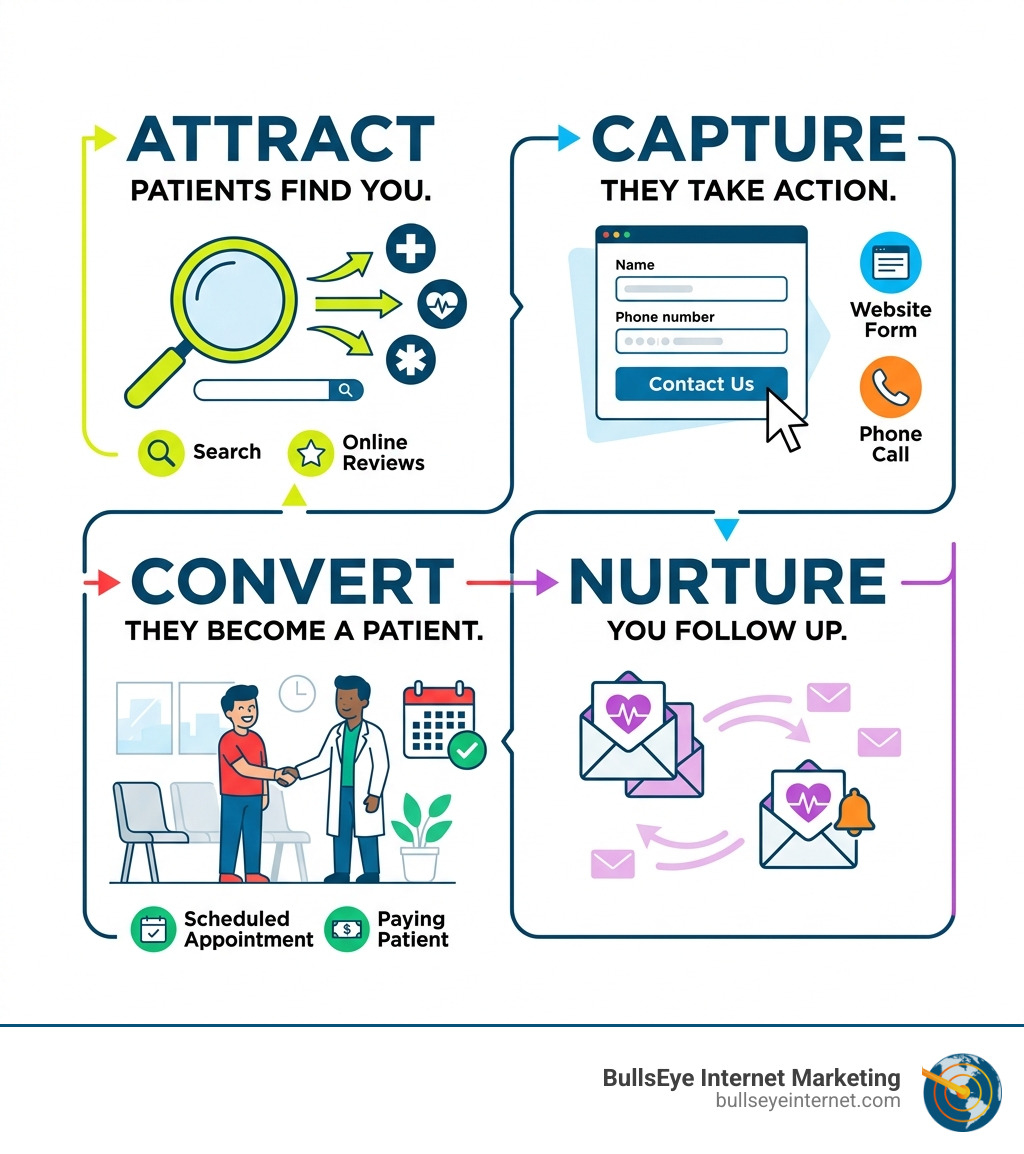
Lead generation for doctors is the process of attracting potential patients, capturing their contact information, and guiding them toward booking an appointment with your practice.
Here’s a quick breakdown of how it works:
- Attract – Patients find you through search, social media, or ads
- Capture – They take an action (fill out a form, call, book online)
- Nurture – You follow up with helpful information and reminders
- Convert – They become a scheduled, paying patient
Word-of-mouth used to be enough. But the healthcare landscape has shifted dramatically. Today, 77% of patients use online search to find and evaluate doctors before ever picking up the phone. If your practice isn’t showing up when they search, a competitor’s is.
The challenge is real, especially for smaller practices and specialty groups. Unlike large hospital systems with dedicated marketing departments, most independent doctors are focused on patient care — not Google rankings, Facebook ads, or email sequences. That gap is exactly where patient pipelines run dry.
And it’s not just about visibility. Even practices that do get website traffic often fail to convert those visitors into booked appointments. Over 70% of patients browse on smartphones, yet many medical websites are slow, hard to navigate, and missing a simple “Book Now” button.
The good news? A structured, modern lead generation strategy can fix all of this — without requiring you to become a marketing expert.
I’m Ronnie Katz, founder of BullsEye Internet Marketing, and since 2006 I’ve helped medical practices and other local businesses master lead generation for doctors through SEO, paid ads, local search optimization, and conversion-focused strategies. In this guide, I’ll walk you through exactly what’s working in 2026 to fill waiting rooms consistently and cost-effectively.
Lead generation for doctors glossary:
The Core Pillars of Lead Generation for Doctors
To succeed in 2026, we have to look beyond simple “advertising.” True Lead generation for doctors is built on a foundation of trust and technical excellence. Patients aren’t just looking for a service; they are looking for a solution to a personal, often stressful, problem.
The first pillar is Local SEO. Since healthcare is inherently local, your practice needs to dominate searches within your specific Florida community, whether you are in Miami, Fort Lauderdale, or West Palm Beach. This means optimizing for “near me” searches and specific local keywords.
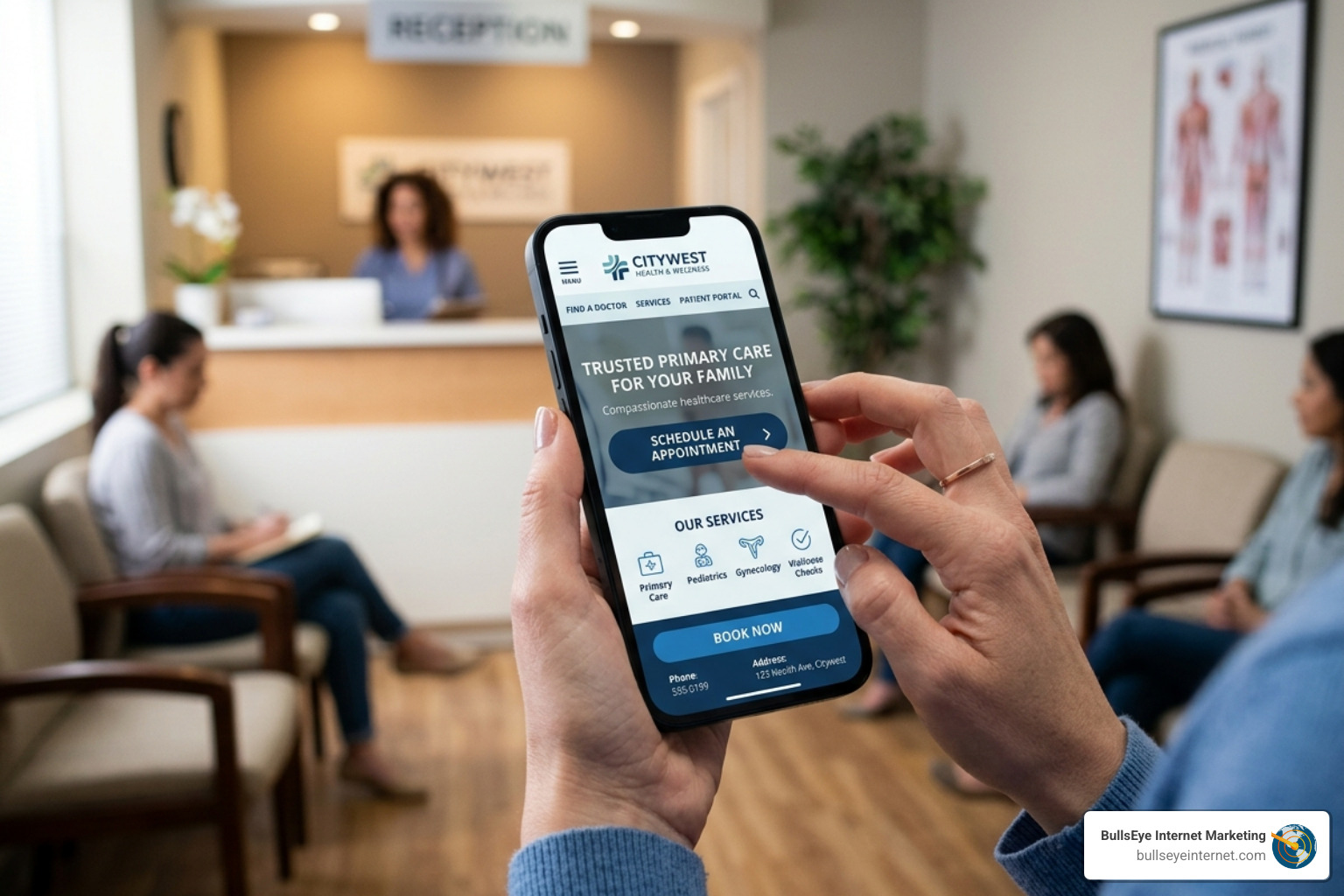
The second pillar is Mobile Optimization. With over 70% of patients browsing on smartphones, a site that takes more than three seconds to load or requires “pinch-to-zoom” is a lead killer. Patients in 2026 expect a “one-tap” experience.
Finally, we must understand Patient Search Intent. A patient searching for “why does my knee pop?” is at a different stage than someone searching for “orthopedic surgeon in Boynton Beach.” Your strategy must address both. For those in the Sunshine State, specialized SEO and digital marketing for physicians in FL is essential to navigate the competitive local landscape.
Optimizing Your Google Business Profile
If you want to appear in the “Local Map Pack”—the three listings that show up at the top of a Google search—your Google Business Profile (GBP) is your most valuable asset. In April 2026, this is often the first (and sometimes only) thing a patient sees.
We recommend filling out every single section of your profile. This includes your hours, services, and even “attributes” like “accepting new patients” or “wheelchair accessible.” High-quality photos of your office and staff help humanize your practice and build immediate rapport.
Don’t forget the power of reviews. Research shows that most patients use online reviews to evaluate physicians prior to scheduling. Responding to every review—both positive and negative—shows that you care about patient feedback. For those looking to skip the line, Why Healthcare Google Local Ads Are A Game Changer For Clinics explains how paid local ads can secure that top spot instantly.
Website Conversion and User Experience
Getting a visitor to your site is only half the battle. To truly master Lead generation for doctors, your website must act as a 24/7 sales tool.
One of the biggest trends in 2026 is self-scheduling. Statistics indicate that 80% of patients prefer doctors who offer online appointment scheduling. If a patient has to wait until 9:00 AM on Monday to call your office, they will likely find another doctor who lets them book at 11:00 PM on Sunday.
Speed is also a factor. A slow site doesn’t just frustrate patients; it hurts your rankings. By ensuring your site is fast and mobile-friendly, you cater to the majority of your audience. To see how specialized ad formats can drive traffic to these optimized pages, check out Google Local Services Ads For Health Care Services.
High-Impact Paid Advertising for Medical Practices
While SEO is a long-term play, paid advertising is the “booster shot” for your patient pipeline. In 2026, the most successful practices use a multi-channel approach, combining the high intent of Google Ads with the demographic precision of Facebook and Instagram.
| Feature | Google Search Ads | Google Local Services Ads |
|---|---|---|
| Payment Model | Pay-per-click (PPC) | Pay-per-lead |
| Placement | Top of search results | Above standard search ads |
| Verification | Standard | Google Guaranteed/Screened |
| Best For | Specific symptoms/treatments | General practice discovery |

Leveraging Paid Search for Lead Generation for Doctors
Google Ads allows us to target patients exactly when they are looking for help. When someone searches for “urgent care appointment today,” they are ready to convert. By using Google Local Services Ads, doctors can even earn a “Google Screened” badge, which adds a massive layer of credibility.
The key to high-intent leads is conversion tracking. We don’t just want to know how many people clicked an ad; we want to know how many people booked an appointment. This data allows us to refine your budget and focus on the keywords that actually fill your waiting room. For specialists, Google Local Services Ads For Dermatologists provides a blueprint for capturing these high-value leads.
Social Media Advertising and Retargeting
Social media isn’t just for “likes” anymore. Platforms like Facebook and Instagram allow for hyper-specific demographic targeting. We can show ads to women aged 30-50 in Coral Springs who have expressed interest in “wellness” or “pediatrics.”
Retargeting is perhaps the most underutilized tool in Lead generation for doctors. Most people don’t book an appointment on their first visit to your site. Retargeting allows us to show a gentle reminder ad to those visitors as they browse other sites or social media, keeping your practice top-of-mind. Learn more about this in Local Ads For Dermatologists How To Attract More Patients With Google Ads.
Content Marketing and Social Authority
In a world of “fake news” and medical misinformation, doctors who provide clear, authoritative content win the most leads. Content marketing is about proving your expertise before the patient even enters the exam room.
Educational blogs and videos are incredibly effective. Whether it’s a video explaining a common procedure or a blog post about seasonal allergies in South Florida, this content builds trust. Furthermore, effective physician referral marketing strategies highlight that building trust with other providers is just as important as building it with patients.
Strategic Content for Lead Generation for Doctors
To turn “readers” into “leads,” we use gated content. This could be a comprehensive eBook titled “The Patient’s Guide to LASIK” or a “Symptom Checker” PDF. In exchange for the download, the patient provides their email address, allowing you to nurture that lead over time.
Webinars are another powerful tool. Hosting a live Q&A session on a topic like “Managing Joint Pain” allows you to interact with dozens of potential patients at once, establishing your practice as the local authority. Choosing the right partner to manage this is crucial, as noted in The Ultimate Guide To Choosing Dermatology Advertising Experts.
Building Community on Social Platforms
Social media should be social. While LinkedIn is great for B2B networking and physician referrals, Instagram and Facebook are where you build a community. Share “behind the scenes” photos of your staff, celebrate practice milestones, and share health tips that are easy to digest.
For aesthetic and elective practices, visual platforms are non-negotiable. Cosmetic Dermatology Marketing shows how high-quality visuals and patient engagement can drive significant lead volume in visual-heavy specialties.
Streamlining the Patient Acquisition Funnel
Generating a lead is pointless if they fall through the cracks. In 2026, the “leaky bucket” is the biggest enemy of medical marketing. If your office staff is too busy to answer the phone, you are losing money.
This is where managed chat and chatbots come in. A HIPAA-compliant chatbot can answer basic questions (“Do you take Blue Cross?”) and even book appointments 24/7. This ensures that a lead is captured the moment they are interested, regardless of your office hours. Many practices use professional healthcare lead generation services to ensure no lead goes unanswered.
Automation and Lead Nurturing
Once you have a lead’s contact information, the work has just begun. Email sequences can automatically send a “Welcome” series to new leads, providing them with office directions, what to expect at their first visit, and links to patient forms.
Automation also helps with appointment reminders. Reducing “no-shows” is just as important as getting new leads. By integrating your marketing with a CRM (Customer Relationship Management) system, you can track the entire patient journey from the first click to the final follow-up. To avoid wasting your marketing spend on poor-quality leads, see Local Ads For Dermatologists How To Reduce Wasted Leads And Save Budget.
Compliance, Metrics, and Avoiding Common Pitfalls
We cannot talk about Lead generation for doctors without mentioning HIPAA compliance. Every tool you use—from your email provider to your chatbot—must be secure and protect Patient Health Information (PHI).
Common mistakes include using non-compliant contact forms or responding to reviews in a way that confirms a person is a patient. Data security is not just a legal requirement; it’s a cornerstone of the trust you build with your community.
To measure your success, we track several key metrics:
- Cost-per-lead (CPL): How much do you spend to get one person to contact you?
- Conversion Rate: What percentage of website visitors actually become leads?
- Patient Lifetime Value (LTV): How much is a new patient worth to your practice over time?
Frequently Asked Questions about Medical Lead Generation
How do I ensure my lead generation is HIPAA compliant?
You must ensure that any platform capturing patient data (like your website forms or CRM) has a signed Business Associate Agreement (BAA) with you. Never transmit PHI through standard email or non-secure text messages. At BullsEye Internet Marketing, we prioritize secure, compliant strategies for every client.
Is it better to buy leads or generate them organically?
Purchasing leads can provide a quick “booster shot,” but organic leads (from SEO and content) typically have a much higher conversion rate and lower long-term cost. We find that a hybrid approach—using paid ads for immediate volume while building SEO for long-term stability—works best for Florida practices.
What is a good cost-per-lead for a medical practice in 2026?
CPL varies wildly by specialty. A general practitioner might see leads for $20-$40, while a specialized surgeon might pay $150-$300. The key is to compare your CPL against the lifetime value of a patient to ensure a healthy ROI.
Conclusion
The days of relying solely on the “Yellow Pages” or a lucky referral are over. To thrive in the 2026 healthcare market, you need a proactive, data-driven approach to Lead generation for doctors.
At BullsEye Internet Marketing, we specialize in making this complex process simple for you. We don’t believe in locking you into long-term contracts; we believe in earning your business every single month through transparent results. Perhaps our biggest competitive advantage is our geographic exclusivity—we only work with one client per industry in any given area. If we are working with you in Miami, we aren’t working with your competitor down the street.
Whether you are in Broward, Miami-Dade, or Palm Beach County, we are here to help you scale your practice and fill your waiting room with high-quality patients.
Ready to dominate your local market? Explore our Professional Service Ads and let’s start building your patient pipeline today.
