
Lead Generation in 2026 Is Harder Than Ever — Here’s What Actually Works
Lead generation strategies are the methods businesses use to attract potential customers, capture their contact information, and move them toward a sale. Here are the most effective ones in 2026:
- SEO and content marketing — attract high-intent buyers through organic search
- Paid advertising (Google, LinkedIn) — generate leads fast with targeted campaigns
- Pay-per-lead models — pay only for verified, qualified leads
- LinkedIn outreach — the #1 B2B channel for return on ad spend
- Email nurture sequences — automated follow-up that converts over time
- Lead magnets (calculators, tools, templates) — capture contacts with real value
- Local SEO and Google Business Profile — capture high-intent local buyers
- Referrals and peer recommendations — trusted by 59% of B2B buyers
- AI and automation — score, route, and follow up with leads in minutes
- Retargeting campaigns — re-engage warm visitors who didn’t convert
Here’s an uncomfortable truth: 80% of new leads never convert to sales. Not because businesses aren’t generating enough leads — but because they’re generating the wrong ones, or failing to follow up fast enough.
Nearly 70% of B2B marketers are increasing their lead generation budgets. At the same time, Google Ads cost per lead climbed from $66.69 in 2024 to $70.11 in 2025. More spend. More competition. Thinner margins.
The businesses winning right now aren’t the ones chasing the highest lead volume. They’re building systems — connecting the right channels, the right content, and the right follow-up to turn strangers into paying customers.
This guide will show you exactly how to do that.
I’m Ronnie Katz, founder and Principal CEO of BullsEye Internet Marketing, and since 2006 I’ve helped businesses across competitive industries build lead generation strategies that actually move the needle — from SEO and pay-per-lead to Google Ads and local search. Everything in this guide comes from over two decades of hands-on experience getting phones to ring and sales funnels to convert.
Terms related to Lead generation strategies:
What is Lead Generation and Why Does It Matter?
At its core, lead generation is the systematic process of identifying, attracting, and cultivating potential customers for your business’s products or services. A “lead” is any person or organization who has interacted with your brand and indicated interest by sharing their contact details, giving you permission to follow up.
In the fast-evolving landscape of July 2026, relying on cold outreach or passive “hope-and-pray” marketing is a recipe for empty pipelines. Lead generation is the engine of predictable, scalable business growth. Without a structured way to capture interest, your marketing campaigns are just expensive noise.
The modern buyer’s journey has fundamentally changed. Buyers are highly self-educated, researching solutions across multiple channels before ever speaking to a sales representative. Furthermore, trust in traditional corporate marketing is at an all-time low. Consider this industry reality: only 36% of buyers trust company employees, while 59% trust recommendations from peers at other businesses.
This trust gap makes capturing first-party data (information collected directly from your audience with their consent) absolutely critical. By implementing value-first lead generation strategies, you transition anonymous website visitors into known prospects while establishing the credibility needed to close deals. For a deeper understanding of these core principles, check out this comprehensive What is Lead Generation? Guide & Best Practices .
The Core Steps of the Lead Generation Process
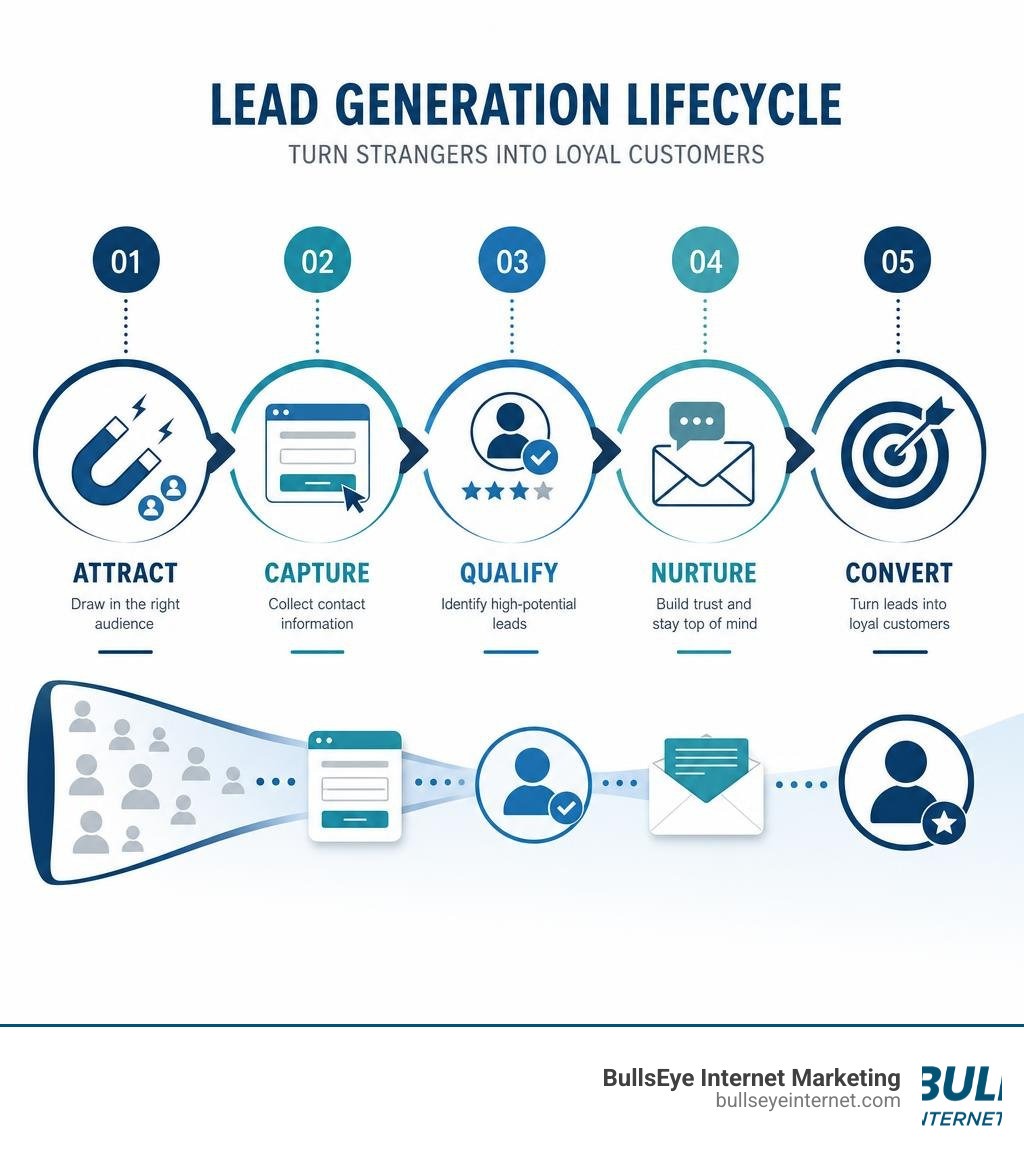
Successful lead generation is not a series of random, disconnected campaigns. It is a compounding, five-step system designed to turn strangers into loyal clients:
- Attraction: You draw high-intent prospects to your brand using targeted channels like organic search (SEO), paid advertising, local Map Packs, or social media.
- Capture: You present a compelling offer—a lead magnet, interactive tool, or direct consultation—and collect their contact information via an optimized form or phone call.
- Qualification: You filter out the tire-kickers. Through explicit fit criteria and implicit behavioral tracking, you separate low-value contacts from high-intent buyers.
- Nurturing: Because most newly captured leads are not ready to buy immediately, you build relationships through automated, highly personalized email sequences and educational content.
- Conversion: When the prospect demonstrates clear buying signals, they are routed to your sales team (or direct booking system) to close the deal.
Throughout this process, database security and privacy compliance (such as maintaining clear privacy policies on your forms) are paramount. Securing customer data protects your brand and builds the foundational trust required for long-term relationships. For businesses seeking to target specific geographical markets, our Local Lead Generation Services Complete Guide outlines how to execute these steps on a localized level.
Inbound vs. Outbound Lead Generation: Finding the Right Balance
To build a resilient revenue engine, you must understand the two primary methodologies of customer acquisition: inbound and outbound marketing.
- Inbound Lead Generation is a passive-attraction model. You create high-value content, optimize your website for search engines, and build organic authority so that when prospects are actively searching for a solution, they find you. It is a long-term strategy that compounds over time, lowering your overall customer acquisition cost (CAC).
- Outbound Lead Generation is an active-outreach model. You identify highly targeted prospects who fit your Ideal Customer Profile (ICP) and reach out to them directly via highly personalized emails, targeted social media ads, direct mail, or cold calls. It is a fast-acting strategy designed to fill immediate pipeline gaps.
Rather than picking a side, high-performing businesses in 2026 deploy a hybrid strategy. They use inbound marketing to build long-term brand authority and capture active search demand, while leveraging highly targeted outbound outreach to secure immediate deals with high-value accounts.
| Feature | Inbound Lead Generation | Outbound Lead Generation |
|---|---|---|
| Primary Focus | Attracting prospects who are actively searching | Directly targeting specific, high-value accounts |
| Speed to Results | Slow (compounds over 3 to 12 months) | Fast (immediate outreach and ad activation) |
| Cost Structure | Higher upfront asset creation, lower long-term cost | Direct cost-per-click, cost-per-lead, or sales labor |
| Conversion Intent | High (the buyer initiated the search) | Medium-Low (requires education and trust-building) |
| Key Channels | SEO, Content Marketing, GBP, Organic Social | Cold Email, PPC, LinkedIn Outreach, Direct Mail |
Choosing the Best Channels for Your Business
There is no “one-size-fits-all” channel. Your ideal marketing mix depends on where your buyers spend their time, your team’s execution capabilities, and your financial runway.
If you have a healthy budget but need leads immediately, paid advertising and pay-per-lead models are your fastest path to success. If you are building for sustainable, long-term industry dominance, investing in SEO, organic search, and automated email nurturing will yield the highest compounding ROI. For many local service businesses, contractors, and professional firms, shifting the risk away from traditional ad spend and focusing on verified results is the smartest move. Learn how this works in our guide to Pay Per Lead Advertising.
High-Converting Lead Generation Strategies for 2026
To stand out in a crowded market, your digital assets must be conversion machines. You can drive millions of visitors to your website, but if your landing pages are cluttered and confusing, your budget is wasted.

High-converting landing pages focus on a single, clear goal. They feature a compelling, outcome-based headline, a prominent call-to-action (CTA) above the fold, clean visual hierarchy, and strong social proof (such as reviews, ratings, and video testimonials featuring real names and businesses).
For businesses operating in specific regions—such as South Florida, including Miami-Dade, Broward, and Palm Beach Counties—local search engine optimization (Local SEO) is your highest-leverage asset. Local search carries incredibly high purchase intent. When someone searches for a local service, they are usually ready to buy.
Optimizing your Google Business Profile (GBP) is the cornerstone of local lead generation. By maintaining strict Name, Address, and Phone Number (NAP) consistency, gathering authentic customer reviews, and posting regular updates, you can dominate the local Map Pack and capture high-intent local phone calls. Discover the exact steps to achieve this with The 7 Steps To GMB Lead Generation Success.
Organic Search and Content Lead Generation Strategies
SEO in 2026 is no longer about stuffing keywords into random blog posts. Search engines and AI discovery tools prioritize topical authority—the depth and breadth of your expertise across entire subject clusters.
To build topical authority, you must align your content directly with search intent. Instead of targeting broad, informational keywords that attract casual researchers, focus your content engine on high-intent, bottom-of-funnel search queries (such as competitor comparisons, reviews, and “alternative” searches).
Additionally, diversify your content formats. Video marketing has quietly become one of the most effective ways to capture and keep attention. YouTube has over 2.53 billion monthly active users, making it the second most visited website globally. Furthermore, 85% of marketers rank short-form video (under 60 seconds) as the most effective form of social media content.
Whether you are creating short, educational videos for social media or building in-depth guides, your content must focus on providing immediate, practical utility. For a complete blueprint on structuring your organic content funnel, explore the Lead Generation Guide: The Complete Playbook 2026 .
Paid Advertising and Pay-Per-Lead Lead Generation Strategies
Paid media is a powerful tool for rapid lead acquisition, but it is becoming increasingly expensive. Google Ads CPL climbed from $66.69 in 2024 to $70.11 in 2025, forcing businesses to be hyper-strategic with their audience segmentation and landing page optimization.
For B2B organizations, LinkedIn remains the gold standard for paid social. LinkedIn ranks #1 for return on ad spend (ROAS) in B2B advertising, delivering an average 113% return. By using native LinkedIn Lead Gen Forms, which pre-populate form fields using a user’s profile data, you can dramatically reduce mobile form friction and boost conversion rates.
To maximize your return on investment and eliminate the risk of wasted ad spend, many businesses are transitioning to pay-per-lead (PPL) and pay-per-call models. Instead of paying for clicks, impressions, or untracked visitors, you partner with an agency and pay only when a verified, qualified lead or phone call is generated. This shifts the financial risk away from your business and aligns your marketing costs directly with real pipeline value.
To master the transition from paid traffic to paying clients, read our guide on From Clicks To Customers Mastering PPC For Lead Generation.
How to Qualify and Score Leads to Maximize Sales Efficiency
One of the most common marketing failures is celebrating lead quantity while ignoring lead quality. If your marketing team hands over 500 leads to your sales team, but 480 of them are unqualified tire-kickers with no budget, you are actively wasting your sales team’s valuable time and driving up your acquisition costs.
To maximize efficiency, you must implement a robust lead qualification and scoring framework.

A lead scoring model assigns numerical values to prospects based on two distinct categories:
- Fit (Explicit Criteria): How well does the lead match your Ideal Customer Profile? This includes firmographic and demographic data such as industry, company size, revenue, job title, and geographic location.
- Engagement (Implicit Criteria): How is the lead interacting with your brand? This tracks digital behaviors such as visiting high-value pricing pages, downloading specific bottom-of-funnel templates, opening email sequences, or attending webinars.
By combining these two dimensions, you can clearly categorize your leads:
- Marketing Qualified Leads (MQLs): Prospects who match your basic fit criteria and have engaged with top- or middle-of-funnel content, indicating general interest.
- Sales Qualified Leads (SQLs): High-intent prospects who have been vetted by a scoring model or a human representative as ready for a direct sales conversation.
To streamline this handoff, we highly recommend utilizing the classic BANT framework to evaluate and prioritize prospects:
- Budget: Does the prospect have the financial resources to purchase your solution?
- Authority: Is the person you are communicating with the decision-maker, or a key stakeholder in the buying committee?
- Need: Does your product or service solve a specific, high-priority pain point they are currently facing?
- Timing: What is their purchase timeline? Are they looking to implement a solution immediately, or are they just planning for next year?
Creating High-Converting Lead Magnets
The days of gating generic, 40-page “ultimate guides” are officially over. Buyers are fatigued by thin, AI-generated ebooks and refuse to trade their contact details for content they could easily find in a simple Google search.
To convert modern audiences, your lead magnets must deliver immediate, personalized utility in under five minutes. The highest-converting lead magnets in 2026 are interactive tools and calculators (such as ROI calculators, cost estimators, and self-assessments). While static ebooks typically convert at 3% to 8%, interactive calculators convert at 10% to 25% because they provide instant, tailored value.
To maximize conversions on your lead capture forms, follow these form field optimization best practices:
- Keep it Short: Limit your initial forms to 3 to 5 fields (e.g., Name, Business Email, and Company Name). Form completion rates drop sharply when you demand too much information upfront (averaging 25% for 3 fields, but falling under 10% for 10+ fields).
- Use Progressive Profiling: If you need deeper qualification data, use smart forms that recognize returning visitors and dynamically replace completed fields with new questions (like “What is your primary marketing challenge?”).
- Leverage Multi-Step Forms: Break your forms into smaller, low-friction steps. Start with simple, non-intrusive questions (e.g., “What industry are you in?”) to build psychological momentum before asking for contact details on the final step.
Leveraging AI and Automation for Lead Nurturing
Once you capture a lead, the clock starts ticking. Leads contacted within 5 minutes are roughly 9 times more likely to convert than those contacted after 30 minutes. Yet, the average B2B response time is over 42 hours. This massive gap is where revenue is lost.
No human team can consistently monitor inboxes and web chats 24/7 to hit a five-minute response window. That is where marketing automation and AI come in.
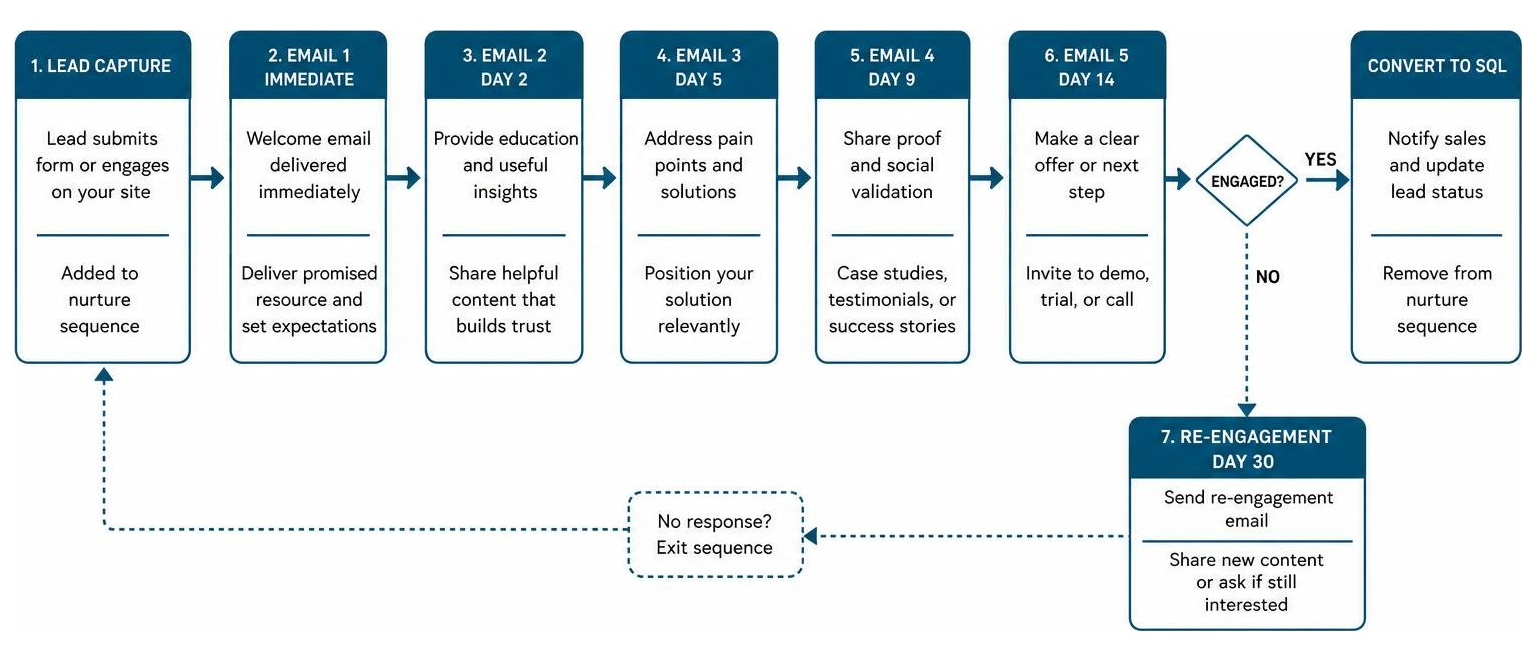
Modern lead generation strategies rely on automated systems to handle the initial heavy lifting:
- Autonomous AI Agents: Smart chatbots can engage inbound web visitors in real-time, qualify them using your custom BANT criteria, and schedule meetings directly onto your sales team’s calendars.
- Automated Lead Routing: The moment a high-intent lead submits a form, they are instantly routed to the correct sales representative based on location, industry, or company size.
- Drip Email Sequences: Newly captured leads are automatically enrolled in structured, behavioral-trigger email sequences designed to build trust over time. A healthy nurture sequence content mix consists of roughly 70% educational value, 20% social proof (case studies and testimonials), and 10% direct offers.
To understand exactly which campaigns, ads, and landing pages are driving your high-value phone calls, implementing robust tracking is essential. Learn how to connect the dots with our guide to Call Tracking Solutions.
Key Metrics to Measure Lead Generation Success
If you are only tracking raw lead volume, you are measuring vanity metrics. To build a highly profitable lead generation engine, you must track actionable, revenue-aligned metrics:
- Cost Per Lead (CPL): Calculated by dividing your total campaign spend by the number of leads generated. (If a campaign costs $1,000 and generates 200 leads, your CPL is $5).
- Lead-to-Opportunity Conversion Rate: The percentage of raw leads that successfully convert into qualified sales opportunities.
- Pipeline Contribution: The total monetary value of the sales pipeline generated by your marketing campaigns.
- Customer Acquisition Cost (CAC): The total marketing and sales spend required to acquire a single paying customer.
A higher Cost Per Lead in a premium, high-intent channel (like Google Search or Pay Per Lead) often results in a significantly lower Customer Acquisition Cost because those leads qualify faster and close at a much higher rate.
Frequently Asked Questions about Lead Generation
What is the most effective lead generation strategy for B2B?
While there is no single silver bullet, a hybrid approach of LinkedIn organic content paired with targeted peer referral networks consistently yields the highest conversion rates. LinkedIn organic marketing delivers an average 229% ROI for B2B organizations. Additionally, because 59% of B2B buyers trust recommendations from peers over company marketing, building a strong referral network is highly effective for securing warm, high-trust leads.
How does speed-to-lead impact conversion rates?
Speed-to-lead is one of the most critical factors in modern sales. Responding to a new lead within the first five minutes increases your qualification and conversion rates by roughly 9x compared to waiting just 30 minutes. Utilizing automated routing, instant email autoresponders, and AI-powered booking tools ensures your business makes the first move before your competitors do.
Should we gate all of our content behind forms?
Absolutely not. Gating all of your content creates immense user friction and severely harms your organic SEO reach. The best practice is to keep your educational blog posts, industry insights, and basic guides completely ungated so search engines can index them and build your brand authority. Only gate your highest-value, proprietary assets—such as interactive calculators, ready-to-use templates, and deep industry research reports.
Conclusion: Dominate Your Market Without the Stress
Building a sustainable, compounding pipeline of high-quality leads doesn’t have to cost you your sanity. You don’t need to be on every single social media platform, nor do you need to spend tens of thousands of dollars testing unproven ad campaigns.
The secret to sustainable growth lies in building a structured, high-intent system: targeting the right local search terms, optimizing your conversion assets, scoring your leads accurately, and following up instantly.
At BullsEye Internet Marketing, we specialize in making your phone ring and your pipeline fill with zero friction. We are a digital marketing agency that focuses on generating actual calls and sales through Pay Per Lead, Google Business Profile optimization, SEO, PPC, and conversion rate optimization.
We do things differently to give your business a massive competitive advantage:
- No Long-Term Contracts: We earn your business every single month based on real, transparent results.
- Strict Exclusivity: We work with only one client per industry per geographic area in our service locations, which include Florida (from Miami-Dade and Broward to Palm Beach, Martin, and St. Lucie Counties) and across the United States. When you partner with us, we focus 100% of our local search power on beating your competitors—not helping them.
Ready to stop chasing vanity metrics and start driving real revenue? Get started with Pay Per Lead services today, and let us build your predictable growth engine.
