
Why Traditional SEO Alone Won’t Cut It Anymore
How to GEO is the process of optimizing your content to be finded, understood, and cited by AI-powered search engines like ChatGPT, Google’s AI Overviews, Perplexity, and Claude. Here’s what you need to do:
Quick Answer: The 5 Core Steps to GEO Success
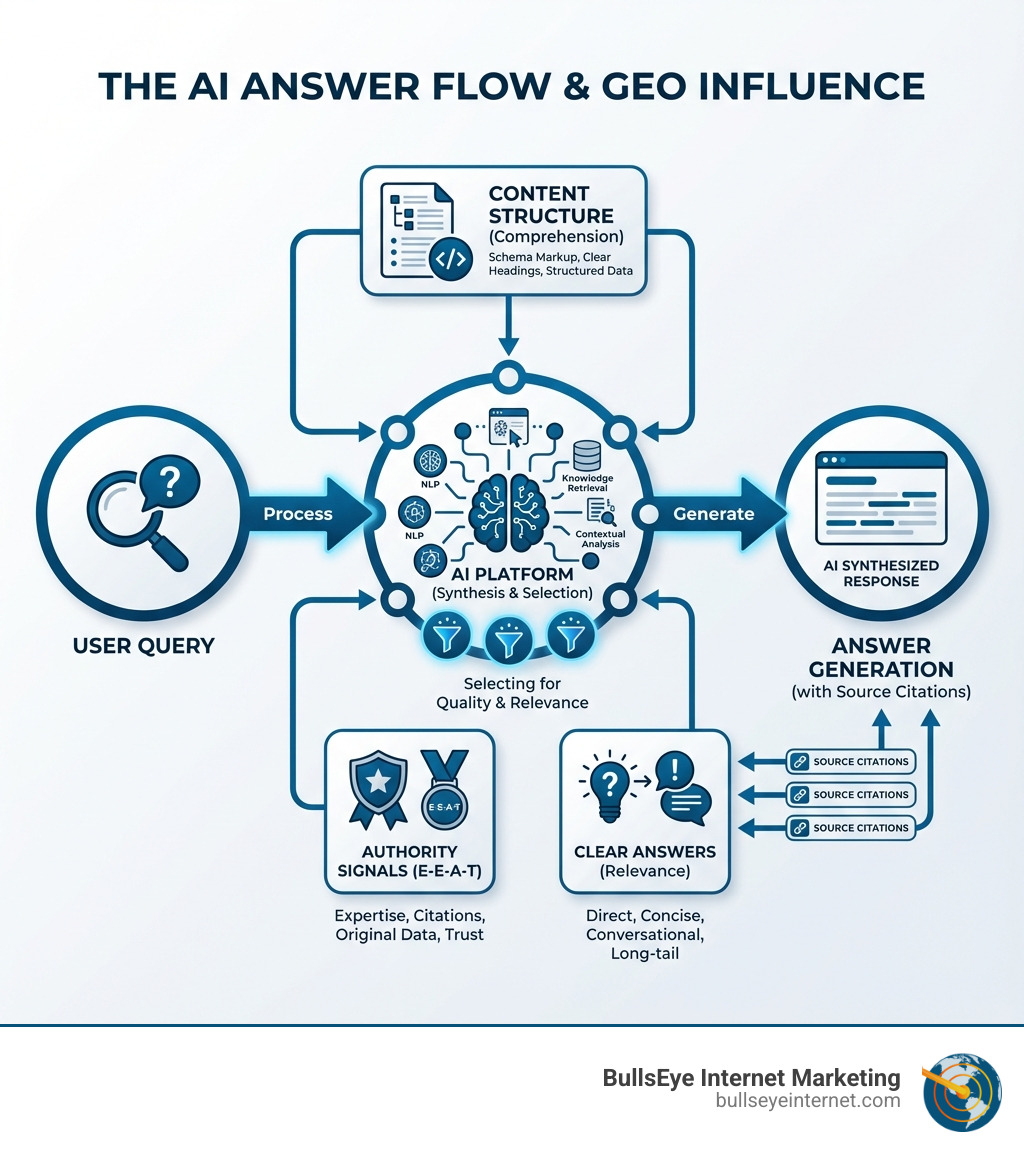
- Structure Content for AI Comprehension – Use clear headings, short paragraphs, bullet points, and schema markup so AI can easily parse your content
- Optimize for Conversational Queries – Target question-based, long-tail keywords that mirror how people naturally ask AI platforms
- Build E-E-A-T Authority Signals – Demonstrate Experience, Expertise, Authoritativeness, and Trust through citations, original data, and expert credentials
- Leverage Multimedia & Community Platforms – Distribute content across YouTube, Reddit, and other platforms where AI trains and pulls answers
- Monitor AI Citations & Refine – Track when AI platforms mention your brand and continuously optimize based on what’s working
The search landscape is shifting fast.
When a potential customer asks ChatGPT for recommendations in your industry, will your business be cited? Or will AI mention three of your competitors without ever finding your brand?
That’s the reality business owners face today. Over 1 billion queries are processed daily by ChatGPT alone, and Google’s AI Overviews now appear in more than 50% of searches. Even more telling: Gartner predicts search engine volume will drop 25% by 2026 due to AI chatbots and virtual agents.
This isn’t about search engines returning a list of blue links anymore. AI platforms now synthesize information from multiple sources and generate direct answers—with citations. If your content isn’t structured, authoritative, and optimized for AI comprehension, you’re invisible.
The good news? You don’t need to throw away everything you know about SEO. GEO is an evolution, not a replacement. The businesses that adapt now—while competitors are still focused solely on traditional rankings—will capture market share and customer attention in this new AI-driven search reality.
I’m Ronnie Katz, founder and Principal CEO of BullsEye Internet Marketing, and I’ve been helping businesses dominate online visibility since 2006. In this guide, I’ll show you exactly how to GEO—step by step—so your business gets cited by AI engines and captures customers where they’re actually searching.
Key terms for How to GEO:
What is Generative Engine Optimization (GEO) and Why Does It Matter?
Generative Engine Optimization (GEO) is the cutting-edge practice of tailoring your digital content to be easily consumed, understood, and cited by AI-driven platforms. Think of it as preparing your content to be the definitive answer an AI assistant provides, rather than just another link in a long list of search results. We’re talking about getting your brand, products, or services directly referenced, quoted, and recommended within AI responses from platforms like Google’s AI Overviews, ChatGPT, Claude, and Perplexity.
The AI content pipeline works by taking vast amounts of data—our content—and processing it to synthesize answers. AI models parse HTML, tokenize content, convert it into vector embeddings, and then stitch these fragments into conversational answers. This means our content needs to be machine-readable, semantically clear, and structured in a way that AI crawlers can easily find and extract atomic facts.
You might also hear this referred to as Answer Engine Optimization (AEO) or AI Optimization (AIO). Regardless of the name, the goal is the same: to ensure your content is visible and influential in a world where AI is increasingly the first point of information findy.
Why does this matter so much? Because the impact on website traffic and brand visibility is profound. As we saw, Gartner predicts a significant drop in traditional search volume, replaced by traffic from generative engines. This isn’t a hypothetical future; it’s happening now. 89% of B2B buyers already use AI platforms like ChatGPT for research. If our content isn’t showing up there, we’re missing out on critical opportunities.
The core difference between traditional SEO and GEO boils down to intent and outcome. Traditional SEO focuses on ranking pages for keywords, aiming for clicks to our website. GEO focuses on being the source that AI uses to answer a user’s question directly, aiming for citations and mentions.
Here’s a quick table to illustrate the shift:
| Feature | Traditional SEO | Generative Engine Optimization (GEO) |
|---|---|---|
| Goal | Rank web pages in SERPs, drive clicks | Get content cited in AI-generated answers |
| Focus | Keywords, backlinks, page rank | Semantic clarity, authority, direct answers, context |
| Key Tactics | Keyword density, meta tags, link building, site speed | Answer-first structure, entity optimization, E-E-A-T, schema, multi-platform presence |
| Metrics | Clicks, impressions, rankings, traffic | AI citations, brand mentions, voice share, AI-attributed conversions |

The Foundation: Why SEO Still Matters
Let’s be clear: GEO is an evolution, not a revolution that eradicates SEO. In fact, traditional SEO still forms the bedrock of GEO success. Why? Because AI platforms often source information from websites that already demonstrate authority and relevance in traditional search. Think of it this way: AI wants to provide reliable answers, and reliable answers often come from reliable sources that have already established their credibility with search engines.
This means we still need to nail the basics: impeccable technical SEO (fast site speed, mobile responsiveness, clear site architecture), comprehensive content that addresses user intent, and a strong backlink profile. These fundamentals make our content findable and trustworthy, not just for human users but for AI crawlers too. As Google itself advises, a solid SEO foundation is crucial for any online presence. We can’t build a penthouse suite (GEO) without a strong foundation (SEO).
Entity Optimization: Becoming a Recognized Authority
AI systems don’t just understand keywords; they understand entities. An entity is a person, place, thing, or concept, and AI understands the relationships between these entities through what are called knowledge graphs. For example, AI doesn’t just see “Florida beaches”; it understands “Florida” as a state, “beaches” as a type of geographical feature, and can connect them to specific locations like “South Florida” or “Miami Beach.”
Our goal is to make our brand a recognized and authoritative entity within these knowledge graphs. This means creating consistent brand information across all digital platforms. Imagine our business, BullsEye Internet Marketing, consistently listed with our services, locations (like Broward County, Miami-Dade County, Palm Beach County), and expertise across the web.
Here’s how we do it:
- Consistent Digital Footprint: Ensure our name, address, phone number (NAP), and services are identical on our website, Google Business Profile, LinkedIn Company Page, and relevant industry directories.
- Link Everything: Link all our digital properties together. Our blog posts should link to our services pages, our social media profiles to our website, and so on. This creates a strong, interconnected network that signals our presence and authority to AI.
- Build Co-citations: AI doesn’t just count backlinks; it also recognizes mentions of our brand, even without a direct link. If our business is frequently mentioned alongside our industry or competitors, AI starts to understand our position in the market. For instance, if an article discusses “digital marketing agencies in South Florida” and mentions BullsEye Internet Marketing alongside other agencies, that’s a powerful co-citation.
Entity optimization is our secret weapon. When AI recognizes our brand as a distinct, authoritative entity, it’s far more likely to reference us in its generated answers.
How to GEO: A 5-Step Action Plan for AI Visibility
Now that we understand the “what” and “why” of GEO, let’s dive into the “how.” This 5-step action plan will guide us in optimizing our content for AI-driven search, ensuring our business stands out in the evolving digital landscape.

Step 1: How to GEO with Perfectly Structured Content
AI models are like super-efficient students: they love well-organized notes. The clearer and more structured our content, the easier it is for AI to comprehend, extract, and ultimately cite.
- Clear Headings (H2, H3): Use descriptive H2 and H3 headings that often frame questions. This helps AI quickly identify the main topics and sub-topics, acting like a table of contents for the AI model. For example, instead of just “Our Services,” use “H2: What Digital Marketing Services Does BullsEye Internet Marketing Offer?”
- Short Paragraphs & One Idea Per Paragraph: Break down complex information into digestible chunks. Each paragraph should ideally convey a single, complete idea. This allows AI to extract “atomic facts” without getting bogged down in dense text.
- Bullet Points and Numbered Lists: These are AI’s best friends! Lists make information scannable for both humans and machines. They’re perfect for summarizing benefits, steps, or features, making it incredibly easy for AI to pull out key data points for its answers.
- Schema Markup (JSON-LD): This is like giving AI a cheat sheet for our content. Schema.org markup, particularly in JSON-LD format, provides explicit types and context for our data.
- FAQ Schema: If we have a Frequently Asked Questions section, marking it up with FAQ schema helps AI understand that these are questions and answers, making them prime candidates for direct AI answers.
- HowTo Schema: For step-by-step guides, HowTo schema clearly outlines the process, allowing AI to easily extract instructions.
- Article, Organization, Product Schema: Using these schemas for our blog posts, company information, and services helps AI categorize and understand the core entities and their attributes on our site.
- Providing Direct, Concise Answers: AI platforms are designed to give direct answers. We should adopt an “answer-first” structure. After asking a question in an H2, provide a concise, 40-60 word direct answer immediately, followed by more detailed explanations. This mirrors how AI will likely present the information.
Step 2: Master Conversational Keywords & Natural Language
People don’t talk to AI like they type into a traditional search bar. They ask questions, use natural language, and engage in conversations. This means our keyword strategy needs to evolve beyond just short, transactional terms.
- Question-Based Queries & Long-Tail Keywords: Focus on the questions people are asking. Use tools like AnswerThePublic or analyze discussions on platforms like Reddit and Quora to uncover the exact phrases and questions our target audience in Florida (or anywhere in the US) is using. These long-tail, conversational queries are what AI is designed to answer.
- Voice Search Optimization: With over a billion voice searches occurring monthly, optimizing for natural language is no longer optional. Voice queries are inherently conversational and question-based. Ensure our content directly addresses these types of questions.
- Natural Language Processing (NLP): AI’s NLP capabilities mean it understands the context and semantic meaning behind words, not just exact keyword matches. We should write naturally, using synonyms and related concepts, to cover topics comprehensively. This helps AI understand the full scope of our content.
- Tools for Finding Conversational Queries:
- AnswerThePublic: Visualizes questions people ask around a topic.
- BuzzSumo: Identifies popular content and questions.
- Reddit and Quora: Excellent for finding real-world questions and discussions in our niche.
- Google Keyword Planner: Provides search volume for longer, more descriptive queries.
Step 3: Build Unshakable Authority Signals (E-E-A-T)
AI models are designed to provide reliable, trustworthy information. They prioritize sources that demonstrate Experience, Expertise, Authoritativeness, and Trustworthiness (E-E-A-T). This is where our reputation as BullsEye Internet Marketing truly shines.
- Experience & Expertise: Showcase our years of experience in digital marketing and our specialized knowledge in areas like Pay Per Lead, Google Business Profile Optimization, and SEO for businesses across Florida.
- Author Bylines: For blog posts, ensure our authors (like Ronnie Katz) have clear bylines with their credentials and experience.
- Original Research & Data: Publish unique insights, case studies, or data from our work with clients. This positions us as a thought leader and a primary source of information, which AI loves to cite.
- Authoritativeness: This is built through external validation.
- Quality Backlinks: While AI considers mentions without links, high-quality backlinks from reputable websites still signal authority to both traditional search engines and AI models. Focus on earning links from relevant industry sites and publications.
- Brand Mentions & Co-citations: Encourage mentions of BullsEye Internet Marketing across the web, even without a direct link. If we’re mentioned alongside other respected entities in our field, AI strengthens its understanding of our authority.
- Trustworthiness: Be transparent, accurate, and consistent.
- Citing Sources: When we make claims or provide statistics, we should cite our sources. This demonstrates thoroughness and builds trust.
- Expert Quotes: Incorporate quotes from recognized experts (internal or external) in our content. This adds credibility and depth.
- Consistent Information: Ensure all information about our business—services, locations, contact details—is consistent across all platforms.
For a deeper dive into E-E-A-T, refer to Google’s E-E-A-T Evaluation Guide.
Step 4: Leverage Multimedia and User-Generated Content (UGC)
AI is becoming increasingly multimodal, meaning it processes information from various formats, not just text. This opens up new avenues for visibility.
- Role of Images and Videos: High-quality images, infographics, and videos are no longer just “nice-to-haves.” They help AI understand content, engage users, and can even be cited directly.
- Optimizing Alt Text: For images, always use descriptive alt text. This helps AI understand the image’s content and context, making our content more accessible and findable.
- Visual Content in AI Overviews: Google AI Overviews often include visual content. If we have relevant images or videos, they might be pulled into an AI answer.
- Content Distribution on YouTube: YouTube is a massive search engine in itself, and AI models frequently pull information from video content. Creating engaging video tutorials, explanations of our services, or client testimonials and optimizing them for YouTube can significantly boost our GEO efforts.
- The Power of Reddit and Quora: Believe it or not, user-generated content from platforms like Reddit and Quora is frequently cited by AI models. Why? Because these platforms often contain real-world questions, authentic discussions, and diverse perspectives.
- Engage in Communities: Actively participating and providing valuable answers on relevant subreddits or Quora spaces related to digital marketing, SEO, or local business challenges in Florida can lead to our insights being picked up by AI.
- Monitor Mentions: Keep an eye on discussions where our brand or services are mentioned.
- Impact on Source Visibility: A GEO study highlighted that methods like the inclusion of citations, quotations from relevant sources, and statistics notably boosted source visibility by over 40% across various queries. This means incorporating well-researched, data-backed multimedia and leveraging community platforms can significantly increase our chances of being cited.
Step 5: How to GEO by Measuring and Refining Your Strategy
GEO is not a “set it and forget it” endeavor. It requires continuous monitoring, analysis, and refinement. Just like traditional SEO, we need to understand what’s working and what’s not.
- Tracking AI Citations: This is the holy grail of GEO measurement. We need to know when and how AI platforms are citing our content.
- Manual Testing: Start by manually asking major AI platforms (ChatGPT, Google AI Overviews, Perplexity, Claude) questions relevant to our business and niche. Note which sources they cite.
- Chrome Extensions: Tools like the Google AI Overview Impact Analysis and Google AI Overview Citation Analysis Chrome extensions can help track AI Overviews and cited sources.
- AI Visibility Tools: Platforms like Semrush are developing tools to track AI visibility and compare it against competitors.
- Brand Mention Monitoring: Beyond direct citations, track general mentions of our brand across AI platforms. Are we being discussed? What’s the sentiment?
- Analyzing AI Overview Responses: Pay close attention to how AI Overviews are structured. Do they use lists, tables, or videos? What kind of language do they use? This helps us adapt our content structure and style to better align with what AI prioritizes.
- Identifying Content Gaps: By analyzing AI responses, we can spot questions that AI isn’t answering comprehensively or accurately. These are opportunities for us to create definitive content that fills those gaps and becomes a prime citation candidate.
- A/B Testing Content Structures: Experiment with different content structures, heading styles, and answer formats. See what leads to more AI citations and better visibility. This iterative approach is key to long-term GEO success.
Frequently Asked Questions about Generative Engine Optimization
We’ve covered a lot of ground on how to GEO, but some common questions always pop up. Let’s tackle them head-on.
Do backlinks still matter for GEO?
Yes, absolutely. Backlinks are not dead for GEO; they are still a crucial signal for authority and trustworthiness (E-E-A-T). AI models, much like traditional search engines, use backlinks as a strong indicator of a source’s credibility and relevance. When an AI is synthesizing an answer, it wants to cite the most reputable and authoritative sources available. A strong backlink profile signals that our content is valued and referenced by others, which in turn makes it a more attractive source for AI to cite. The key here is quality over quantity – high-quality, relevant backlinks from authoritative sites are far more impactful than a large number of low-quality links.
Which AI platforms should I prioritize for optimization?
Our approach should be to focus on universal principles that work across all major AI platforms. While each platform (Google’s AI Overviews, ChatGPT, Claude, Perplexity) might have slight nuances in how they process and present information, the core tenets of GEO remain consistent. Optimizing for well-structured, authoritative, and truly helpful content will benefit our visibility everywhere.
However, if we had to prioritize, we’d start with Google’s AI Overviews due to their direct integration into the most widely used search engine. Then, we’d look at ChatGPT and Claude, given their massive user bases and growing influence. Perplexity is also gaining traction, particularly for its clear citation of sources, making it a valuable platform to monitor. By adhering to the best practices outlined in this guide, we’ll naturally optimize for all these platforms simultaneously.
How is GEO success measured?
Measuring GEO success is different from traditional SEO, but equally vital. We need to shift our focus from just website traffic and rankings to metrics that indicate AI visibility and influence:
- Citation Rate: This is the percentage of relevant AI-generated answers that reference our brand, website, or specific content. It’s the most direct indicator of our GEO effectiveness.
- Brand Mentions within AI Responses: How often is our brand (BullsEye Internet Marketing) mentioned in AI answers, even without a direct link? This speaks to brand recognition and authority within the AI ecosystem.
- Referral Traffic from AI Platforms: While AI aims for direct answers, users may still click through to cited sources for more detail. Tracking this referral traffic helps us understand the direct impact of our AI visibility.
- AI Visibility Scores: Specialized GEO tracking tools (like those being developed by Semrush) are emerging to provide comprehensive scores and insights into our content’s performance across various AI models.
- Conversions & Leads: Our goal is to drive business. We need to attribute conversions and leads that originate from users who encountered our brand through AI-generated answers.
By tracking these metrics, we can understand the true return on investment (ROI) of our GEO efforts and continuously refine our strategy.
Conclusion: Future-Proofing Your Digital Presence
The digital marketing landscape is always changing, and Generative Engine Optimization is the latest, most impactful evolution. It’s clear that the future of search is AI-driven, and our visibility depends on adapting our strategies to meet this new reality.
We’ve explored how to GEO by focusing on creating perfectly structured content, mastering conversational keywords, building unshakable E-E-A-T authority, leveraging multimodal and user-generated content, and diligently measuring our efforts. This isn’t about replacing SEO; it’s about integrating GEO with our existing SEO strategies to create a powerful, future-proof digital presence.
For businesses across the United States, especially here in Florida—from Miami-Dade County to Martin County, and all the vibrant cities like Doral, Coral Gables, and West Palm Beach—the competitive advantage of being an early adopter in GEO cannot be overstated. While others are still chasing traditional rankings, we can position our brand to be the trusted authority that AI recommends.
At BullsEye Internet Marketing, we specialize in helping businesses like yours steer these complex shifts, generating calls and sales by optimizing for every avenue of findy. We believe in providing a competitive advantage, which is why we offer no long-term contracts and work with only one client per industry per geographic area.
Don’t let your business become invisible in the age of AI. Accept GEO now, and ensure your brand is not just found, but cited, by the next generation of search.
Learn more about our Answer Engine Optimization services to see how we can help your business thrive in this AI-first world.
