
Why Most Websites Leak Revenue (And What Conversion Optimization Consulting Does About It)
Conversion Optimization Consulting is the practice of hiring specialists to analyze why website visitors aren’t taking action — and then systematically fixing it using data, testing, and proven strategy.
Here’s what it covers at a glance:
| What It Is | What It Does | Who It’s For |
|---|---|---|
| Data-driven CRO strategy | Turns more visitors into leads or buyers | B2B and B2C businesses |
| Expert-led audits and testing | Finds and fixes funnel leaks | Companies with traffic but low conversions |
| Ongoing A/B testing programs | Validates every change before rollout | Businesses wanting measurable ROI |
| UX, copy, and design optimization | Removes friction from the buying journey | Brands frustrated by high acquisition costs |
You’re already spending money to get people to your website. The problem isn’t always the traffic. As one CRO perspective puts it plainly: “Most sites do not have a traffic problem. They have a leak.”
Conversion optimization consulting plugs those leaks. Instead of buying more traffic and hoping for better results, consultants look at what’s already happening — where users drop off, what stops them from clicking, what builds or destroys trust — and they fix it with evidence, not guesswork.
The payoff can be significant. Real-world programs have delivered results ranging from a 61% jump in conversion rates to generating millions in revenue from a single experiment. Even incremental improvements — say, a 10% lift in conversions — can translate directly into thousands of dollars without increasing your ad budget by a single cent.
I’m Ronnie Katz, founder of BullsEye Internet Marketing, and since 2006 I’ve helped businesses increase their online visibility, traffic, and conversions — with Conversion Optimization Consulting being a core part of what drives real, measurable growth for our clients. Over two decades of hands-on work across SEO, PPC, landing page design, and analytics means I’ve seen exactly where businesses lose money online — and how to stop it.
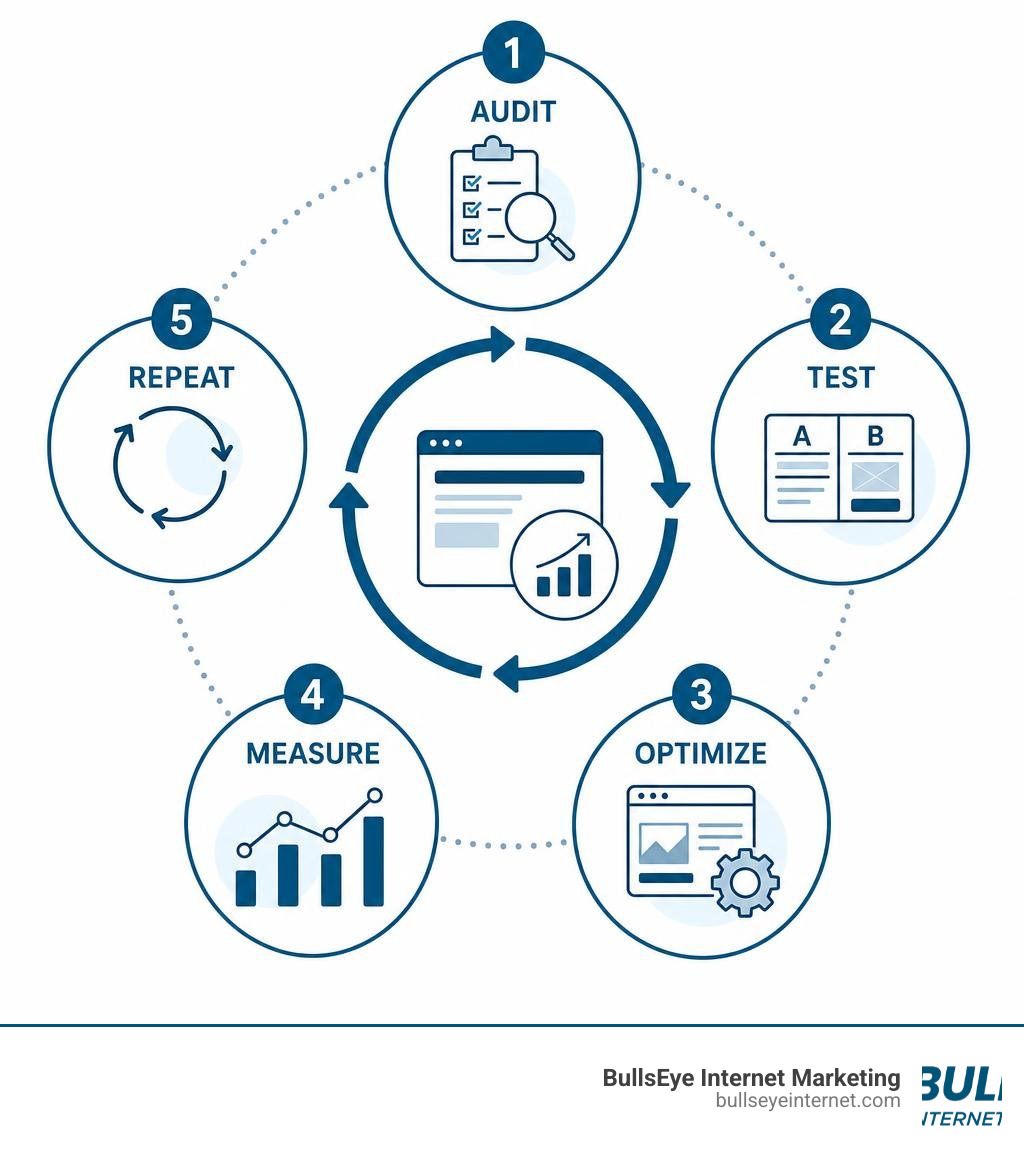
Conversion Optimization Consulting definitions:
What is Conversion Optimization Consulting and Why Does It Matter?

To understand why specialized consulting is so critical in July 2026, we first have to look at the broader digital marketing landscape. Driving traffic to a website is only half the battle. If your site has poor usability, confusing navigation, or weak messaging, that hard-earned traffic bounces away.
That is where Website Visitor Conversion becomes the ultimate lever for business growth. CRO is the systematic process of increasing the percentage of website visitors who take a specific, desired action—whether that is filling out a contact form, requesting a demo, or purchasing a product.
But why hire a consultant rather than just trying a few random website tweaks yourself?
Because optimization is a science, not a collection of “best practice” design trends. A website that looks beautiful might perform terribly if it doesn’t align with user psychology. A conversion optimization consultant looks past aesthetics to analyze actual user behavior, identify friction points, and build a structured testing program that treats your website as a continuous revenue generator.
The Core Benefits of Conversion Optimization Consulting for B2B Brands
B2B companies face a uniquely complex buying cycle. Unlike standard consumer purchases, B2B sales involve multiple decision-makers, higher price points, and longer research phases. You aren’t trying to trigger an impulse buy; you are trying to build deep trust and capture high-quality leads.
When B2B brands invest in conversion optimization consulting, the benefits ripple across their entire sales pipeline:
- Lower Customer Acquisition Costs (CAC): By converting a higher percentage of your existing traffic, you get more leads out of your current PPC and SEO budgets.
- Higher Quality Leads: Experienced consultants design forms and landing pages that qualify prospects, ensuring your sales team spends time only on high-intent buyers.
- Shorter Sales Cycles: Removing friction from the buying journey helps decision-makers find the exact proof, pricing, and case studies they need to move forward quickly.
- Stronger Competitive Advantage: When your website builds trust faster and more effectively than your competitors’ sites, you win the market share before a sales call is even booked.
How Consulting Differs from General CRO Services
It is common to confuse general CRO services with dedicated conversion optimization consulting. The difference lies in strategy versus execution.
General CRO services are often transactional. An agency might offer to run a single A/B test on a button color or rewrite a landing page headline. They focus on quick, isolated fixes.
In contrast, Conversion Optimization Consulting provides a comprehensive, strategic roadmap. A consultant starts with an exhaustive diagnostic audit of your entire digital ecosystem. They don’t just look at a landing page; they analyze your product pricing presentation, signup flows, checkout experiences, and tracking setups. They align every test with your overarching business goals, ensuring that an increase in conversions actually translates to an increase in bottom-line revenue.
If you are looking for long-term growth, you need a partner who can provide strategic direction. You can explore top global networks to find such specialists through resources like Conversion Optimization Consultants | consultport.com or review verified agency directories such as Top Conversion Rate Optimization Services in the United States .
The Strategic Methodology of Top CRO Consultants

Top-tier consultants don’t make adjustments based on “gut feelings.” They follow a rigorous, scientific methodology designed to eliminate bias and base every change on empirical evidence. This starts with a Strategic Site Audit to establish a clear baseline of your technical performance, tracking accuracy, and user experience.
Step-by-Step Optimization Process
The standard optimization framework follows a structured, repeating loop:
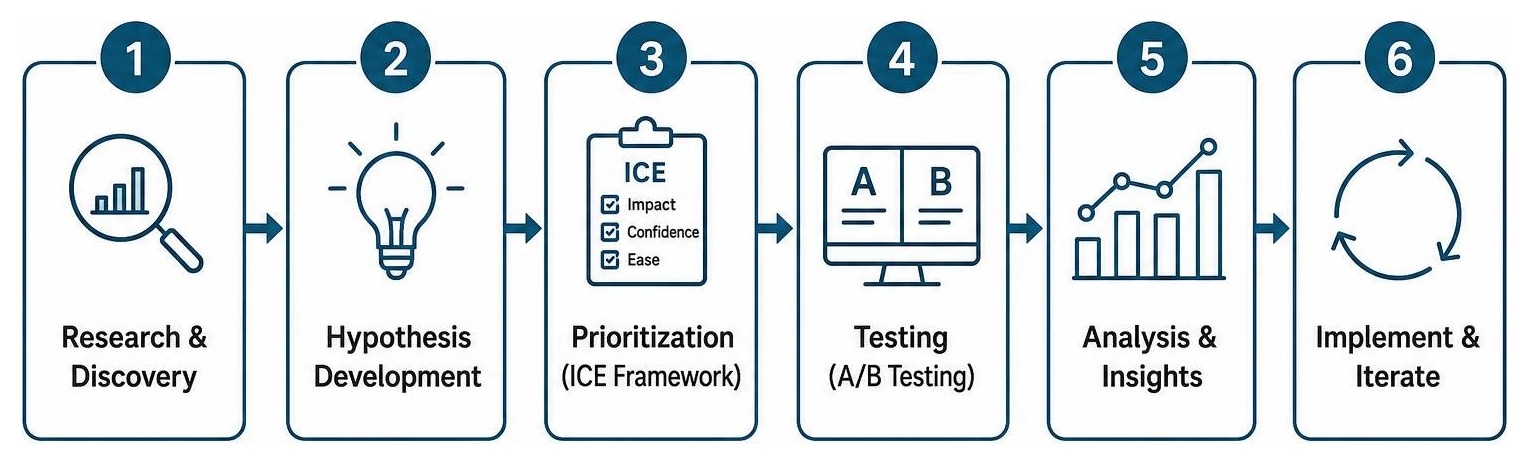
- Research and Discovery: This involves gathering both quantitative data (from web analytics) and qualitative insights (from user testing, heatmaps, and customer surveys). The goal is to see exactly where users are dropping off and understand why they are leaving. For a deeper look at your technical and structural starting point, a comprehensive Website SEO Audit is often performed to ensure search engines and users alike can access your pages seamlessly.
- Hypothesis Development: Instead of guessing, consultants build structured hypotheses. For example: “Because heatmap data shows that 70% of users scroll past our generic hero image without reading the subheadline, replacing it with an outcome-focused layout will increase demo sign-ups.”
- Prioritization (The ICE Framework): Not all ideas are created equal. Consultants rank hypotheses using the ICE framework:
- Impact: How much of an improvement will this test make if it wins?
- Confidence: How sure are we that this hypothesis is correct, based on our data?
- Ease: How much developer and designer time will it take to launch this test?
- Test Design and Implementation: Designers and developers build the test variants, ensuring they look perfect across all devices and screen sizes.
- Running the Test: The experiment runs until it gathers enough data to reach statistical significance (typically 95% confidence or higher).
- Analysis and Learning: Whether a test wins or loses, it yields valuable data. Winning variations are implemented permanently, while losing variations provide deep insights into what your audience does not want, shaping the next round of testing.
Tailoring the Approach for B2B vs. B2C Audiences
The psychological triggers that drive a consumer to buy a pair of shoes are vastly different from those that drive an enterprise executive to purchase software.
For B2C and eCommerce brands, the focus is heavily on reducing checkout friction, optimizing cart flows, utilizing social proof, and creating perceived urgency. If you run an online store, working with an agency that specializes in Ecommerce Website Design ensures your product pages and checkout funnels are built from day one to maximize transaction volume.
For B2B brands, the focus shifts to clear value propositions, trust signals, and progressive lead capture. A B2B website must speak directly to the user’s specific pain points and build immediate credibility. Lead forms must strike a careful balance: too many fields will destroy your conversion rate, while too few fields might flood your sales team with unqualified leads. Consultants often optimize these flows by testing multi-step forms, which leverage compliance psychology to increase completion rates without sacrificing data quality.
Key Elements and Tools Used to Plug Funnel Leaks
If your website isn’t converting, it is because there are “leaks” in your conversion funnel. To find and seal these leaks, consultants use a suite of advanced analytical tools to watch exactly how users interact with your pages. Understanding how these strategies keep visitors moving toward your primary goals is essential to plugging these funnel leaks.
To get the most out of these efforts, businesses often Boost Conversions and Sales with Data-Driven Web Analytics Services. Having clean data is the foundation of any successful optimization program.
High-Impact Page Elements to Optimize
While every website is unique, consultants almost always start by analyzing and optimizing a few high-impact elements:
- Headlines and Value Propositions: Your headline has seconds to answer three critical questions for a visitor: What is this? Why should I care? What do I do next?
- Call-to-Action (CTA) Buttons: Consultants test CTA placement, color, and copy. Replacing generic copy like “Submit” or “Click Here” with action-oriented, benefit-driven copy like “Get My Free Quote” or “Start My Trial” often yields immediate lifts.
- Site Navigation and Layout: If users can’t find what they are looking for in a few clicks, they will leave. Streamlining menus and simplifying page layouts keeps users focused on the conversion path.
- Social Proof and Trust Signals: Case studies, customer reviews, security badges, and industry awards are critical for reducing buyer anxiety.
- Landing Page Layouts: Utilizing a professional Landing Page Designer helps ensure your paid traffic lands on highly focused, distraction-free pages designed for a single conversion goal.
Essential CRO Tools and Platforms
To collect data and run experiments, consultants rely on a robust tech stack:
- Heatmaps and Session Recordings (e.g., Hotjar, Microsoft Clarity): These visual tools show where users click, how far they scroll, and where they get stuck or confused.
- A/B Testing Software (e.g., VWO, Optimizely, Convert, Varify.io): These platforms allow consultants to split traffic between different versions of a page and track which one performs better.
- Web Analytics (e.g., Google Analytics 4, Mixpanel): Essential for tracking funnel drop-offs and traffic sources. Utilizing a professional Web Analytics Service ensures your tracking is set up correctly, preventing false positives from corrupted data.
Measuring Success: Timelines, Metrics, and ROI
One of the best aspects of conversion optimization consulting is that its value is completely measurable. Unlike branding campaigns, you don’t have to wonder if your investment is working. You can see the direct correlation between your testing program and your revenue.
To track this accurately, you need robust Website Analytics to monitor key user behaviors over time, ensuring your optimization decisions are backed by statistical confidence.
How Long Does It Take to See Results?
A common question businesses ask is: How quickly will we see a return on our investment?
The timeline depends heavily on your website’s traffic volume. To declare a statistically valid winner in an A/B test, you generally need enough traffic to reach a 95% confidence level—often requiring at least 5,000 unique visitors per variation and 100 conversions per goal.
On high-traffic pages, a consultant can often find winning variations and generate positive ROI within the first 12 weeks of a program. For lower-traffic websites, consultants rely more heavily on qualitative research, usability testing, and high-confidence UX fixes, which can still show measurable improvements in lead quality and sales within a few months.
Demonstrating ROI and Key Metrics to Track
Consultants demonstrate their value by tracking metrics that tie directly to your business goals. When working with Web Analytics Services, they monitor:
- Conversion Rate (CR): The percentage of visitors who complete your goal.
- Cost Per Acquisition (CPA): How much you spend to acquire a single lead or customer. Structured CRO programs can lower CPA by up to 49% compared to relying solely on traffic growth.
- Average Revenue Per User (ARPU): Maximizing the value of every single visitor who lands on your site.
- Bounce Rate and Average Session Duration: Indicating how engaged users are with your content.
The Cost of Hiring CRO Experts: Pricing Models Explained
Pricing for conversion optimization consulting varies based on the size of your business, the complexity of your website, and your monthly traffic volume.
| Pricing Model | Typical Cost Range | Best For | Pros & Cons |
|---|---|---|---|
| Monthly Retainer | $5,000 – $16,000/month | Mid-market to enterprise brands | Pros: Continuous testing, dedicated team. Cons: Requires ongoing budget commitment. |
| Project-Based / Audit | $3,500 – $25,000+ | Startups & growing businesses | Pros: Fixed cost, clear deliverables. Cons: No ongoing testing or implementation. |
| Performance-Based | Percentage of revenue lift | High-volume eCommerce sites | Pros: Low upfront risk, aligned incentives. Cons: Complex tracking and attribution required. |
When to Outsource: Hiring Conversion Optimization Consulting vs. Building In-House
Building an in-house CRO team is incredibly expensive. To do it right, you need to hire a CRO strategist, a data analyst, a UX/UI designer, and a front-end developer. For most businesses, outsourcing to a specialized consultant or agency is far more cost-effective.
Outsourcing also brings invaluable objectivity. When you are too close to your own business, it is incredibly difficult to view your website through the eyes of a frustrated customer. A consultant brings a fresh perspective, backed by years of experience running experiments across hundreds of websites.
If you are a business located in Florida, partnering with a regional team that understands your local market can provide a major competitive edge. Working with local experts who understand the unique demographics of South Florida—from Broward County to West Palm Beach and Martin County—ensures your campaigns are tailored to the audiences most likely to convert. Localized support helps you maximize your regional campaigns and achieve a stronger return on investment.
Frequently Asked Questions About Conversion Optimization
What is a good conversion rate for my industry?
There is no universal “good” conversion rate, as benchmarks vary wildly. For example, while average eCommerce conversion rates sit around 2.8%, B2B lead generation sites often see different averages, and highly optimized landing pages can convert at 10% or higher. Rather than chasing arbitrary industry benchmarks, focus on relative progress—improving your own baseline incrementally by 5% to 10% at a time.
Do I need a lot of traffic to start conversion rate optimization?
While high traffic is required to run high-velocity A/B tests, you do not need massive traffic to benefit from conversion optimization. Low-traffic sites simply use different methodologies. Instead of split testing, consultants focus on qualitative research, user testing, heatmaps, and implementing high-confidence usability fixes to make every single visitor count.
Can A/B testing hurt my website’s SEO rankings?
No, not when executed correctly. Search engines like Google encourage testing as long as you follow basic guidelines. This includes using canonical tags to point to the original version of your page, using 302 (temporary) redirects instead of 301 (permanent) redirects during split-URL tests, and ending the test as soon as you have a clear winner to avoid “cloaking” content.
Conclusion
Hiring the right conversion optimization experts doesn’t have to be overwhelming. By focusing on data-driven methodologies, clear communication, and a structured testing process, you can transform your website from a passive brochure into an active sales machine.
At BullsEye Internet Marketing, we help businesses throughout the United States—with a deep focus on South Florida, including Broward County, Miami-Dade County, Palm Beach County, Martin County, and St. Lucie County—maximize their digital marketing ROI.
We do digital marketing differently. We offer no long-term contracts and work with only one client per industry per geographic area, giving you a massive competitive advantage in your local market. Whether you need help with SEO, PPC, Google Business Profile optimization, or advanced conversion rate optimization, we are here to help you get more calls and sales out of your traffic.
Ready to stop leaking revenue and start scale-testing your growth? Contact us today to learn more about our Professional Service Ads and conversion optimization solutions.
