
Why Marketing a Law Practice Is Harder Than It Looks
Marketing a law practice is one of the most competitive challenges any attorney faces today. Here’s a quick overview of what it takes to grow a legal practice through marketing:
| Step | What It Means |
|---|---|
| Define your goals | Set SMART targets like “10% more client calls per quarter” |
| Know your audience | Build client personas based on demographics and legal needs |
| Build your digital presence | Website, Google Business Profile, SEO, directories |
| Create valuable content | Blogs, videos, FAQs that answer real client questions |
| Earn trust | Collect reviews, referrals, and testimonials |
| Run targeted ads | Google Ads, Local Services Ads, social media ads |
| Track and adjust | Measure KPIs and reallocate budget to what works |
There are nearly 100,000 lawyers and notaries in Canada alone — and over 1.3 million in the U.S. Every one of them is competing for the same clients you are.
The difference between firms that grow and firms that stagnate usually isn’t legal skill. It’s visibility. Most potential clients won’t ask a friend for a referral first — they’ll open Google. And if your firm isn’t showing up, a competitor’s is.
The good news? A focused, strategic approach to marketing can produce dramatic results. Some firms have seen hundreds of percent increases in qualified leads simply by reallocating their budget to the right channels and fixing the basics.
But “just do more marketing” is not a strategy. You need a clear framework — one that connects your goals, your audience, and your tactics into a system that actually delivers clients.
I’m Ronnie Katz, founder of BullsEye Internet Marketing, and I’ve spent over 20 years helping businesses — including law firms — grow through smarter digital marketing, making marketing a law practice one of my core areas of expertise. In this guide, I’ll walk you through exactly what works, what doesn’t, and how to build a system that fills your calendar consistently.
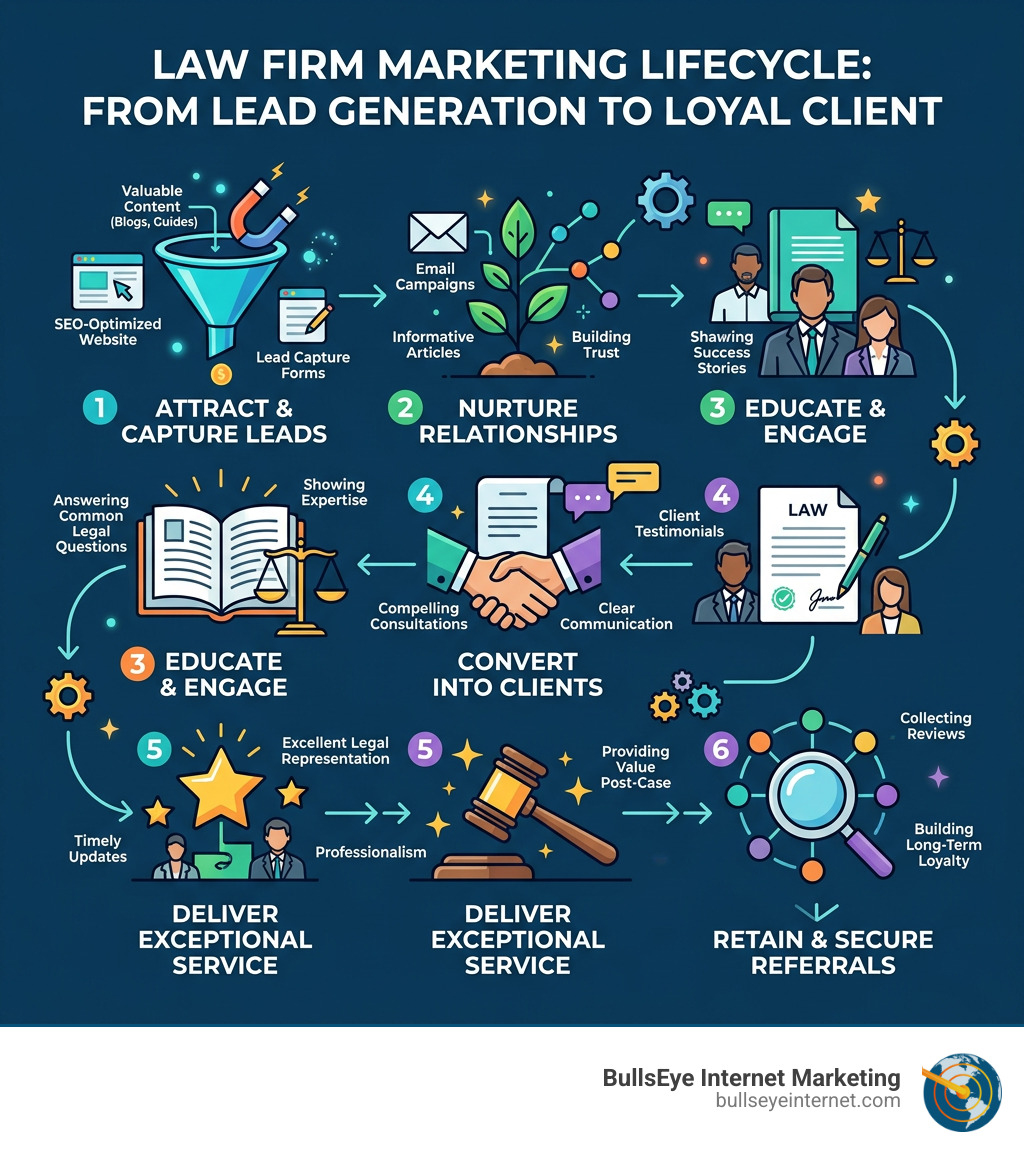
Building a Foundation for Marketing a Law Practice
Before you spend a single dollar on a Facebook ad or a billboard, you need a foundation. Many attorneys treat marketing like a series of “random acts of lunch” or sporadic blog posts. To market like a pro, you must distinguish between your strategy and your plan.

Strategy vs. Plan: The “Why” vs. the “How”
A marketing strategy is your overarching “why.” It defines your goals, your target audience, and your core message. Your marketing plan is the “how”—the specific list of actions, like “post three LinkedIn videos a week” or “optimize the Google Business Profile.” Without a strategy, your plan is just a list of expensive chores.
Setting SMART Goals
“Getting more clients” is a wish, not a goal. To grow, you need SMART goals: Specific, Measurable, Achievable, Relevant, and Time-bound. For example, instead of “growing the firm,” aim to “increase qualified leads for estate planning by 15% in South Florida over the next six months.”
Identifying Target Personas
Who is your ideal client? If you say “anyone with a legal problem,” you’re talking to no one. You need to profile your audience. Are they small business owners in Miami aged 35–50 concerned about intellectual property? Or are they individuals in Palm Beach County navigating a high-net-worth divorce? Understanding their demographics, fears, and search habits allows you to tailor your message.
Competitive Research and Your USP
What are your competitors doing? If everyone in your area is heavy on Twitter but light on helpful video content, that’s your opening. You also need a Unique Selling Proposition (USP). Your USP shouldn’t be “we work hard.” It should be something specific, like “The only Broward County firm offering flat-fee subscription services for startup compliance.” here is an example of how a structured plan looks when these elements come together.
Digital Strategies to Dominate the Legal Market
In 2026, digital marketing isn’t just an option; it’s the lifeline of your practice. With over 96% of people using search engines to find legal advice, your online visibility determines your revenue.
The Power of SEO and Local SEO
Search Engine Optimization (SEO) is the long game that offers the highest ROI. Statistics show that law firms can see a 3,345% marketing ROI with a dedicated SEO strategy. This involves:
- On-Page SEO: Using localized keywords like “Miami criminal defense lawyer” in titles and headers.
- Content + E-E-A-T: Google rewards content that demonstrates Experience, Expertise, Authoritativeness, and Trustworthiness.
- Local SEO: This is critical for firms because law is inherently local. You want to appear in the “Map Pack.” This requires a complete Google Business Profile, which can net you 7x more clicks than an incomplete one.
For specialized practices, the approach shifts slightly. For instance, seo for family law attorneys requires a deep focus on emotional triggers and local service areas.
Google Local Services Ads (LSAs)
If you want leads now, LSAs are the gold standard. Unlike traditional PPC where you pay for clicks, google-local-services-ads-for-lawyers allow you to pay per lead. You appear at the very top of Google with a “Google Screened” badge, which builds instant trust.
Technical SEO and User Experience
Google’s algorithm is picky. If your site takes forever to load, you’ll lose people. Even a increase bounce rate by up to 32% can happen from just a one-second delay. Furthermore, over over 58% of global traffic comes from mobile devices. If your site isn’t mobile-friendliness optimized, you are essentially invisible to half your market.
Prioritizing user-friendliness means having clear CTAs, easy navigation, and fast load times. You also need to build backlinks from authoritative sites to prove to Google that you are a credible source in the legal community.
Leveraging Content and Social Proof for Authority
Law is a relationship business built on trust. Digital marketing simply allows you to scale that trust.
Content and Video Marketing
Content marketing isn’t just about blogging; it’s about answering the questions your clients are already asking. Video is particularly potent here. Only about 24% of law firms use video, yet websites with video are 53× more likely to hit the first page of Google. Even better, adding video to landing pages can lead to 80% higher conversion rates. It allows potential clients to see your face and hear your voice, breaking down the “unapproachable lawyer” barrier.
Email and Social Media
Don’t ignore your existing network. Email marketing is incredibly cost-effective, delivering an average of $1 for every $1 spent. It’s the perfect tool for nurturing long-term relationships.
Social media is equally vital. Roughly 83% of law firms use social media because it works, with 84% reporting they get real leads from it. Since the majority of your firm’s potential clients use social media, platforms like LinkedIn and Facebook are essential for staying top-of-mind.
The Power of Social Proof
In the legal world, your reputation is everything. 87% of consumers won’t even consider a business with low or no reviews. We encourage our clients to proactively ask for reviews on Google and legal directories. Case studies and testimonials (with client consent, of course) serve as powerful evidence of your expertise.
Traditional Tactics and Ethical Compliance
While digital is king, traditional tactics still have a seat at the table, especially when they are integrated into a modern strategy.
Referrals and Networking
Word-of-mouth is still the “bread and butter” for many firms. 92% of people trust recommendations from friends and family above all other advertising. Pro pros don’t just wait for referrals; they build systems for them. This includes joining lawyer referral services and maintaining active roles in civic organizations or business associations in places like Miami-Dade or Palm Beach County.
Ethical Compliance: The Golden Rule
Marketing a law practice isn’t like marketing a restaurant. You are bound by strict marketing guidelines and professional conduct rules. In Florida, for example, your ads must be truthful, non-deceptive, and include necessary disclaimers. You cannot make false claims about results or solicit clients in ways that violate bar rules. Always ensure your marketing is demonstrably true and verifiable.
Budgeting for Growth
How much should you spend?
- Solo/Small Firms: Typically 5-10% of gross revenue.
- Established/Aggressive Firms: 15-20% or more to capture market share in competitive areas.
For a deeper dive, check out our digital-marketing-for-law-complete-guide.
Measuring Success and Avoiding Pitfalls
Marketing without tracking is just expensive guessing. You need to know which channels are actually putting money in your pocket.
KPIs and ROI Tracking
You should be monitoring key performance indicators (KPIs) like:
- Cost Per Lead (CPL): How much does it cost to get one person to call?
- Conversion Rate: What percentage of website visitors become leads?
- Bounce Rate: If people leave your site quickly, it’s a sign your bounce rate is too high and your content isn’t resonating.
We recommend every firm install Google Analytics on your site to track these metrics accurately.
In-House vs. Outsourced Marketing
| Feature | In-House | Agency (Specialized) |
|---|---|---|
| Cost | Fixed salary/benefits | Scalable service fees |
| Expertise | Generalist | Specialized (SEO, PPC, LSA) |
| Time | Lawyer’s time is diverted | Lawyer focuses on cases |
| Tools | High software costs | Agency provides tools |
Many firms find that a pay-per-lead-for-lawyers model or hiring an agency is more efficient than trying to learn the ever-changing Google algorithm themselves.
Common Pitfalls
The biggest mistake we see is the “feast and famine” cycle. Firms market when they are slow, then stop when they get busy. Pro marketing is a marathon, not a sprint. Another pitfall is poor lead management. If you spend $5,000 on ads but no one answers the phone or follows up on contact forms, you’ve wasted your money. Use intake software to ensure no lead falls through the cracks.
Frequently Asked Questions about Marketing a Law Practice
What is the ideal budget for marketing a law practice?
Most experts suggest a range of 6% to 20% of gross profit. Solo firms in non-competitive niches might stay on the lower end, while a personal injury firm in a high-competition city like Miami might spend significantly more. Effective ppc-advertising-for-law-firms requires a consistent monthly commitment to see a return.
How long does it take to see results from marketing a law practice?
It depends on the tactic. why-every-lawyer-should-invest-in-google-local-ads can generate leads almost immediately. SEO and content marketing, however, usually take 3 to 6 months to start showing significant organic growth. Think of PPC as a faucet (instant) and SEO as a forest (takes time to grow but provides long-term shade).
Should I handle marketing in-house or hire an agency?
If you are a solo practitioner, your time is your most valuable asset. Spending five hours a week on technical SEO is five hours you aren’t billing. Hiring a specialized agency provides a competitive edge and handles the complexities of detailed-reviews-of-the-top-10-law-firm-marketing-agencies-miami and other local market dynamics.
Run Your Law Practice as CEO with BullsEye Internet Marketing
Marketing a law practice like a pro requires a shift in mindset. You are not just a lawyer; you are the CEO of a business that happens to provide legal services. By building a strategic foundation, dominating digital channels, and maintaining ethical standards, you can move away from the stress of the “feast and famine” cycle and toward predictable, sustainable growth.
At BullsEye Internet Marketing, we specialize in making this happen for firms across the U.S., with a heavy focus on Florida and the South Florida region. We offer a unique advantage: no long-term contracts and geographic exclusivity. We only work with one client per industry in a specific area, ensuring your competitive advantage is never diluted.
Ready to stop guessing and start growing? Check out An Essential Guide to Advertising for Lawyers to see how we can help you hit the bullseye with your firm’s growth.
