
Why Dermatology Ad Management Determines Whether Your Practice Grows or Stalls
Dermatology ad management is one of the most complex challenges in healthcare marketing — and getting it wrong is expensive.
Here’s a quick answer to what effective dermatology ad management involves:
| What It Covers | Why It Matters |
|---|---|
| Separating medical and cosmetic campaigns | Prevents budget cannibalization between low-CPC and high-CPC keywords |
| Condition-specific ad groups | Matches patient search intent for better conversion |
| Procedure-specific landing pages | Improves Quality Score and reduces wasted spend |
| Service-line conversion tracking | Shows which campaigns actually drive revenue |
| Meta ads for cosmetic services | Reaches patients before they start searching |
| Remarketing for cosmetic patients | Converts browsers into booked consultations |
Most dermatology practices run two very different businesses under one roof. Medical dermatology is insurance-driven, with lower cost-per-click keywords in the $8–$15 range. Cosmetic dermatology is cash-pay, with keywords running $25–$45 per click.
When those two worlds share a single campaign, the results are predictable — and not in a good way.
Google’s algorithm will naturally optimize toward the easier conversions (medical appointments), while your high-margin cosmetic procedures quietly get starved of budget. Meanwhile, 75% of patients never scroll past page one of search results, which means every dollar of wasted ad spend is a patient who booked with a competitor.
The dermatology industry is also growing fast — at a 6.94% compound annual growth rate — which means competition for patient attention is only increasing. Medspas are aggressively advertising. National chains have big budgets. And patients are consulting at least three online sources before booking an appointment.
That’s the landscape you’re competing in.
I’m Ronnie Katz, founder of BullsEye Internet Marketing, and with over 20 years of experience in PPC, local SEO, and paid advertising — including specialized work in dermatology ad management — I’ve seen how the right campaign structure transforms a practice’s patient acquisition. In this guide, I’ll walk you through exactly how to build a system that works.
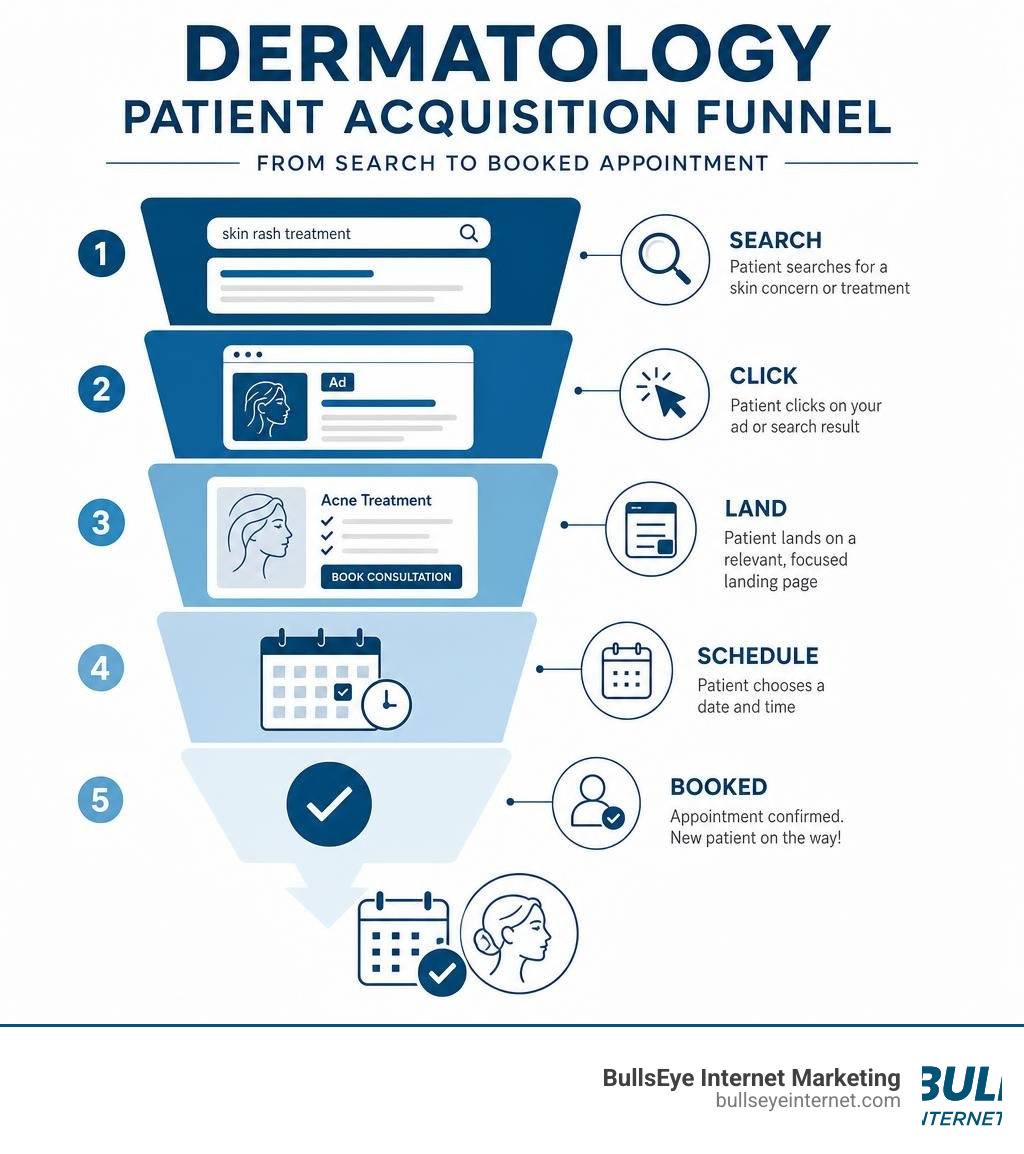
Dermatology ad management terms at a glance:
The Core Pillars of Dermatology Ad Management
To build a marketing system that doesn’t bleed cash, we must first understand the fundamental pillars of dermatology ad management. Managing campaigns for a specialized practice isn’t like running ads for a local retail shop. It requires a deep understanding of patient psychology, search intent, and the strict rules governing medical advertising.

Every dollar we allocate must be tied to a clear business objective. In South Florida—from the busy streets of Miami to the upscale neighborhoods of Palm Beach County—patient acquisition is incredibly competitive. To stand out, your advertising campaigns must align with clinical credibility and professional standards, such as those established by the American Academy of Dermatology.
Why Blended Campaigns Ruin Dermatology Ad Management
Let’s look at the absolute biggest mistake we see when auditing dermatology ad accounts: blending medical and cosmetic services into a single campaign.
When you put “acne treatment” (medical) and “Botox injections” (cosmetic) in the same budget pool, you create immediate budget cannibalization. Cosmetic keywords carry a massive cost-per-click (CPC) disparity compared to medical keywords. If Google’s smart bidding algorithm sees that it can get five medical appointment clicks for the price of one cosmetic inquiry, it will pump your entire daily budget into medical searches.
Your cosmetic campaigns get starved out, and you wonder why your cash-pay procedures aren’t booking. Conversely, if high-CPC cosmetic keywords dominate the budget, your highly profitable medical services like skin cancer screenings and Mohs surgery are left with nothing.
To prevent this, campaign segmentation is non-negotiable. For an in-depth breakdown of how to structure your bidding logic and prevent budget waste, check out our Ultimate Google PPC Management Guide.
Navigating YMYL and E-E-A-T in Dermatology SEO
Paid ads do not exist in a vacuum; they work hand-in-hand with your organic search engine optimization (SEO). Because dermatology deals directly with a patient’s physical health, Google classifies dermatology websites under the YMYL (Your Money or Your Life) category. This means Google holds your digital content to the highest possible standards of accuracy and trust.
To rank organically and support your paid ad campaigns, your website must project strong E-E-A-T (Experience, Expertise, Authoritativeness, and Trustworthiness) signals.
How do we do this?
- Board-Certified Authorship: Every clinical page on your site should be written or reviewed by a board-certified dermatologist, complete with a link to their professional bio.
- Clinical Guidelines: Align your medical explanations with trusted clinical guidelines.
- Local Trust Signals: Highlight your physical presence and community trust, a strategy highly emphasized by leading regional practices like Lakes Dermatology | Serving Burnsville & Minnetonka.
By proving your medical authority to Google’s search crawlers, you lower your overall acquisition costs and build a natural bridge between your paid ads and organic search results.
Segmenting Medical and Cosmetic Campaign Architecture
To achieve true efficiency, we must split your ad account into two distinct structural pillars. Here is how medical and cosmetic campaigns differ across the board:
| Feature | Medical Dermatology | Cosmetic Dermatology |
|---|---|---|
| Primary Driver | Insurance coverage / Medical necessity | Self-pay / Aesthetic desires |
| Average CPC | $8 – $15 | $25 – $45 |
| Patient Intent | High-intent, looking for immediate relief | Research-heavy, comparative shopping |
| Conversion Action | Insurance pre-qualification / Direct booking | Consultation request / Deposit booking |
| Main Competitors | Local general practitioners, hospital networks | Medspas, plastic surgeons, aesthetic clinics |
By treating these as two separate entities, you protect your budgets and allow Google’s machine learning to optimize for the correct conversion actions. This structural hygiene is exactly what makes top-tier practices like Advanced Dermatology: Expert Medical & Cosmetic Dermatology so successful online.
Medical Dermatology: Condition-Based Ad Groups
When patients search for medical dermatology, they aren’t searching for “dermatologist” in a generic sense. They are searching for their specific symptoms or conditions.
Your medical campaigns should be structured into highly specific, condition-based ad groups:
- Acne and Rosacea: Targeting teens and adults looking for clinical-grade solutions.
- Psoriasis and Eczema: Highlighting advanced biologics and specialized therapies.
- Skin Cancer Screenings & Mohs Surgery: Targeting high-value, life-saving procedures.
For these campaigns, we target insurance-qualified keywords (e.g., “dermatologist that accepts Blue Cross”) to filter out patients who won’t convert due to out-of-network costs. To see how to dominate these local medical searches, refer to our guide on Dermatologist Google Local Ads Strategies to Outrank Competitors.
Cosmetic Dermatology: Competing Against Medspas
Cosmetic dermatology is a completely different beast. Here, you aren’t just competing with other dermatologists; you are competing with local medspas that often run aggressive, low-price campaigns for Botox, dermal fillers, and laser hair removal.
To win this battle, your ads must leverage your ultimate competitive advantage: clinical authority.
Medspas often use non-physician injectors with minimal medical oversight. Your ad copy and landing pages should proudly highlight that your treatments are performed or supervised by board-certified dermatologists. This positioning is incredibly effective in highly competitive coastal markets, such as Dermatology in West Palm Beach, FL, where patients are willing to pay a premium for safety, medical expertise, and natural-looking results.
Meta Advertising for Cosmetic Dermatology
While Google Ads captures active searchers, Meta platforms (Facebook and Instagram) are perfect for generating visual demand. Cosmetic dermatology is inherently visual, making Meta’s feed-based environment highly lucrative.
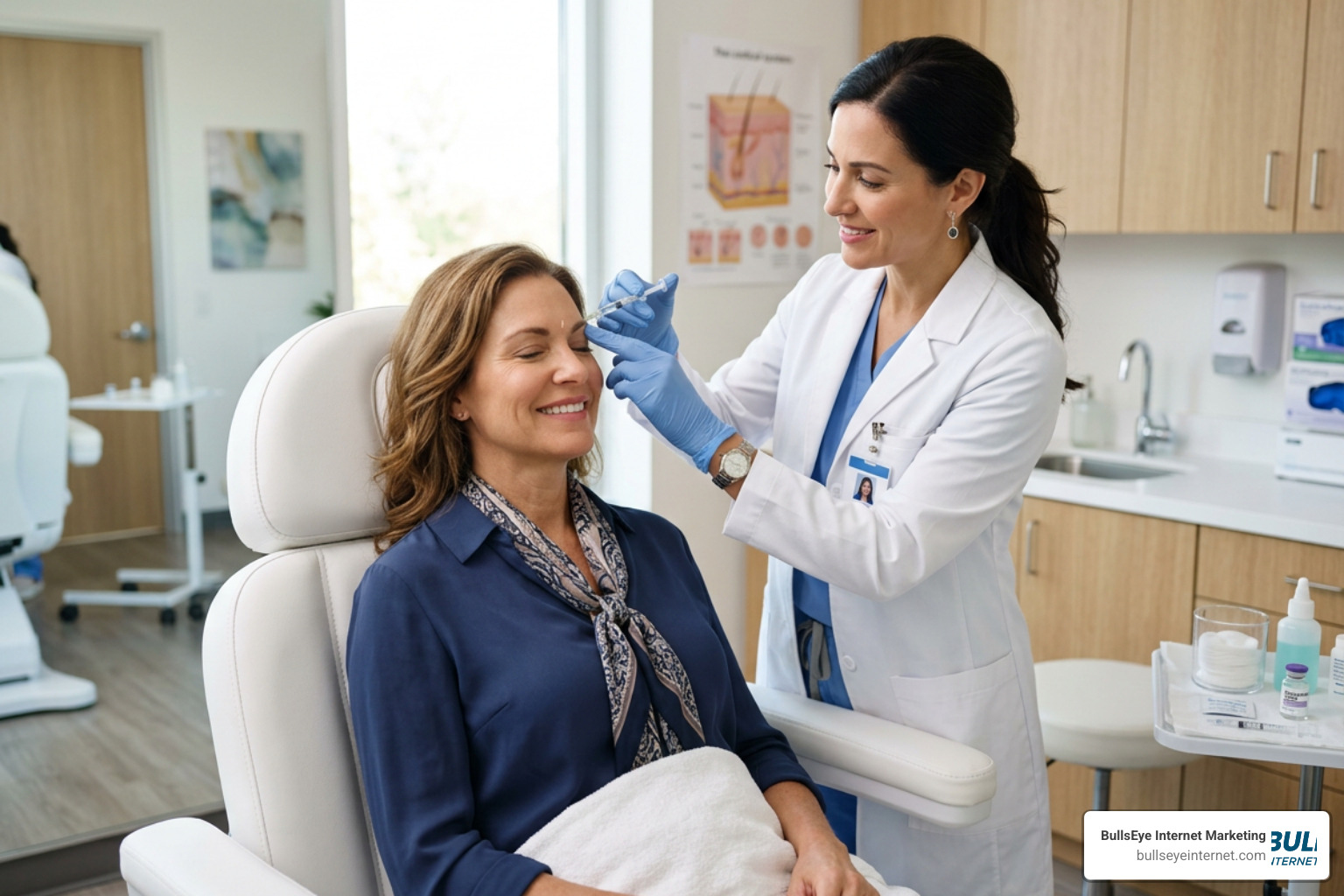
To succeed on Meta, your creative strategy should prioritize real patient video content over highly polished stock imagery.
- Video Ads: Show behind-the-scenes treatment demonstrations, patient journeys, and doctor Q&As. Videos outperform static images by two to four times on conversion rate.
- Audience Targeting: Target by age, gender, and high-income zip codes in South Florida (such as Broward or Palm Beach County).
- Compliance First: Meta has incredibly strict policies regarding healthcare advertising. Avoid zoomed-in body parts, unrealistic claims, or before-and-after photos that imply physical imperfections. Instead, focus on the overall wellness and skin health journey.
For a deeper dive into scaling your social media ad spend safely, review our Pay Per Click Management Expert Guide.
Remarketing Strategies for Cosmetic Patients
Because cosmetic procedures are self-pay, patients rarely book on their first visit. They compare prices, read reviews, and look at portfolios over a period of one to four weeks.
This is why remarketing is a non-negotiable line item in your budget. By setting up behavior-segmented audiences, we can retarget users based on their engagement depth:
- Casual Browsers (visited homepage): Show them general practice trust signals, Google reviews, and doctor credentials.
- High-Intent Visitors (visited Botox or filler pages): Show them educational videos explaining the procedure, recovery times, and subtle, natural results.
Remarketing keeps your practice top-of-mind and generates consultations at a 40% to 60% lower cost per lead than cold prospecting campaigns. Learn how to tie these channels together in our guide on Local Ads for Dermatologists: How to Attract More Patients with Google Ads.
Landing Page Optimization and Conversion Tracking
No matter how perfect your ads are, they will fail if they point to a poorly designed website. Your landing pages must be built to convert.
A high-converting landing page must be mobile-first, load in under two seconds, and feature a clear, unmistakable call to action (CTA). For medical ads, that might be an “Inquire About Insurance” form; for cosmetic ads, it should be a “Book a Consultation” button. Reducing friction on these pages is the fastest way to lower your acquisition costs, as outlined in our guide on Local Ads for Dermatologists: How to Reduce Wasted Leads and Save Budget.
Why One Landing Page Per Service Line is Critical
Sending ad traffic to your homepage is the easiest way to waste your marketing budget. If a patient searches for “Mohs surgery for skin cancer” and lands on a homepage covered in photos of chemical peels and lip fillers, they will click the back button immediately.
You must build procedure-specific and condition-specific landing pages to ensure perfect message match:
- Medical Pages: Should feature prominent insurance pre-qualification forms, clinical explanations of the condition, and clear steps on what to expect.
- Cosmetic Pages: Should focus on the aesthetic experience, doctor credentials, and a streamlined booking system (often requiring a small, refundable deposit to reduce no-shows).
This level of dedication to user experience is why local institutions like Broward Dermatology: Home maintain such high patient trust and retention rates in South Florida.
Service-Line-Separated Conversion Tracking
If you cannot measure which ads are driving actual revenue, you are flying blind. You must set up service-line-separated conversion tracking to attribute leads accurately.
This means routing medical and cosmetic campaigns to completely different phone tracking numbers and form submissions.
- Medical Conversions: Tracked when a user completes an insurance verification form or calls to book an appointment.
- Cosmetic Conversions: Tracked when a user submits a consultation request or pays a booking deposit.
To take it a step further, integrate your EHR (Electronic Health Record) system (such as ModMed or Nextech) with Google’s Offline Conversion API. This allows you to feed actual appointment attendance and treatment revenue back into Google Ads, training the Smart Bidding algorithm to find higher-value patients rather than just cheap clicks. For a masterclass on setting up these advanced tracking systems, refer to our Google Ads Complete Guide.
Frequently Asked Questions about Dermatology Ads
How much should a dermatology practice spend on Google Ads monthly?
For a single-location practice offering both medical and cosmetic services, we recommend a budget floor of $5,000 per month to remain competitive. Most multi-location practices or highly competitive South Florida clinics scale their ad spend between $10,000 and $45,000 per month. This budget should be strictly divided, allocating roughly 60% to high-margin cosmetic services and 40% to consistent, high-volume medical condition searches.
How quickly do dermatology PPC campaigns start generating patient leads?
You will typically see your first leads within the first week of launching your campaigns. However, Google’s Smart Bidding algorithm requires a “learning period” of about 6 to 8 weeks to accumulate conversion data and optimize bids. By the 90-day mark, your cost-per-lead (CPL) will stabilize, and you will see a consistent, predictable flow of new patient inquiries.
Are before-and-after photos allowed in dermatology Meta ads?
Yes, but they are subject to extreme scrutiny. Meta’s advertising policies strictly prohibit ads that imply personal attributes or showcase “unrealistic” or “shocking” physical transformations. To stay compliant, avoid zoomed-in, cropped body parts (like a close-up of a needle entering skin or a severe acne patch). Instead, use split-screen videos of real patients talking about their confidence journey, or use side-by-side images that focus on overall facial rejuvenation in a natural, respectful format.
Conclusion
Mastering dermatology ad management in 2026 requires moving away from the lazy, blended campaign structures of the past. By cleanly separating your cash-pay cosmetic services from your insurance-driven medical treatments, building hyper-specific landing pages, and utilizing advanced conversion tracking, you can scale your practice’s patient acquisition without breaking a sweat.
Choosing the Right Partner for Dermatology Ad Management
At BullsEye Internet Marketing, we specialize in helping dermatology practices in South Florida and across the United States dominate their local markets.
We do digital marketing differently:
- No Long-Term Contracts: We believe in earning your business month after month based on real results, not rigid contracts.
- Geographic Exclusivity: We work with only one client per industry in any given geographic area. If we partner with you, we will never work with your direct competitor down the street.
- Pay Per Lead & Scale: We focus on generating high-intent phone calls and booked appointments, maximizing your return on investment.
If you are ready to stop burning your ad budget and start filling your schedule with high-value patients, explore our BullsEye Internet Marketing Services and contact us today for a free, comprehensive PPC audit!
