
Why Mass Tort Marketing Demands a Different Playbook
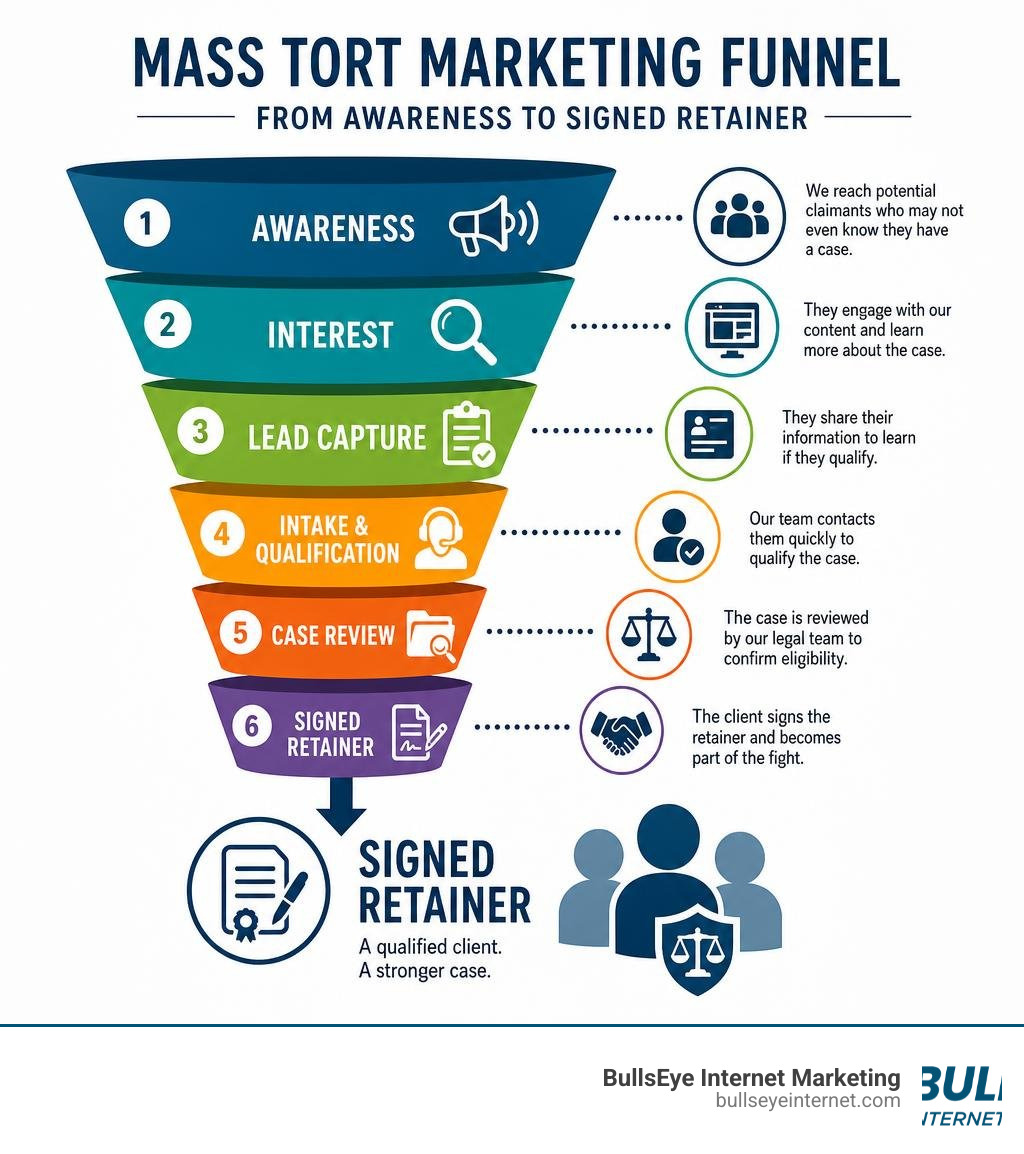
Mass tort marketing is the process of identifying and recruiting large groups of injured plaintiffs — people harmed by the same product, drug, or company — and converting them into signed legal clients at scale.
Here’s a quick breakdown of what it involves:
| Element | What It Means |
|---|---|
| Who it targets | Groups of people injured by the same product or event |
| Primary goal | Sign hundreds or thousands of qualified claimants |
| Key channels | Facebook/Instagram, Google PPC, TV, programmatic display |
| Core challenge | Most victims don’t know they have a claim yet |
| Success metric | Cost per signed retainer (not just cost per lead) |
| ROI horizon | Typically 3–7 years from case acquisition to settlement |
Mass torts now make up more than 30% of the federal civil docket. That’s a massive slice of litigation — and a massive opportunity for law firms that know how to market effectively.
But here’s the problem most firms run into: mass tort marketing is not just personal injury marketing at a larger volume. It requires a completely different strategy, a much larger budget, and a highly specific intake process built to convert at scale.
Most potential plaintiffs don’t come looking for you. They don’t know they were harmed. They don’t know a lawsuit exists. Your marketing has to create that awareness before it can capture a lead.
And once you capture that lead, speed matters enormously. Research shows that up to 50% of potential clients sign with the first attorney who contacts them. If your intake process is slow or understaffed, your marketing budget is essentially funding your competitor’s caseload.
I’m Ronnie Katz, founder of BullsEye Internet Marketing, and with over 20 years of experience in digital marketing — including SEO, PPC, and lead generation for law firms — I’ve helped legal practices build mass tort marketing systems that generate qualified cases without wasting budget on unqualified leads. In this guide, I’ll walk you through exactly how to build and scale a campaign that actually works.
Mass tort marketing helpful reading:
What is Mass Tort Marketing and How Does It Differ From Personal Injury?

To succeed in this space, we must first understand the fundamental differences between standard personal injury (PI) cases and mass tort litigation.
In a traditional personal injury scenario, you are dealing with individual, localized incidents—like a car accident on I-95 in Miami or a slip-and-fall in a Fort Lauderdale retail store. The victim knows they are injured, understands that someone else may be at fault, and actively searches for legal representation. This is high-intent, direct-response marketing.
Mass torts, however, involve hundreds or thousands of plaintiffs who have suffered similar injuries caused by the same defective medical device, pharmaceutical drug, toxic environmental exposure, or consumer product. These cases are often consolidated into a single federal district court under Multi-District Litigation (MDL) rules to streamline pretrial proceedings. You can read more about how these structures operate in this Mass Torts Overview.
Because of this consolidation, mass tort campaigns allow law firms to build incredible economies of scale. Instead of litigating one-off cases, a firm can represent hundreds of claimants affected by the same corporate negligence.
However, the marketing dynamic is entirely different. As we outline in the ultimate guide to personal injury lawyer marketing, standard PI marketing captures existing search intent. Mass tort marketing, by contrast, must focus heavily on awareness.
Most mass tort victims have no idea they have a viable legal claim. For example, a veteran suffering from hearing loss might not connect their condition to defective military-issue earplugs they used a decade ago. A patient diagnosed with severe gastrointestinal issues might not realize their medication is under legal scrutiny. Your marketing campaigns must first educate these individuals about the connection between their injury and the product before you can ever hope to sign them as a client.
Audience Targeting and Demographics in Mass Tort Marketing
Because mass tort campaigns are product- or event-specific, general broad-spectrum advertising is a fast way to burn through your budget. Precision demographic profiling is mandatory.
To identify and target the ideal client, we must analyze several key layers:
- Product Exposure Windows: When was the defective product on the market, and when was the prospect exposed to it? For instance, Camp Lejeune toxic water claims require proof of residence or work at the military base during a highly specific historical window.
- Demographic Segments: Certain torts have highly defined user bases. Hair relaxer litigation primarily targets women of color, while dockets involving specific prostate drugs or hernia meshes target completely different age and gender groups.
- Geographic Concentrations: Some environmental torts require hyper-local targeting. If you are pursuing claims related to Ethylene Oxide (EtO) exposure or localized industrial chemical leaks, your digital campaigns must be strictly geofenced around the affected facilities or specific contaminated water zip codes.
- User Behavior and Interests: Platforms like Meta allow us to target users based on interest groups, community memberships, and behavioral signals that align with specific lifestyles or occupations (such as agricultural workers for herbicide exposure).
The Litigation Economics of Mass Tort Campaigns
Before launching any campaign, you must realize that mass tort marketing is a capital allocation decision long before it is a creative advertising challenge.
Unlike standard PI cases where settlements might distribute in 12 to 18 months, mass torts have an incredibly long ROI horizon—often taking 3 to 7 years from initial case acquisition to final payout distribution. This means your firm must have the cash flow and risk tolerance to sustain substantial upfront marketing investments.
Furthermore, settlement ranges vary dramatically by docket category:
- Pharmaceutical Torts (e.g., Talcum Powder, Hair Relaxers): Typical per-plaintiff settlement ranges can run from $80,000 to $500,000.
- Environmental / Toxic Exposure Torts (e.g., PFAS, AFFF): Settlement ranges often span $60,000 to $400,000.
- Medical Device Torts (e.g., Hernia Mesh): Expected ranges generally sit between $100,000 and $350,000.
Because of these variations, you must carefully model your acquisition costs against projected payouts to ensure your litigation math actually works.
Multi-Channel Digital Strategies for Mass Tort Case Acquisition

Relying on a single advertising platform is one of the most common pitfalls in modern legal marketing. To scale effectively and drive down your average acquisition cost, we recommend a diversified, multi-channel approach.
As detailed in our comprehensive law firm marketing guide 2026, integrating your digital channels creates a powerful compounding effect. A prospective client might first see an educational video on social media, see a programmatic display ad while reading the news, and finally perform a high-intent search on Google when they are ready to take action.
By saturating multiple touchpoints, you build trust and significantly increase your overall conversion rates.
Digital Channels: PPC, SEO, and Social Media
To build a balanced client acquisition machine, we must blend immediate, high-intent channels with scalable, high-volume awareness platforms.
- Pay-Per-Click (PPC) Search Advertising: Google Ads remains the gold standard for capturing high-intent leads. When someone searches for “Roundup lymphoma attorney” or “AFFF cancer lawsuit eligibility,” they are actively looking for legal help. While these keywords carry a high cost-per-click, the conversion rate is exceptionally high. You can learn how to optimize these paid campaigns in our guide on ppc advertising for law firms.
- Paid Social (Meta & Instagram): Because social media platforms excel at visual storytelling, they are perfect for the “awareness layer” of mass torts. By deploying targeted video ads, you can educate users about a defective product and prompt them to realize they might be affected. By training your Meta pixel on “signed retainer” conversion events rather than raw lead form submissions, the platform’s algorithm learns to find high-quality prospects, helping you build highly accurate lookalike audiences over time.
- Search Engine Optimization (SEO): While paid ads provide instant lead flow, SEO is your long-term play for sustainable, low-cost acquisition. By creating high-authority content hubs, detailed symptom checkers, and comprehensive guides regarding specific dockets, your site can rank organically for valuable research-based search queries. Implementing our step-by-step guide to local attorney seo ensures that when local or national prospects search for information regarding their injuries, your firm stands out as the definitive legal resource.
Campaign Metrics, Cost Benchmarks, and Intake Optimization
To run a profitable mass tort campaign, you must look past basic vanity metrics like impressions or clicks. The only metrics that truly matter to your bottom line are your cost-per-lead (CPL) and, most importantly, your cost-per-signed-retainer (CPR).
The table below outlines key cost-per-signed-retainer benchmarks across several active 2026 dockets:
| Mass Tort Docket / Campaign Type | Average Cost Per Signed Retainer (CPR) | Typical Qualification Rate |
|---|---|---|
| Sports Betting Addiction | $250 – $350 | High (~25%) |
| Video Game Addiction | $350 – $400 | Moderate (~18%) |
| Social Media Addiction | $650 – $914 | Low (~9%) |
| PFAS / Contaminated Water | $1,200 – $1,800 | Very Low (~5%) |
| Institutional / Church Abuse | $2,000 – $3,000 | Ultra Low (Requires phone-first intake) |
As you can see, dockets that require highly specific medical evidence or complex geographic proof (like PFAS contaminated water) command much higher acquisition costs.
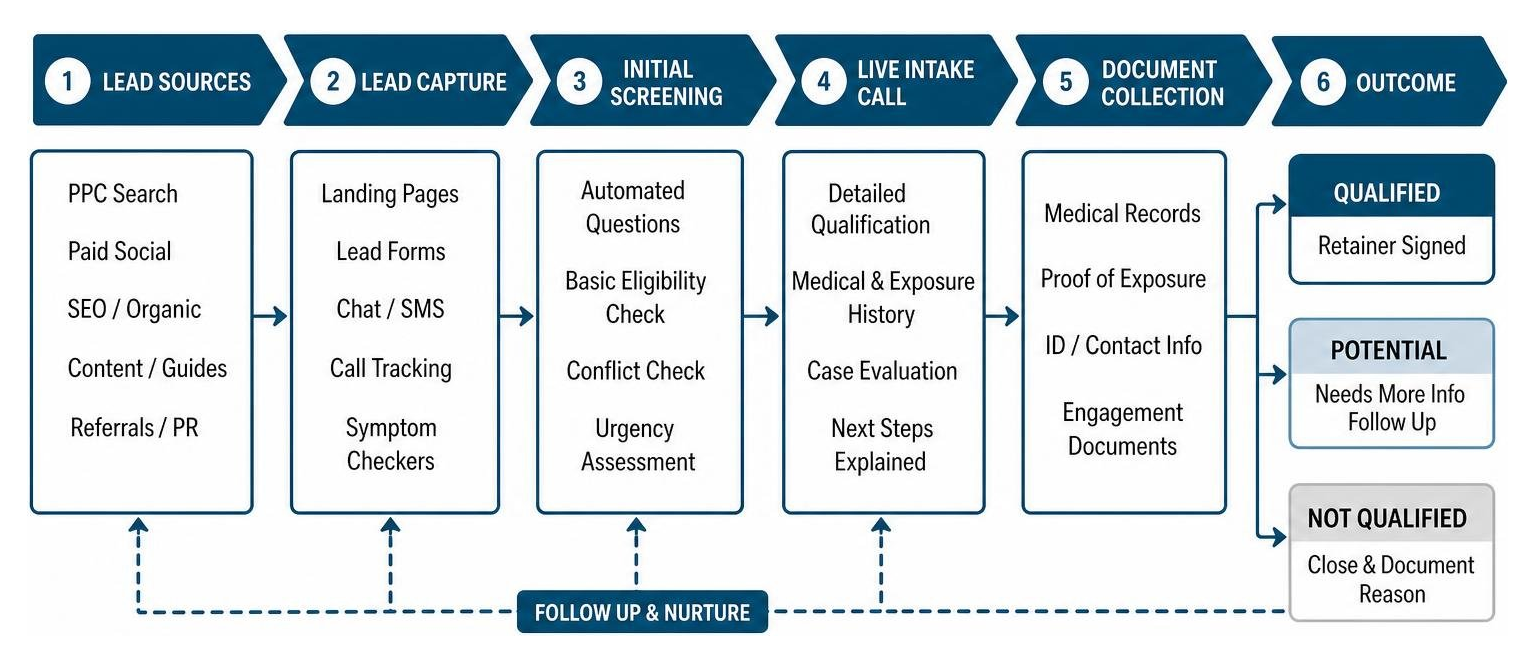
To prevent “lead leakage” and keep your acquisition costs low, you must establish a flawless bridge between your marketing campaigns and your intake department.
Key Performance Indicators for Mass Tort Marketing
To measure campaign success accurately, your firm should track these five core KPIs:
- Cost Per Lead (CPL): The total media spend divided by the number of raw inquiries generated.
- Cost Per Signed Retainer (CPR): The total campaign spend divided by the number of fully executed attorney-client agreements.
- Cost Per Qualified Claimant (CPQC): The cost of acquiring a lead who passes all medical, exposure, and statute of limitations criteria.
- Lead Return Rate: The percentage of leads purchased from external vendors that are rejected during secondary screening due to falsified or inaccurate data (the industry standard is typically 15% to 30%).
- Multi-Touch Attribution: Tracking the exact path a claimant took from their first ad interaction to the final signed retainer to determine which channels are driving the highest ROI.
Structuring a 24/7 Intake and Conversion Machine
You can run the most beautiful, high-performing ads in the world, but if your intake team is slow, your campaign will fail.
In mass torts, up to half of all potential clients will sign with the very first law firm that gets them on the phone. This means your response time must be measured in seconds, not hours.
To turn your intake into a high-converting machine, we recommend applying the principles found in our guide on how to build a client acquisition machine for your law practice. Your intake system must operate 24/7/365, utilizing automated text messages and email sequences to engage leads the instant they submit a form.
Furthermore, your intake staff must be thoroughly trained in empathetic, trauma-informed communication—particularly when handling sensitive dockets like institutional abuse or severe personal illness. By combining a compassionate human touch with seamless digital e-signatures, you can secure exclusive attorney leads that actually convert before they have a chance to contact a competitor.
Ethics, Compliance, and Risk Management in Mass Tort Advertising
Because mass tort campaigns operate at a national scale and deal with sensitive health and consumer data, they attract significant regulatory scrutiny.
Firms must navigate a complex web of state bar advertising rules, federal regulations, and data privacy laws. Failing to comply can result in severe bar sanctions, massive class-action fines, or the dismissal of your cases during MDL discovery.
To keep your campaigns safe and ethical, we advise reviewing our comprehensive resources on lawyer advertising rules solutions for modern firms.
Key compliance considerations include:
- TCPA (Telephone Consumer Protection Act): You must secure explicit, documented consent before using automated systems to call or text potential claimants.
- HIPAA Regulations: If your intake process collects detailed medical history or diagnostic records, your data storage, CRM, and transmission protocols must be fully HIPAA-compliant.
- State Bar Rules on Solicitation: Your ad copy must avoid misleading statements, deceptive headlines, or promises of guaranteed financial payouts. Every ad should clearly state that it is “Attorney Advertising” and identify the sponsoring law firm of record.
Avoiding Misleading Payout Promises and Fraudulent Leads
The mass tort lead generation market is unfortunately filled with bad actors selling recycled, incentivized, or outright fraudulent leads.
Some vendors use highly misleading ads that promise massive, guaranteed cash payouts to entice unqualified individuals to sign up. When these leads reach your firm, they are often angry, confused, and completely unqualified for the litigation.
To protect your firm, you must maintain a documented “chain of custody” for every single lead. This means tracking the exact ad the claimant clicked, the consent language they agreed to, and the precise screening script used during qualification.
This level of detail is crucial; historical legal precedents (such as the Buzzell precedent in the AMS Pelvic Mesh MDL) have shown that courts can and will dismiss cases if a firm cannot prove a clean, ethical marketing-to-litigation chain of custody.
The safest approach is to run “bar-card-clean” marketing campaigns directly through your own firm’s ad accounts, ensuring you own all of your data, pixels, and client relationships from day one.
Evaluating and Selecting Reputable Lead Generation Partners
If you choose to purchase leads or signed retainers from a third-party vendor rather than running campaigns in-house, you must perform rigorous due diligence.
Before signing any contract, ask these critical questions:
- What are the exact qualifying criteria and screening scripts being used?
- What is your policy for lead refunds or exchanges if a lead fails to meet the agreed-upon criteria?
- Can we audit the original call recordings and digital submission timestamps for every lead?
- Are these leads 100% exclusive to our firm, or are they being resold to other practices?
- Does the contract offer flexibility, or does it lock us into long-term spending commitments?
By ensuring your lead generation partners align with your firm’s compliance standards and co-counseling structures, you can avoid costly ethical pitfalls and build a highly profitable mass tort portfolio.
Emerging Trends and the Future of Mass Tort Case Generation
As we navigate 2026, the mass tort landscape is evolving rapidly, driven by advanced technology and shifting legal dockets.
One of the most significant shifts is the integration of artificial intelligence and machine learning into audience targeting. Instead of relying solely on broad interest categories, sophisticated marketing campaigns now leverage algorithmic predictive modeling to identify households most likely to have used a defective product or lived in an area with environmental contamination. AI-driven chat systems are also being used to handle initial, top-of-funnel screening questions, allowing human intake specialists to focus exclusively on qualifying high-intent prospects.
At the same time, we are seeing the rise of exciting new frontiers in mass tort litigation. While mature environmental dockets like AFFF (aqueous film-forming foam) and PFAS contamination continue to see heavy investment, emerging dockets are presenting fresh opportunities for forward-thinking firms.
Litigation surrounding Video Game Addiction, Social Media Youth Harm, and pharmaceutical side effects (such as Ozempic-induced gastroparesis or Depo-Provera meningioma risks) are rapidly expanding. Firms that enter these dockets on the leading edge of the spend cycle—rather than waiting for the peak of competition—are securing signed retainers at a fraction of the cost of older, saturated dockets.
Frequently Asked Questions About Mass Tort Marketing
How much does a mass tort marketing campaign cost?
Because mass tort marketing operates on a national or regional scale, it requires a significant financial commitment. A viable, multi-channel digital campaign typically requires an upfront monthly budget of at least $50,000 to $100,000 to generate enough volume to build momentum. National, highly competitive campaigns can easily exceed $500,000 per month. If you prefer to buy individual pre-qualified leads or signed retainers from reputable vendors, you can expect to pay anywhere from $500 to over $3,000 per signed case, depending on the complexity of the docket.
What is the difference between a mass tort lead and a signed retainer?
A mass tort lead is simply a prospect who has submitted their contact information and expressed initial interest, but whose medical history, product exposure, and statute of limitations eligibility have not yet been verified. A signed retainer is a fully qualified claimant who has passed all of your firm’s rigorous screening criteria and executed a formal attorney-client representation agreement via e-signature. Typically, only 15% to 50% of raw digital leads will successfully convert into signed retainers.
What are the most active mass tort dockets in 2026?
The most active and heavily funded dockets in 2026 include AFFF (PFAS) firefighting foam litigation, hair relaxer uterine and ovarian cancer claims, Depo-Provera meningioma lawsuits, and NEC baby formula cases. While historic dockets like Camp Lejeune and Talcum Powder are in their later, modified stages, newer frontiers like Video Game Addiction and Social Media Youth Harm are rapidly gaining momentum.
Defining Mass Tort vs. Personal Injury for BullsEye Internet Marketing
Mastering mass tort marketing in 2026 requires a sophisticated blend of data-driven digital targeting, strict ethical compliance, and a lightning-fast, 24/7 intake machine. Because these campaigns demand substantial upfront capital and carry a multi-year ROI horizon, you cannot afford to waste your media spend on low-quality traffic or unqualified leads.
At BullsEye Internet Marketing, we specialize in helping law firms cut through the noise and build highly efficient client acquisition systems. We do this by focusing on high-impact digital strategies—including PPC, SEO, and conversion rate optimization—to drive phone calls and signed cases directly to your practice.
We do things differently to give your firm a major competitive advantage:
- No Long-Term Contracts: We earn your business month after month based on real, measurable results.
- Strict Market Exclusivity: We work with only one client per industry, per geographic area. When you partner with us, we focus all of our energy and local search expertise on dominating your market—and we never help your competitors.
If you are ready to scale your mass tort practice and secure highly qualified cases across Florida or nationwide, check out our An Essential Guide to Advertising for Lawyers or contact us today for a free custom campaign quote. Let’s build your client acquisition machine together!
