
Why Dermatology Practice Growth Is One of the Best Opportunities in Healthcare Right Now
Dermatology practice growth is one of the most actionable goals in medicine today — and the window to act is wide open.
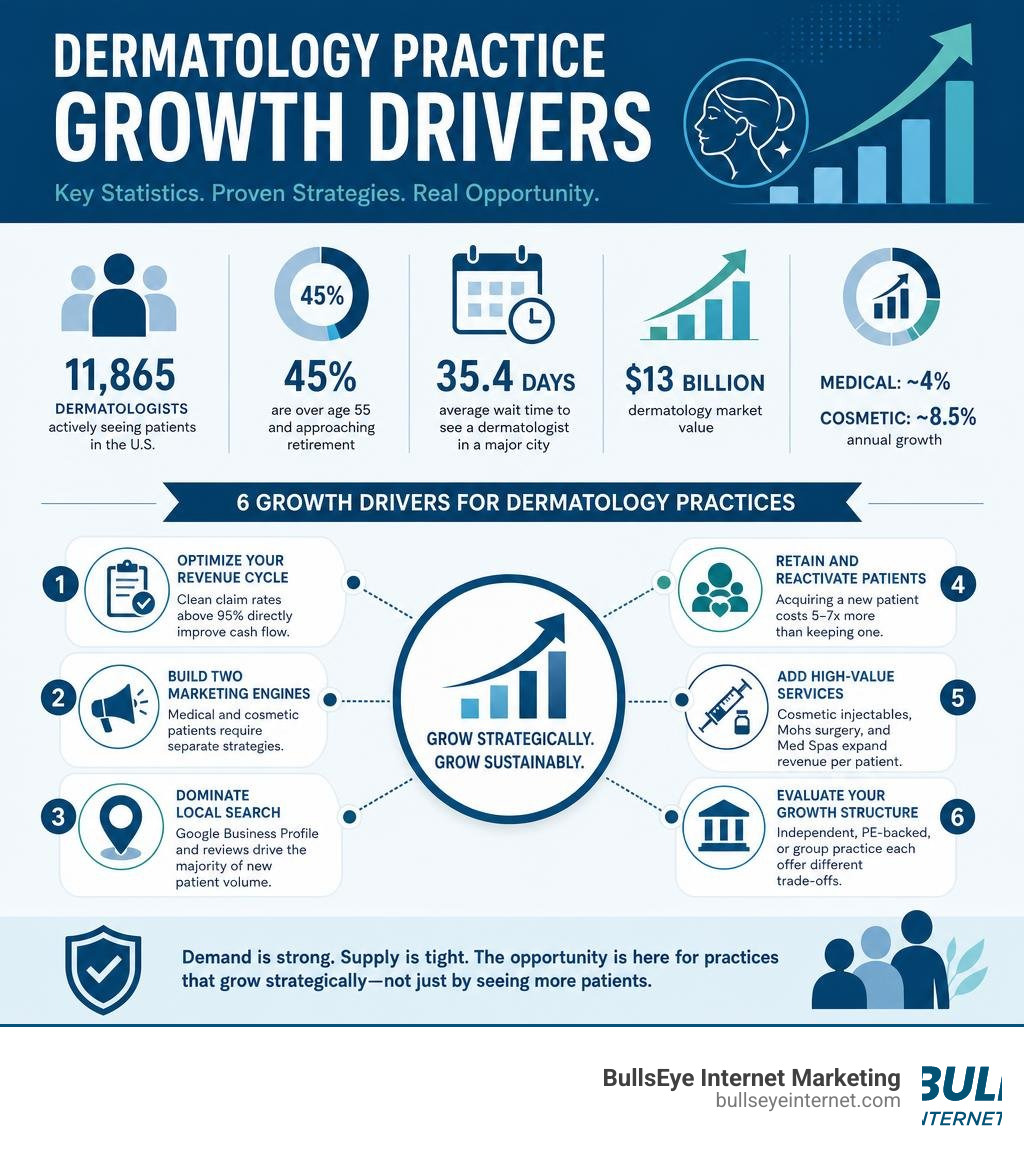
Here’s a quick summary of the most effective ways to grow a dermatology practice:
- Optimize your revenue cycle — clean claim rates above 95% directly improve cash flow
- Build two marketing engines — medical and cosmetic patients require separate strategies
- Dominate local search — Google Business Profile and reviews drive the majority of new patient volume
- Retain and reactivate patients — acquiring a new patient costs 5-7x more than keeping one
- Add high-value services — cosmetic injectables, Mohs surgery, and Med Spas expand revenue per patient
- Evaluate your growth structure — independent, PE-backed, or group practice each offer different trade-offs
The numbers tell a compelling story. There are roughly 11,865 dermatologists actively seeing patients in the U.S. — and nearly 45% of them are over age 55 and approaching retirement. The average wait time to see a dermatologist in a major city is 35.4 days. Demand is strong and supply is tight.
At the same time, the industry is changing fast. Private equity groups have consolidated hundreds of locations. Corporate chains are competing on volume. And patients — especially cosmetic ones — are more informed and more selective than ever.
That pressure creates a real opportunity for practices that grow strategically, not just by seeing more patients.
The dermatology market was valued at $13 billion and is projected to keep expanding. Medical dermatology is growing at roughly 4% annually, while cosmetic dermatology is pushing 8.5% per year. Combined, that’s a sustainable growth rate most industries would envy.
But growth doesn’t happen by accident. It takes the right mix of marketing, operations, staffing, and positioning — and most practices are leaving significant revenue on the table by focusing on only one or two of those levers.
I’m Ronnie Katz, founder of BullsEye Internet Marketing, and since 2006 I’ve helped medical practices — including dermatology clinics — increase visibility, drive qualified patient traffic, and convert leads into booked appointments through proven digital marketing strategies. Dermatology practice growth is something I’ve worked on hands-on with practice owners who were frustrated by high acquisition costs and marketing that simply wasn’t delivering results. In this guide, I’ll walk you through every major growth lever, from local SEO and paid ads to staffing, service expansion, and navigating consolidation decisions.
Simple guide to Dermatology practice growth terms:
Strategic Frameworks for Sustainable Dermatology Practice Growth

Achieving sustainable dermatology practice growth requires a delicate balance between clinical excellence and business efficiency. Many practice owners fall into the trap of believing that simply working longer hours or packing the daily schedule with more patients is the path to expansion. In reality, scaling a practice successfully in 2026 requires optimizing your infrastructure to handle increased volume without diluting the patient experience or burning out your staff.
Demographic shifts are heavily in favor of the dermatology field. An aging population and rising awareness of skin cancer rates mean that demand for medical dermatology services continues to climb. However, the way practices are structured to meet this demand has shifted dramatically over the last decade.
According to peer-reviewed Scientific research on dermatology practice characteristics, the landscape has undergone significant consolidation. While solo and small practices (2 to 5 providers) historically accounted for more than 80% of dermatology practices, the balance of power has shifted. The number of solo practitioners has steadily decreased, while the number of dermatologists working in large group practices (more than 10 providers) has surged.
For practices in high-growth regions like South Florida — including Miami-Dade, Broward, and Palm Beach counties — this consolidation means independent practices must operate with the same corporate efficiency as large networks while leveraging their unique boutique appeal to capture local market share.
Balancing Medical and Cosmetic Services for Dermatology Practice Growth
To build a resilient business model, we must understand that dermatology operates as a dual-revenue model: medical dermatology (primarily insurance-driven) and cosmetic services (strictly cash-pay). Treating these two segments as separate business units under one roof is critical for balanced dermatology practice growth.
Medical dermatology provides the practice with a highly stable, recurring patient base. Driven by clinical necessity, patients seek regular skin cancer screenings, acne treatments, and management of chronic conditions like psoriasis and eczema. Medicare reimbursement forms a substantial portion of this revenue, often accounting for 30% to 60% of a medical dermatology practice’s income. The challenge here is volume and scheduling; with average metropolitan wait times exceeding a month, medical operations must be highly optimized to move patients through efficiently.
Cosmetic dermatology, on the other hand, offers high-margin, immediate cash flow. Treatments like neuromodulators, soft-tissue fillers, laser therapies, and non-invasive body contouring do not rely on insurance approvals or complex billing cycles. However, cosmetic patients behave like retail consumers. They demand modern amenities, seamless booking experiences, and immediate communication.
To successfully scale, mature practices should implement specific Patient growth strategies for mature cosmetic practices. Instead of competing on price—which devalues your clinical brand—focus on premium packages, tiered membership programs, and cross-promoting cosmetic offerings to your existing medical patient base. For instance, a patient coming in for a routine annual skin check is a natural candidate for medical-grade skincare retail or preventive aesthetic treatments.
Leveraging Technology to Accelerate Dermatology Practice Growth
Modern technology is the primary engine behind operational efficiency. Without a robust digital infrastructure, scaling your patient volume will inevitably lead to administrative bottlenecks, longer wait times, and staff turnover.
Key technological pillars for growth include:
- Dermatology-Specific EHR Systems: General electronic health record systems often lack the visual documentation workflows required for skin mapping and lesion tracking. Implementing a dermatology-specific EHR allows providers to document visits in seconds, reducing administrative screen time.
- Integrated Practice Management Software: This links scheduling, billing, and patient communications into a single dashboard, reducing manual data entry errors.
- Prior Authorization Automation: Prior authorizations for biologics and specialized acne medications are a major source of administrative friction. Automated software tools can submit and track these requests, freeing up hours of medical assistant time.
- Data Analytics Platforms: To grow, you must measure. Real-time dashboards should track key metrics such as clean claim rates, average revenue per visit, and patient acquisition costs.
By implementing these tools, you can actively combat physician burnout and lower operating expenses. To dive deeper into optimizing your practice’s financial performance through clinical efficiency, check out this guide on How to grow your dermatology practice revenue.
Navigating Consolidation: Independent Practice vs. Private Equity

The rise of private equity (PE) in the dermatology space has redefined the competitive landscape. Large consolidated networks have acquired hundreds of independent practices, using economies of scale to negotiate higher reimbursement rates with payers and centralize administrative tasks like billing, HR, and marketing.
For independent dermatologists in competitive markets like Palm Beach, Broward, and Miami-Dade, this consolidation presents a strategic choice: join a larger network, sell to private equity, or remain fiercely independent.
Remaining independent is highly viable in 2026, but it requires a shift in positioning. Independent practices cannot compete with PE-backed giants on pure insurance-panel volume. Instead, they must position themselves as premium, highly accessible, boutique alternatives. While a corporate network clinic might feel like a high-volume assembly line, an independent practice can offer direct access to board-certified dermatologists, personalized care, and a superior patient experience.
To see how solo practitioners and boutique clinics are thriving without corporate backing, read How independent dermatologists build premium patient books.
| Metric / Feature | Independent Private Practice | Private Equity-Backed Group |
|---|---|---|
| Average Revenue Per Medical Visit | $280 to $680 (Premium, boutique pricing) | $180 to $380 (Contracted network rates) |
| Clinical Autonomy | Complete control over scheduling, treatments, and products | Often subject to standardized protocols and corporate formularies |
| Administrative Burden | Managed locally or outsourced to specialized partners | Centralized back-office support (billing, HR, compliance) |
| Patient Experience | Relationship-focused, lower wait times, high continuity of care | Volume-focused, higher provider turnover |
| Capital Access | Self-funded or local bank financing | Direct access to institutional capital for rapid expansion |
Optimizing Physical Footprint: Location Expansion vs. Space Optimization
When planning for dermatology practice growth, one of the most critical capital decisions is whether to expand your physical footprint. This can be achieved through two main pathways: opening new locations or maximizing your existing office space.
Before committing to a costly second lease in a new market, we always recommend optimizing your current square footage. Converting underutilized administrative space or storage rooms into active exam rooms is the fastest, most cost-effective way to scale capacity. For example, transitioning from paper charts to a fully cloud-based EHR system can free up entire rooms previously dedicated to physical chart storage.
Additionally, scheduling optimization can expand your capacity without adding physical walls. Grouping similar procedures together, utilizing mid-level providers for routine follow-ups, and offering early morning or weekend hours can significantly increase your weekly patient throughput.
If you do decide that geographic expansion is necessary to capture new patient demand, purchasing an existing clinic is often more efficient than building a new office from scratch. For those looking to expand in the Sunshine State, keeping an eye on opportunities like a Dermatology practice for sale in Florida can provide an established patient base and immediate cash flow from day one.
Building a Culture-First Team: Adding Providers and Extenders
You cannot scale a practice alone. To achieve sustainable dermatology practice growth, you must strategically add new providers, physician extenders (Physician Assistants and Nurse Practitioners), and licensed aestheticians. However, hiring without a clear cultural alignment can quickly degrade your clinical quality and reputation.
A culture-first approach starts with codifying your practice’s core values. These values should guide everything from patient interactions to how your team handles mistakes. For example, implementing a structured onboarding process ensures that every new hire—whether a board-certified Mohs surgeon or a front-desk coordinator—understands your commitment to patient care.
When integrating physician extenders, clear clinical guidelines and supervision structures are essential. PAs and NPs can highly efficiently manage routine medical visits, acne follow-ups, and minor procedures, freeing up the MDs to focus on complex cases, Mohs surgeries, and high-value cosmetic consults.
Similarly, licensed aestheticians can bridge the gap between medical care and cosmetic retail, offering chemical peels, facials, and skincare consultations that drive high-margin retail revenue while keeping patients engaged between clinical visits.
High-Impact Marketing Strategies for Patient Acquisition and Retention
In 2026, a beautiful office and excellent clinical outcomes are no longer enough to guarantee growth. To consistently attract new patients, your practice must run highly optimized marketing campaigns. Because medical and cosmetic patients search for care differently, you need to build and maintain two distinct marketing engines.
Medical patients are typically driven by necessity, insurance coverage, and local convenience. They start their journey on search engines, looking for terms like “dermatologist near me” or “skin cancer screening Miami.” Cosmetic patients, conversely, are driven by visual results, social proof, and brand reputation. They discover providers through before-and-after galleries, educational video content, and social media platforms.
To build a comprehensive digital blueprint that addresses both of these audiences, consult our detailed Dermatology practice marketing guide.
For immediate patient acquisition, paid digital advertising is highly effective. To learn how to structure campaigns that target high-intent searchers while maintaining a low acquisition cost, read our resources on How to attract more patients with Google Ads and explore our advanced Strategies to outrank competitors with Google Local Ads.
Dominating Local Search and Paid Advertising
The foundation of local patient acquisition is your Google Business Profile (GBP). When a patient searches for a dermatologist in Fort Lauderdale or West Palm Beach, Google displays the “Map Pack”—the top three local business listings. If your practice is not appearing in these top three spots, you are missing out on the vast majority of local search traffic.
To dominate local search, we focus on:
- Name, Address, and Phone (NAP) Consistency: Ensuring your practice details are identical across your website, GBP, and all online directories.
- Review Velocity and Volume: Actively generating a steady stream of fresh, positive Google reviews.
- Service-Specific Landing Pages: Creating dedicated, SEO-optimized pages on your website for every condition you treat and cosmetic service you offer.
Beyond organic search, paid search advertising allows you to instantly appear at the very top of Google when patients are actively looking for care. For dermatology practices, Google Local Services Ads (LSAs) are a game-changer. Unlike traditional pay-per-click ads where you pay for every click regardless of intent, LSAs operate on a pay-per-lead model. You only pay when a qualified lead calls or books an appointment directly through the ad.
To set up and optimize these highly profitable campaigns, review our guide on Google Local Services Ads for Dermatologists.
Managing paid ad budgets requires careful optimization to prevent wasted spend on non-converting search terms. Learn how we help practices maximize their return on investment by Reducing wasted leads and saving budget. For a complete collection of our insights on paid search performance, browse our dedicated Dermatologist Google Local Ads tag.
Patient Retention and Reactivation: Maximizing Lifetime Value
While acquiring new patients is exciting, retaining your existing ones is far more profitable. It costs five to seven times more to acquire a new patient than it does to retain an existing one. Despite this, the average dermatology clinician has between 1,000 and 2,000 “lost” patients—individuals who came in for an initial visit or acne treatment but never returned.
With the average annual revenue per dermatology patient sitting at approximately $509.98, reactivating even a fraction of these lapsed patients can drive massive revenue growth without increasing your marketing spend.
To capture this hidden revenue, practices should implement automated recall and reactivation campaigns. For example, a patient who had a mole biopsy 11 months ago should automatically receive a personalized text or email reminder in month 12 to book their annual skin check. Similarly, cosmetic patients who received neuromodulator injections should be automatically prompted to schedule their follow-up treatment at the 3-to-4-month mark.
To learn how to design and execute these high-yield campaigns, read about Reactivating lost patients for exponential revenue growth.
Frequently Asked Questions about Dermatology Practice Growth
What are the key financial benchmarks for a healthy dermatology practice?
A healthy, scalable dermatology practice typically operates with a net operating margin between 24% and 28%. The median revenue per full-time equivalent (FTE) physician is approximately $1.3 million for medical dermatology and upwards of $1.8 million for cosmetic-focused practices.
To maintain these healthy margins, practices should aim for a clean claim rate (claims accepted on first submission) of over 95%. When investing in new clinical equipment—such as advanced aesthetic lasers—practices should calculate the expected return on investment (ROI) by projecting monthly procedure volume against lease or purchase costs, aiming for a complete capital recovery within 12 to 18 months.
What regulatory and compliance risks should growing practices consider?
As dermatology practices scale, regulatory compliance becomes increasingly complex. Key risk areas include:
- HIPAA Compliance: This is especially critical when managing online reviews and social media. Practices must never confirm a patient’s clinical relationship or disclose medical details in public review responses.
- Before-and-After Photography: Under FTC and state guidelines, sharing clinical photos requires explicit, written patient consent, and must include clear disclosures regarding typical results.
- Supervision Requirements: State medical boards have strict rules regarding the level of physician supervision required for nurse practitioners, physician assistants, and aestheticians, particularly when performing cosmetic laser treatments or injectables.
- Corporate Practice of Medicine (CPOM): Many states prohibit non-physicians or private equity corporations from owning medical practices, requiring structured management services organization (MSO) models to remain compliant.
How can a dermatology practice successfully integrate ancillary services?
Integrating ancillary services is an excellent way to increase your average revenue per patient. High-potential service lines include:
- Dermatopathology Labs: By bringing pathology services in-house, larger practices can significantly speed up biopsy turnaround times while capturing both the professional and technical billing components.
- Med Spas: Operating a separate or integrated Med Spa allows you to offer medical-grade aesthetic treatments under physician oversight, capturing a broader demographic of cosmetic consumers.
- Teledermatology: Utilizing telehealth for routine follow-ups, acne management, and quick spot checks improves scheduling flexibility and patient convenience.
- Medical-Grade Skincare Retail: Offering curated retail products yields high gross margins (typically 48% to 68%) and reinforces your role as the patient’s ultimate skin health authority.
Conclusion
Achieving sustainable dermatology practice growth is a multi-front journey. It requires clinical excellence, streamlined operations, smart technology adoption, and a highly strategic approach to marketing. Whether you choose to remain a boutique independent practice in South Florida or scale through geographic expansion, success comes down to how effectively you attract, convert, and retain your patients.
At BullsEye Internet Marketing, we specialize in helping dermatology practices navigate this competitive landscape. We don’t believe in one-size-fits-all marketing. Our agency specializes in generating high-quality calls and bookings through tailored SEO, Google Business Profile optimization, and high-converting paid search campaigns.
To give our clients a true competitive advantage, we offer a unique promise: we never require long-term contracts, and we work with only one client per industry per geographic area. This means when you partner with us in your local South Florida market, we are fully committed to helping your practice—and only your practice—dominate local search.
Ready to smooth out the wrinkles in your growth strategy and start scaling your patient bookings? Grow your practice with BullsEye Internet Marketing services today, and let’s build a customized growth engine for your clinic.
