
The High-ROI Case for Email Marketing for Attorneys
When we evaluate client acquisition channels with law firm partners, pay-per-click (PPC) and local service ads (LSAs) often dominate the conversation. However, once we look at long-term profitability, email marketing for attorneys continuously takes top billing.
According to the Data Marketing Association, email delivers an average return of $42 for every $1 spent—a staggering 4,200% ROI. Why does email outperform paid channels so dramatically? It comes down to direct control and long-term client lifetime value (LTV). When you run paid ads, you rent space on someone else’s platform. The moment you turn off your ad spend, the leads disappear. An email database, on the other hand, is an owned digital asset that compounds in value over time.
For additional perspective on how email integrates into a firm’s complete growth strategy, review our comprehensive Law Firm Marketing Guide 2026.
Key Metrics and ROI Comparison for Legal Practices
To understand why email is so cost-effective, let’s contrast it directly against paid search acquisition tactics.
| Channel | Typical Acquisition / Platform Cost | Avg. Conversion / Open Rate | Strategic Advantage |
|---|---|---|---|
| Google PPC (e.g., PI Law) | $800 – $1,500 per client | ~2% – 4% landing page conversion | Immediate high-intent lead capture |
| Local Services Ads (LSAs) | $300 – $600 per lead | Varies by market and response time | High local visibility and trust badge |
| Email Marketing | $30 – $50 / month total | 22.49% Open Rate / 5.64% CTR | Owned audience, compounding ROI, zero marginal cost per send |
Legal industry campaigns yield an average click-through rate (CTR) of 5.64%, comfortably outperforming many traditional B2B sectors. When you consider that 64% of small businesses rely on email to connect with audiences, law practices that skip this channel are handing a distinct market advantage to their competitors.
How Email Marketing for Attorneys Boosts Client Retention and Referrals
Up to 50% of new cases coming into a typical law practice originate from word-of-mouth referrals and past clients. Yet, most firms lose touch with clients the moment their case file closes.
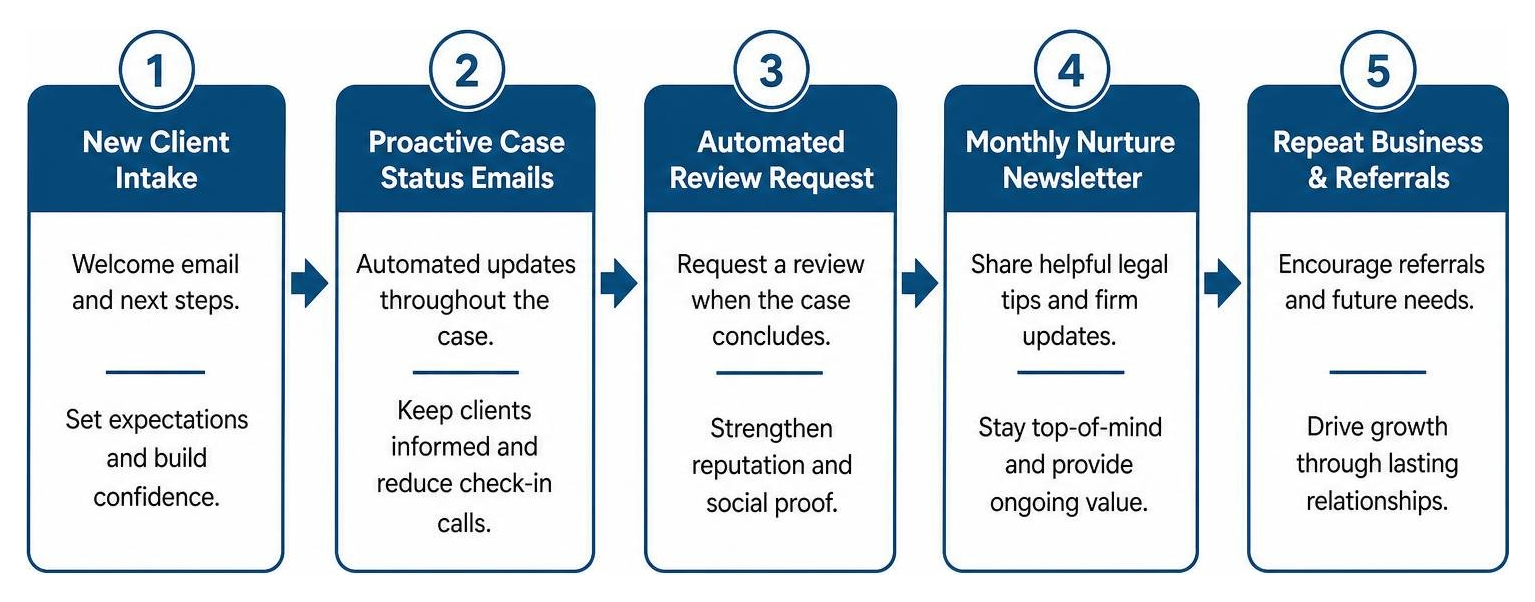
By deploying automated touchpoints, you ensure your firm remains top-of-mind. Furthermore, sending regular automated case status updates solves one of the biggest administrative headaches in legal practice: constant inbound check-in phone calls. Implementing proactive case status emails can reduce “where’s my case?” calls by 40% to 60%, saving your staff dozens of administrative hours every single week.
To learn more about modernizing your client engagement strategies beyond traditional word-of-mouth, explore our guide on moving Beyond Word of Mouth: Modern Marketing for Legal Services.
Essential Email Campaigns for Law Firms
Running an effective email program isn’t about sending random broadcasts whenever you remember to write one. It requires structuring specific lifecycle campaigns designed to serve clear objectives.
Onboarding and Case Updates with Email Marketing for Attorneys
Welcome emails are opened more than 8 out of 10 times—generating 4x as many opens and 10x as many clicks as standard broadcasts. When a client hires your firm, their anxiety level is at an all-time high. A structured “Day 0” welcome sequence puts them at ease immediately.
Your onboarding sequence should outline what to expect over the first 72 hours, introduce key team members, and answer standard administrative questions. Following onboarding, keeping clients informed via automated milestone emails transforms client satisfaction and lowers administrative overhead.
Educational Newsletters and Referral Nurturing
Your ongoing newsletter should follow the 80/20 rule: 80% educational, helpful content, and 20% firm updates or direct offers.
- Ditch the Legalese: Write as if you are speaking directly to a client over coffee. Translate complex statutory changes into plain language.
- Referral Partner Nurturing: Create a distinct email sequence for non-competing professionals (such as CPAs, estate planners, or doctors). A quarterly digest tailored to their business needs keeps your referral engine active.
- Automated Review Requests: Asking for a review via email seven days after a case successfully closes converts at 15% to 25%, compared to just 5% to 10% when asking in person at your office.
For a deeper dive into ethical engagement strategies, review the insights shared in The Power of Email Marketing for Law Practices.
Ethically Growing and Segmenting Your Legal Email List
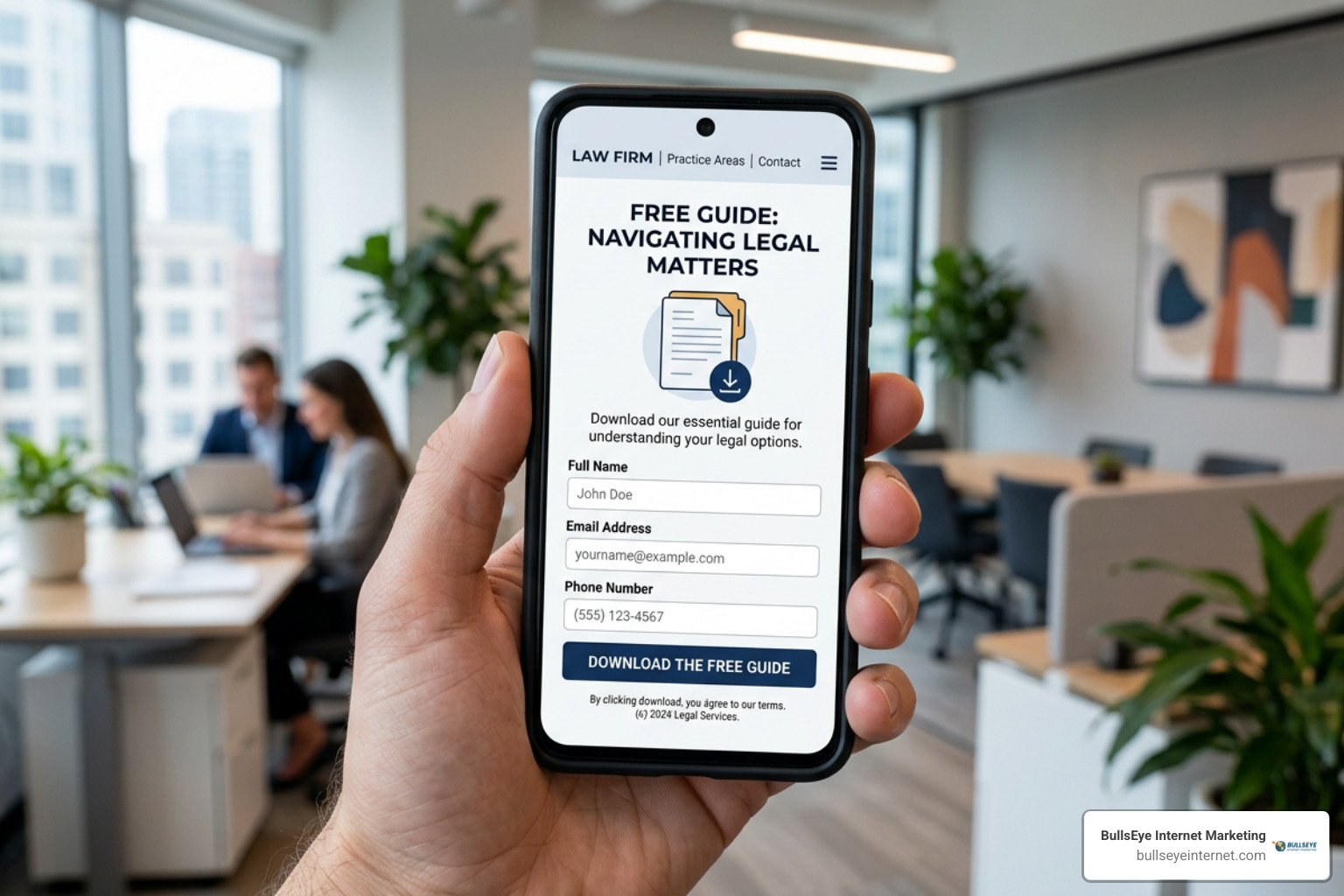
A common mistake attorneys make is purchasing cold email lists. Buying email lists violates major platform rules, destroys your sender reputation, and can land you in trouble with state bar advertising regulators. You must build your list organically.
If you are starting from scratch, read our step-by-step framework on Small Law Firm Marketing: From Zero to Client Hero.
Lead Magnets and Ethical List Building
The most efficient way to attract high-intent subscribers is through valuable online resources called “lead magnets.”
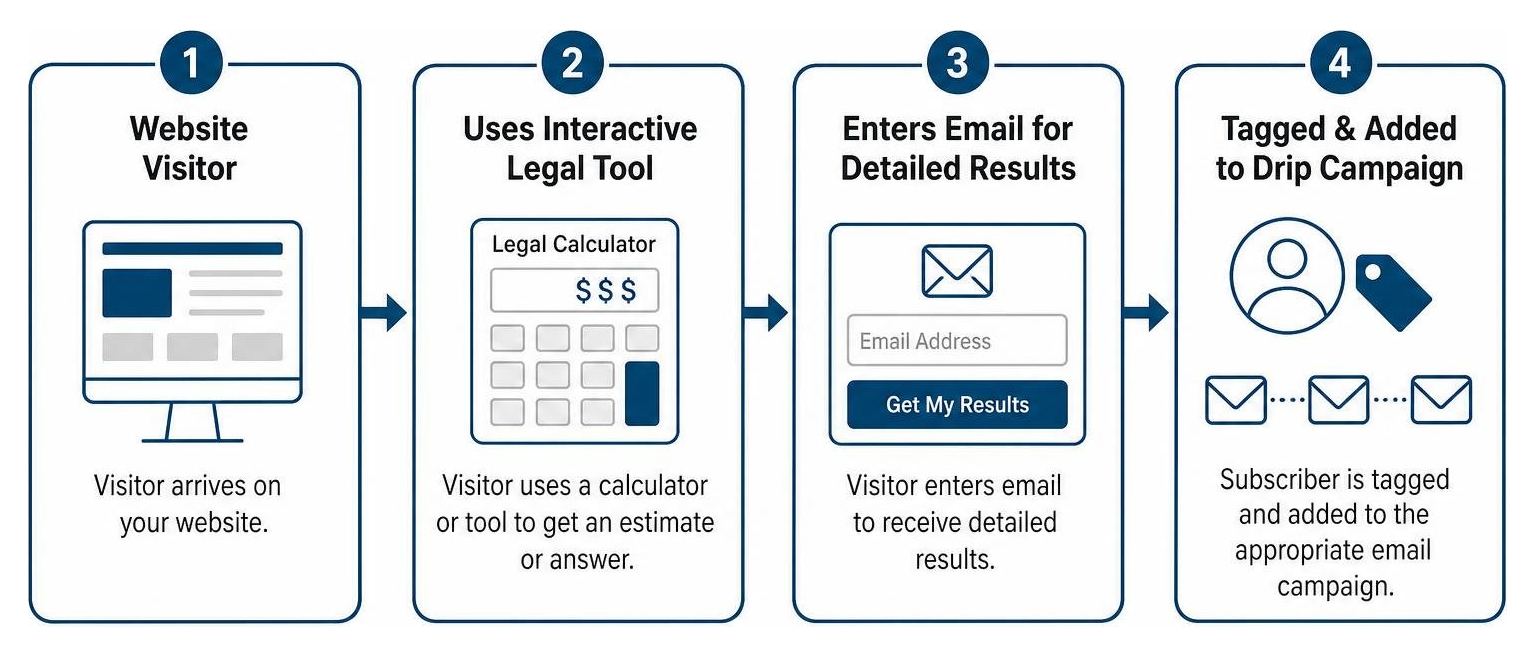
- Interactive Calculators: Adding a state-specific probate fee or child support estimator with an email opt-in gate converts 8% to 12% of website visitors, compared to just 1% to 2% for standard contact forms.
- Gated Downloadable Guides: Offer checklists such as “5 Critical Mistakes to Avoid After a Car Accident” or “The Estate Planning Readiness Checklist.”
- Website Footer Forms: Simple, clean sign-up boxes in your website footer convert standard blog readers into long-term subscribers.
For official guidance on starting your outreach programs smoothly, consult the Florida Bar’s resource page on Getting Started with Email Marketing.
Audience Segmentation Strategies
Broadcasting identical emails to everyone in your contact database leads to high unsubscribe rates. Simple list segmentation increases open rates by 14%, while advanced segmentation can drive conversion rates two to three times higher.
Segment your audience using three primary criteria:
- Practice Area / Interest: Tag contacts by service interest (e.g., estate planning, personal injury, corporate litigation).
- Lifecycle Stage: Group subscribers into active prospects, current clients, closed past clients, and professional referral partners.
- Lead Acquisition Source: Track whether contacts signed up via a website calculator, a hosted webinar, or an in-person networking event.
Compliance, Ethics, and Bar Advertising Rules

Attorneys face stricter email marketing rules than typical businesses. Maintaining strict compliance with commercial regulations and legal ethics guidelines is non-negotiable.
The Compliance Checklist for Law Practices
- CAN-SPAM Act Rules: Every commercial email must include your physical business address, a non-deceptive subject line, and an easily accessible, one-click unsubscribe mechanism. Opt-out requests must be honored within 10 business days.
- State Bar Advertising Disclaimers: Most state bars require specific disclaimers in marketing communications, such as “Attorney Advertising.” When sharing past case verdicts or settlement numbers, always include mandatory language stating that past results do not guarantee future outcomes.
- Protecting Client Confidentiality: Never disclose identifying client details in newsletters or marketing updates without express written consent. Anonymize all case descriptions completely.
- GDPR and Data Privacy: If you serve international clients or residents in strict privacy jurisdictions, use double opt-in registration forms to ensure explicit consent is recorded.
To ensure your broader client generation tactics remain completely compliant, check out our guide on Attorney Marketing Solutions: How to Stop Chasing Clients and Start Attracting Them.
Deliverability, Mobile Optimization, and Common Pitfalls
Even the best copy won’t generate results if your emails get buried in spam folders or look broken on smartphone screens.
Technical Setup and Copy Formatting Rules
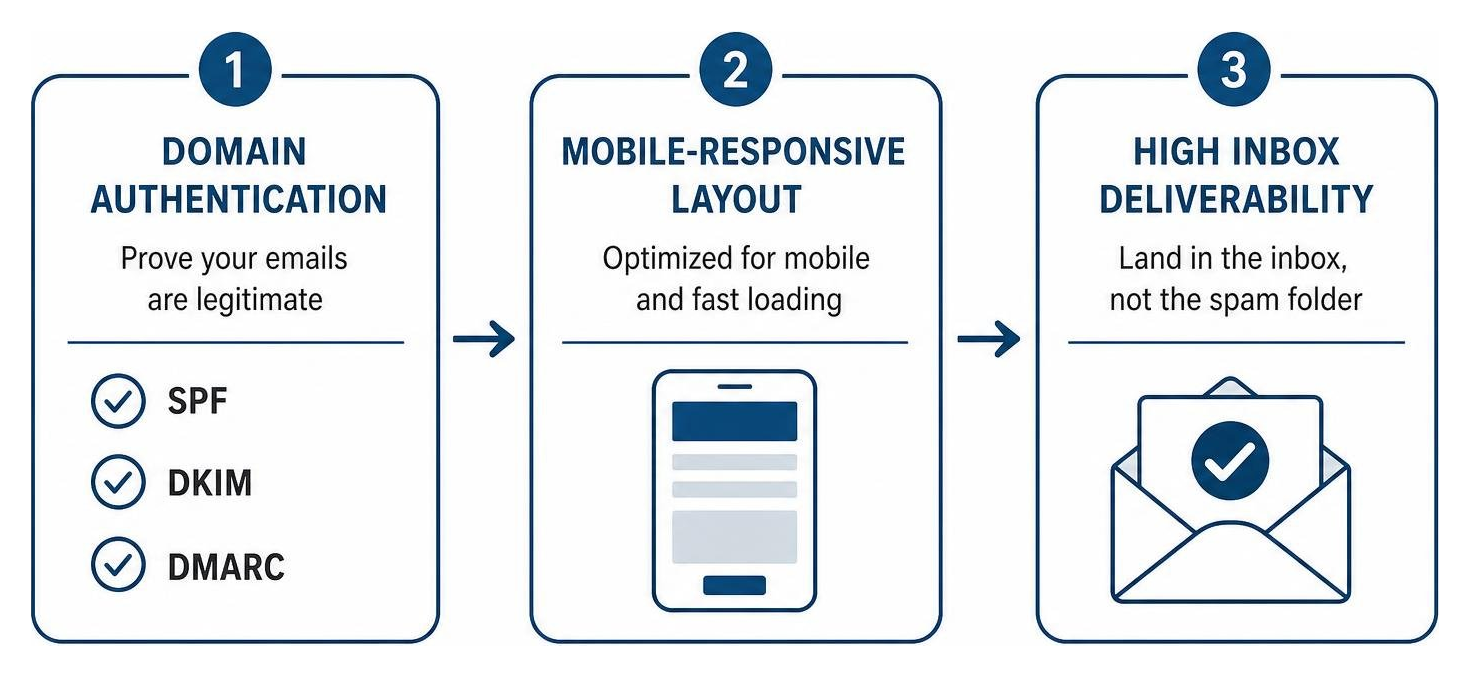
- Mobile-First Layouts: Around 64% of email opens occur on mobile devices, and over 50% of recipients delete emails that do not render properly on mobile. Keep your email layouts clean and single-column.
- Technical Authentication: Set up SPF, DKIM, and DMARC records on your domain. This proves to inbox providers like Gmail and Outlook that your emails are legitimate, keeping you out of the spam filter.
- The 2–4 Word Subject Line Formula: Data shows that short subject lines consisting of just 2 to 4 words achieve the highest open rates (up to 46%).
- Optimal Length: Emails with roughly 20 lines of text achieve the highest click-through rates. Keep your message punchy and direct, linking out to full articles on your firm’s website for deeper reading.
- HTML Sizing: Keep your email HTML payload size under 100KB to avoid deliverability throttling and load-time delays.
Avoid common pitfalls like using overly complex legalese or sending broadcasts erratically. For more proven advice on avoiding marketing mistakes, review No Objections Allowed: The Complete Guide to Online Marketing for Attorneys.
Frequently Asked Questions About Legal Email Marketing
What is the average open rate for legal email marketing campaigns?
The legal industry average open rate is approximately 22.49%. Click-through rates average 5.64%, outperforming many other professional service sectors. Top-performing segmented campaigns regularly achieve open rates between 35% and 50%.
How often should a law firm send marketing emails?
For general client newsletters, a monthly or bi-weekly cadence works best. Highly frequent broadcasts (such as daily or multiple sends per week) increase unsubscribe rates unless the subscriber explicitly opted into daily legal updates or active case alerts.
What is the best way to handle email marketing for attorneys without violating ethics rules?
Always secure opt-in consent, include your official firm name and physical postal address, provide a clear unsubscribe link, and include state bar disclaimers (e.g., “Attorney Advertising”). Never make guarantees regarding case outcomes, and fully anonymize client details to preserve confidentiality.
Conclusion
Building a systematic approach to email marketing for attorneys is one of the single most reliable ways to protect your law firm against shifting search algorithms, skyrocketing ad costs, and changing economic cycles. By curating an owned audience, segmenting your lists intelligently, and sharing valuable, plain-language legal guidance, your firm builds an enduring competitive advantage that generates consistent referrals for years to come.
At BullsEye Internet Marketing, we specialize in helping law firms establish high-converting digital acquisition channels without locking you into long-term contracts. We maintain a strict single-client exclusivity policy per industry and geographic area—giving your practice an unrivaled local edge.
Ready to take your legal marketing strategy to the next level? Explore our Essential Guide to Advertising for Lawyers or contact our team today to discover how we can help grow your law firm!
