
Why Every Dermatology Practice Needs to Think About Online Visibility Right Now
To improve dermatology online visibility, focus on these core actions:
- Optimize your Google Business Profile with accurate info, photos, and your full list of conditions treated
- Build dedicated pages for each treatment and skin condition you offer
- Earn and manage patient reviews consistently across Google and health directories
- Fix your technical foundation — site speed, mobile experience, and HTTPS
- Maintain consistent NAP (Name, Address, Phone) across every online directory
- Publish physician-attributed content that answers real patient questions
- Track calls, rankings, and conversions — not just traffic
Here is the reality: over 70% of dermatology patients now start their search on Google. They type things like “mole check near me” or “dermatologist accepting new patients” — and they book with whoever shows up first.
If your practice isn’t visible at that moment, you don’t get a second chance.
The shift is real and it’s accelerating. Patients no longer rely on word-of-mouth alone. They research symptoms, compare providers, read reviews, and make decisions — all before picking up the phone. A modern dermatology practice that ignores its digital presence is leaving a steady stream of new patients to competitors who have figured this out.
And the cost of invisibility isn’t just lost calls. It’s lost lifetime value. A teenager who books for acne today may return years later for laser resurfacing or cosmetic treatments. That one organic search result can be worth thousands of dollars over time.
The good news? Dermatology is actually one of the best specialties for organic search. Patients search for specific problems — acne scars, rosacea, suspicious moles — and your practice can show up with the exact answer they need.
I’m Ronnie Katz, founder and Principal CEO of BullsEye Internet Marketing, and since 2006 I’ve helped healthcare practices and local businesses improve dermatology online visibility and turn organic search into a reliable, measurable patient pipeline. In this guide, I’ll walk you through every layer of a proven dermatology SEO strategy — from your Google Business Profile to content, technical fixes, reviews, and beyond.
Must-know Improve dermatology online visibility terms:
Why You Must Improve Dermatology Online Visibility in 2026
The way patients seek medical care has fundamentally changed. Healthcare consumerism is at an all-time high, meaning patients treat choosing a dermatologist much like they do choosing a hotel or a restaurant. They expect a seamless, informative, and highly visible digital experience.
For dermatology practices, search engine optimization (SEO) is no longer a luxury—it is the foundation of patient acquisition. This is particularly true because Google classifies medical and skin health content under its strict “Your Money Your Life” (YMYL) guidelines.
Because inaccurate medical information can directly impact a user’s physical or financial well-being, Google subjects dermatology websites to incredibly high standards of E-E-A-T (Experience, Expertise, Authoritativeness, and Trustworthiness). To rank, your digital presence must prove that your clinical insights are accurate, safe, and backed by certified medical professionals.
According to the Skin conditions by the numbers – American Academy of Dermatology, skin diseases affect one in four Americans, representing an enormous pool of active searchers. Whether they are dealing with chronic conditions like eczema and psoriasis or looking for skin cancer screenings, millions of individuals are turning to search engines every single day for answers.
How Patients Find Dermatologists Online
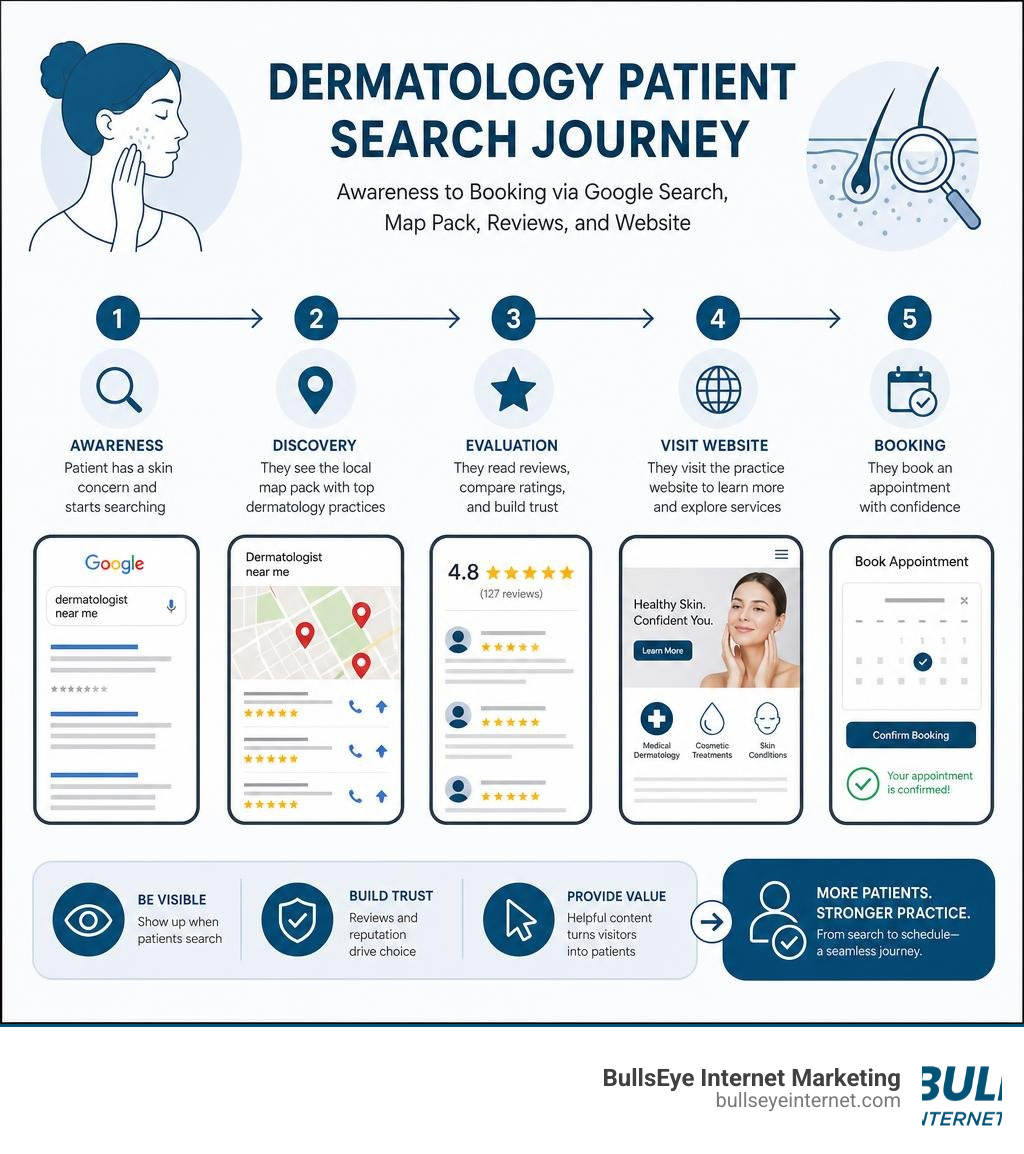
The modern patient journey is rarely a straight line, but it almost always starts on a smartphone. In fact, over 60% to 70% of dermatology-related searches occur on mobile devices.
When a patient notices an unusual rash or wants to address acne scars, they go through three distinct phases:
- The Awareness Phase: They search for symptoms (e.g., “why is my skin peeling on my face”).
- The Consideration Phase: They look for specific solutions (e.g., “best treatments for dry skin” or “chemical peel vs microdermabrasion”).
- The Decision Phase: They search for a local provider to perform the treatment (e.g., “dermatologist in Delray Beach” or “mole check near me”).
During the decision phase, Google’s Local Map Pack dominates the screen. This feature displays the top three local medical clinics matching the user’s location.
Additionally, we must optimize for zero-click searches and AI Overviews. Increasingly, search engines present direct answers right on the results page. By providing clear, snippet-ready definition blocks on your website, your practice can become the trusted source Google displays at the very top of the page, capturing the patient’s trust before they even click a link.
The Financial Impact of Organic Search vs. Paid Ads
While paid advertising (PPC) can deliver instant traffic, it functions like a water faucet: the moment you stop paying, the patient leads dry up.
Organic SEO, on the other hand, builds a compounding, sustainable asset. The financial contrast between the two models is stark:
- PPC and Paid Social: Typically costs between $75 and $200 per new patient acquired.
- Organic SEO: Delivers a long-term cost per patient acquisition of just $25 to $40 after 3 to 6 months of consistent strategy.
For a mid-sized practice investing in monthly content and technical optimization, this translates to adding 80 to 150 new organic patients every month. Over time, the high lifetime value of these patients—who may start with a simple acne consultation and return for years of cosmetic or preventive care—dramatically outpaces the cost of organic marketing.
To understand how local visibility directly impacts your bottom line, explore the Benefits of Local SEO for Your Business to see how building organic authority keeps your patient pipeline full without a continuous ad spend.
Core Components of a Dermatology SEO Strategy
To successfully improve dermatology online visibility, you cannot rely on a single tactic. A winning strategy requires a balanced, multi-layered approach that addresses technical health, on-page optimization, content depth, and local authority.
Technical SEO and Website Optimization to Improve Dermatology Online Visibility
Think of your website as the digital front door of your clinic. If the door is stuck, slow, or looks unsafe, patients will turn around and walk away. Google feels the same way. Technical SEO ensures search engine crawlers can easily read, index, and rank your site.

To build a healthy technical foundation, prioritize these critical factors:
- Site Speed and Core Web Vitals: A site that takes more than 3 seconds to load will lose over half its visitors to the “back” button. Your Largest Contentful Paint (LCP) for key landing pages should be under 2.5 seconds. Use image compression (WebP format) and lazy loading to keep page speeds lightning-fast.
- Mobile-First Indexing: Because the vast majority of your prospective patients search on their phones, Google ranks your site based on how well it performs on mobile devices. Ensure your navigation is thumb-friendly, buttons are at least 44x44px, and text is easily readable without zooming.
- HTTPS Security: As a medical practice, website security is non-negotiable. An active SSL certificate (HTTPS) is a primary trust signal for both search engines and patients.
- Crawl Error Resolution: Regularly audit your site using tools like Google Search Console to find and fix broken links (404 errors), redirect loops, and crawl blocks.
- XML Sitemaps: Keep an updated sitemap submitted to Google to ensure every newly published treatment page is indexed immediately.
Structuring High-Converting Treatment and Condition Pages
Many dermatology practices make the mistake of lump-summing their services onto a single “Services” page. This creates search intent cannibalization, where Google cannot figure out which page to rank for specific terms.
Instead, you should build dedicated, high-converting pages for every single condition and treatment you offer. Each page should follow a clear, patient-centric structure:
- The Hook Header: A clear, empathetic title addressing the patient’s concern (e.g., “Say Goodbye to Persistent Acne Scars”).
- The Pain & Science: Explain the condition in simple, patient-friendly language rather than dense medical jargon.
- The Solution: Detail your specific treatments, emphasizing your clinical expertise and advanced technology (like specific laser brands).
- Visual Proof: Display compliant, high-quality before-and-after galleries with descriptive alt-text (e.g., “Before and after three sessions of CO2 fractional laser for deep boxcar scars”).
- E-E-A-T Indicators: Clearly show doctor credentials, board certifications, and professional associations.
- Medical Schema Markup: Use structured data like
MedicalBusinessandMedicalProcedureschema so search engines understand exactly what clinical services you provide.
Ensuring your structural elements align with industry standards is critical for maximizing search visibility and providing a seamless user experience.
Local SEO: Dominating the Map Pack for Dermatology
General SEO focuses on ranking for broad terms globally. Local SEO, however, is about dominating your immediate geographic territory. If your clinic is located in Lake Worth, Boynton Beach, or West Palm Beach, you do not need traffic from Seattle. You need the patients who live within a 15-to-30-minute drive of your office.
To learn the foundational mechanics of local search, read through our Local SEO Complete Guide.
For local clinics, look at successful examples in your region. For instance, Palm Beach Dermatology: Home – Dermatologist in Lake Worth, FL has built a strong local footprint by focusing on community-centric search terms.
Optimizing Your Google Business Profile
Your Google Business Profile (GBP) is the single most powerful tool in your local marketing toolkit, contributing to roughly 36% of local map pack rankings.

To fully optimize your profile:
- Primary Category Selection: Set your primary category to “Dermatologist” rather than a generic “Medical Clinic” or “Skin Care Clinic.” You can use secondary categories for cosmetic services or laser clinics.
- Conditions Treated and Services: Manually add your full list of clinical services and conditions treated (e.g., eczema, psoriasis, skin cancer screening, Botox, dermal fillers) to your profile.
- Accurate NAP Consistency: Ensure your Name, Address, and Phone number are formatted exactly the same way on your website, your GBP, and every external medical directory.
- High-Quality Photos: Regularly upload real, professional photos of your clinic’s interior, your medical staff, and your specialized equipment. Avoid generic stock photos; patients want to see the actual environment where they will receive care.
Leveraging Reviews and Reputation Management to Improve Dermatology Online Visibility
Online reviews are a massive ranking factor, influencing approximately 17% of local map pack rankings. More importantly, 81% of patients actively consider online reviews when choosing a healthcare provider, and 95% perceive internet healthcare reviews as being at least moderately reputable.
To build a robust review generation engine:
- Implement Systematic SMS Requests: Don’t wait for patients to leave reviews passively. Send automated, friendly text messages or emails 24 to 48 hours after their appointment. SMS requests convert at a much higher rate than email.
- Maintain Strict HIPAA Compliance: When responding to reviews—especially negative ones—never confirm that the reviewer is a patient or disclose any protected health information (PHI). Keep your public responses generic and invite the individual to resolve any issues privately offline. Use first name and last initial only if displaying testimonials on your website.
- Leverage Medical Directories: Ensure your profiles are claimed and consistent on third-party healthcare platforms like WebMD, Healthgrades, and Vitals.
By combining systematic review acquisition with strict compliance, your practice can build a stellar online reputation that naturally attracts new patients and establishes long-term trust in your local community.
Integrating SEO with PPC and Multi-Channel Marketing
To achieve maximum digital dominance, your organic search strategy should work hand-in-hand with paid advertising and other marketing channels. This creates a cohesive, omnichannel presence that captures patients at every stage of their search journey.
| Feature | Organic SEO | Paid Search (PPC) |
|---|---|---|
| Time to Results | 3 to 12 months (compounding growth) | Immediate (instant visibility) |
| Long-Term Cost | Low ($25–$40 per acquired patient) | High ($75–$200 per acquired patient) |
| Click Share | Captures ~70% of total search clicks | Captures ~30% of search clicks |
| Sustainability | Traffic continues if budget is paused | Traffic stops immediately when budget stops |
| Trust Factor | High (perceived as natural authority) | Medium (marked as sponsored/ad) |
Maximizing Reach with Google Local Services Ads
For immediate, high-intent lead generation, Google Local Services Ads (LSAs) are an excellent addition to your organic SEO efforts. Unlike traditional PPC ads, LSAs appear at the very top of the search results page, even above standard Google Ads, and operate on a pay-per-lead model rather than pay-per-click.
To find out how to implement these ads effectively, read Google Local Services Ads for Dermatologists.
Using LSAs allows you to build immediate trust because your practice displays with a “Google Screened” badge, proving your licenses and credentials have been verified. To optimize your spend and ensure you aren’t paying for mismatched clinical inquiries, consult Local Ads for Dermatologists: How to Reduce Wasted Leads and Save Budget and learn how to scale your patient acquisition with Local Ads for Dermatologists: How to Attract More Patients with Google Ads.
Coordinating Organic Search with Paid Search Campaigns
When you run PPC and SEO simultaneously, you create a powerful search synergy.
First, occupying both the paid ad spot and the top organic/map spot on the same search page dramatically increases your practice’s perceived authority. Second, the data from your PPC campaigns can inform your SEO strategy: if a specific keyword like “coolsculpting near me” converts highly in paid ads, you know it is worth building out dedicated organic content hubs for that treatment.
To learn how to coordinate these channels and outperform local medical chains, explore Dermatologist Google Local Ads: Strategies to Outrank Competitors and browse our curated resources under the Tag: Dermatologist Google Local Ads.
For a deeper dive into multi-channel growth, watch this insightful Dermatology Marketing Strategies for Glowing Growth – Live Panel video to see how modern clinics balance digital channels for maximum impact.
Measuring Success, Timelines, and Compliance Challenges
Implementing a dermatology SEO strategy requires clear metrics, realistic expectations, and strict adherence to medical advertising regulations.
Key Metrics and Performance Indicators to Track
To measure the true return on investment of your SEO campaign, look beyond basic “website traffic” and focus on metrics that directly impact your clinic’s revenue.
- Organic Conversions: Track the number of completed online appointment request forms and click-to-call actions directly originating from organic search.
- Call Tracking with Dynamic Number Insertion (DNI): Use call tracking software to attribute incoming phone calls to specific organic landing pages or Google Business Profile listings.
- Local Map Pack Rankings: Monitor your position in the top 3 local map results for high-value terms in your specific neighborhoods (e.g., “dermatologist in Boynton Beach”).
- Keyword Movement: Track the upward climb of your targeted condition-specific and treatment-specific keywords.
- Bounce Rate and Dwell Time: Ensure patients are actively engaging with your content rather than hitting the back button immediately, which signals to Google that your page lacks helpful info.
To understand how professional agencies measure and report these metrics, you can read about the Local SEO Agency Services You Need to Know About and implement a structured measurement framework using The Ultimate Local SEO Playbook: Boost Your Business’s Online Presence.
Understanding Timelines and Budget Considerations
SEO is an ongoing investment, not a one-time fix. It behaves much like a gym membership: you cannot work out for a week and expect a lifetime of physical fitness.
Here is what a realistic timeline looks like for most dermatology practices:
- Months 1 to 2: Foundational technical fixes, schema implementation, and Google Business Profile optimization.
- Months 3 to 4: Initial ranking movement for long-tail, hyperlocal, and highly specific treatment keywords.
- Months 6 to 12: Significant organic traffic growth, a steady rise in map pack visibility, and a measurable decrease in your overall patient acquisition cost.
In terms of budget, a comprehensive dermatology SEO strategy that includes regular content creation, technical oversight, and local citation building typically ranges from $2,500 to $6,000 per month, depending on the competitiveness of your local market. While this requires an upfront commitment, the compounding nature of organic search ensures that your cost-per-lead drops continuously over time.
Frequently Asked Questions about Dermatology SEO
How long does it take to see results from dermatology SEO?
While early technical improvements and Google Business Profile optimizations can show local map movement within 60 to 90 days, a robust, competitive organic SEO campaign typically takes 6 to 12 months to deliver a substantial, self-sustaining flow of new patient leads.
How do we maintain HIPAA compliance while optimizing our website?
To maintain absolute compliance, never publish patient names, full faces, or medical details without written, documented consent. When responding to reviews, never confirm clinical details or acknowledge that the reviewer is a patient. Ensure your website analytics and contact forms do not store protected health information (PHI) unless you have a signed Business Associate Agreement (BAA) with your technology vendors.
Can an independent dermatology practice outrank large directory sites?
Yes. While large directory sites like the American Academy of Dermatology (AAD) or Healthgrades have massive domain authority, they lack hyperlocal depth. By building highly targeted, neighborhood-specific landing pages and deep, condition-specific content hubs tailored to your local community, independent practices can easily dominate local map packs and hyperlocal organic searches.
Conclusion
Building a powerful online presence is the single most effective way to secure the long-term growth of your dermatology practice. By optimizing your technical foundation, creating deep clinical content, and dominating the local Map Pack, you can turn search engines into your most reliable source of high-value patients.
But you do not have to carry this technical burden alone.
At BullsEye Internet Marketing, we specialize in generating high-quality calls and patient leads through tailored SEO, Google Business Profile optimization, and high-converting PPC campaigns. We do things differently: we offer no long-term contracts, and we work with only one client per industry per geographic area, giving your practice an exclusive, unmatched competitive advantage in your local market.
Whether your clinic is in Fort Lauderdale, Miami, Delray Beach, or anywhere across South Florida, we are here to help you dominate your territory.
Ready to transform your digital presence from a hidden secret into a patient-generating powerhouse? Explore our specialized Local SEO Agency solutions, and take the first step toward clinical growth by visiting Grow Your Practice with BullsEye Internet Marketing Services to schedule your consultation today!
