
Build Topical Authority With a Pillar Page Strategy
A pillar page strategy organizes your website around a major customer topic. Create one broad, useful pillar page, then support it with focused articles that answer specific questions. Link the pages together in both directions so people, search engines, and AI answer engines can understand how the information connects.
This approach turns scattered blog posts into a clear content system. It can help you rank for more related searches, reduce keyword overlap between pages, guide visitors toward the right next step, and give AI tools clearer, self-contained answers to retrieve and cite.
For a business owner, the goal is not simply more pages or more traffic. It is building a trusted resource around the problems your best prospects are actively trying to solve – then connecting that visibility to calls, leads, and sales.
I’m Ronnie Katz, founder and Principal CEO of BullsEye Internet Marketing. With more than 20 years in online marketing, I use pillar page strategy, SEO, AEO, and conversion-focused content architecture to help businesses earn visibility that produces measurable opportunities.
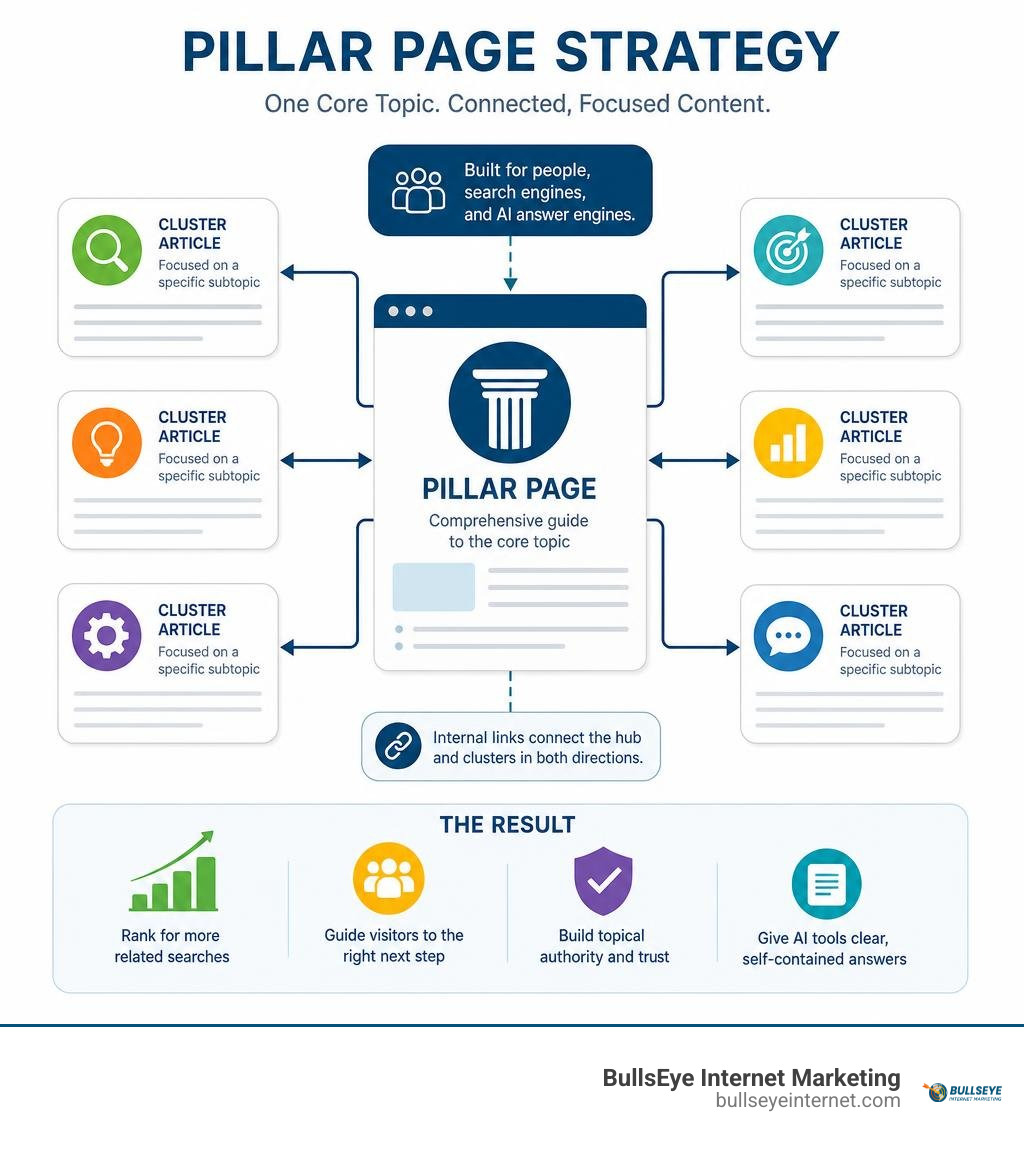
Simple pillar page strategy word guide:
Fundamentals of a Modern Pillar Page Strategy
Modern search systems no longer treat web pages as disconnected islands. Google’s algorithms, semantic search engines, and generative AI models evaluate websites based on content hubs, entity mapping, and topical completeness. If your site features scattered blog entries competing for overlapping keywords, crawl depth suffers and search bots struggle to identify your core expertise.
When you adopt a strategic content architecture, you create an organized knowledge base that respects how modern algorithms parse information. For instance, Google’s AI systems often operate with a grounding budget of roughly 2,000 words per page—extracting as little as 13% of a sprawling document to generate real-time answers. A deliberate architectural design ensures every section delivers clear, liftable value for Retrieval-Augmented Generation (RAG) engines while keeping your human visitors engaged.
| Content Type | Primary Objective | Search Intent Addressed | Typical Structure | Internal Linking Role |
|---|---|---|---|---|
| Pillar Page | Establish broad topical authority and route visitors | Broad informational and commercial exploration | Comprehensive overview (2,500–4,000 words) with jump links | Central hub; links down to all subtopic spokes |
| Blog Post | Answer a specific, narrow question | Specific long-tail informational | Focused deep dive (1,200–2,000 words) | Supporting spoke; links back up to the main pillar |
| Landing Page | Convert paid or direct traffic into immediate leads | Transactional / direct intent | Focused sales copy with minimal external navigation | Standalone asset; focused exclusively on a single CTA |
Defining Pillar Pages, Topic Clusters, and Knowledge Systems
A pillar page serves as the foundation of a topic cluster. It covers a broad core topic at a high level while linking out to dedicated supporting articles (“spokes”) that unpack specific subtopics in detail. To truly succeed, you must Elevate Your Content Strategy with Effective Pillar Page Techniques by treating your content as an integrated knowledge system rather than a glorified link directory.
A standard directory merely dumps links on a page without context. In contrast, a true knowledge system provides genuine educational depth across every section. It guides the user journey from foundational awareness down to specific tactical answers, mapping entities cleanly so search crawlers can recognize your domain as an authoritative entity in your vertical.
Pillar Pages vs. Cornerstone Content and Landing Pages
Many marketers confuse pillar pages with cornerstone content and landing pages, but each serves a distinct role in your digital footprint:
- Pillar Pages: Dynamic hubs designed to establish semantic breadth. They give an exhaustive overview of a broad subject, continuously routing link equity to and from detailed subtopic guides.
- Cornerstone Content: High-value, foundational articles that represent the core identity of a website. While all pillar pages can be considered cornerstone content, not every cornerstone piece acts as an architectural hub interlinking dozens of spokes.
- Landing Pages: Tightly focused on commercial transactions. Traditional landing pages strip away excessive links to funnel visitors toward a form or phone call, whereas pillars welcome exploration across a topic cluster.
Understanding this distinction ensures your content directly supports your business goals. Discovering how to move beyond rankings how SEO consulting services make your website work harder is essential when structuring content that delivers both topical dominance and qualified leads.
Why Pillar and Topic Cluster Models Dominate Modern SEO and AEO
Search algorithms have evolved beyond basic keyword matching. With the rise of Google AI Overviews and conversational answer engines, websites must establish undeniable topical authority to earn visibility. Industry research indicates that websites implementing a pillar-cluster architecture experience 30% to 50% higher organic visibility growth compared to sites relying on standalone posts.
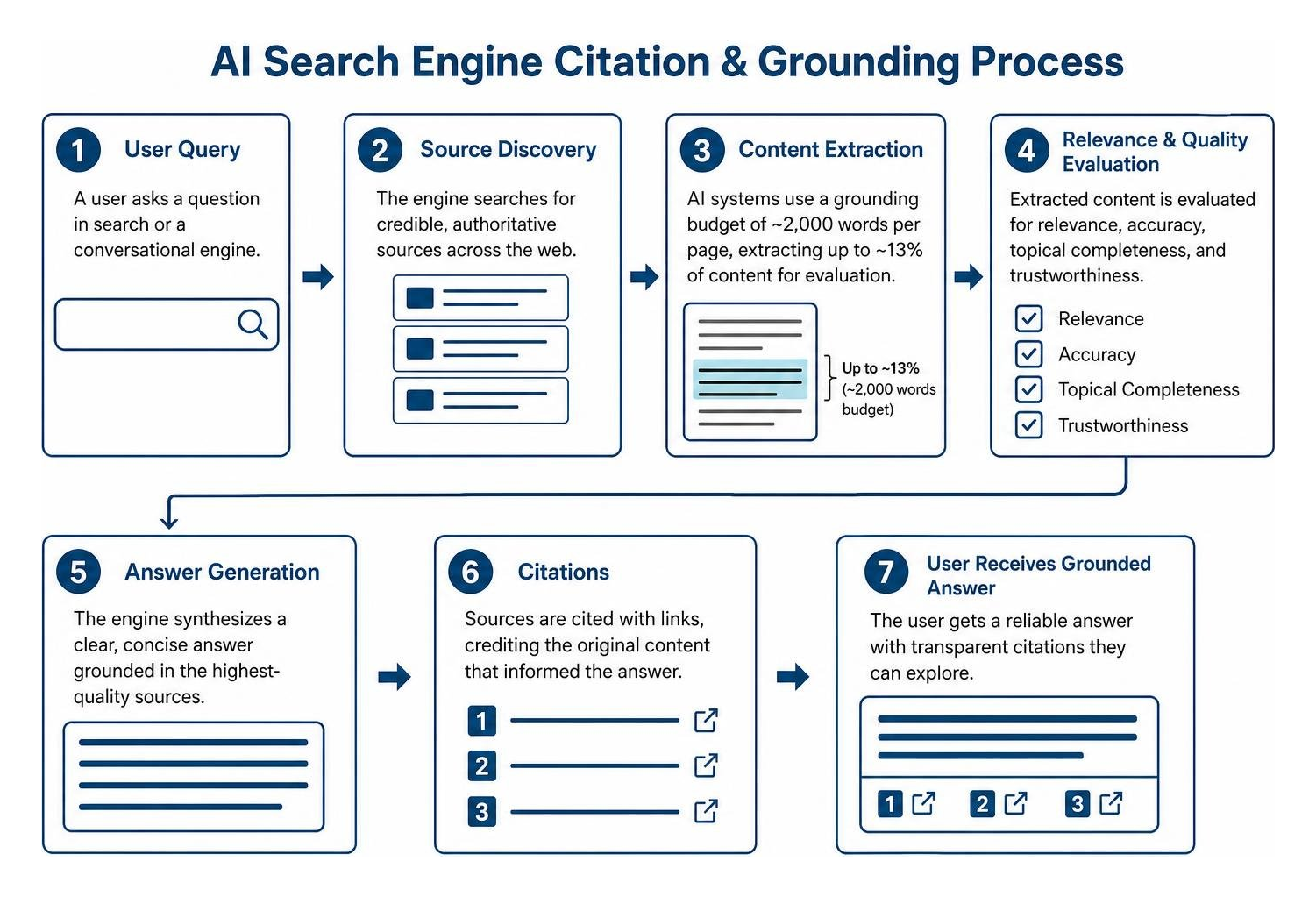
When an answer engine processes a complex query, it searches for verified knowledge sources that cover a theme comprehensively. A well-maintained pillar supported by an active cluster typically captures 15% to 35% of total organic search traffic within its broader thematic category.
AI Search Visibility and Generative Engine Optimization
Generative Engine Optimization (GEO) requires content structured for machine extraction. AI Overviews now appear on 16% to 25% of search queries across the United States. In conversational environments like ChatGPT, category-defining authority sites hold the top citation slot in 90.4% of month-over-month tracking checks.
To earn citations in generative engines, study the blueprint in Pillar Pages: How to Build One That Ranks and Gets Cited. AI models prioritize content with liftable definitions, front-loaded answers, and schema markup (such as about, mentions, and definedTerm). When each section of your pillar begins with a clear, direct answer, AI answer engines can lift that data during their grounding process without getting lost in conversational filler.
Ranking Signals, Topical Authority, and Organic Growth
Organizing content into thematic silos improves how PageRank distributes across your domain. When standalone pages compete for similar search phrases, keyword cannibalization occurs, diluting your ranking potential. Linking supporting articles back to a central pillar signals to search algorithms which asset represents the definitive head term.
In a documented case, restructuring 22 fragmented articles into a unified cluster moved a target pillar from position 14 to position 4 on Google within 11 weeks, while lifting combined cluster traffic by 42%. Partnering with a dedicated search engine optimization company guide can help you identify these architectural opportunities and transform scattered blog posts into high-performing organic assets.
Step-by-Step Blueprint: Planning, Structuring, and Internal Linking
Building a resilient topic hub requires careful planning. You cannot simply write a 4,000-word article, publish ten random blog posts, and expect top rankings. You need a deliberate blueprint that aligns keyword difficulty, search volume, and visitor intent.

Topic Selection and Comprehensive Cluster Scoping
Begin by choosing a core topic that meets three fundamental criteria:
- Commercial Relevance: The subject directly connects to your core services or revenue drivers.
- Topical Breadth: The topic is broad enough to generate at least 8 to 15 distinct subtopics (e.g., “Commercial HVAC Maintenance” rather than “How to Change an Air Filter”).
- Search Demand: The primary term commands solid search interest, while its subtopics capture long-tail questions.
For regional service providers, understanding how to leverage local SEO for small businesses ensures your cluster answers geographic search intent alongside technical industry questions.
Designing a High-Performing Pillar Page Strategy Architecture
A successful pillar page balances comprehensive coverage with effortless user experience. Your page structure should include:
- Direct Answers Above the Fold: Define the core topic in the opening paragraphs to capture quick-answer snippets and satisfy fast-scrolling readers.
- Hyperlinked Table of Contents: Use jump links with clear anchor text so visitors and web crawlers can navigate directly to specific H2 sections.
- Section-Level H2 Headings: Match each major H2 to a primary subtopic query that has a dedicated supporting cluster article.
- Self-Contained Content Blocks: Keep explanations concise, providing high-level answers before directing readers to the in-depth spoke article.
- Scannable Summaries and Comparison Tables: Incorporate structured data, bulleted takeaways, and visual comparison tables to simplify complex ideas.
Bidirectional Internal Linking and Hub Signaling
Internal linking is the connective tissue of your content hub. Search engines rely on consistent linking patterns to understand semantic relationships:
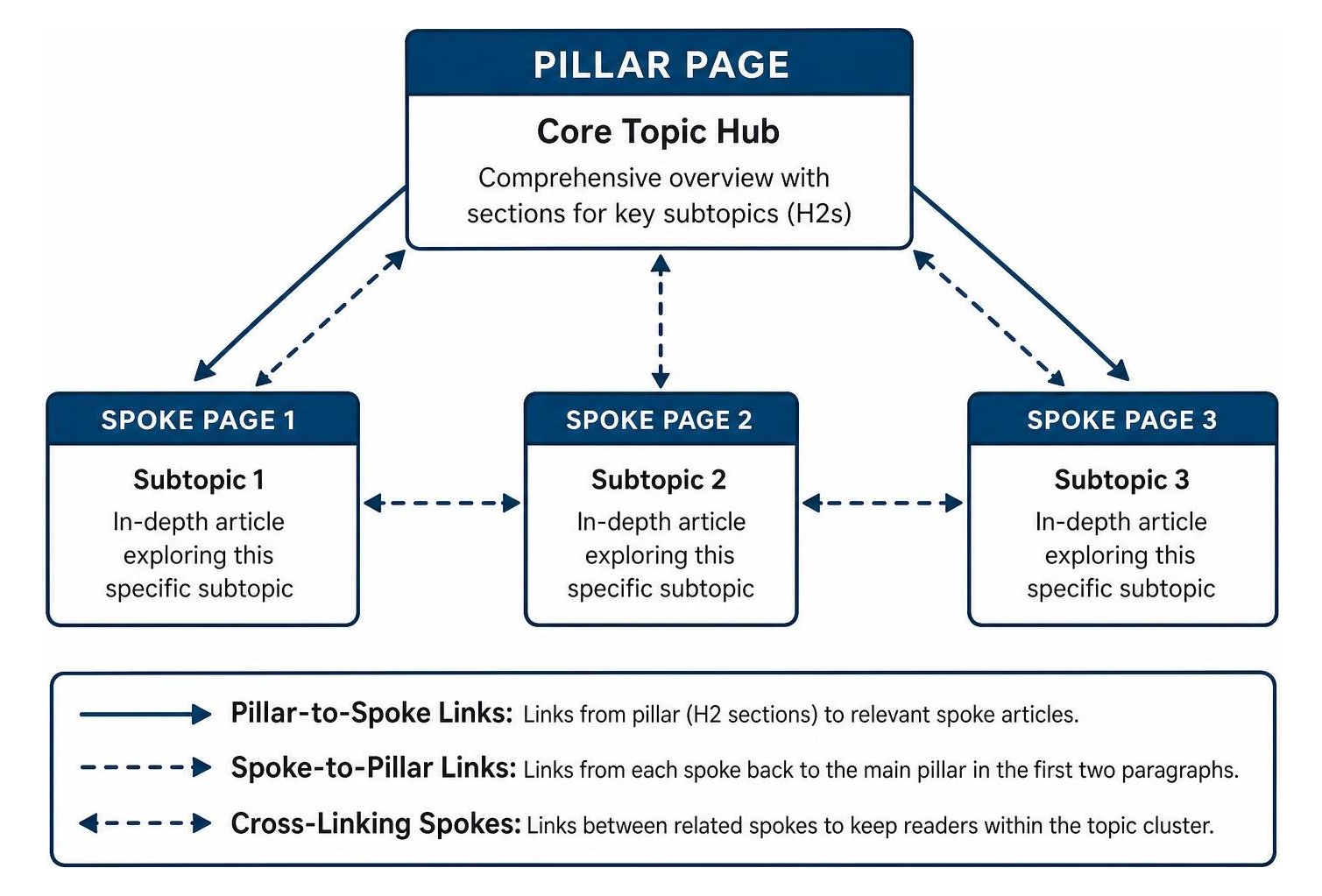
- Pillar-to-Spoke Links: Within each H2 section on your pillar, include a contextual link pointing down to the corresponding cluster article using descriptive anchor text.
- Spoke-to-Pillar Links: Every supporting article must link back up to the main pillar within its first two paragraphs. This passes contextual relevance directly to the hub.
- Cross-Linking Spokes: When two subtopics naturally complement one another, link them laterally. This keeps readers inside your topical ecosystem without diluting hub authority.
Avoiding Critical Mistakes, Maintenance, and Performance Tracking
Even well-researched content hubs can falter if technical and strategic errors go unaddressed. A pillar is not a one-time publishing task; it is an active knowledge asset that requires regular oversight.

Common Pitfalls That Derail Content Hub Performance
Avoid these common missteps when executing your content strategy:
- Gating Pillar Content: Never place your main pillar page behind a lead form, paywall, or login prompt. Search bots and AI crawlers must have unrestricted access to crawl and index the text.
- Treating Pillars as Mere Link Dumps: A pillar page that offers nothing more than a list of external links fails to demonstrate real expertise. Your hub must provide standalone educational value.
- Publishing Thin Clusters: Releasing two-paragraph articles as supporting spokes adds little value. Every cluster piece should serve as a comprehensive answer to its specific long-tail query.
- Premature Launching: Launching a pillar without any supporting articles leaves your hub unsupported. Aim to publish your pillar alongside at least 4 to 6 core cluster articles, expanding the rest over time.
- Keyword Stuffing: Cramming repetitive keywords into H2 tags disrupts readability and signals low quality to search engines. Focus on natural semantic variations and synonyms.
Measuring and Maintaining Your Pillar Page Strategy Over Time
To gauge the true ROI of your topic cluster, track performance beyond basic keyword rankings:
- Total Cluster Traffic: Monitor the aggregate organic traffic across the pillar and all connected spoke articles.
- Assisted Conversions: Measure how often visits to cluster articles lead to phone calls, consultation forms, or demo requests. Utilizing boost conversions and sales with data-driven web analytics services allows you to track these user touchpoints across the entire customer journey.
- AI Citations and Snippet Wins: Monitor whether your structured definitions appear in Google AI Overviews and conversational answer engines.
- Maintenance Cadence: Schedule quarterly reviews to refresh outdated statistics, update internal links, and add new sections addressing emerging industry developments.
Frequently Asked Questions About Topic Clusters and Pillars
How long should an effective pillar page be?
Most high-performing pillar pages range between 2,500 and 4,000 words. However, depth and clarity matter far more than an arbitrary word count. Your pillar should be comprehensive enough to cover all major facets of a core topic without diving so deep into granular details that it makes supporting cluster articles redundant.
How many cluster articles are needed per pillar?
A minimum viable cluster generally requires 8 to 12 supporting articles. For competitive industries, comprehensive content hubs often grow to 20 to 30+ interconnected articles. Focus on quality and search intent first; expand your cluster as new customer questions and subtopics emerge.
How often should pillar pages be updated?
We recommend a quarterly review and at least two comprehensive updates per year. Search algorithms favor fresh, accurate information. Use these maintenance updates to replace outdated statistics, fix broken links, embed new multimedia, and link out to recently published cluster articles.
Conclusion
A well-executed content architecture establishes topical authority, enhances user experience, and positions your business as the definitive source for both search engines and AI answer engines. Organizing scattered blog posts into structured hubs drives steady traffic, improves search rankings, and generates qualified leads.
At BullsEye Internet Marketing, we help businesses build and execute search strategies that drive measurable revenue. We operate with a strict no long-term contracts policy and partner with only one client per industry per geographic market, giving your business a distinct competitive advantage.
Whether you need advanced search optimization, pay-per-lead solutions, or a tailored answer engine optimization and generative search strategy, our team is ready to help you dominate your market. Contact BullsEye Internet Marketing today to transform your online presence.
