
Why Most Law Firms Are Losing Clients Before the Phone Even Rings
Internet marketing for lawyers is the practice of using digital channels — SEO, paid ads, social media, and content — to attract and convert prospective clients online.
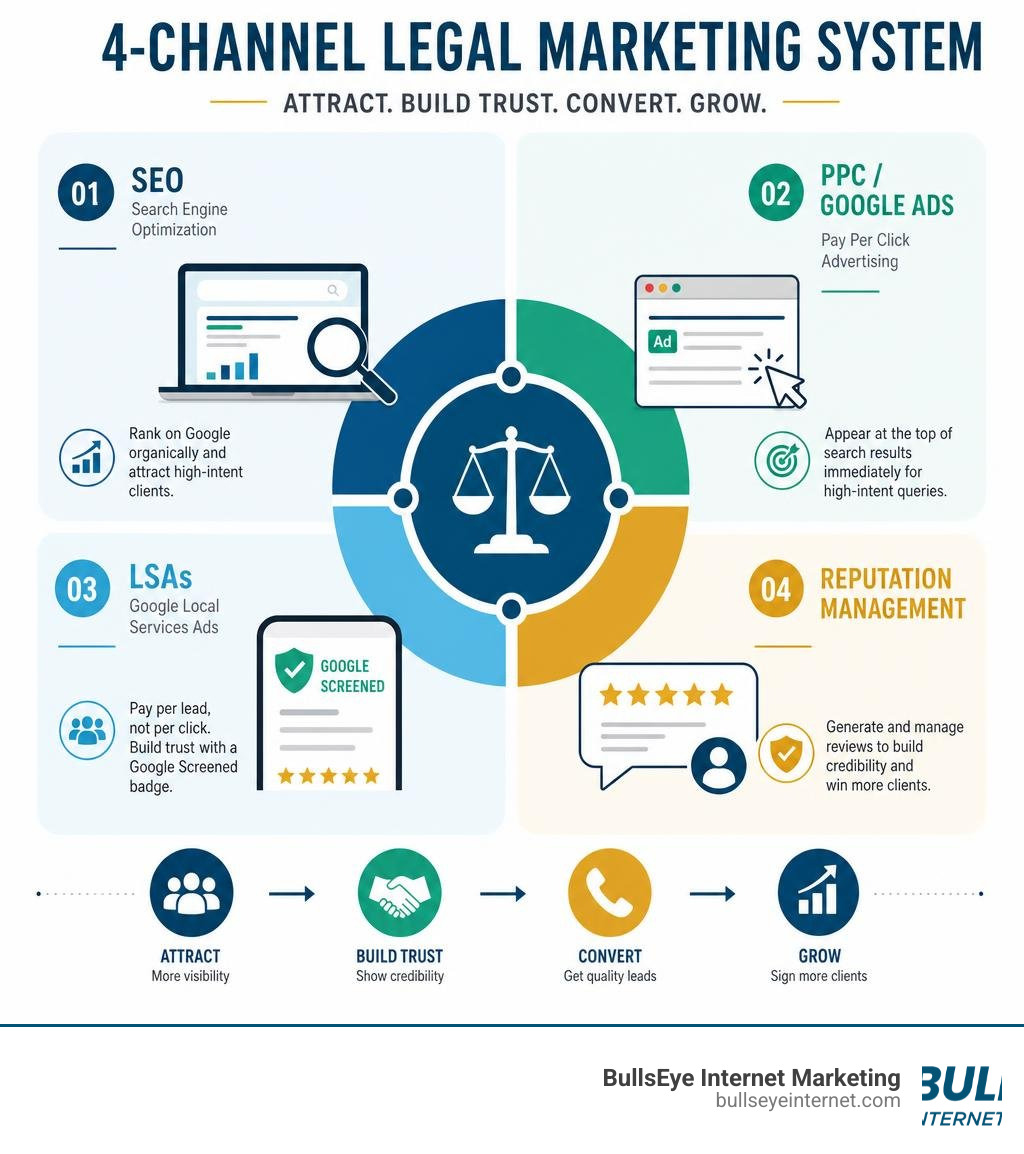
Here is a quick breakdown of what it covers:
- SEO — Rank on Google so clients find you organically when they search for legal help
- PPC / Google Ads — Pay to appear at the top of search results immediately for high-intent queries
- Google Local Services Ads (LSAs) — Pay per lead, not per click, with a trust-building “Google Screened” badge
- Content marketing — Build authority and answer client questions through blogs, guides, and video
- Reputation management — Generate and manage reviews on Google and legal directories like Avvo and Justia
- Email marketing — Nurture leads and stay top-of-mind with past and prospective clients
There are over 1.3 million licensed attorneys in the United States. Every one of them is competing for the same clients. And those clients are not asking friends for referrals the way they used to.
Today, 96% of people seeking legal advice use a search engine at some point in their journey. Another 37% find their attorney directly through an online search. That means if your firm is not showing up on Google, you are invisible to a huge share of the market — no matter how good your reputation is.
The hard truth? Many law firms are still running on referrals alone. That worked in 2005. In 2026, it is a single point of failure.
And even firms that are investing in digital marketing often struggle. High cost-per-click rates, poor-quality leads, agencies that report on traffic instead of signed cases — it adds up to frustration and wasted budget.
This guide cuts through the noise. We cover what actually works: the right channels, realistic budgets, ROI benchmarks, and the compliance rules you cannot afford to ignore.
I’m Ronnie Katz, founder and Principal CEO of BullsEye Internet Marketing, and I have spent over 20 years helping law firms master internet marketing for lawyers — from local SEO and pay-per-lead campaigns to Google Ads and reputation management. In this guide, I will share exactly what the fastest-growing firms are doing differently so you can build a predictable, scalable client pipeline.
Relevant articles related to Internet Marketing for Lawyers:
Why Internet Marketing for Lawyers Is Essential in 2026
The legal landscape has shifted permanently. While word-of-mouth and traditional referrals will always have a place in the legal industry, they are no longer enough to scale a modern firm. The primary driver of this shift is how consumers search for help when they are in trouble. When someone is injured in a car accident in West Palm Beach or facing a complex divorce in Fort Lauderdale, they do not wait for a friend to recommend a lawyer. They open their phone and type their problem directly into Google.
By relying purely on traditional referrals, you limit your growth to your immediate network. Digital marketing democratizes client acquisition, allowing your firm to capture highly motivated clients at the exact moment they need your services.
To explore how the market has moved beyond offline tactics, read our detailed analysis on Beyond Word of Mouth Modern Marketing for Legal Services.
The Limitations of Relying Solely on Word-of-Mouth Referrals
Relying entirely on word-of-mouth creates a single point of failure. If your top three referral sources stop sending cases next month, how long can your firm sustain its current revenue? For most firms, the answer is 30 to 60 days before a severe revenue crisis hits.
Furthermore, modern client behavior has evolved. Even when a prospective client is referred to you by a trusted colleague, they do not call you blindly. They validate that referral online first. They will search for your name on Google, read your Google Business Profile reviews, and inspect your website. If your digital presence is outdated, slow, or lacking social proof, that referred client will quietly move on to a competitor.
For a deeper look at establishing this baseline, check out the Foundations of Digital Marketing for Attorneys: A Comprehensive Guide.
Understanding the Modern Legal Client’s Search Journey
Over 60% of all online searches in the United States are conducted on mobile devices. When a legal emergency happens, the search journey is rapid and highly intent-driven. Legal search queries generally fall into three distinct intent tiers:
- Tier 1: High Intent (Commercial) — “car accident lawyer near me” or “DUI attorney in Miami”. These searchers have an immediate need and are ready to hire.
- Tier 2: Moderate Intent (Investigative) — “how to file for divorce in Broward County” or “what is the statute of limitations for personal injury in Florida”. These users are researching their options and need educational content.
- Tier 3: Low Intent (Informational) — General legal definitions or theoretical questions.
To turn these searchers into paying clients, you must align your digital presence with their specific search intent. If you want to learn how to capture these users systematically, check out our guide on How to Build a Client Acquisition Machine for Your Law Practice.
The Economics of Legal Marketing: Budgets, CPA, and ROI
Before spending a single dollar on internet marketing for lawyers, you must understand the underlying math. Legal advertising is highly competitive, meaning arbitrary spending is a quick path to wasted capital. You need to treat your marketing budget as an actively managed investment, tracking your cost per lead (CPL), cost per acquisition (CPA), and overall return on investment (ROI).

How Much Should a Law Firm Spend on Internet Marketing for Lawyers?
Your marketing budget should scale based on your local market competition and growth goals. As a general rule:
- Low-Competition Areas / Niche Practices: Firms in non-competitive geographic regions or highly specialized fields should allocate roughly 3% of their gross revenue to marketing.
- High-Competition Markets (e.g., South Florida Personal Injury): Firms operating in competitive metro areas like Miami, Fort Lauderdale, or West Palm Beach often need to invest 8% to 10% (or more) of their revenue to capture market share.
For predictable cash flow, many firms partner with agencies that offer transparent, flat-rate pricing models rather than percentage-of-spend models that incentivize agencies to spend more of your money. To understand how to structure your overall business development budget, read How to Market a Law Practice Like a Pro.
Benchmarking Cost Per Acquisition (CPA) and Return on Investment
A standard acceptable benchmark for law firm marketing spend is a 5:1 revenue-to-cost ratio. This means that for every $1,000 you invest in marketing, you should generate $5,000 in gross fee revenue. Your cost per signed case (CPA) must always remain safely below the average lifetime value of that case type.
For example, a personal injury firm in Broward County bidding on highly competitive keywords might pay $150 to $300 per click on Google Ads, resulting in a CPA of $3,000 to $8,000 for a signed auto accident case. However, if the average settlement value of that case is $50,000, the math works beautifully. Conversely, an estate planning firm with an average case value of $3,000 cannot afford a $2,000 CPA; they must rely on lower-cost acquisition channels like local SEO.
Organic Search vs. Paid Advertising: Choosing the Right Channels
To maximize your search engine real estate, the most successful firms use a dual-listing strategy. This means appearing in both the paid ad sections and the organic search results on page one of Google. However, SEO and PPC function differently and serve distinct strategic purposes.
| Metric / Feature | Search Engine Optimization (SEO) | Pay-Per-Click (PPC) / Google Ads |
|---|---|---|
| Time to Results | 3 to 12 months | Instant (within days of launch) |
| Cost Structure | Flat monthly investment; cost per lead decreases over time | Pay per click; costs remain static or rise with competition |
| Lead Quality | Extremely high; organic listings build long-term trust | High; targets immediate transactional intent |
| Long-Term Value | High; assets continue to rank even if you pause spending | Zero; traffic stops the moment you turn off the budget |
Search Engine Optimization (SEO) for Long-Term Authority
SEO is the ultimate long-term growth engine for law firms. While it takes time to build domain authority, a mature SEO program can deliver highly qualified leads for $50 to $100 each. Unlike paid advertising, where your cost per lead remains flat, the ROI of SEO compounds over time. As your website ranks higher for valuable search terms, your search volume increases while your monthly marketing cost remains flat, continuously lowering your client acquisition costs.
To dominate local search, your strategy must focus on optimizing your Google Business Profile, building local citations, and creating comprehensive, localized practice area pages. For a complete blueprint, read our Step-by-Step Guide to Local Attorney SEO.
Pay-Per-Click (PPC) and Google Ads for Immediate Leads
If your firm needs cases immediately, Google Ads is the fastest channel to generate leads. Because legal keywords are among the most expensive in the world, your campaigns must be structured with laser precision.
Avoid broad match keywords, which allow Google to display your ads for irrelevant searches like “free legal advice”. Instead, launch with phrase and exact match keywords, and build a robust list of negative keywords (e.g., “pro bono”, “jobs”, “salary”) to filter out non-converting traffic. Additionally, set up precise ad scheduling. For instance, criminal defense campaigns often see their highest-quality leads between 10 PM and 6 AM on weekends, requiring specific bid adjustments for those hours.
To avoid costly mistakes and set up your campaigns for profitability, check out our Lawyer PPC Advertising Ultimate Guide.
Google Local Services Ads (LSAs) and the Google Screened Badge
Google Local Services Ads (LSAs) appear at the absolute top of the search results page, even above standard Google Ads. LSAs operate on a pay-per-lead model rather than pay-per-click, meaning you only pay when a prospect calls or texts your firm directly through the ad.
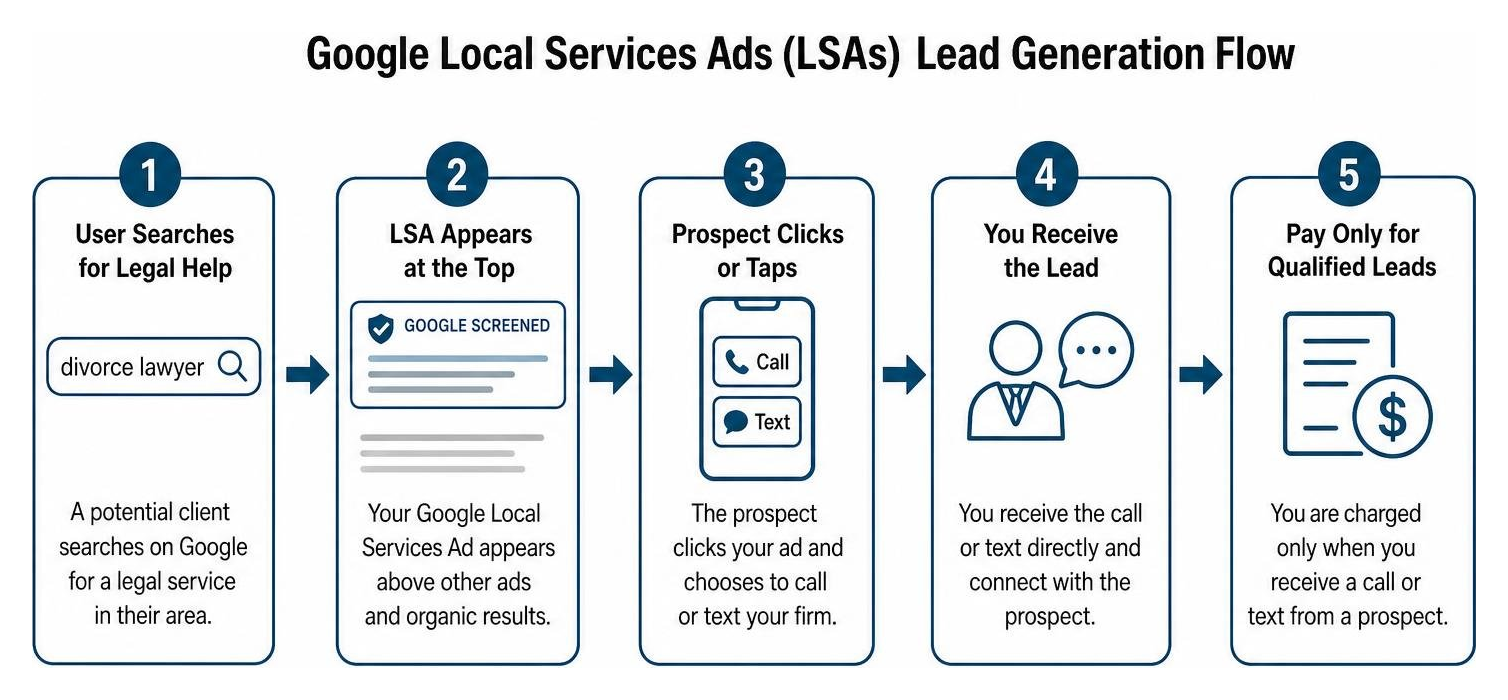
To run LSAs, attorneys must pass Google’s rigorous background and license verification checks to earn the “Google Screened” badge. This badge creates an immediate trust barrier that many of your competitors fail to clear. Law firms displaying the Google Screened badge routinely experience 30% to 50% higher click-through rates compared to standard search ads.
To learn how to maximize your visibility in this space, read our dedicated guide on Google Local Services Ads for Lawyers.
Building a High-Converting, Compliant Law Firm Website
Your website is the digital front door of your law practice. You can run the most sophisticated SEO and PPC campaigns in the world, but if your website is slow, confusing, or hard to navigate on a mobile phone, those paid visitors will bounce immediately.
Core Elements of an Effective Legal Website
To convert casual visitors into signed clients, your website must be built for both speed and trust. Key technical and design requirements include:
- Rapid Page Speed: Your site must load in under 2.5 seconds on mobile devices. Every second of delay past that mark reduces your conversion rates by up to 20%.
- Mobile Responsiveness: Over 60% of your traffic is on mobile. Text must be easy to read, and click-to-call buttons must be prominent and easily accessible.
- Immediate Trust Signals: Humanize your firm by showcasing professional photos of your attorneys, real client reviews, and prominent badges of your awards or professional associations.
- Live Chat Integration: Implementing a managed live chat or chatbot on your landing pages can increase your total web lead volume by 15% to 30% by giving anxious prospects an immediate way to connect.
To stay updated on the latest industry standards for design and technology, review the 2023 Websites & Marketing TechReport.
Navigating State Bar Ethics and Compliance in Internet Marketing for Lawyers
Attorney advertising is subject to strict ethical oversight. When executing internet marketing for lawyers, you must ensure your website and promotional materials comply with your state’s bar association rules (such as the strict guidelines set by the Florida Bar). Key compliance rules include:
- No Misleading Claims: Never guarantee specific case outcomes or create unjustified expectations.
- Clear Disclaimers: Include required state-specific disclaimers, such as “prior results do not guarantee a similar outcome,” prominently on your website.
- Prohibited Terminology: Avoid calling yourself an “expert” or “specialist” unless you hold a formal board certification in that practice area.
- Record Retention: Many state bars require you to retain copies of all digital advertisements and landing pages for 2 to 3 years.
To ensure your campaigns remain fully compliant, read our guide on Lawyer Advertising Rules Solutions for Modern Firms.
Frequently Asked Questions About Law Firm Marketing
How long does it take to see results from law firm SEO versus PPC?
PPC and Google Ads can start generating calls and leads within days of launching your campaign. However, you pay for every single click, and the leads stop the moment your budget runs out.
SEO is a long-term play. Most law firms begin seeing noticeable improvements in organic search rankings and traffic within 3 to 6 months, with consistent, compounding lead generation starting between months 6 and 12. Although SEO requires patience, it provides a much lower cost per lead over time.
For a deeper dive into balancing these two timelines, consult our Digital Marketing for Law Complete Guide.
Should our law firm handle marketing in-house or hire an agency?
Handling digital marketing in-house only makes sense if you have a dedicated internal marketing team or several free hours a week to manage keyword lists, write content, and optimize your website. For most busy attorneys, trying to manage marketing in-house leads to poor campaign performance and takes valuable time away from practicing law.
Hiring a specialized agency allows you to leverage expert knowledge, advanced tracking software, and proven strategies. When choosing an agency, look for partners who offer geographic exclusivity (so they aren’t marketing for your direct competitors in the same city) and transparent contract terms.
To evaluate top-rated regional partners, read our Detailed Reviews of the Top 10 Law Firm Marketing Agencies Miami.
How do online reviews and legal directories impact our rankings?
Online reviews are a primary ranking factor for Google’s local map pack. Consistently gathering authentic, positive Google reviews signals to search engines that your firm is active, trustworthy, and authoritative.
Furthermore, listing your firm in high-authority legal directories like Avvo, Justia, and FindLaw builds high-quality backlinks to your website, which boosts your overall domain authority. These directories also rank highly in organic search results, giving your firm additional opportunities to be found by prospective clients.
To learn how to structure an ethical review collection system, read How to Increase Your Law Firms Online Presence with Local SEO.
Scaling Your Law Firm with BullsEye Internet Marketing
Building a profitable, sustainable client acquisition system requires a strategic combination of immediate paid channels and long-term organic authority. By understanding your acquisition math, building a lightning-fast, compliant website, and optimizing your local search presence, you can scale your practice past the limitations of traditional word-of-mouth referrals.

At BullsEye Internet Marketing, we help law firms across Florida and the United States stop chasing leads and start attracting high-value cases. Our unique approach gives you a distinct competitive advantage:
- No Long-Term Contracts: We earn your business month after month based on real, measurable results.
- Strict Geographic Exclusivity: We work with only one client per practice area in your specific geographic market. We will never market for your direct competitors.
- Multichannel Expertise: From local SEO and Google Business Profile optimization to high-converting PPC and Pay-Per-Lead campaigns, we build systems tailored to your firm’s exact goals.
Ready to claim your market and grow your practice? Let’s build your client acquisition machine.
Explore our custom ad programs today or contact our team to schedule your digital marketing consultation.
