
Is Your Link Profile Secretly Hurting Your Rankings?
A backlink profile audit is a systematic review of every external link pointing to your website — identifying which links help your rankings, which are neutral, and which could be actively dragging you down.
Here’s what a backlink profile audit covers, in plain terms:
- Collect all backlink data from Google Search Console, Ahrefs, and Semrush
- Evaluate referring domain quality using metrics like Domain Rating, Domain Authority, and organic traffic
- Flag toxic or spammy links from link farms, private blog networks, and hacked sites
- Analyze anchor text distribution to catch over-optimization before Google does
- Remove or disavow harmful links through outreach or Google’s Disavow tool
- Find link-building opportunities by comparing your profile against competitors
Here’s a sobering fact: 95% of all web pages have zero backlinks. If your site has links coming in, you already have an advantage — but only if those links are working for you, not against you.
The problem is, most business owners have no idea what their link profile actually looks like. They spend time and money building new links while a handful of toxic ones quietly suppress their rankings. Google’s SpamBrain system has become far more precise at detecting manipulative link patterns — and it doesn’t always warn you before your rankings drop.
That’s why a regular backlink profile audit isn’t optional. It’s maintenance. Think of it like changing the oil in your car. Skip it long enough, and the damage compounds.
I’m Ronnie Katz, founder of BullsEye Internet Marketing, and with over 20 years in SEO and online marketing, I’ve conducted countless backlink profile audits for businesses across highly competitive industries — uncovering toxic links, reclaiming lost equity, and turning messy link profiles into ranking assets. In this guide, I’ll walk you through exactly how to do the same for your site.
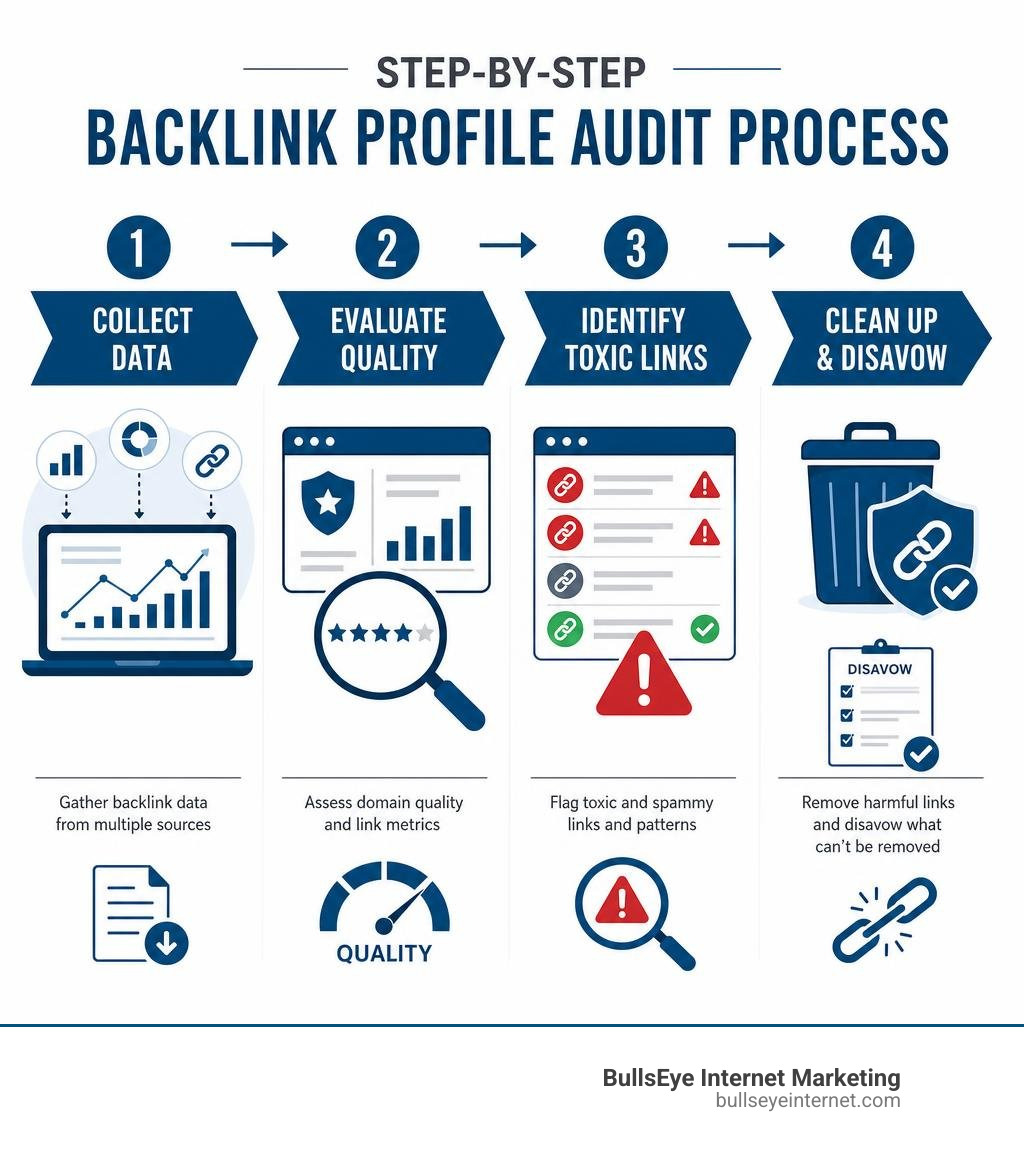
Backlink profile audit word guide:
What is a Backlink Profile Audit and Why It Matters
A backlink profile audit is the process of crawling, analyzing, and vetting every single inbound link pointing to your domain. In search engine optimization, links are the primary currency of trust. When a reputable external site links to your content, it passes what we call “link equity” (or “link juice”), signaling to search engine crawlers that your page is authoritative and trustworthy.
However, not all links are created equal. Just as a recommendation from an industry leader boosts your professional reputation, a recommendation from a shady, untrustworthy source can damage it. In the eyes of Google, low-quality, manipulative, or irrelevant links are major red flags.
Google’s search algorithms, powered by highly sophisticated machine learning systems like SpamBrain, are designed to detect unnatural link patterns instantly. If your site accumulates too many low-quality links, you risk facing algorithmic penalties or manual actions. An algorithmic penalty quietly suppresses your visibility, making your pages plummet in search engine rankings without any formal notification. A manual action, on the other hand, is a formal penalty issued by a human reviewer at Google, which can completely de-index your site until the toxic links are removed or disavowed.
Understanding What Your Backlink Profile Says About Your Business is crucial. A clean, diverse, and contextually relevant link profile tells search engines that you are a legitimate, authoritative player in your niche. Conversely, a profile cluttered with spammy directory links, forum comments, or paid links from private blog networks (PBNs) signals manipulation.
By conducting a regular audit, you protect your hard-earned organic traffic, maintain your search engine rankings, and ensure you are maximizing The Role of High-Quality Backlinks in Modern SEO. High-quality links act as digital votes of confidence. To keep your competitive edge in 2026, you must ensure your voting record is clean.
Step-by-Step Guide to Auditing Your Link Profile
Auditing your link profile requires a structured approach. You cannot simply look at a single metric and decide if your profile is healthy. To get an accurate assessment, we look at five core dimensions:
- Referring domain quality and authority
- Link velocity (the speed at which you gain or lose links)
- Anchor text distribution and optimization
- Link placement and contextual relevance
- Competitive link gaps
Let’s break down the exact step-by-step workflow to execute a comprehensive backlink profile audit from scratch.
Step 1: Consolidating Data for Your Backlink Profile Audit
No single SEO tool has a complete map of the entire internet. While Ahrefs boasts a massive index of 35 trillion external links (updated every 15 minutes) and Semrush tracks over 43 trillion links as of early 2026, they each have blind spots. To get the most accurate and complete picture of your link profile, you must extract and consolidate data from multiple sources.
We recommend pulling data from three primary tools:
- Google Search Console (GSC): This is the most important source because it shows the exact links Google’s own crawlers have indexed and are associating with your site. It is entirely free, though extracting the data can be labor-intensive.
- Ahrefs: Excellent for real-time link detection and deep organic traffic estimates for linking domains. You can use Ahrefs Webmaster Tools for basic free access or their paid plans starting at €27/mo for starter packages.
- Semrush: Highly valuable for its built-in Backlink Audit tool, which automatically flags toxicity markers.
How to consolidate your data:
- Log into Google Search Console, navigate to the “Links” section, and download your external links table as a CSV or Google Sheet.
- Export your full backlink profile from Ahrefs and Semrush.
- Open a master spreadsheet and paste all the exported data into a single sheet.
- Use the “Remove Duplicates” function in Excel or Google Sheets, filtering by the “Source URL” column. This deduplication process ensures you aren’t wasting time analyzing the same link multiple times.
For a deeper look into this initial data gathering stage, you can refer to this How to Audit Your Backlink Profile: Complete Step-by-Step Guide .
Step 2: Evaluating Referring Domain Quality and Metrics
Once your master spreadsheet is ready, it is time to evaluate your referring domains. A referring domain is the actual root website linking to you (e.g., forbes.com is the referring domain for a link from forbes.com/article). Referring domain diversity matters much more than total backlink count; having 1,000 links from 10 domains is far weaker than having 1,000 links from 500 distinct, high-quality domains.
When assessing referring domain quality, look at a combination of quantitative metrics:
- Domain Rating (DR) / Domain Authority (DA): Logarithmic scores from 0 to 100 that estimate a site’s backlink strength.
- Trust Flow (TF): A metric from Majestic (available on paid plans or limited free accounts) that measures how close a site is to trusted, seed-level websites.
- Organic Traffic: This is the ultimate truth detector. If a site has a DR of 70 but receives zero organic traffic from Google, it is highly likely a link farm or a site that has been hit by a penalty. Genuine sites have real search traffic.
Use the following benchmarks to categorize your referring domains:
| Domain Quality Tier | Metric Benchmarks (DR/DA) | Organic Traffic Benchmark | Target Profile Distribution |
|---|---|---|---|
| High Quality | 40 – 100 | 1,000+ monthly visits | 10% – 20% |
| Medium Quality | 20 – 39 | 200 – 999 monthly visits | 40% – 50% |
| Low Quality (Safe) | 1 – 19 | 1 – 199 monthly visits (or new niche sites) | 30% – 40% |
| Potentially Toxic | 0 – 10 | Near-zero or zero traffic | Under 5% |
Note: Do not panic if you have many low-DR links. A brand-new blog in Broward County or Palm Beach County might only have a DR of 12, but if its content is highly relevant to your local South Florida business and it has real local traffic, that link is incredibly valuable.
Step 3: Identifying Toxic Links and Red Flags
Identifying toxic backlinks is the most critical defensive part of your backlink profile audit. Toxic links are links designed to manipulate search engine rankings, often violating Google’s Webmaster Guidelines.
To spot these bad links, look for the following warning signs:
- Link Farms and PBNs: Sites that exist solely to sell links. They typically cover dozens of completely unrelated topics (e.g., “Best Plumbing Tips” right next to “How to Buy Crypto”).
- Hacked or Compromised Sites: Legitimate websites that have been injected with spammy outbound links by malicious actors.
- Spammy Directories: Automated directories with no editorial oversight or human curation.
- High Spam Scores: Automated metrics (like Semrush’s toxicity score above 75) that indicate a high probability of manipulative behavior.
- Foreign Language Spikes: If you run a local business in West Palm Beach or Miami, and you suddenly receive hundreds of Russian, Chinese, or Turkish links, you are likely the target of a negative SEO attack.
To streamline this process, you can cross-reference your flagged domains with the automated lists generated by modern SEO tools, as detailed in this How to Do a Backlink Audit in 30 Minutes (Step-by-Step Guide) – BetterLinks . However, always perform a manual spot check before taking action. Automated tools are only about 70% reliable and frequently flag perfectly safe, highly relevant local links as toxic.
Step 4: Analyzing Anchor Text and Link Placement
Your anchor text is the clickable, visible text in a hyperlink. It tells search engines exactly what the destination page is about. However, over-optimizing your anchor text is one of the fastest ways to trigger an algorithmic filter.
A healthy, natural anchor text distribution looks like this:
- Branded Anchors (40% – 60%): Your business name (e.g., “BullsEye Internet Marketing”).
- Naked URLs (20% – 30%): Your raw domain or page URL (e.g.,
bullseyeinternet.com). - Generic Anchors (10% – 15%): Phrases like “click here”, “website”, or “read more”.
- Partial Match / Topical (10% – 15%): Natural variations of your keywords (e.g., “South Florida SEO agency”).
- Exact Match (1% – 5%): The exact keyword you want to rank for (e.g., “backlink profile audit”). If your exact match anchor percentage climbs above 10%, search engines will suspect manual manipulation.
Beyond anchor text, evaluate link placement and context. Where is the link located on the page?
- In-Content / Editorial Links: Links naturally integrated within the body text of a high-quality article. These carry the highest weight. We want at least 60% of our links to fall into this category.
- Footer, Sidebar, and Header Links: Links placed in global site navigation elements. These are often viewed as template-based, low-value, or paid links.
- Link Velocity: Monitor your link growth timeline. A steady, upward curve in referring domains is a sign of natural, authoritative growth. A sudden, massive spike of hundreds of links in a single day—unrelated to a major PR event—usually points to a negative SEO attack or a low-quality link building campaign.
Actioning the Audit: Disavow vs. Manual Outreach
Once you have identified your toxic, manipulative, or unnatural links, you must clean them up. You have two primary methods for doing this: manual outreach for link removal, or submitting a disavow file via Google Search Console.
Executing a Safe Backlink Profile Audit Cleanup
Before rushing to use Google’s Disavow tool, it is a powerful and potentially dangerous instrument. Disavowing links that are actually helping your site can cause your rankings to drop overnight.
The Golden Rule of Disavowing: Only disavow links if you have a manual action against your site, or if you have a massive influx of highly toxic, spammy links (such as a negative SEO attack) and Google’s algorithms are clearly struggling to filter them out. If you are just dealing with standard, low-quality web scrapers, Google’s algorithms are smart enough to simply ignore them without passing any negative signals.
Step 1: Attempt Manual Outreach The cleanest way to handle bad links is to get them removed entirely.
- Find the contact information or “About Us” page of the linking website.
- Send a polite email requesting the webmaster to remove the link or change it to a
nofollowattribute. - Keep expectations realistic; typical response rates for manual link removal outreach are between 1% and 5%.
- Document all your outreach attempts in a spreadsheet. If you ever need to appeal a manual action, Google will want to see proof that you tried to remove the links manually first.
To ensure you aren’t investing your marketing dollars into shady link schemes that require this kind of cleanup in the first place, read our guide on Don’t Waste Budget: Link Building Services to Avoid in 2025.
Step 2: Create and Upload a Disavow File If manual outreach fails, or if you are dealing with hundreds of spam domains, you must compile a disavow file.
- Create a plain text file (
.txt) encoded in UTF-8. - Format the file with one domain or URL per line. We highly recommend disavowing at the domain level rather than individual page URLs to ensure you block all future spam from that source.
- Format domain-level entries like this:
domain:spammywebsite.com - Format page-level entries like this:
https://spammywebsite.com/spam-page.html - Go to the Google Search Console Disavow Tool, select your property, and upload the
.txtfile.
Competitor Gap Analysis and Link Reclamation
A great backlink profile audit doesn’t just look for bad links; it actively uncovers massive opportunities. By analyzing the backlink profiles of your top three to five organic competitors, you can run a competitor gap analysis to find high-value link-building opportunities.
- Identify competitors ranking in the top positions for your target keywords.
- Run their domains through your SEO tool’s Link Gap analysis feature.
- Look for “easy wins”: domains that link to multiple competitors but do not link to your site. If a high-authority local directory or industry blog links to three of your competitors in Broward County, they are highly likely to link to you as well if you reach out.
- Look for unlinked brand mentions. Search for your brand name or unique product names online. If an editor mentioned your business but forgot to include a link, a quick, friendly email is often all it takes to turn that mention into a high-value backlink.
- Investigate lost links. If you previously had a high-authority backlink that recently broke or was removed during a competitor’s site redesign, reach out to reclaim it.
To build a sustainable, high-authority link acquisition strategy moving forward, explore our comprehensive guide on Link Building.
Common Mistakes to Avoid During a Link Audit

Even experienced SEOs can make critical mistakes during a backlink audit. To protect your site’s search visibility, avoid these common pitfalls:
- Over-Disavowing (Being Too Aggressive): Many site owners panic when they see low-DR links and immediately disavow them. A natural link profile should have a long tail of low-authority, small, or new blogs. Removing these legitimate but low-power links strips away natural link diversity and can cause your search engine rankings to drop.
- Relying Exclusively on a Single Authority Metric: Domain Rating (DR) and Domain Authority (DA) are proprietary, third-party metrics. They are not used by Google. A site with a DR of 80 that has been hacked or turned into a link farm is toxic, while a DR 15 local blog with real, highly engaged local traffic is pure gold. Always evaluate organic traffic and contextual relevance alongside authority scores.
- Ignoring Link Context: Do not rely purely on automated spam scores. An automated tool might flag a link from a food blog to a software product as “irrelevant” and therefore “toxic.” However, if that software is a specialized restaurant POS system and the blog post is a real review written by a local chef, the link is contextually perfect and highly valuable.
- Failing to Document the Process: If your site is ever hit with a manual action, Google will require a detailed documentation of your cleanup efforts before lifting the penalty. Keep a clear log of all evaluated domains, outreach emails sent, and disavow dates.
- Treating the Audit as a One-Time Project: Link profiles drift over time. New scraper sites, directories, and negative SEO links accumulate constantly. A one-time audit only gives you a temporary snapshot.
Frequently Asked Questions About Backlink Audits
How often should I perform a backlink profile audit?
The ideal audit frequency depends entirely on your link-building activity and search landscape competitiveness:
- Active Campaigns: If you are actively building links or operate in a highly competitive niche (such as local lead generation in Miami or Fort Lauderdale), we recommend a monthly quick check of new referring domains and a quarterly deep-dive audit.
- Maintenance Mode: For established sites in less volatile industries, a biannual or annual deep audit is sufficient to keep your profile clean.
- Algorithm Updates / Ranking Drops: You should immediately run an audit if you experience a sudden drop in rankings or right after a major Google Core Update rolls out.
Does Google automatically ignore toxic backlinks?
Yes, in most cases. With the integration of SpamBrain and advanced algorithmic filtering, Google has gotten incredibly good at identifying and simply ignoring low-quality, automated, or scraper-site links. These links generally pass zero PageRank, meaning they do not help you, but they also do not actively harm you.
However, Google does not ignore links if there is clear evidence of deliberate manipulation on your part—such as a history of buying paid links, participating in private blog networks, or being targeted by a sustained, malicious negative SEO attack. In those scenarios, manual intervention via the Disavow tool is still highly necessary.
How long does it take to see results after a link cleanup?
Typically, it takes two to six weeks to see the positive effects of a backlink cleanup. Google must recrawl the linking pages, process your uploaded disavow file, and recalculate your site’s link equity. If you are recovering from a formal manual action, the recovery timeline depends on how quickly Google reviews your reconsideration request, which can take anywhere from a few weeks to several months.
Conclusion
Conducting a thorough backlink profile audit is one of the most powerful ways to protect your digital asset, clean up toxic clutter, and uncover hidden ranking opportunities. However, analyzing tens of thousands of links, verifying domain quality, and safely executing disavow files requires deep technical expertise and a significant investment of time.
At BullsEye Internet Marketing, we specialize in high-impact SEO strategy and Pay Per Lead models designed to drive real calls and sales for businesses across South Florida—including Broward, Miami-Dade, Palm Beach, Martin, St. Lucie, and Indian River counties. Our unique competitive advantage is simple: we offer no long-term contracts and work with only one client per industry per geographic area. This means we focus 100% of our local search expertise on helping your business dominate the local landscape.
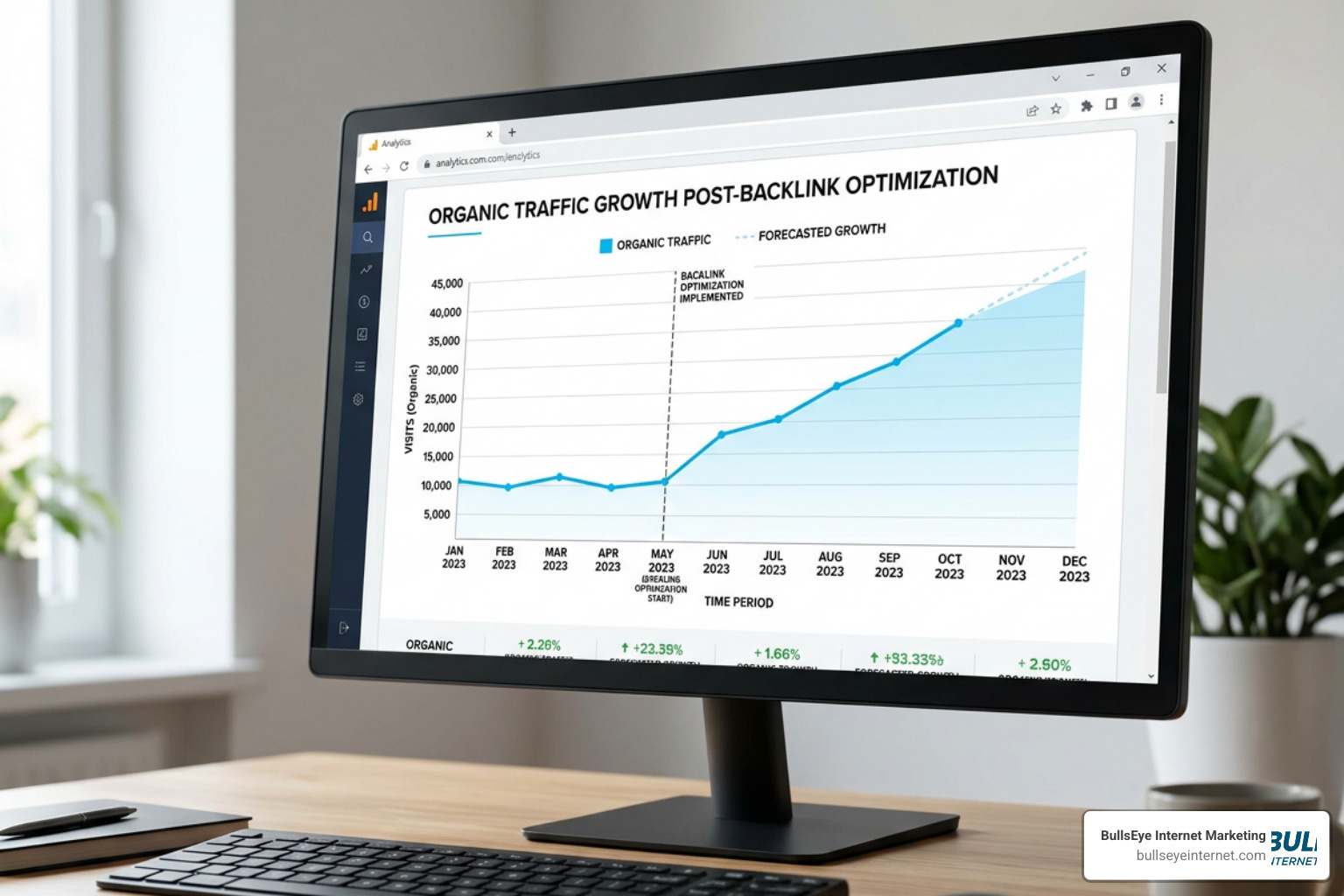
Ready to see what is really going on under the hood of your website? Get a complete, expert analysis of your site’s technical health, link equity, and search visibility by reading our SEO Audit Complete Guide.
If you want our team of local SEO experts to handle the heavy lifting for you, claim your exclusive spot in your geographic area today.
