Why Every Patient Search Is a Chance You Could Be Missing
SEO for medical practices is the process of optimizing your healthcare website — and your entire online presence — so that patients find you when they search for the care you provide.
Here is a quick breakdown of what it covers:
- Keyword research — targeting the terms patients actually type, like “knee pain specialist near me”
- Local SEO — ranking in Google’s map results so nearby patients choose your clinic
- Technical SEO — making your site fast, mobile-friendly, and secure
- Content strategy — creating condition and service pages that answer patient questions
- Reputation management — collecting and responding to reviews in a HIPAA-safe way
- E-E-A-T signals — proving your clinical credentials so Google trusts your content
The payoff is real. Google receives over 1 billion health-related queries every day, and 79% of patients search online before choosing a doctor. If your practice isn’t showing up, a competitor is getting those patients instead.
The stakes are higher in healthcare than in almost any other industry. Google holds medical content to a stricter standard because bad health information can genuinely harm people. That means the generic SEO tactics that work for a pizza shop or a plumber simply won’t cut it here. You need a strategy built specifically for the medical world — one that earns patient trust and search engine trust at the same time.
I’m Ronnie Katz, founder of BullsEye Internet Marketing, and since 2006 I’ve helped healthcare providers and competitive local businesses grow through smart, results-driven SEO for medical practices. In this guide, I’ll walk you through exactly what it takes to turn your website from an invisible brochure into your practice’s most powerful patient acquisition tool.
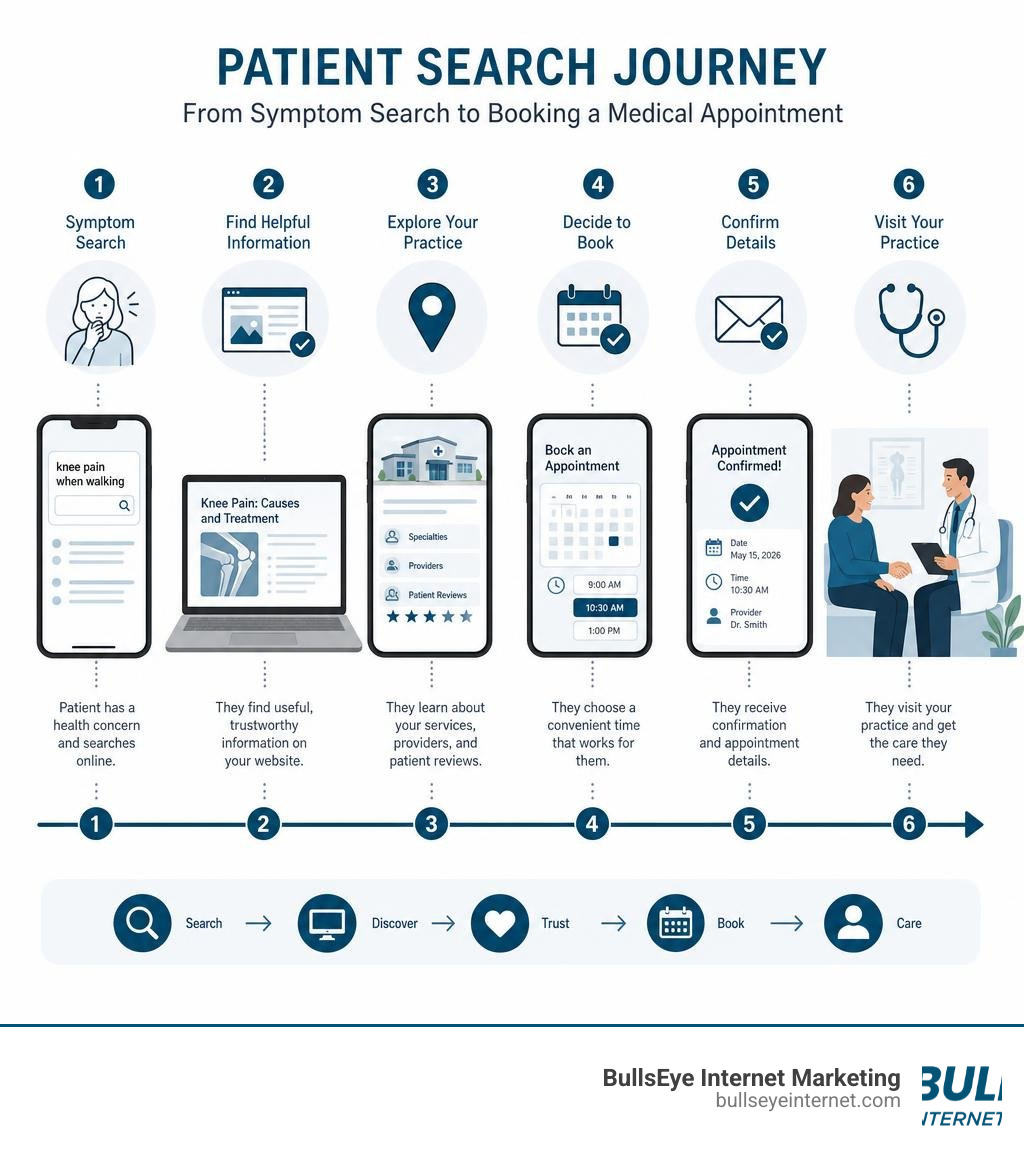
Simple guide to SEO for Medical Practices:
Why Healthcare Search is Different: YMYL and E-E-A-T
When Google evaluates a website about home decor or standard retail, the ranking standards are relatively straightforward. But when a user searches for symptoms of a heart condition, pediatric dosages, or surgical recovery times, Google treats those queries with the utmost caution. In the eyes of search engines, medical websites fall squarely under the category of YMYL (Your Money or Your Life).
Because inaccurate medical information can lead to severe real-world harm, Google employs highly sophisticated algorithms to filter out low-quality advice. To rank well, your website must demonstrate exceptional levels of E-E-A-T (Experience, Expertise, Authoritativeness, and Trustworthiness).
Meeting these standards requires a deliberate architectural approach. You cannot simply write a 300-word blog post about a complex condition and expect to rank. Google wants to see that your content is authored by credentialed medical professionals, backed by scientific consensus, and regularly updated.
Furthermore, you must balance these search engine requirements with strict regulatory laws. For practices in South Florida, maintaining absolute HIPAA compliance and patient privacy is non-negotiable. This means your tracking tools, contact forms, and review collection methods must protect Protected Health Information (PHI) at all times.
To understand how these pieces fit together under Google’s current guidelines, our localized guide on SEO for Medical Practices details how to build trust without crossing regulatory lines.
Why General Search Strategies Fail: The Unique Demands of SEO for Medical Practices
Many general digital marketing agencies treat a medical clinic like any other local business. They focus on high-volume keywords, write generic blog posts, and build backlinks from irrelevant websites. This approach is a recipe for failure in the healthcare space.
First, search intent in healthcare is highly nuanced. A patient searching for “urologist” has a very different intent than one searching for “why does my lower back hurt after urinating.” General SEO strategies often ignore these “symptom-class” queries, missing out on patients at the exact moment they are looking for a diagnosis.
Second, medical advertising is subject to strict ethical and legal restrictions. You cannot make unverified clinical claims or use sensationalized language that might fly in other industries. Your content must build clinical trust through objective, educational, and compassionate communication. To see how content marketing should be adapted for local medical audiences, explore our guide on Content Marketing for Local SEO.
Building Clinical Authority with Provider Bios and Schema
One of the most effective ways to prove your E-E-A-T to Google is by optimizing your provider bio pages and implementing advanced structured data. Google doesn’t just read the text on your page; it uses schema markup to understand the relationships between entities.
By implementing Physician schema and MedicalCondition schema, you tell search engines exactly who you are, what your specialties are, and what conditions you treat. Your provider bios should not just be a list of hobbies; they must clearly display:
- Board certifications and medical licenses
- Medical school education and residency details
- Hospital affiliations and professional memberships
- Links to official, authoritative profiles (such as your NPI registry or state medical board profile)
When Google can verify your credentials against trusted external databases, your website’s overall authority climbs, making it much easier to rank for competitive clinical terms.
The Core Pillars of SEO for Medical Practices
To build a healthy online presence, your strategy must rest on three stable pillars. If any of these pillars is weak, your entire patient acquisition engine can collapse.

- Technical Foundation: Ensuring search engines can crawl, index, and understand your website easily on any device.
- Content Authority: Creating in-depth, medically accurate pages that answer patient questions.
- Local Authority: Dominating your local geographic area so patients in your neighborhood choose you over a clinic miles away.
Technical SEO: Speed, Mobile Usability, and Security
Your technical foundation is the digital “infrastructure” of your practice. If your website takes five seconds to load, patients will click the “back” button and find another doctor. In fact, research shows that mobile devices contribute to over 60% of all healthcare-related searches, making mobile optimization critical.
To secure your technical foundation, we focus on several key areas:
- Core Web Vitals: Optimizing your site’s visual stability, interactivity, and loading performance.
- Mobile-First Design: Ensuring your navigation, font sizes, and patient intake forms are flawless on smartphones.
- HTTPS and Security: A secure SSL certificate is mandatory for any YMYL site, protecting patient data from the moment they land on your page.
- Crawlability: Submitting clean XML sitemaps and fixing broken internal links so Google’s bots can index your service pages without issues.
Content Strategy: Condition-Based vs. Service-Based Keywords
When conducting keyword research for your practice, it is easy to focus solely on service-based keywords like “cardiology clinic Miami” or “dermatologist Fort Lauderdale.” While these high-intent keywords are valuable, they are also highly competitive and represent only a fraction of patient searches.
To win, you must also target condition-based and symptom-class queries. Patients often search for their symptoms long before they know what service or procedure they need.
For example, a patient might search for “sharp pain in heel when waking up” before they ever search for “podiatrist for plantar fasciitis.” By creating dedicated, comprehensive pages that explain these symptoms, outline potential diagnoses, and discuss treatment options, you capture patients at the very beginning of their medical journey.
Dominating Local Search and Patient Acquisition
For physical medical clinics in South Florida—whether you are in Miami, Fort Lauderdale, Delray Beach, or Boynton Beach—local SEO is your single highest-leverage marketing channel. When patients need immediate medical care, they don’t look at national search results; they look at the Google Local 3-Pack.
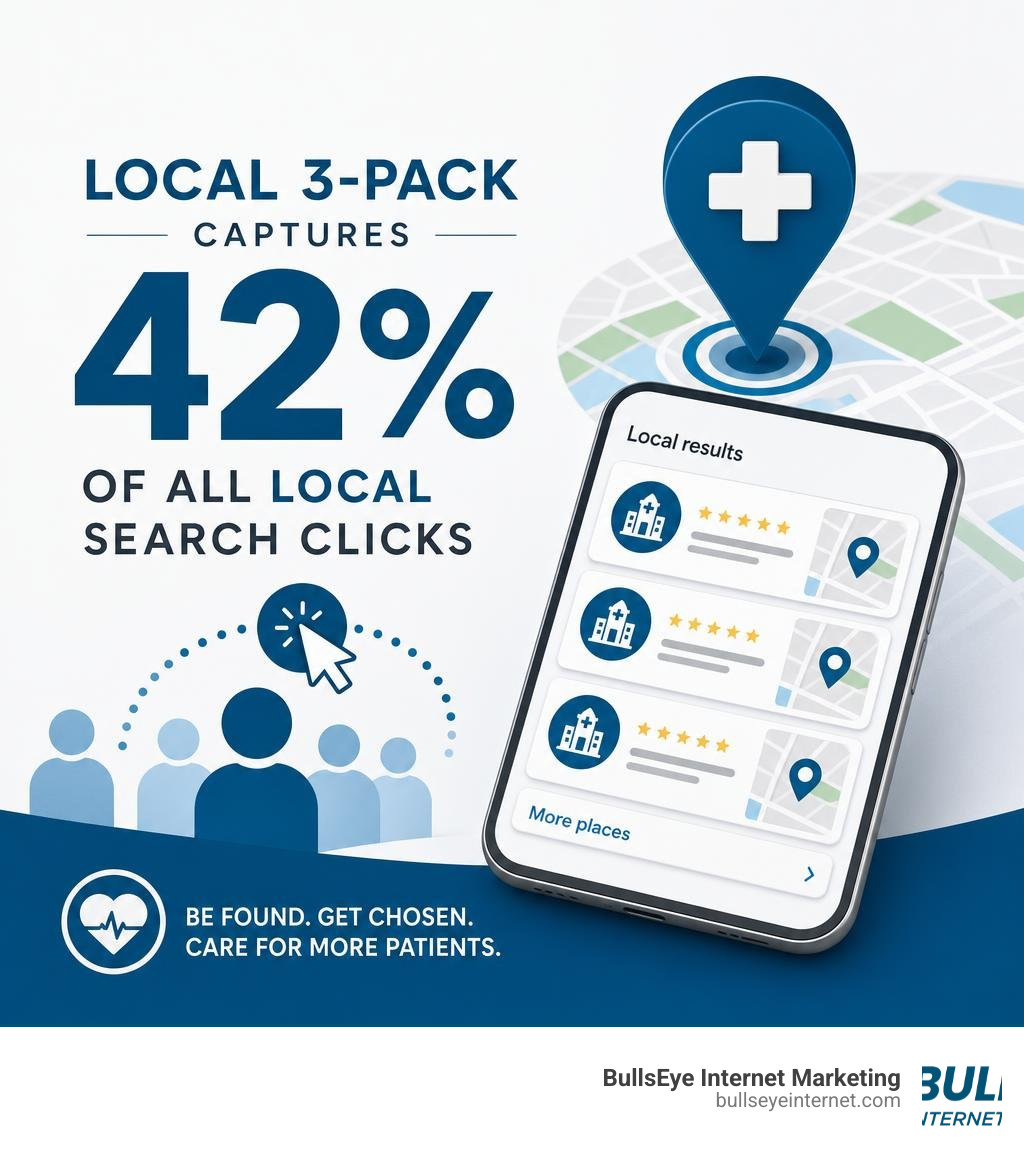
The Local 3-Pack displays the top three local clinic listings directly on Google Maps, capturing an incredible 42% of all local search clicks. To claim one of these coveted spots, you must align your local signals, starting with absolute Name, Address, and Phone number (NAP) consistency across the web. To understand the broader mechanics of ranking locally, read our Local SEO Complete Guide.
Optimizing Your Google Business Profile for Maximum Visibility
Your Google Business Profile (GBP) is the heartbeat of your local search presence. It acts as your digital front desk, working 24/7 to introduce your clinic to nearby patients.
To fully optimize your profile, you must treat it as an active, ongoing asset rather than a set-it-and-forget-it task:
- Primary Category: Select the most specific primary category that represents your practice (e.g., “Pediatrician” instead of just “Medical Clinic”).
- Secondary Categories: Utilize relevant secondary categories to cover all your services (e.g., “Medical Center,” “Sports Medicine Clinic”).
- Business Description: Write a patient-centric, localized description utilizing all 750 available characters.
- Visual Engagement: Regularly upload high-resolution photos of your office, staff, and medical equipment to build trust.
- GBP Posts: Publish weekly updates regarding seasonal health tips, clinic news, or insurance updates.
For a step-by-step walkthrough on maximizing this asset, refer to our Google Business Profile Optimization Guide.
HIPAA-Compliant Review Acquisition and Reputation Management
Online reviews are a primary deciding factor for modern healthcare consumers. Statistically, 69% of patients say positive online reviews are very or extremely important when choosing a provider. Furthermore, listings with 10 or more reviews generate twice as many patient inquiries.
However, medical practices must navigate review generation carefully to remain HIPAA-compliant. You can never share patient details, confirm a reviewer’s clinical history, or even acknowledge that a reviewer is a patient without explicit, written consent.
To build reviews safely, we recommend using automated, HIPAA-compliant communication tools to request feedback via secure SMS or email immediately following an appointment. When responding to reviews—especially negative ones—always use a neutral, standardized template that protects patient privacy:
“Thank you for your feedback. We take all patient experiences seriously. Due to privacy laws, we cannot discuss specific patient matters here, but we invite you to contact our practice manager directly at our office so we can address your concerns.”
Remarkably, 78% of patients say they would return to a medical practice if the practice responded to their concerns after they left a negative review. Managing your reputation actively is key to local dominance. Learn more about this process in our guide on How to Optimize Your Google Business Profile for Local SEO Success.
Common Medical SEO Mistakes and How to Avoid Them
Even highly experienced doctors make critical errors when managing their online marketing. Because of Google’s strict YMYL standards, a single major mistake can result in your website being completely filtered out of search results.
Here are the most common medical SEO mistakes we see and how to correct them:
- Keyword Stuffing: Forcing local keywords like “best dermatologist Miami” dozens of times into your content. This reads poorly and triggers Google’s spam filters.
- Duplicate Location Pages: Creating identical pages for different South Florida cities (e.g., Boca Raton, Delray Beach, Boynton Beach) and only swapping out the city name. Google views this as low-quality, doorway content.
- Buying Reviews: Purchasing fake reviews to artificially boost your rating. This violates Google’s terms of service and can lead to permanent suspension of your Google Business Profile.
- Neglecting Technical Health: Ignoring slow page speeds, broken links, or mobile display errors that frustrate patients and search engines alike.
To identify if your site is suffering from these issues, a professional review is essential. Learn how to diagnose your site with The Role of SEO Audits in Boosting Google Business Profile Performance.
Medical SEO Mistakes vs. Correct Solutions
| Common Mistake | Why It Hurts Your Practice | The Correct Solution |
|---|---|---|
| Keyword Stuffing | Ruins readability; triggers Google search spam penalties. | Write naturally for patients, placing keywords in headers and titles. |
| Doorway Location Pages | Seen as duplicate, low-quality content by search engines. | Write unique, localized content for each physical clinic location. |
| Buying Fake Reviews | Can lead to permanent Google Business Profile suspension. | Implement a systematic, HIPAA-compliant automated request process. |
| Generic Service Pages | Fails to address specific patient questions or symptom queries. | Build detailed condition and procedure pages with structured schema. |
Measuring Performance, Timelines, and Execution
Implementing an SEO strategy is an investment in your practice’s long-term growth. Unlike paid ads, which stop generating leads the moment you stop paying, organic SEO builds compounding value over time. To track your progress accurately, you must monitor the right metrics using modern analytics tools like GA4. For a foundational look at local metrics, check out Local SEO Strategies for Small Business Success.
Measuring Success: Tracking ROI and Timelines for SEO for Medical Practices
When measuring the return on investment (ROI) of your SEO for medical practices, look beyond vanity metrics like total impressions. Instead, track metrics that directly impact your bottom line:
- Organic Traffic Growth: The number of unique visitors landing on your clinical service and condition pages.
- Conversion Rates: The percentage of website visitors who call your office or use your online scheduling tool.
- Local Map Visibility: Your average ranking position in Google Maps for high-intent searches in your specific zip codes.
- Patient Acquisition Cost (PAC): Total SEO investment divided by the number of new patients acquired through organic search.
A realistic medical SEO rollout operates on a 90-day foundational timeline, with compounding growth occurring over 6 to 12 months. Technical fixes and profile optimizations deliver early wins, while content creation and authority building drive long-term patient volume.
In-House Management vs. Outsourcing to a Specialized Agency
Many practices attempt to handle their SEO in-house, assigning marketing tasks to a busy receptionist or trying to write blog posts themselves between patient consultations. However, medical SEO is highly technical, constantly changing, and demands significant time.
Outsourcing to a specialized agency allows your clinical team to focus entirely on patient care while experts manage your technical health, content production, and local listings. For practices located in South Florida, working with an agency that understands the local landscape is invaluable. To learn why local market knowledge matters, read Why Local SEO is Crucial for Businesses in South Palm Beach.
Frequently Asked Questions about Medical SEO
How long does it take to see results from medical SEO?
For established practices with existing domain authority, technical fixes and Google Business Profile optimizations can yield noticeable improvements in local map rankings within 30 to 60 days. However, building comprehensive content authority and outranking large medical directories for competitive clinical terms typically takes 6 to 9 months of consistent effort.
How do we collect patient reviews without violating HIPAA?
You can safely collect reviews by sending automated, secure requests via email or text message after appointments. The key to compliance is in the response: never confirm clinical details, never acknowledge that the reviewer is an active patient, and keep all public responses strictly professional, neutral, and focused on your practice’s general policies.
Can a single-physician clinic outrank massive medical aggregators?
Yes. While a solo practice cannot outrank national aggregators like WebMD or Healthline for broad informational queries (like “what is arthritis”), you can easily outrank them for high-intent, local symptom-class queries (like “knee pain specialist in Fort Lauderdale”) by implementing hyper-local content and structured schema markup.
Driving Growth for Medical Practices with BullsEye Internet Marketing
Your medical website should not be a passive online business card. With a tailored medical SEO strategy, it can become your practice’s most reliable asset—filling your waiting room with high-intent patients who trust your expertise before they even walk through your door.
At BullsEye Internet Marketing, we specialize in driving phone calls, inquiries, and new appointments for healthcare providers across South Florida, including Miami-Dade, Broward, and Palm Beach counties. We do digital marketing differently: we offer no long-term contracts and work with only one client per industry per geographic area, giving your practice a massive competitive advantage in your local market.
If you are ready to stop losing patients to competitors and want to dominate local search, let us build a custom strategy for your clinic. Explore our Professional Service Ads page and contact us today to secure your exclusive local partnership.