
The Seismic Shift: Why Your Business Needs LLM SEO Now
Large Language Model SEO is the practice of optimizing content so AI systems like ChatGPT, Perplexity, and Google’s AI Overviews can understand, retrieve, and cite your brand when answering user questions. The goal is to become the source that AI models reference directly in their responses, not just to rank on a search results page.
Quick Answer: What You Need to Know About Large Language Model SEO
- Goal: Get cited in AI-generated answers, not just rank in search results.
- Why It Matters: 58% of consumers use AI for product recommendations, and AI search referrals to retail sites surged 1,300% during a recent holiday season.
- Key Difference: Traditional SEO optimizes for keywords and clicks; LLM SEO optimizes for semantic understanding and citations.
- Core Focus: Create clear, conversational, well-structured content with original data that AI can easily extract.
- Success Metrics: Brand mentions in AI responses, referral traffic from AI platforms, and sentiment in citations.
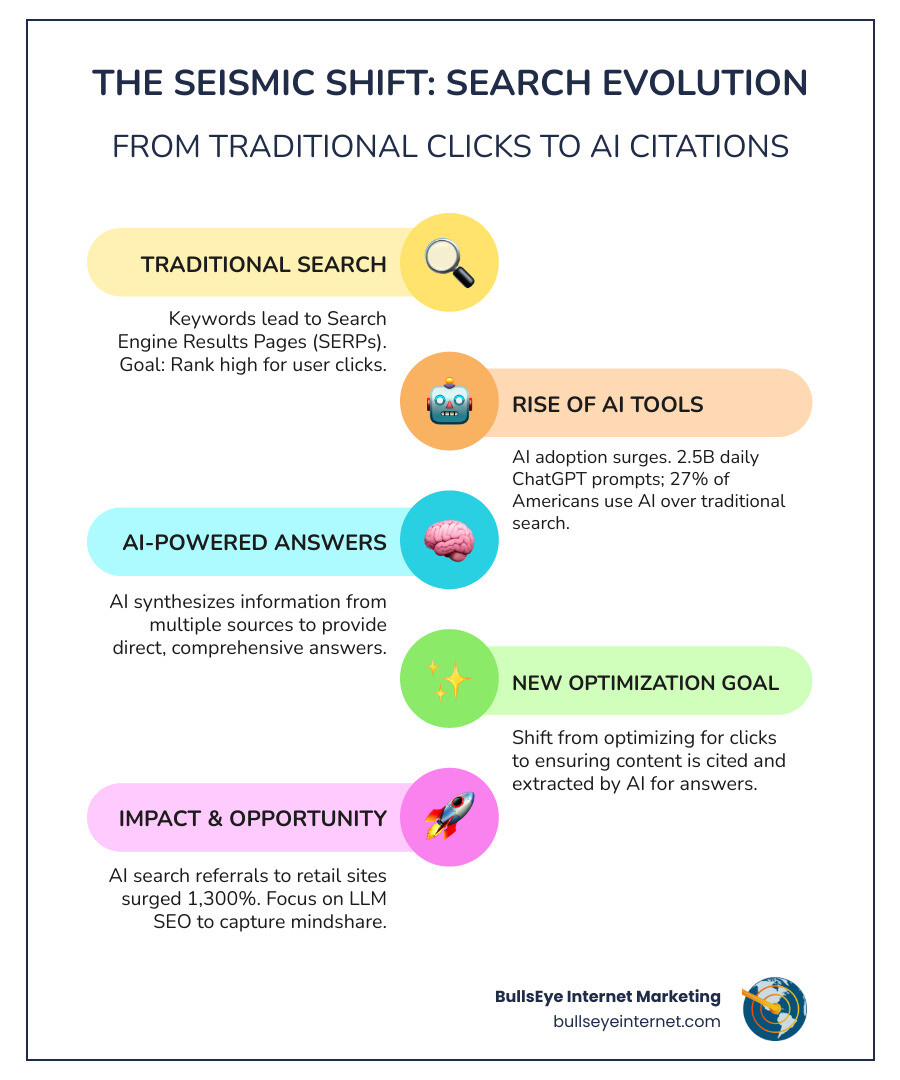
The numbers tell a stark story. ChatGPT handles billions of prompts daily, and nearly 27% of Americans have started using AI tools instead of traditional search engines. This isn’t a future trend; it’s happening now.
Traditional search behavior is fragmenting. Users who once typed “best project management software” into Google are now asking AI for detailed comparisons. They get comprehensive answers without clicking a link. Google’s own AI Overviews may reduce clicks by as much as 34.5%.
This shift creates both a threat and an opportunity. If you act now, you can position your business as an authoritative source that AI systems consistently recommend. The businesses winning in this new environment are optimizing their content so AI can find, understand, and cite it as a trusted source.
As Ronnie Katz, founder of BullsEye Internet Marketing with over 20 years of online marketing experience, I’ve helped businesses adapt to every major shift in search. Large Language Model SEO represents the most significant change we’ve seen since search engines emerged. My team implements cutting-edge Answer Engine Optimization strategies to ensure our clients’ expertise reaches customers through these new AI-powered channels.
Basic Large Language Model SEO glossary:
LLM SEO vs. Traditional SEO: A New Paradigm
The rise of Large Language Models (LLMs) has introduced a fundamental shift in SEO. While traditional SEO focused on ranking in a list of search results, Large Language Model SEO aims to have your content chosen, summarized, and cited directly within an AI-generated answer.
With traditional SEO, the goal was a click on a “blue link.” With LLMs, the focus shifts from ranking to becoming the authoritative source the AI references. We’re moving from optimizing for clicks to optimizing for citations.
Here’s a breakdown of the key differences:
| Feature | Traditional SEO | LLM SEO |
|---|---|---|
| Primary Goal | Rank high in search results pages | Be cited/summarized in AI-generated answers |
| Content Interpretation | Keyword matching, topical relevance | Semantic understanding, context, user intent |
| Success Metrics | Organic Rank, Click-Through Rate (CTR), Website Traffic | Mentions, Citation Frequency, Sentiment in AI responses, Referral Traffic from AI Platforms |
| User Interaction | Users click to visit website | Users get direct answers, potentially zero-click |
| Optimization Focus | Keywords, backlinks, technical SEO | Clarity, structure, authority, original data, conversational language |
This shift introduces “zero-click answers,” where users get information directly from the AI. While this sounds daunting, it’s a massive opportunity. If your content is structured to be easily understood by LLMs, you can become the go-to source for AI-generated answers, building brand authority and driving high-intent traffic when the AI provides a link.
The Growing Importance of AI in Search
The importance of Large Language Model SEO is undeniable. A recent survey revealed that 58% of consumers use Gen AI tools for product recommendations. The 2024 holiday season saw a 1,300% surge in AI search referrals to U.S. retail sites, showing a profound change in how people research products.
Key statistics highlight this growth:
- ChatGPT handles over 2.5 billion prompts a day from 120 million daily users.
- In the U.S., 27% of people now use AI tools over traditional search engines.
- Queries in AI-native search are longer (averaging 23 words vs. 4), and sessions are deeper, indicating users seek more detailed information.
Businesses that adapt now will gain a significant competitive advantage. Those who don’t risk losing visibility as customer attention moves to these new AI-powered channels.
How LLMs Process, Understand, and Select Content
To succeed with Large Language Model SEO, we must understand how these systems process and select content. LLMs use sophisticated natural language processing (NLP) to comprehend context, semantic nuances, and user intent, rather than just matching keywords.
Most LLMs are trained on vast datasets of public information. When a user asks a question, the LLM interprets the meaning and generates a relevant answer based on its training. To fetch current information, many AI systems use Retrieval-Augmented Generation (RAG). With RAG, the LLM retrieves relevant documents from an external knowledge base (like your website) and uses that information to inform its response. This means your content must be easily crawlable and indexable for these retrieval systems.
LLMs prefer well-organized content. Studies show that content with consistent heading levels (H2, H3) and bullet points is more likely to be cited. They gravitate towards clear definitions, digestible lists, and structured arguments. The more clearly your content is presented, the easier it is for an LLM to extract key information.

The Core Signals LLMs Look For: Authority and Trust
In Large Language Model SEO, establishing authority and trust is paramount. LLMs prioritize sources that demonstrate Expertise, Experience, Authoritativeness, and Trustworthiness (E-E-A-T). If your content doesn’t signal credibility, it’s unlikely to be included in AI answers.
Here’s how to build authority for LLMs:
Transparent Sourcing: Include quotes, statistics, and links to credible data sources. Content with verifiable facts is mentioned 30-40% more often by LLMs.
Demonstrate Expertise: Showcase deep industry knowledge with author bios, credentials, and citations of academic or industry reports.
Build Brand Presence: Maintain consistent brand details (Name, Address, Phone – NAP) across all online channels. Claim your Google Business Profile and consider a Wikipedia or Wikidata entry if your brand is notable.
Original Research: Conduct your own surveys or create unique data sets. Stating “36% of HR managers observe a doubling in retention with our solution” provides a valuable, citable data point.
Branded Search Volume: A recent study showed a correlation between brand mentions in LLMs and branded search volume. Growing brand searches can indirectly boost your chances of being mentioned by AI.
By focusing on these signals, you can position your content as a trusted source that LLMs are more likely to recognize and cite.
Understanding Related Concepts: LLMO and AEO
As you steer AI-powered search, you’ll encounter a few related terms.
Large Language Model Optimization (LLMO): This is the overarching strategy for ensuring your content is processed correctly by LLMs. It aims to increase your brand’s presence across all AI-generated answers, whether in search, chatbots, or other applications.
Answer Engine Optimization (AEO): AEO is the practice of optimizing content to directly answer user queries, making it suitable for featured snippets, knowledge panels, and Google’s AI Overviews. Our Answer Engine Optimization services at BullsEye Internet Marketing are designed to achieve this, ensuring your content provides immediate, concise answers that search engines and LLMs can easily extract. AEO is a crucial component of an effective LLMO strategy.
Generative Engine Optimization (GEO): Often used interchangeably with LLMO, GEO specifically targets optimization for generative AI search engines. It involves tactics to ensure AI systems choose your content as the basis for their conversational answers.
LLMO is the broadest concept, AEO focuses on direct answers, and GEO targets generative search outputs. All three are critical components of a modern digital strategy.
Core Principles of Large Language Model SEO
Let’s explore the core principles that guide effective Large Language Model SEO. These principles are about creating content that is not only appealing to humans but also perfectly structured for AI comprehension.
Our goal is to make our content so clear, organized, and authoritative that an AI must use it.
Content Structure: LLMs prefer order. Use clear headings (H1, H2, H3), bullet points, and numbered lists. A logical, hierarchical structure makes it easy for AI to extract key facts and summarize topics.
Factual Accuracy: LLMs strive for accuracy and are less likely to cite content with errors. Every claim should be verifiable and backed by data or reputable sources.
Originality: LLMs value content that offers fresh perspectives or proprietary research. Content that simply rehashes existing information is less likely to stand out.
User Intent: Understanding user intent is crucial. Your content should anticipate questions and provide clear, direct answers, addressing the “why” and “how” behind a query.
By adhering to these principles, we create content that is valuable to both our human audience and the AI systems mediating their search process.
Strategy 1: Create Conversational, In-Depth Content
The shift to conversational search requires a new content strategy for Large Language Model SEO. Users are asking full questions, and our content must provide comprehensive, conversational answers.
Address Natural Language Queries: Anticipate the questions your audience asks. Instead of just “best plumbers Miami,” consider “who are the most reliable plumbers in Miami-Dade County?” Use tools like Google’s “People Also Ask,” AlsoAsked, and AnswerThePublic to find these queries.
Use Q&A and FAQ Formats: Structuring content with clear question-and-answer sections is highly favored by LLMs. Implementing dedicated FAQ sections makes your content incredibly digestible for AI. Studies show that improving readability can result in a significant visibility boost of 15-30%.
Write for Extraction: Make it easy for LLMs to pull out key information. Start with a direct answer, then elaborate. Use hierarchical headings, lists, and summary boxes to break down complex information.
Answer the “Why” and “How”: Go beyond surface-level facts to explain the reasoning behind a concept and the process for a solution. This demonstrates a thoroughness that LLMs value.
Strategy 2: A Deep Dive into Large Language Model SEO with Structured Data
While LLMs understand natural language, structured data and schema markup play a crucial, indirect role in Large Language Model SEO. Structured data provides explicit clues to search engines about your content’s meaning and context, which helps the systems that LLMs use to retrieve information.
Structured data is important because it:
Reinforces Meaning for Machines: Using Schema.org and JSON-LD markup helps you explicitly define entities (organizations, products, people). This clarity makes your content more reliable in the eyes of an AI’s retrieval systems.
Improves Entity Recognition: Schema markup for
Organization,Person, andSameAsproperties helps search engines build a robust profile of your entity, allowing LLMs to confidently associate information with your brand.Improves Eligibility for Rich Results: Search engines use schema to power rich results, featured snippets, and AI Overviews. If your content is eligible for these formats, it’s more likely to be selected as a source for an LLM’s answer.
FAQSchemaandProductSchemaare particularly useful.
By providing these semantic signals, you make your content more machine-readable, which aids the systems that power LLMs in selecting your content as an authoritative source.
Strategy 3: Leverage Original Data, Freshness, and Citations
For Large Language Model SEO, being a unique and current source is a powerful advantage. LLMs crave fresh, original insights and prefer content that is regularly updated and widely cited.
Proprietary Research and Surveys: This is the most potent way to become an indispensable source. By conducting your own research or creating proprietary data sets, you generate information that exists nowhere else. Content with unique statistics is mentioned 30-40% more often in LLMs.
Content Refresh Cadence: Stale content is less useful. Implement a regular content refresh strategy by updating statistics, adding new insights, and displaying a “Last Updated” timestamp. Audit top-performing content every 3-6 months.
Building Brand Mentions and Digital PR: The more your brand is mentioned on reputable websites, the more authority it gains with LLMs. Actively seek mentions, launch data reports to encourage citations, and contribute expert quotes to news outlets. User-generated content on platforms like Reddit and Quora is also heavily referenced by LLMs.
Earning Authentic Citations: A strong backlink profile from reputable sites signals to AI that your content is trustworthy. Create inherently linkable content, such as definitive guides, original research, or unique tools.
By consistently generating fresh data and working to get your brand cited, you can significantly improve your visibility within LLM-generated responses.
A Practical Guide to Implementing and Measuring LLM SEO
Implementing Large Language Model SEO builds on foundational SEO principles, adapted with an LLM-first mindset.
Here are some practical first steps:
- Audit AI Visibility: Manually query LLMs (ChatGPT, Perplexity, Google’s AI Overviews) with questions relevant to your business to establish a baseline.
- Identify Content Gaps: Find opportunities where your expertise could provide a better answer than what LLMs currently offer.
- Structure for Clarity: Restructure existing content and plan new content with clear headings, lists, and summaries.
- Focus on Conversational Keywords: Shift research to natural language questions and long-tail queries.
- Implement Schema: Use structured data for your organization, key people, and FAQs.
- Refresh Key Content: Prioritize updating your most important pages with fresh data and clear answers.
Practical Steps for Your Large Language Model SEO Strategy
Here are actionable steps to optimize your content for LLMs:
Conduct Content Audits: Review existing content for clarity, depth, and structure. Identify pages that could be improved with FAQs, bullet points, or clearer definitions.
Identify Conversational Keywords: Use tools like Google’s “People Also Ask” boxes and platforms like AlsoAsked and AnswerThePublic to find the exact questions people are asking. Incorporate these into your content as headings.
Use NLP-Friendly Formats: Structure content with descriptive headings, Q&A sections, lists, tables, and concise paragraphs. Consider adding “Key Takeaways” boxes.
Implement Schema Markup: Ensure proper schema (Organization, Person, FAQ, Product, etc.) is implemented on relevant pages to provide explicit signals about your content’s meaning.
Keep Content Fresh: Regularly update web pages (every 3-6 months for key content) and display the “Last Updated” date to signal freshness to users and AI.
Set Up Bing Webmaster Tools: Bing powers much of ChatGPT’s AI search. Ensuring your site is properly indexed by Bing is crucial. Sign up for free at Bing Webmaster Tools here, verify your site, and submit your sitemap.
Earn Mentions and Grow Branded Search: Actively get your brand mentioned on reputable sites. Growing your branded search volume also signals to LLMs that you are a trusted entity.
Measuring Success and Navigating Challenges
Measuring Large Language Model SEO requires a different approach than traditional SEO, focusing on broader indicators of brand visibility and influence.
Measuring Success:
Track Referral Traffic: Monitor referral traffic from AI domains (e.g.,
chatgpt.com,perplexity.ai) in your analytics. These referrals are highly valuable.Monitor Brand Mentions: Track if and how your brand is mentioned in AI responses. This can be done by manually querying LLMs or using emerging AI visibility tools.
Topical Authority Expansion: Observe if LLMs increasingly associate your brand with specific topics, indicating you are building authority.
Navigating Challenges:
Zero-Click Attribution: Many LLM answers are “zero-click,” making direct attribution difficult. Focus on brand awareness and indirect influence, as traditional metrics like CTR become less relevant.
Ineffective Methods: Some so-called “AI SEO hacks” are ineffective. Stick to a strategic, evidence-based approach focused on quality and authority.
Competition: As more businesses adopt LLM SEO, it can become a “zero-sum game.” Continuous innovation and truly unique content are essential to stand out.
The Pitfall of AI-Generated Content: Do not use AI to generate your core content. LLMs are trained on new, original information, not a rehash of what they can already generate. Focus on creating original, human-driven content.
Frequently Asked Questions about LLM SEO
What is the main difference between LLM SEO and traditional SEO?
The primary difference is the goal: traditional SEO aims to rank a webpage on a search results list for users to click, while LLM SEO aims to have your content selected, synthesized, and cited directly within an AI-generated answer.
Does LLM SEO mean I can ignore traditional SEO best practices?
No, LLM SEO is an extension of traditional SEO, not a replacement. Foundational practices like technical SEO, creating high-quality content, and building authority are more important than ever, as LLMs often use search engines to retrieve information.
How can I track if my LLM SEO efforts are working?
You can track success by monitoring referral traffic from AI domains in your analytics, using tools to track brand mentions and sentiment within AI answers, and manually querying LLMs with relevant prompts to see if your content is cited.
Conclusion: Future-Proofing Your Digital Strategy
The landscape of online findy is undergoing a profound change, with Large Language Model SEO at the forefront. We are moving from a world of search rankings to one of answer shaping, where AI systems directly mediate information for users. This is a fundamental redefinition of how businesses achieve visibility.
For businesses in South Florida and across the USA, adapting to this new environment is essential for growth. The opportunity for early adopters is immense. LLM traffic channels are projected to drive as much business value as traditional search by 2027, and AI search visitors often convert at a higher rate because they are more informed.
Integrating Large Language Model SEO into your marketing mix means:
- Future-Proofing Your Presence: Position your brand where attention is headed for long-term visibility.
- Building Unrivaled Authority: Become a trusted source for AI systems to build brand authority.
- Capturing High-Intent Leads: Leads from AI recommendations arrive with a higher level of trust and intent.
At BullsEye Internet Marketing, our Answer Engine Optimization services are designed to help your business steer this new frontier. We focus on getting your expertise recognized by LLMs, ensuring your phone rings with qualified leads. By owning a concept clearly and consistently, our clients can thrive in the new era of AI-powered search.
Don’t let your competitors capture this new wave of visibility. It’s time to adapt and optimize for the AI-powered search landscape.
Get a complete picture of your search visibility with our Answer Engine Optimization services
