
Why Marketing for Law Firms Has Never Been More Competitive
Marketing for law firms has transformed from a simple referral game into a high-stakes, multi-billion-dollar digital competition — and most firms are still playing by the old rules.
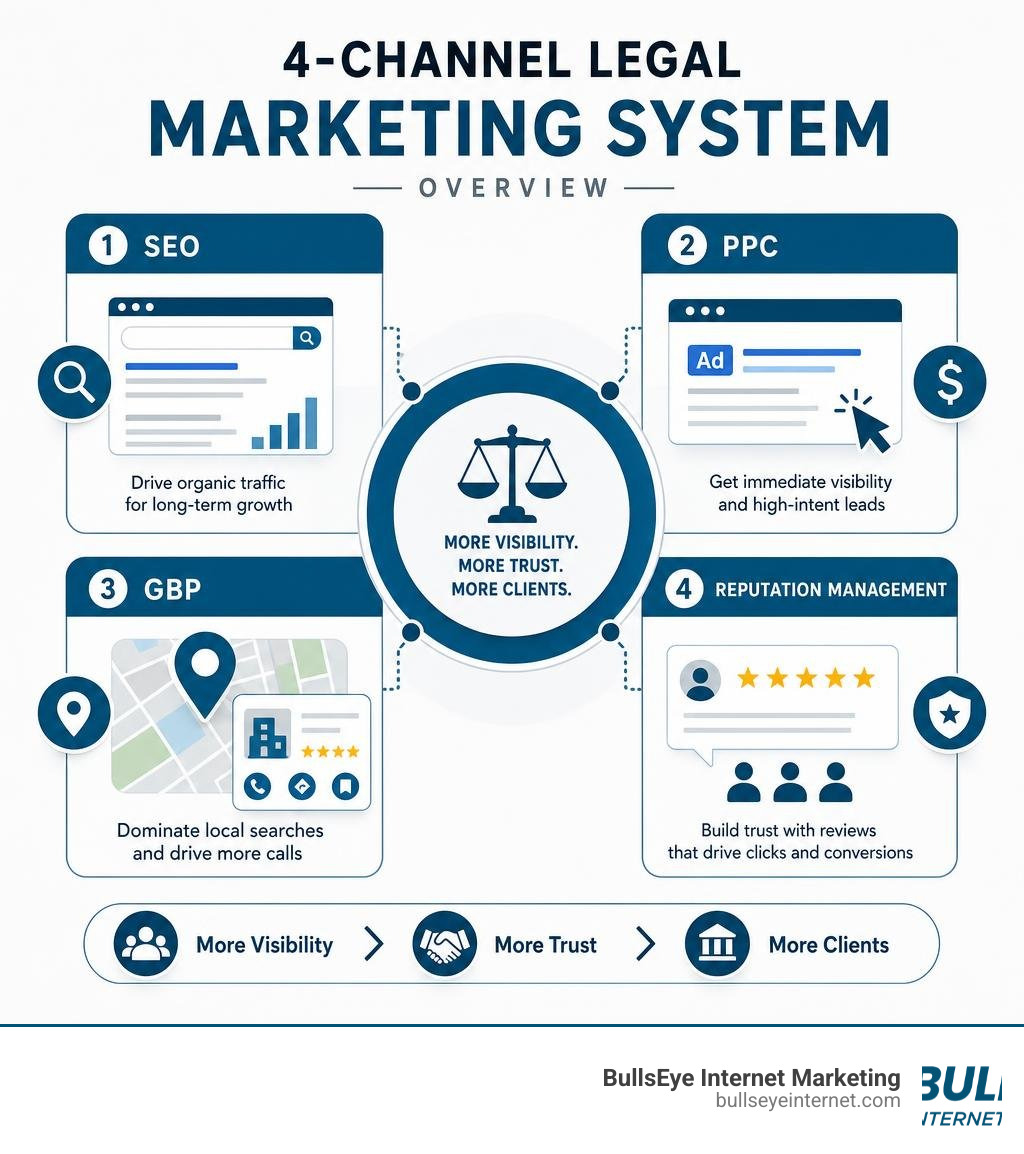
Here’s a quick overview of what effective law firm marketing looks like in 2026:
| Channel | What It Does | Best For |
|---|---|---|
| SEO | Drives organic search traffic | Long-term, lowest cost per lead |
| Google Ads / PPC | Immediate visibility for high-intent searches | Fast lead generation |
| Google Business Profile | Powers local map pack calls | Local and small firms |
| Content Marketing | Builds authority and trust | All firm sizes |
| Reputation Management | Reviews drive clicks and conversions | Every practice area |
| Referral Amplification | Scales word-of-mouth systematically | Growth-stage firms |
The numbers tell the story clearly. In 2024 alone, the legal industry spent more than $2.5 billion on advertising across the U.S. Meanwhile, 96% of people seeking legal help start with a search engine — not a phone book, not a referral, not a TV ad.
Yet despite all this, only 14% of solo attorneys and 32% of small firms even have a formal marketing budget.
That gap between what the market demands and what most firms are doing? That’s where growth happens.
The fastest-growing firms aren’t just spending more. They’re spending smarter — combining SEO, paid ads, reputation management, and referral systems into one integrated client acquisition engine. High-growth law firms achieve an average compound annual growth rate of 41.7%, outpacing their peers by more than 5x.
The good news: you don’t need a massive budget to compete. You need the right strategy.
I’m Ronnie Katz, founder of BullsEye Internet Marketing, and I’ve spent over 20 years helping businesses — including law firms — master marketing for law firms through SEO, PPC, local search, and Pay Per Lead systems that actually drive cases. In this guide, I’ll walk you through exactly what’s working right now, so you can stop guessing and start growing.
Easy Marketing for law firms glossary:
The Current State of Marketing for Law Firms in 2026
The legal sector is in the middle of a massive digital shakeup. In 2026, the battle for new clients has moved almost entirely online. Legal services operate in a strict “Your Money or Your Life” (YMYL) search environment. This means Google and other search engines hold legal websites to the absolute highest standards of accuracy, trust, and authority.
As we look at the Law firm marketing statistics for 2026: A comprehensive analysis, we see that total industry ad spending has reached historic highs. However, the cost per impression is rising rapidly. From 2020 to 2024, total legal ad spend jumped 39%, while the actual number of ads run decreased. This tells us one thing: the cost to get in front of your audience is skyrocketing. To survive, we have to build highly optimized, conversion-focused campaigns rather than relying on brute-force spending.
Shifting from Traditional to Digital Channels
For decades, traditional media like massive highway billboards, radio spots, and late-night television ads were the gold standard for personal injury and criminal defense firms. While these channels still hold branding value for massive firms with seven-figure budgets, the vast majority of firms in South Florida—from Miami-Dade to Palm Beach County—are shifting their dollars to digital.
The reason is simple: consumer behavior has changed. When someone is in a car accident on I-95 or facing a sudden family law crisis in Fort Lauderdale, they don’t wait to spot a billboard. They pull out their phone and search. Because search engine research is highly targeted, digital channels capture users at the exact moment they need representation. This results in a much higher conversion rate and a far lower cost per case than traditional mass-media campaigns.
The Referral Ceiling and Scalable Growth
Many talented attorneys tell us, “We don’t need marketing; we run entirely on word-of-mouth.” While referrals are the ultimate proof of great legal work, they come with a major catch: they do not scale.
Relying solely on referrals creates a single point of failure. If your top three referral sources retire, change practice areas, or partner with another firm, your pipeline can dry up in 30 to 60 days. To build a highly predictable business, you must break through this referral ceiling.
According to recent data, the fastest-growing firms derive roughly 40% of their clients from structured marketing channels and 60% from referrals. This healthy mix ensures you aren’t vulnerable to dry spells. If you want to build a predictable, self-sustaining pipeline, you need to learn How to Build a Client Acquisition Machine for Your Law Practice.
Strategic Budget Allocation and Client Acquisition
How much should you actually spend on your marketing? It is one of the most common questions we hear. There is no one-size-fits-all answer, but we can look at how successful firms across different growth stages structure their budgets.
| Firm Size / Revenue | Recommended Marketing Budget (% of Gross Revenue) | Core Focus Channels |
|---|---|---|
| Solo Practice / Under $500k | 7% – 10% | Local SEO, Google Business Profile, Review Generation |
| Small Firm / $500k – $2M | 6% – 8% | Local SEO, PPC (Google Ads), Content Marketing |
| Mid-Sized / $2M – $10M | 5% – 7% | SEO, Google Ads, Local Services Ads (LSAs), Email |
| Enterprise / $10M+ | 2% – 5% | Omnichannel (SEO, PPC, LSA, Video, Brand Campaigns) |
Budget Allocation Strategies for Effective Marketing for law firms
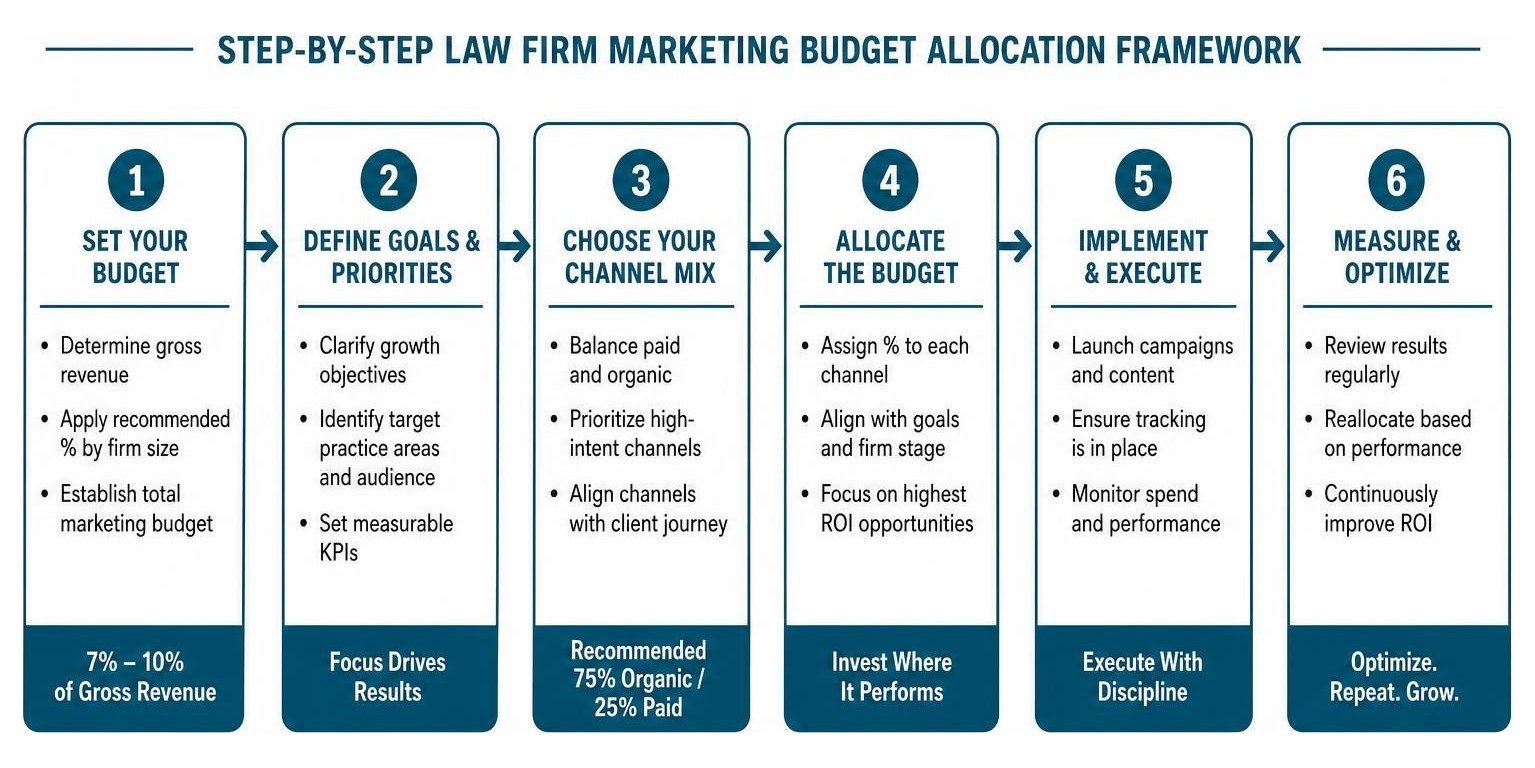
Once you have established your overall budget, the next step is deciding how to distribute those funds. A balanced digital strategy should divide resources between immediate lead generation and long-term asset building.
For most growing firms, we recommend a 75/25 split between organic long-term channels (like SEO and content) and paid immediate-return channels (like Google Ads). This ensures that while you pay to keep the phone ringing today, you are also building an organic presence that will drive down your average cost per lead over time. To dive deeper into these foundational strategies, check out this Law Firm Marketing Basics: The Ultimate Guide for 2026.
Tailoring Strategies for Small vs. Large Law Firms
A small law firm cannot market itself the same way a national corporate practice does. For solo practitioners and small firms in competitive areas like Broward County or Martin County, the secret to winning is extreme specialization.
Instead of trying to rank for broad, highly competitive terms like “personal injury lawyer,” smaller firms should target highly specific niches. For example, specializing in “bicycle accident cases” or “high-net-worth divorce representation” allows you to rank faster for high-intent keywords. By focusing your limited budget on a tight geographic area and a highly defined practice niche, you can easily outmaneuver larger competitors. Discover how to build your niche with our guide on Small Law Firm Marketing: From Zero to Client Hero.
Maximizing ROI with Search Engine Optimization and Paid Ads
When it comes to digital marketing, search engines are the ultimate battleground. Let’s look at how to maximize your return on investment using a combination of organic search engine optimization and highly targeted paid advertising.
Local SEO and Google Business Profile Benchmarks
For local practices—such as criminal defense, family law, and estate planning—your Google Business Profile (GBP) is your most valuable digital asset. The local “Map Pack” appears at the top of local search results and drives a massive percentage of all mobile clicks and phone calls.
To rank in the Map Pack, you must optimize your profile continuously. This means keeping your Name, Address, and Phone number (NAP) perfectly consistent across all online directories, adding localized keywords to your business description, and systematically collecting Google reviews.
Firms with over 100 reviews and a rating of 4.8 stars or higher hold a massive competitive advantage. At BullsEye Internet Marketing, we specialize in helping local practices dominate their local map packs. To see how top agencies approach local search, read our Detailed Reviews of the Top 10 Law Firm Marketing Agencies Miami.
Paid Advertising Economics: Google Ads and LSAs
While SEO is a long-term play, Pay-Per-Click (PPC) advertising is like a faucet: turn it on, and leads start flowing immediately. However, legal keywords are some of the most expensive in the entire advertising industry. In highly competitive South Florida markets, a single click for “car accident lawyer” can easily exceed $100.
To avoid blowing your budget, you must understand the economics of PPC:
- Google Search Ads: These allow you to bid on specific search terms. To succeed, you must use tight keyword matching, aggressive negative keyword lists (to avoid paying for irrelevant searches), and highly optimized landing pages.
- Google Local Services Ads (LSAs): These are the “Google Screened” ads that appear at the very top of search results. Unlike traditional PPC, LSAs operate on a pay-per-lead model, meaning you only pay when a qualified lead calls or messages your firm.
Because of the high cost per click, acquiring a single signed case through paid channels typically costs between $2,500 and $3,000. To make this profitable, you must have a flawless client intake process to convert every lead that comes in.
Learn how to set up your paid campaigns efficiently with our guides on Google Local Services Ads for Lawyers and PPC Advertising for Lawyers: Complete Guide.
Trust, Compliance, and AI Integration in Legal Marketing
Because legal issues are deeply personal and often stressful, trust is the single most important factor in a client’s decision to hire your firm. Your marketing must build confidence before a prospect ever speaks to an attorney.

Content Marketing, Social Media, and Video
An educational blog is one of the best ways to demystify complex legal processes and reduce client anxiety. By writing detailed, easy-to-read articles that answer common questions—such as “What should I do immediately after a car accident in West Palm Beach?”—you position your firm as an approachable authority.
Social media and video marketing are also powerful tools for building trust. While B2B firms find great success on LinkedIn, consumer-facing practices are increasingly leveraging short-form video on platforms like YouTube and TikTok.
Showing your face on camera, explaining legal concepts simply, and sharing client success stories makes your firm feel human and relatable. For practical tips on structuring your online presence, read Lawyer Marketing in 2026: What Law Firms Need to Grow Online.
Legal Advertising Compliance and Bar Rules
Before launching any campaign, you must ensure your marketing complies with state bar association guidelines. Legal advertising is heavily regulated to protect consumers from misleading claims.
Key rules to keep in mind include:
- No Misleading Claims: You cannot guarantee specific outcomes or claim to be the “best” or “top” lawyer without verifiable, objective data.
- Clear Disclaimers: Any blog post or social media content must clearly state that the information provided is not formal legal advice and does not create an attorney-client relationship.
- Case Results and Testimonials: When sharing past verdicts or client reviews, you must include a disclaimer stating that past results do not guarantee a similar outcome.
Violating these rules can lead to severe penalties from your state bar. Always work with a marketing partner who understands these restrictions inside and out. For a detailed breakdown of how to stay compliant, consult our guide on Lawyer Advertising Rules: Solutions for Modern Firms.
Leveraging AI and Automation in Modern Marketing for law firms
Artificial Intelligence (AI) is transforming legal marketing at a breakneck pace. AI adoption among legal professionals jumped from just 19% in 2023 to 79% in 2024.
Firms are using AI to streamline content brainstorming, draft initial social media posts, and optimize their search strategies for AI-driven search engines (a process known as Generative Engine Optimization, or GEO).
However, the most impactful use of AI is in client intake automation. Did you know that only 40% of law firms actually answer their phone calls live? Yet, firms that respond to an inquiry within 5 minutes see a 400% higher conversion rate. By using AI chatbots and automated scheduling tools on your website, you can capture leads 24/7 and schedule consultations instantly, ensuring no opportunity slips through the cracks.
Frequently Asked Questions about Law Firm Marketing
Navigating legal marketing can feel overwhelming. Here are clear answers to some of the most common questions we receive from law firms looking to grow.
How much should a law firm spend on marketing in 2026?
Most growing law firms spend between 6% and 10% of their gross revenue on marketing. If you are a solo practitioner looking to establish your brand, you may need to invest up to 10% to build your initial digital footprint. Larger, established firms looking to maintain their market share can often scale back to 2% to 5% of their gross revenue.
How long does it take for legal SEO to show results?
SEO is a long-term investment. For local SEO and Google Business Profile optimization, you can expect to see meaningful improvements in local Map Pack visibility within 60 to 90 days. For national or highly competitive organic rankings, it typically takes 6 to 12 months of consistent optimization and content creation to secure first-page positioning on Google.
What is the average cost per case acquisition for paid ads?
In competitive practice areas like personal injury or criminal defense, the average cost to acquire a single signed case through paid search channels (like Google Ads) ranges between $2,500 and $3,000. This cost can be significantly lower for niche practice areas or when using highly targeted Local Services Ads (LSAs).
Building a Predictable Client System with BullsEye Internet Marketing
Marketing for law firms in 2026 is no longer just about buying ad space—it is about building a cohesive, trust-driven digital system. From optimizing your Google Business Profile for local search to running precise paid ad campaigns and automating your client intake, every piece of the puzzle must work together to turn clicks into clients.
At BullsEye Internet Marketing, we do things differently. We specialize in generating real calls and signed cases through Pay Per Lead, Google Business Profile Optimization, SEO, PPC, and conversion optimization.
Our unique selling proposition is simple: we offer no long-term contracts, and we work with only one client per industry per geographic area. This gives you an exclusive, highly unfair competitive advantage in your local South Florida market.
Ready to stop burning your ad budget and start building a predictable client acquisition machine? Partner with BullsEye Internet Marketing for expert legal advertising today, and let’s dominate your local market together.
