
Why Most Law Firms Struggle to Turn Google Ads Into Signed Cases
Legal PPC management is the process of planning, running, and optimizing paid search ads for law firms — so that when someone searches for a lawyer, your firm shows up first and wins the case.
Here’s a quick breakdown of what it involves:
| What It Is | What It Does |
|---|---|
| Pay-per-click ads on Google (and Bing) | Puts your firm at the top of search results immediately |
| Local Services Ads (LSAs) | Charges per lead, not per click — with a Google Screened badge |
| Campaign management & optimization | Lowers your cost per signed case over time |
| Landing page + conversion tracking | Turns clicks into consultations and retained clients |
Legal PPC is not just about running ads. It’s about making every dollar work harder in one of the most expensive advertising environments on the internet. The average cost per click for a personal injury keyword in a major metro area can exceed $150 — and in cities like Los Angeles, New York, or Chicago, individual clicks can top $300. One wrong move and your budget evaporates with nothing to show for it.
But here’s the flip side: a personal injury firm spending $8,000 per month on Google Ads that signs just two cases worth $50,000 or more each is generating a return that most industries can only dream about. And firms that use online search ads are hired 25% faster than firms that don’t.
The difference between burning money and printing it comes down to how well your campaigns are managed.
I’m Ronnie Katz, founder of BullsEye Internet Marketing, and I’ve spent over 20 years in legal PPC management — helping law firms cut wasted ad spend and build campaigns that consistently turn clicks into signed cases. Let’s walk through exactly how to do it.
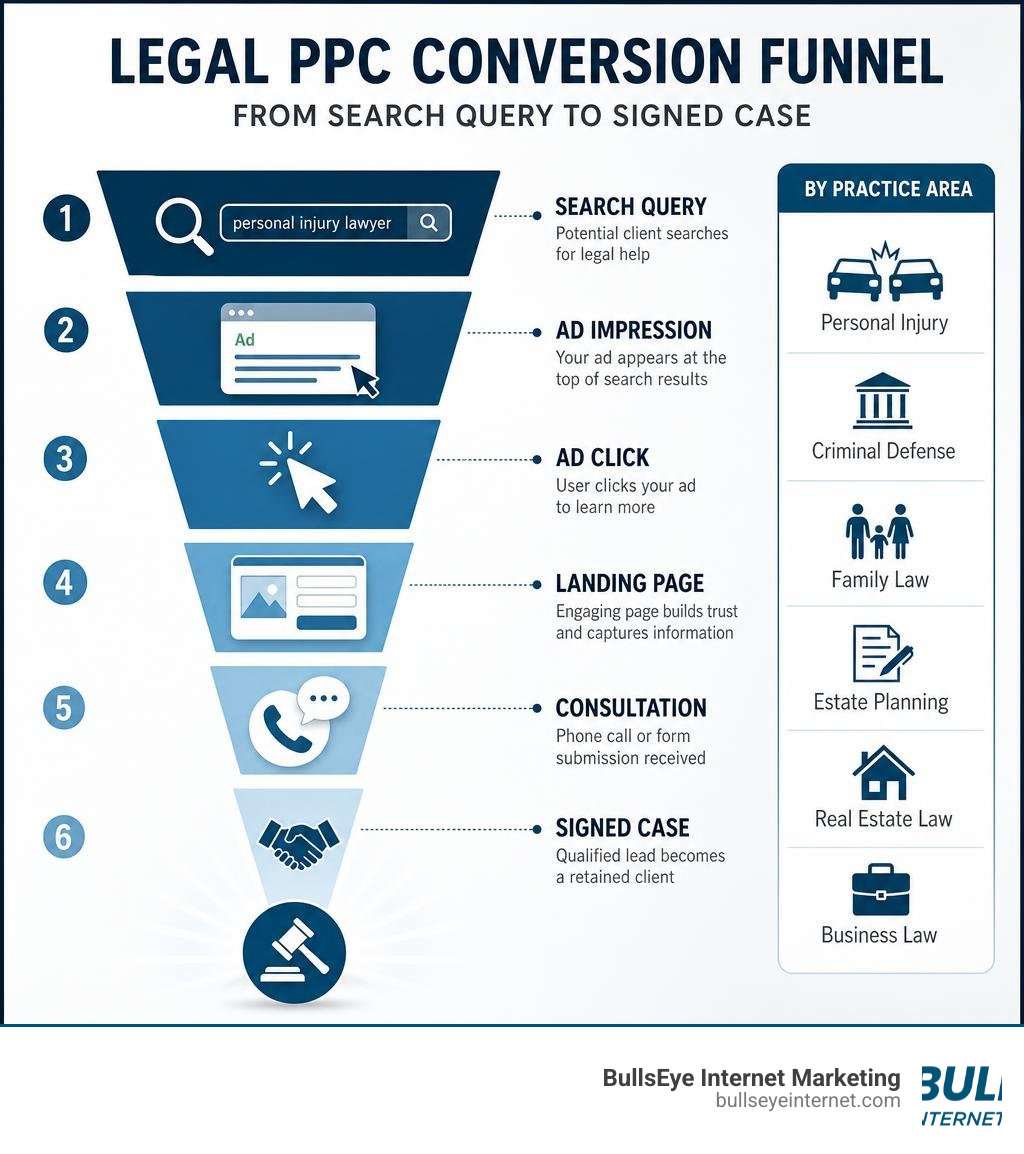
Know your legal ppc management terms:
What is Legal PPC Management and Why Does It Matter?
At its core, legal PPC management is about intent-based targeting. Unlike social media ads that interrupt people while they are looking at vacation photos, search engine PPC catches prospects at the exact moment they need professional legal help. When a resident in Miami or Fort Lauderdale searches for “car accident lawyer near me,” they are not browsing for fun. They have an immediate, high-stakes problem that needs solving.
By placing your firm at the absolute top of the search engine results page (SERP), you bypass the months of waiting required for organic search engine optimization (SEO). While SEO is an indispensable long-term strategy for building authority, PPC acts as your rapid-response team, delivering immediate visibility and a steady stream of real-time leads.
For a deeper dive into how this ecosystem functions, you can read our comprehensive pay-per-click advertising for lawyers guide.
The Core Benefits of Legal PPC Management
Running a highly optimized paid search campaign provides several game-changing advantages for modern law firms:
- Immediate Lead Generation: Your ads go live and start appearing in front of highly qualified prospects within hours of campaign launch.
- Measurable ROI: Every single dollar, click, phone call, and signed case is tracked. You can mathematically prove which keywords are generating revenue and which ones are simply wasting money.
- Hyper-Local Targeting: You can restrict your ads to the exact geographic areas you serve. If your firm is located in West Palm Beach, you can target specific neighborhoods across Palm Beach County, Broward County, and Miami-Dade County, preventing your budget from being wasted on clicks from people too far away to hire you.
- Leveling the Playing Field: A boutique law firm in Coral Gables can outrank a massive national firm with a multi-million dollar budget simply by maintaining a more precise, highly relevant campaign structure.
To understand how PPC fits into your firm’s broader growth plans, check out an essential guide to advertising for lawyers.
Standard Google Ads vs. Local Services Ads (LSAs)
Many attorneys confuse standard Google Search Ads with Local Services Ads (LSAs). While both appear at the top of Google search results, they operate on completely different models.
Standard search ads are traditional pay-per-click ads. You bid on keywords, write custom ad copy, direct users to a dedicated landing page on your website, and pay every time someone clicks your ad—regardless of whether they call you.
Local Services Ads sit at the very top of the search results page, even above standard PPC ads. They operate on a pay-per-lead model, meaning you only pay when a qualified prospect calls or messages you directly through the ad.
Furthermore, LSAs feature the highly trusted “Google Screened” badge. To earn this badge, law firms must pass rigorous background checks, license verifications, and malpractice insurance reviews. Firms with the Google Screened badge see 30% to 50% higher click-through rates compared to standard search ads because the badge acts as an immediate trust signal.
For a step-by-step breakdown of how to master this channel, read our guide on google local services ads for lawyers.
Structuring High-Converting Campaigns by Practice Area
The single biggest mistake we see law firms make is lumping all of their practice areas into one giant campaign. If you run a multi-practice firm in Fort Lauderdale and point ads for criminal defense, family law, and personal injury to the same generic homepage, your conversion rates will plummet.
Successful legal PPC management requires tight campaign segmentation. Each practice area must have its own dedicated campaign, with highly specific ad groups and keywords tailored to the exact search intent of the user.
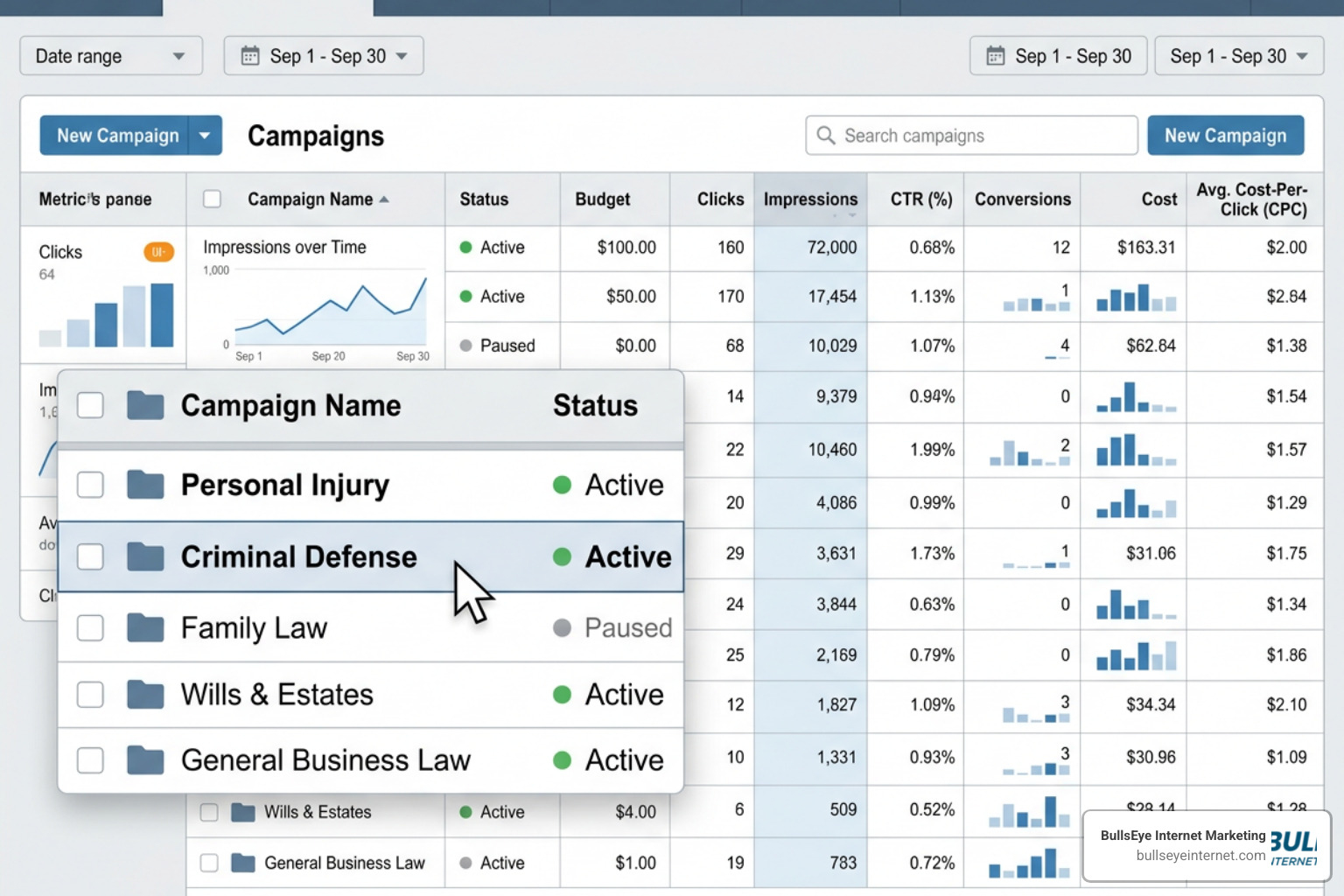
By separating your campaigns, you can allocate your budget dynamically to the practice areas that yield the highest return on investment, while ensuring your ad copy matches the searcher’s headspace. Learn more about organizing your account in our guide on ppc advertising for law firms.
Personal Injury and Criminal Defense Campaigns
Personal injury and criminal defense campaigns are defined by high urgency and high competition. When someone is arrested in Broward County or involved in a major auto accident on I-95, they need a lawyer immediately.
Because over 65% of legal searches happen on mobile devices, these campaigns must be heavily optimized for mobile users. This means implementing prominent click-to-call extensions and ensuring your landing pages load in under 2.5 seconds.
In these high-urgency niches, your bidding strategy should focus on capturing top-of-page impression share to ensure you are the first firm a panicked searcher sees. To master this high-stakes environment, read the criminal defense marketing playbook for modern law firms.
Family Law and Estate Planning Campaigns
Family law and estate planning prospects operate in a completely different headspace. These users are rarely in a panic; instead, they are looking for a trusted advisor to guide them through complex, sensitive life transitions like divorce, child custody, or asset protection.
Your keyword strategy here should focus on longer-tail, highly informational queries (e.g., “how to protect assets in a Florida divorce” or “do I need a trust in West Palm Beach”). Your ad copy and landing pages must focus on building client trust, showcasing credentials, and offering comforting, clear paths forward. For a deeper look at tailoring your approach, explore a comprehensive guide to family law marketing.
Budgeting and Cost Benchmarks for Paid Legal Ads
To run a successful paid search program, you must understand the financial benchmarks of your specific practice area. Because legal keywords are highly competitive, cost-per-click (CPC) rates vary widely.
Here is a realistic look at the average CPC and cost per signed case (acquisition) benchmarks across major legal specialties in South Florida for 2026:
| Practice Area | Typical CPC Range | Typical Cost Per Signed Case (CPAC) |
|---|---|---|
| Personal Injury (Auto Accidents) | $75 – $250+ | $3,000 – $8,000 |
| Criminal Defense (DUI/DWI) | $50 – $150 | $500 – $1,500 |
| Family Law (Divorce/Custody) | $30 – $100 | $1,000 – $3,000 |
| Estate Planning | $15 – $50 | $200 – $600 |
| Immigration | $20 – $60 | $300 – $800 |
| Bankruptcy | $30 – $75 | $400 – $1,000 |
Calculating Your True Cost Per Acquired Case (CPAC)
Many law firms fire their marketing agencies because they focus on the wrong success metrics. They look at Cost Per Lead (CPL) and freak out when they see a lead costing $200. But CPL is a vanity metric. If an agency generates ten leads at $50 each, but none of them turn into a client, you have spent $500 for zero return.
Conversely, if you get one high-quality lead that costs $300 and immediately signs a $15,000 contingency fee case, your marketing is incredibly profitable.
To measure true ROI, you must calculate your Cost Per Acquired Case (CPAC):
$$\text{CPAC} = \frac{\text{Total Ad Spend}}{\text{Number of Signed Cases}}$$
To lower your CPAC, you must implement end-to-end conversion tracking. This means linking your Google Ads account to call-tracking software like CallRail and your internal CRM. This allows you to track a lead from the initial click, to the phone call, to the consultation, and ultimately to the signed retainer. For strategies on generating high-converting leads, check out our insights on exclusive attorney leads that actually convert.
Common Pitfalls and Landing Page Optimization
The legal vertical is unforgiving. If your campaigns are not managed with surgical precision, you will burn through thousands of dollars in a matter of days. The most common culprit? Wasted ad spend on irrelevant search terms.
If you target the phrase “divorce lawyer” on a broad match setting, Google might show your ad to someone searching for “free divorce papers,” “how to get a divorce without a lawyer,” or “divorce attorney salary.” To protect your budget, you must build an extensive negative keyword list before launching your campaign.

Additionally, sending paid traffic to your firm’s homepage is a recipe for high bounce rates. Homepages are full of distractions—links to blog posts, community work, and multiple practice areas. A high-converting legal landing page must be a distraction-free environment designed to do one thing: get the user to call or fill out a form.
Here is a starting list of essential negative keywords every law firm should implement immediately:
- DIY Terms: “free”, “pro bono”, “do it yourself”, “forms”, “templates”, “court rules”, “statutes”
- Career/Education: “jobs”, “salaries”, “internships”, “law school”, “bar exam”, “careers”
- Informational: “definition”, “book”, “history”, “news”, “articles”, “classes”
For a deeper look at avoiding these budget-killing mistakes, read our ppc advertising for lawyers complete guide.
Essential Landing Page Elements for Legal PPC Management
To turn expensive clicks into signed cases, your dedicated landing pages must feature these critical elements:
- A Matching Headline: The headline of your landing page must perfectly match the search intent and ad copy that the user clicked. If they clicked an ad for “DUI Defense Attorney in Fort Lauderdale,” your landing page headline should read “Experienced DUI Defense Attorney in Fort Lauderdale”—not “Full-Service Criminal Defense Firm.”
- Immediate Trust Signals: Display your years of experience, positive Google review counts, professional accreditations, and high-profile case results above the fold.
- A Single, Clear Call to Action (CTA): Do not give users ten different things to do. Provide a prominent, clickable phone number for mobile users and a simple 3-to-4 field contact form. Remove all main site navigation menus so the user cannot wander away.
- Mobile Responsiveness: Ensure the page loads in under 2.5 seconds on mobile devices and looks flawless on smartphones.
Navigating Legal Advertising Regulations and Compliance
Unlike retail brands, law firms must comply with strict ethical and professional advertising rules set by state bar associations, often based on the American Bar Association Model Rules of Professional Conduct. In Florida, the Rules of Professional Conduct regarding attorney advertising are incredibly strict.
When writing your ad copy and landing page content, you must avoid:
- Unverifiable Claims: You cannot use words like “best,” “expert,” or “specialist” unless you are board-certified by the Florida Bar in that specific practice area.
- Guarantees of Outcomes: Promising or implying a specific financial recovery or legal outcome is strictly prohibited.
- Misleading Testimonials: If you use client reviews, they must include necessary disclaimers indicating that past results do not guarantee future outcomes.
Failing to comply with these rules can result in heavy fines and disciplinary action. To ensure your campaigns stay compliant, explore our guide on lawyer advertising rules solutions for modern firms.
Frequently Asked Questions About Legal PPC
How much should a law firm budget for PPC advertising?
For solo practitioners and small firms in South Florida, we recommend a starting testing budget of $3,000 to $6,000 per month, focusing on one or two core practice areas. Mid-sized firms looking to dominate competitive areas like personal injury or criminal defense across Broward and Miami-Dade counties typically need to invest $6,000 to $15,000+ per month to remain competitive.
To explore budgeting strategies in detail, read our detailed guide to google ads for lawyers.
What metrics should law firms track to measure PPC success?
While you should monitor front-end metrics like click-through rate (CTR) and conversion rate to ensure your ads and landing pages are performing, the most important metric to track is your Cost Per Acquired Case (CPAC). If your marketing agency is only reporting on “clicks” and “impressions,” they are hiding a lack of real business results.
How long does it take to see results from legal PPC?
PPC can generate phone calls and leads within hours of launching your campaign. However, the first 30 to 60 days are a critical data-gathering and optimization phase. During this time, we analyze search term reports, add negative keywords, and adjust bids. You should expect a stable, predictable return on investment within 90 days. For a timeline of what to expect, check out our law firm marketing guide 2026.
Conclusion
Legal PPC management is one of the fastest, most predictable ways to scale your law firm and outpace your local competitors. But because legal keywords are among the most expensive on the internet, there is no room for error.
At BullsEye Internet Marketing, we handle your campaigns with the precision and transparency you deserve. We do not believe in locking our clients into long-term contracts—we earn your business month after month based on real, measurable results.
Best of all, we offer strict geographic exclusivity: we only work with one client per practice area in any given geographic location. When you partner with us, we focus 100% of our energy on helping your firm dominate your local market, rather than pitting you against your neighbors.
Ready to turn expensive clicks into signed cases? Check out an essential guide to advertising for lawyers and contact us today to schedule your free campaign assessment.
