
Why Choosing the Right LLM SEO Agency Can Make or Break Your AI Visibility
An LLM SEO agency specializes in optimizing your brand for AI-powered search platforms like ChatGPT, Google AI Overviews, and Perplexity. Unlike traditional SEO, which targets rankings, LLM SEO aims to get your business cited and recommended in AI-generated answers. This is crucial because it’s where customers are increasingly finding information.
An LLM SEO agency provides key services like AI visibility audits, content engineering for AI extraction, technical optimization with schema and entity signals, real-time monitoring of brand mentions, and strategic reporting on metrics like citation frequency and AI-referred traffic.
The way people search is changing. Gartner research predicts search engine volume will drop 25% by 2026 as users turn to AI assistants for instant answers. When someone asks an AI for a recommendation, your competitors might be getting cited while you’re invisible. This shift isn’t about clicks; it’s about citations.
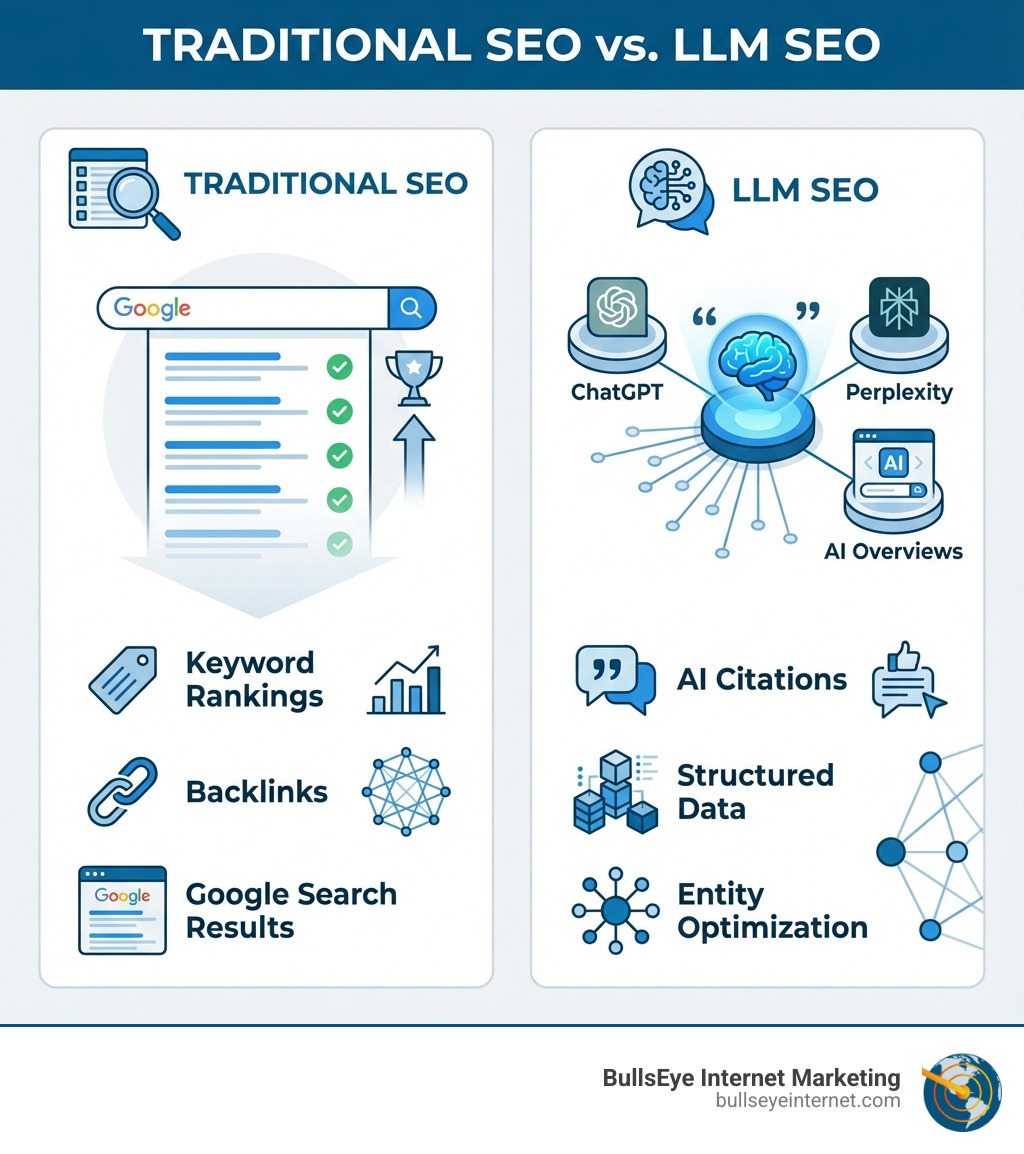
Traditional SEO focused on ranking in Google’s “ten blue links.” LLM SEO (or Generative Engine Optimization, GEO) focuses on becoming a trusted source for AI platforms. These platforms don’t index the entire web; they use a smaller set of authoritative sources to generate responses.
The data shows this shift is happening now. AI-referred traffic to retail sites jumped 1,300% during 2024, and pages updated within 90 days appear 3x more in AI answers. Yet, only 10% of marketers feel prepared, according to BrightEdge. The problem is that most traditional SEO agencies use outdated rules that don’t work for AI.
That’s why asking the right questions before hiring an LLM SEO agency is critical. You need a partner who understands how LLMs cite content, can track AI visibility, and builds strategies around structured data and authority signals. This guide provides the 10 most important questions to ask any agency about their strategies, measurement, and ability to deliver tangible results.
I’m Ronnie Katz, founder of BullsEye Internet Marketing. Since 2006, we’ve helped businesses dominate online visibility. As an early adopter of LLM SEO, I’ve seen how adapting early creates a massive competitive advantage. Let me show you what to look for to make the smartest choice.
The New Search Frontier: Understanding LLM SEO and GEO
The search landscape is shifting from the familiar “ten blue links” to AI-driven answers. Understanding this new frontier is crucial for selecting the right LLM SEO agency.

At its core, LLM SEO (Large Language Model Optimization) is about making your content citable by AI systems like ChatGPT, Google’s AI Overviews, and Perplexity. Also known as Generative Engine Optimization (GEO), its goal is earning citations, not just clicks. Users are getting instant, synthesized answers from AI, which pulls from a smaller set of trusted, well-structured sources. If your content isn’t optimized for this, you risk becoming invisible. For a deeper dive, explore our Search Engine Optimization Expert Guide.
Question 1: What is LLM SEO and how does it differ from traditional SEO?
This is a fundamental question for any prospective LLM SEO agency.
Traditional SEO focuses on ranking in Google’s search results for specific keywords. Success is measured by organic traffic and keyword rankings.
LLM SEO, however, aims to earn citations in AI-generated answers. It’s about becoming the trusted source AI models reference. This requires a different approach:
- Content for AI Models: Prioritizing structured, factual, and easily extractable content with clear headings and concise answers.
- Factual Accuracy & Authority: Demonstrating deep expertise that can be corroborated across multiple trusted sources. Generic content is ignored.
- Structured Data & Entities: Using schema markup and entity optimization to help AI models understand your content’s context and connect your brand to knowledge graphs.
In short, traditional SEO is about getting found by a crawler. LLM SEO is about getting understood and cited by an AI.
Question 2: Why is adapting to AI search a business imperative today?
Adapting to AI search is not a fad; it’s a business imperative.
- Explosive Traffic Growth: AI-referred traffic to retail sites jumped 1,300% during 2024. This is a real, rapidly expanding traffic source you can’t afford to miss. See more data in studies like Data on AI traffic from Ahrefs.
- Early Adopter Advantage: Moving early creates algorithmic momentum. When AI models repeatedly cite your brand, they reinforce your authority, giving you a head start over competitors.
- Competitor Visibility: Forward-thinking businesses are already optimizing for AI. If they are being cited and you are not, you are ceding market share and brand recognition.
- Future-Proofing Your Brand: With Gartner predicting a 25% drop in traditional search volume by 2026, LLM SEO is about ensuring your brand remains findable as user behavior permanently shifts.
Ignoring this shift is like ignoring mobile optimization a decade ago—a risk your business can’t afford, whether you’re in South Florida or anywhere in the United States.
What Strategies and Tactics Define a Top LLM SEO Agency?
A top LLM SEO agency uses a new playbook designed for how AI models process and cite information. Their strategies go beyond traditional SEO, focusing on content engineering for AI, implementing structured data and schema markup, optimizing for entities, ensuring technical access for AI crawlers, and building authority through digital PR and corroboration.

Question 3: What specific optimization techniques should an agency use?
When evaluating an LLM SEO agency, ask for their specific techniques. A good partner will detail their approach to:
- Content Freshness and Extraction-Ready Content: Pages updated within 90 days appear 3x more in AI answers. Content must be “extraction-ready” with concise answers (under 40 words), bullet points, and tables that LLMs can quote directly.
- Robust Schema Markup: Expert deployment of schema like FAQ (which can increase AI citation likelihood by 40%), HowTo, Article, and Product schema is critical. This gives explicit signals to AI models. For more on this, see Details on using ChatGPT for SEO.
- Optimized On-Page Structure: An AI-friendly structure includes clear headers (H1, H2, H3), summaries, and lists to make content easy for AI to parse.
- Internal Linking for Topical Authority: A strong internal linking structure helps AI models understand the depth of your expertise, building a knowledge base it can trust.
These techniques show a deep understanding of how AI processes information, moving beyond basic on-page SEO.
Question 4: How does your agency build authority and trust for AI models?
AI models prioritize trustworthy sources, so an LLM SEO agency must have a robust strategy for building authority.
- High-Authority Mentions and Links: Securing mentions from reputable, niche-relevant websites that AI models trust is crucial for corroborating your brand’s expertise.
- Corroboration Loops: This advanced strategy involves spreading accurate information across various trusted domains to reinforce your brand’s authority when an AI model cross-references facts.
- Emphasis on E-E-A-T Signals: Google’s E-E-A-T (Experience, Expertise, Authoritativeness, Trustworthiness) guidelines are hyper-critical. This involves showcasing author credentials, demonstrating expertise, and building trust through transparent information.
- Authoritative Guides and Original Research: Creating unique, in-depth guides and original data studies positions your brand as a primary source of information that AI models are eager to cite.
- Fixing Thin Content: A crucial step is to identify and improve or remove thin, generic content, ensuring everything on your site signals expertise. This includes using unique media over stock photos.
Focusing on these tactics helps ensure your brand is not just present, but trusted by AI systems.
Measuring Success: KPIs, Costs, and Making the Right Choice
Choosing an LLM SEO agency is a significant investment. You need to understand how they measure success, what services cost, and what distinguishes an effective agency from the rest.
| Feature | LLM SEO Agency | Traditional SEO Agency | In-House Team |
|---|---|---|---|
| Expertise | Specialized in AI citation logic; adapts rapidly to AI changes. | Expertise in Google ranking factors; struggles with AI-specifics. | Deep brand knowledge; often lacks specialized LLM SEO expertise. |
| Strategy | Earning citations in AI answers, becoming a trusted source. | Ranking for keywords, increasing organic traffic. | Aligns with marketing goals; may struggle to prioritize AI. |
| Tracking | Focuses on AI visibility, citation frequency, AI-referred traffic. | Focuses on keyword rankings, organic traffic; often ignores AI traffic. | Limited ability to track AI-specific metrics without special tools. |
| Resources | Dedicated team and tools for LLM optimization; scales efficiently. | Resources allocated to traditional tasks; requires re-training for AI. | High learning curve for AI SEO; can be a resource drain. |
| Cost | $700-$5,000+ per month; higher due to specialized expertise. | Varies widely; may not address emerging AI search needs. | Salary and benefits; hidden costs in training and tools. |
| Advantage | Early mover advantage; secures brand presence in AI search. | Maintains existing Google visibility; risks falling behind in AI. | Reacts quickly to brand issues; may lack breadth to compete in AI. |
Question 5: What metrics do you use to measure LLM SEO success?
LLM SEO requires a different set of KPIs than traditional SEO. A good LLM SEO agency will focus on:
- AI Visibility & Share of Voice (SOV): How often your brand is cited in AI answers for target queries compared to competitors across platforms like ChatGPT and Google AI Overviews.
- Citation Frequency & Depth: How often and how extensively AI models quote your content, indicating trust.
- AI-Referred Traffic: Tracking referral traffic specifically from AI platforms using UTM parameters to measure direct impact. An agency must have specialized methods for this.
- Lead Quality & Conversions: Measuring if visitors from AI are more qualified and tracking conversion rates to show clear ROI.
For robust tracking, tools like Google Tag Manager are invaluable. Learn more in our guide on Using Google Tag Manager to Track Keyword Performance Beyond Google Ads.
Question 6: What is the typical cost and what does it include?
Understanding the investment for an LLM SEO agency is critical. Costs vary based on scope, content volume, technical complexity, and industry competitiveness. Agencies typically offer monthly retainers or project-based fees.
Dedicated LLM SEO agency services generally range from $700 to $5,000+ per month. For competitive markets like South Florida, expect costs to be on the higher end. It’s crucial to get a custom quote based on your business goals. This is an investment in future-proofing your business.
Question 7: What should I look for when choosing an LLM SEO agency?
Choosing the right LLM SEO agency is paramount. Look for:
- Proven Results & Case Studies: Ask for specific examples of increased AI citations and traffic.
- Deep Understanding of LLM Logic: They should be able to explain how LLMs cite content and how their strategies are custom for it.
- Separate AI Traffic Tracking: This is non-negotiable. They must have a method to track AI visibility and referral traffic distinctly.
- Transparent Reporting: Look for custom dashboards that clearly show work performed, campaign status, and ROI.
- A Clear, Strategic Process: They should have a defined process from audit to optimization, including how they reverse-engineer AI source selection.
- Adaptability: The best agencies are constantly testing and refining their approach to stay ahead of rapid AI changes.
You need a transparent partner who understands AI-driven search and can prove they deliver tangible results.
Frequently Asked Questions about LLM SEO
Question 8: Will optimizing for AI search also help my traditional Google rankings?
Yes, in most cases. Optimizing for AI search often benefits traditional Google rankings because both systems prioritize high-quality, authoritative content, clear site structure, and structured data like schema markup. As Google integrates more AI into its main search results (like AI Overviews), the lines between traditional and AI SEO will blur. The foundational principles of good SEO—valuable content, technical soundness, and authority—are amplified by LLM optimization. For more on this, explore our guide on SEO vs SEM: What’s the Difference and Why Both Matter.
Question 9: Is it too early to invest in LLM-focused SEO?
Absolutely not. It’s critical to start now for several reasons:
- First-Mover Advantage: Getting in early provides a significant head start and builds algorithmic momentum as AI models repeatedly cite your brand.
- Competitors Are Already Optimizing: Many businesses are already adapting. If your competitors are being cited in AI answers and you are not, you’re already falling behind.
- Secure Your Brand Presence: Investing now ensures your brand is authoritative in the new conversational search channels, rather than playing catch-up in a more crowded landscape later.
Waiting to invest means ceding market share to proactive competitors. The landscape is evolving weekly, so now is the time to act.
Question 10: How long does it take to see results from LLM optimization?
The timeline for LLM SEO results can be faster than traditional SEO, with many businesses seeing measurable improvements within 60-90 days. For example, clients have seen 32% more sales-qualified leads in six weeks or achieved 80%+ AI visibility on core queries in 90 days.
However, results depend on factors like your existing content quality, the speed of schema implementation, and industry competitiveness. Since pages updated within 90 days appear 3x more in AI answers, consistent refreshes are key. While quick wins are possible, LLM optimization is an ongoing process of adaptation to maintain and grow your AI visibility.
Conclusion
The shift to AI-driven search is happening now, reshaping how customers find brands. Choosing the right LLM SEO agency is a strategic necessity to remain visible and competitive. The future of search depends on earning citations, not just clicks, and asking the right questions of a potential partner is crucial.
At BullsEye Internet Marketing, we understand this evolution. As a client-first agency, we offer transparency, real results, and no long-term contracts, earning your business every month. We focus on driving calls and sales for businesses across the United States, especially in Florida communities like Miami-Dade, Broward, and Palm Beach Counties. Our commitment to geographic exclusivity gives you a critical competitive advantage in the new AI search landscape.
Don’t let your competitors dominate the AI conversations that matter. Take the next step to secure your brand’s future.
Get your Answer Engine Optimization strategy today and let us help you hit the bullseye of AI visibility.
