
Why Your Old SEO Playbook is Obsolete
An LLM SEO audit is a systematic evaluation of your website to determine how visible, trustworthy, and citable your content is to Large Language Models (LLMs) like ChatGPT, Google’s AI Overviews, Perplexity, and Gemini. Unlike traditional SEO audits that focus on keyword rankings and backlinks, an LLM SEO audit examines:
- Content Structure – Can AI easily parse and summarize your information?
- Entity Salience – Is your brand mentioned consistently across credible sources?
- Technical Readiness – Are LLMs able to access and interpret your pages?
- Authority Signals – Do you demonstrate expertise, experience, and trustworthiness?
- Prompt Alignment – Does your content match how users phrase questions in conversational search?
If you asked a question inside ChatGPT or Gemini recently, you might have noticed something interesting. Brands and websites started showing up right in the answer, not just as links down the page. This is the new search landscape, and it’s fundamentally different from what we’ve known for the past 20 years.
Here’s the hard truth: Organic click-through rates fell by 34.5% after Google introduced AI Overviews. Even the #1 ranking link on Google doesn’t get the traffic it used to. If your content isn’t showing up in LLM outputs, you don’t just have an SEO problem – you have a visibility problem.
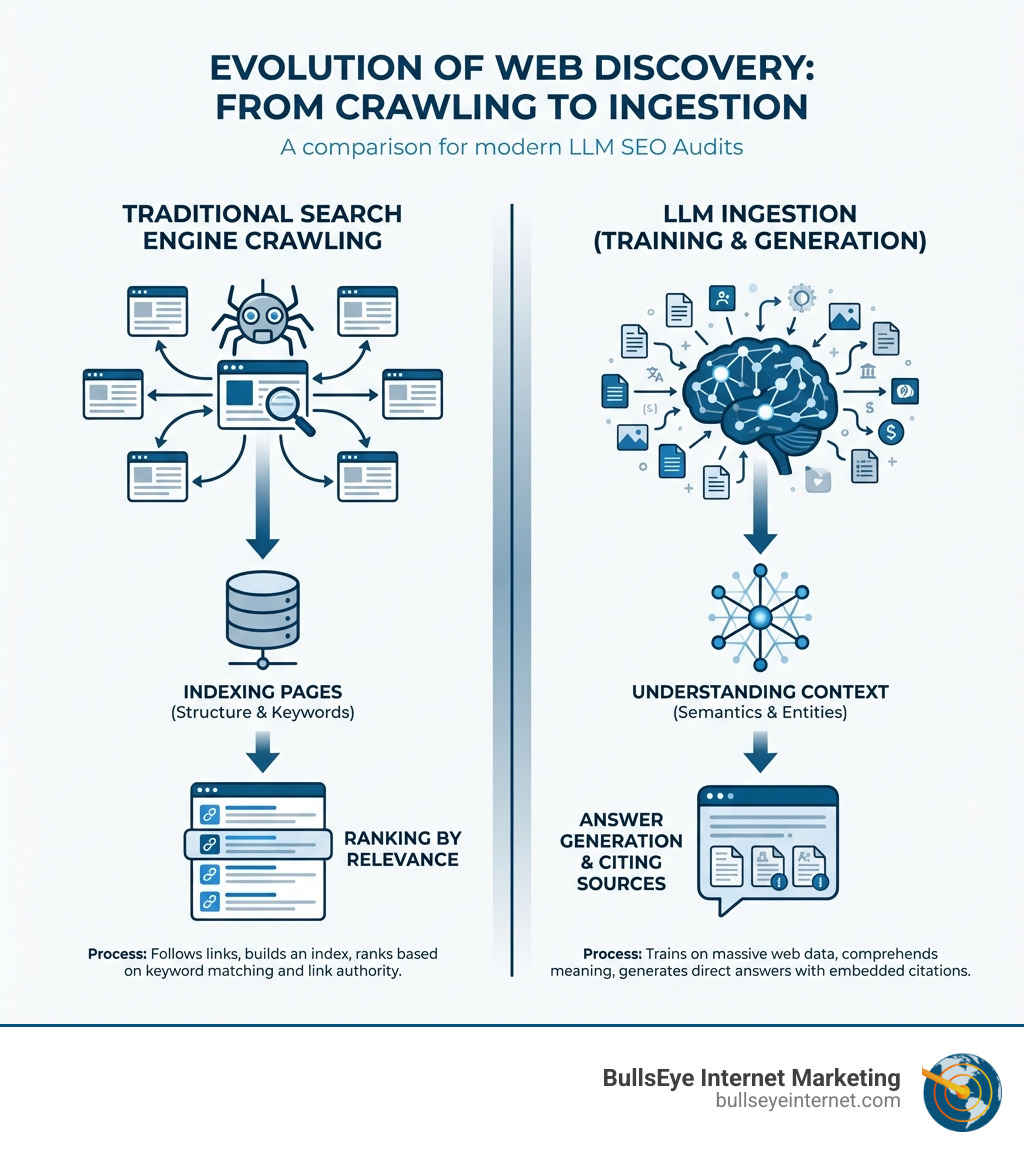
LLMs don’t crawl the web like traditional search engines. They train on it, summarize it, and cite it (sometimes). If the LLM can’t quickly determine what your page is about, how reliable it is, and how relevant it is to the query, it won’t use it. A small number of trusted sites end up being referenced again and again. If your site isn’t one of them, you’re invisible.
This shift requires a completely different approach to optimization. Traditional SEO tools can’t tell you how AI-powered search engines are interacting with your website and brand. You need to understand how LLMs interpret content structure, evaluate authority, and decide what deserves to be cited.
I’m Ronnie Katz, and since 2006 I’ve helped businesses adapt to every major search evolution, from local SEO to mobile-first indexing. Now, conducting LLM SEO audits has become essential for helping clients maintain visibility in AI-driven search. Let me show you exactly what needs to change.
Simple guide to LLM SEO audit terms:
The Fundamental Shift: How LLMs See and Interpret Your Website
The rise of Large Language Models has ushered in a new era of search, one where the old rules of engagement no longer fully apply. LLMs interpret and “crawl” websites in a fundamentally different way than traditional search engines. While traditional search engines like Google primarily crawl, index, and rank pages based on a myriad of signals (keywords, backlinks, technical health), LLMs operate more like sophisticated learners. They train on vast datasets of web content, summarize information, and then cite sources to generate conversational answers.
This means that instead of just looking for keywords and links, LLMs are looking for clarity, structure, semantic relevance, and intent alignment. If your content strategy is still built around blue links and keyword stuffing, you’re playing checkers in a game that’s moved to 4D chess. This shift has a tangible impact on website traffic; as mentioned earlier, organic CTR fell by 34.5% after Google AI Overviews were introduced, and even the #1 ranking link doesn’t get the traffic it used to. This isn’t just about search rankings anymore; it’s about predictive relevance – how likely an LLM is to consider your content relevant and trustworthy enough to include in its generated answers.
To understand this change in more detail, it is helpful to look at how Google itself describes AI Overviews and organic traffic trends in its own updates. You can read Google’s perspective on how AI Overviews affect click quality and volume here: latest data on organic clicks.
From Keywords to Concepts: Understanding Semantic Search
Gone are the days when simply sprinkling keywords throughout your content guaranteed visibility. LLMs excel at semantic search, meaning they understand the context and intent behind a user’s query, not just the exact words used. This requires our content to be:
- Semantically Rich: Our content needs to cover topics comprehensively, exploring related sub-topics and entities to demonstrate deep understanding. LLMs don’t just care about keywords; they care about context, coverage, and relevance.
- Contextually Understood: LLMs look for how well our content addresses the nuances of a topic. This involves using natural language, answering implicit questions, and providing clear, unambiguous information.
- Entity-Focused: LLMs are excellent at recognizing entities – people, places, organizations, concepts. Our content should clearly define and consistently refer to these entities, helping LLMs build a robust understanding of our brand and its expertise.
- Topically Authoritative: We need to establish our website as an authority on specific topics. This means creating comprehensive content clusters, interlinking related articles, and demonstrating genuine expertise (E-E-A-T).
- Aligned with Natural Language Queries: Users are increasingly interacting with AI using conversational language. Our content should be structured to answer these natural language questions directly and concisely, anticipating user intent and providing immediate value. This is where prompt alignment becomes crucial.
The New Crawling: How LLMs Ingest and Process Information
Unlike the traditional “spider” that systematically crawls links, LLMs often ingest data in more varied ways, sometimes through training datasets, real-time browsing, or specialized AI crawlers. A critical difference is how they handle JavaScript. Modern AI tools often crawl websites without executing JavaScript, which means they might “see” a very different version of your page than a human browser or a fully rendering traditional search engine bot.
This can lead to a visibility problem if our crucial content or on-page SEO elements are dependent on JavaScript. Our LLM SEO audit must therefore include:
- Real-Time Web Crawl Compatibility: We need to ensure that our website’s core content and metadata are accessible and render correctly even without JavaScript. This involves checking for server-side rendering (SSR) or ensuring that essential information is present in the initial HTML.
- Machine-Readable Structure: LLMs thrive on well-organized, clean HTML. This means using proper heading tags (H1, H2, H3), lists, tables, and paragraphs that clearly delineate information. A “hot mess” of formatting will likely be overlooked.
- Importance of Sitemaps for LLMs: Just as with traditional SEO, XML sitemaps remain vital. They help search engines and AI crawlers find all important pages on our site and understand its structure, ensuring nothing valuable is missed during the ingestion process. For additional background on how sitemaps support findy and crawling, see Google’s guidance on sitemaps.
- Metadata Accessibility: Crucial elements like meta descriptions and titles must be present and optimized in the initial HTML, not dynamically injected by JavaScript, so LLMs can easily interpret what our page is about.
The Core Components of an LLM SEO Audit
An LLM SEO audit is a deep dive into how well our digital footprint aligns with the unique demands of AI-driven search. It’s about diagnosing why LLMs might be skipping our site and what needs fixing to earn visibility in this new landscape.

Our comprehensive audit focuses on several key areas:
- Content Structure: Ensuring our content is organized in a way that LLMs can easily parse, understand, and summarize.
- Technical Readiness: Verifying that our website’s technical foundation supports optimal LLM ingestion and interpretation.
- Authority Signals: Assessing our brand’s perceived trustworthiness and expertise in the eyes of AI models.
- Entity Salience: Confirming that our brand and its core concepts are consistently recognized and understood across the web.
- Bias Mitigation: Actively working to ensure our content is not inadvertently overlooked due to biases inherent in LLM training data.
How to Structure Content for Your LLM SEO Audit
LLMs aren’t impressed by flashy visuals or clever intros; they want clarity, consistency, and easy-to-parse content. To optimize our content for LLM understanding and citation, we focus on:
- Answer Chunking and Format: Break down long paragraphs into concise, digestible sections, ideally 30-50 words. Use clear headings, bullet points, and numbered lists to make information scannable. This “liftable” content is easier for LLMs to extract and summarize.
- Question-Led Headers: Rephrase headers as natural language questions that users might ask. Then, immediately follow with a concise, direct answer (the “answer-first” approach). For example, instead of “Benefits of XYZ,” use “What are the benefits of XYZ?” followed by a direct answer.
- Front-Loading Information: Place the most important information at the beginning of sections and articles. LLMs often prioritize the initial content for summarization.
- Readability: Our content should be easy for both humans and machines to read. This includes using simple language, avoiding jargon where possible, and maintaining a logical flow. Tools like Surfer SEO can help us optimize for semantic depth and content structuring, ensuring our content is machine-friendly.
Key Technical Checks in an LLM SEO Audit
Technical SEO is still foundational, but with an LLM twist. Our audit carefully checks for:
- Structured Data Readiness: This is huge. Schema markup, especially JSON-LD, helps LLMs understand the context and meaning of our content. We use specific schema types like Article, FAQPage, Product, or Speakable to explicitly tell LLMs what our content is about. We test pages using tools like Google’s Rich Results Test or the Schema Markup Validator to ensure our markup is valid and correctly implemented. This helps LLMs interpret our data accurately.
- Page Experience Signals: While traditionally important for user experience and ranking, these signals also tell LLMs about the quality and reliability of our site. Core Web Vitals (Largest Contentful Paint, First Input Delay, Cumulative Layout Shift) directly impact how LLMs perceive our site’s performance. A fast, stable, and interactive site signals quality.
- Mobile-Friendliness: With many users interacting with LLMs on mobile devices, a responsive and mobile-friendly site is crucial for seamless ingestion and display of our content.
- HTTPS: Secure websites (HTTPS) are a basic trust signal for both users and LLMs. It assures them that our site is reliable and secure.
- Crawlability and Indexability: Although LLMs don’t “crawl” in the traditional sense, their underlying data ingestion mechanisms still rely on findable and accessible content. We ensure our robots.txt isn’t blocking important content, our sitemaps are up-to-date, and canonicalization is correctly implemented to prevent duplicate content issues. Google’s guidance on structured data is our bible here and can be reviewed at Google’s guide to structured data.
Building Trust: Auditing Your Brand’s Authority and Entity Home
LLMs, especially those generating answers, place a high value on trust and authority. They want to cite reliable sources. This is where the concept of an “entity home” comes into play. An entity home is the definitive source of information about our brand, product, or key concepts. It’s where LLMs should go to understand who we are and what we stand for.
Our LLM SEO audit evaluates:
- E-E-A-T (Experience, Expertise, Authoritativeness, Trustworthiness): These are critical quality signals. We audit our content for clear author bios, original research, citations to credible sources, and transparent business information. LLMs use these signals to assess the reliability of our content.
- Author Signals: Do our authors have visible credentials and a track record of expertise in their field? Clearly associating expert authors with our content builds immense trust for LLMs.
- Brand Trust: Beyond individual authors, we assess the overall reputation and trustworthiness of our brand across the digital landscape.
- Mention Density vs. Backlinks: While backlinks are still valuable, LLMs also look at the frequency and context of brand mentions across the web. Are we being talked about in relevant, authoritative spaces? Tools like SparkToro can help us audit brand mention frequency and understand our brand presence across social and content platforms. This signals to LLMs that we are a recognized and trusted entity.
- Consistent Brand Information: Ensure our brand name, address, phone number (NAP), and other key details are consistent across our website, social profiles, and business directories. This consistency helps LLMs accurately identify and trust our entity.
Essential Tools, Metrics, and Post-Audit Actions
Navigating the LLM-driven search landscape requires more than just a new mindset; it demands new tools and a refined approach to measurement. We can’t manage what we don’t measure, and in this evolving environment, what we measure has changed.
The LLM SEO Toolkit: What to Use and Why
While no single tool does it all (yet!), a combination of specialized platforms gives us the insights we need for an effective LLM SEO audit:
- Content Optimization Tools: For LLM-aligned content structuring, tools like Surfer SEO are invaluable. They help us optimize around semantic relevance, content depth, and clarity, which are exactly what LLMs look for. Clearscope is another excellent tool for semantic depth, entity recognition, and topical authority, aligning perfectly with LLM’s content evaluation.
- Real-Time Monitoring Tools: Platforms like ContentKing offer real-time content monitoring, giving us a baseline for how content should be structured and semantically enriched for conversational search behavior. While it might not show citations in every LLM yet, it’s essential for site structure and content health.
- Prompt Finding and User Intent Mapping Tools: To understand how users are asking questions in conversational interfaces, tools like AlsoAsked are crucial. They don’t just care about keywords; they reveal context, coverage, and relevance – precisely what LLMs seek when deciding what to include in an answer.
- Schema Implementation Tools: For easy schema implementation and visibility improvements, we leverage plugins like Rank Math. They simplify the process of adding structured data, which is a cornerstone of LLM optimization.
- Brand Presence Analysis Tools: To understand our brand’s digital footprint and track mentions for LLM citation audits, SparkToro is very useful. It helps us see where our brand is being discussed and cited.
- LLM Browsing + Source Attribution Prompts: Don’t underestimate the power of direct interaction! Using ChatGPT browsing features with source attribution prompts allows us to conduct live checks on whether our site is being cited by GPT, providing immediate, real-world feedback.
Measuring What Matters: Key Metrics for LLM Visibility
Traditional SEO metrics (like organic keyword rankings in blue links) are still important, but they no longer tell the whole story. For LLM visibility, we track:
- AI Visibility Score: This metric reflects how often our brand is mentioned in AI-generated answers compared to competitors. Tools like Semrush’s AI Visibility Toolkit provide this.
- Citation Tracking: How often are LLMs explicitly citing our website or content as a source? This is a direct indicator of trust and relevance.
- Share of Voice in AI Answers: Beyond simple citations, what percentage of AI-generated answers for our target topics include our brand or content?
- Prompt Rankings: For specific conversational prompts, where does our content appear in the AI’s generated response? Is it a primary source, or just a supporting detail?
- Sentiment Analysis: How is our brand being portrayed in AI-generated answers? Is the sentiment positive, negative, or neutral? This impacts brand perception.
- Brand Mention Frequency: Tracking how often our brand is mentioned across the web helps LLMs gauge our overall authority and salience.
- Traffic from AI Referrers: Some LLM platforms (like Perplexity or Google’s AI Overviews) may send traffic back to our site. Monitoring this referral traffic helps us measure direct ROI. Organic click volume year-on-year has remained stable according to Google, but the source of those clicks might be shifting.
From Audit to Action: Implementing Your Findings
An LLM SEO audit isn’t just about identifying problems; it’s about creating a roadmap for improvement. After we complete the audit, we take actionable steps:
- Prioritizing Fixes: We create a prioritized backlog of issues, focusing on those with the highest impact and lowest effort first. This ensures we’re addressing critical visibility blockers efficiently.
- Content Updates and Refreshes: We revisit and refine existing content to meet AI performance standards. This often involves restructuring for clarity, adding schema markup, enhancing semantic richness, and ensuring alignment with user intent. For example, rewriting headers as questions and providing concise answers. We recommend quarterly content refreshes, as LLMs evolve quickly and reward fresh, well-structured content.
- Mitigating Data Bias: If our content is being overlooked due to potential LLM biases (e.g., if our niche is underrepresented in training data), we actively work to structure our content and signals to clearly demonstrate trust and authority. This might involve publishing on third-party expert platforms or enhancing E-E-A-T signals.
- A/B Testing Content Structures: We experiment with different content layouts and formats to see what resonates best with LLMs, constantly refining our approach.
- Creating an Implementation Backlog: We document all recommended changes, assign owners, and set due dates, treating LLM optimization as an ongoing, iterative process rather than a one-time fix. We implement fixes in small, testable increments and re-audit to verify results.
Frequently Asked Questions about LLM SEO Audits
What is the biggest difference between a traditional SEO audit and an LLM SEO audit?
A traditional SEO audit primarily focuses on helping our website rank higher in the “10 blue links” of a search engine results page. It examines factors like keywords, backlinks, technical crawlability, and domain authority. The goal is to get clicks from a list of results.
An LLM SEO audit, on the other hand, shifts its focus to being cited or featured within a generative AI answer. It analyzes how well our content is structured for machine readability, the strength of our brand’s entity-level authority, our E-E-A-T signals, and how well our content aligns with conversational prompts. The goal is to be the source an LLM trusts enough to summarize or directly reference in its generated response. It’s the difference between being listed and being quoted.
Is having good structured data enough to perform well in LLMs?
While having good structured data is an incredibly strong start and a critical foundation for LLM visibility, it’s not the whole story. Think of it as providing a clear table of contents for a book; it helps, but the book still needs to be well-written. LLMs also heavily weigh factors like:
- Clarity and Conciseness: Is our text easy to understand and summarize?
- Brand Authority (Mention Density): Are we consistently recognized and referenced by other credible sources?
- Freshness of Content: LLMs often prefer up-to-date information.
- Prompt Alignment: Does our content directly answer common user questions and align with how users phrase queries in conversational AI?
- Overall Content Quality: Is our content genuinely helpful, comprehensive, and accurate?
So, structured data is essential for machine interpretation, but it needs to be combined with high-quality, well-structured, and authoritative content to truly perform well in LLM environments.
How can I measure the ROI of an LLM SEO audit?
Measuring the Return on Investment (ROI) of an LLM SEO audit involves tracking specific metrics that reflect visibility and impact within AI-driven search environments:
- Increase in Brand Mentions and Citations: Monitor how frequently our brand or content is explicitly cited or mentioned by LLMs across platforms like ChatGPT, Google’s AI Overviews, or Perplexity. This can be tracked using specialized LLM SEO tools.
- Traffic from AI Referrers: Keep an eye on our analytics for referral traffic coming from AI-powered search results or conversational interfaces. While AI Overviews might reduce direct clicks, some platforms do attribute traffic.
- Share of Voice in AI Answers: Analyze how often our brand appears in AI-generated answers for our target keywords or topics compared to our competitors. An increase here indicates improved LLM visibility.
- Improved Brand Perception: Conduct sentiment analysis on AI-generated content that mentions our brand to see if the tone and attributes are positive, aligning with our brand goals.
- Conversion Rates: If our content is being cited and driving traffic (even if indirect), track conversions (leads, sales, calls) that can be attributed to this new channel. We specialize in generating calls and sales, and optimizing for LLMs directly supports this goal by enhancing brand authority and visibility at the answer level.
By tracking these metrics, we can demonstrate how our LLM SEO audit leads to improved brand visibility, authority, and ultimately, a positive impact on our business objectives.
Conclusion: Future-Proofing Your Brand in the Age of AI
The search landscape has undeniably shifted. We’ve moved beyond a simple list of links to an era where answers are generated directly, and brands must earn their place within those answers. An LLM SEO audit is no longer an optional luxury; it’s an essential strategy for maintaining visibility and authority in this evolving digital world, especially for businesses operating across Florida and all 50 US states.
Our focus at BullsEye Internet Marketing has always been on providing our clients with a competitive advantage, and that commitment extends to the AI-driven future. By prioritizing clarity, authority, and machine-readable structure, we can ensure our content is not just seen, but understood and trusted by the LLMs that are increasingly mediating user information consumption.
The journey doesn’t end with a single audit. Continuous auditing, optimization, and adapting to the rapid pace of AI development are key to long-term success. We help businesses like yours steer these new paradigms, ensuring your brand stands out where it matters most – in the minds of your customers, and in the answers generated by AI.
