
An Essential Guide to Local Pack Optimization
What Is Local Pack Optimization (And Why It Matters for Your Business)
Local Pack Optimization is the process of improving your business’s visibility in Google’s top three local search results — the map-based listings that appear above organic results for searches like “plumber near me” or “coffee shop downtown.”
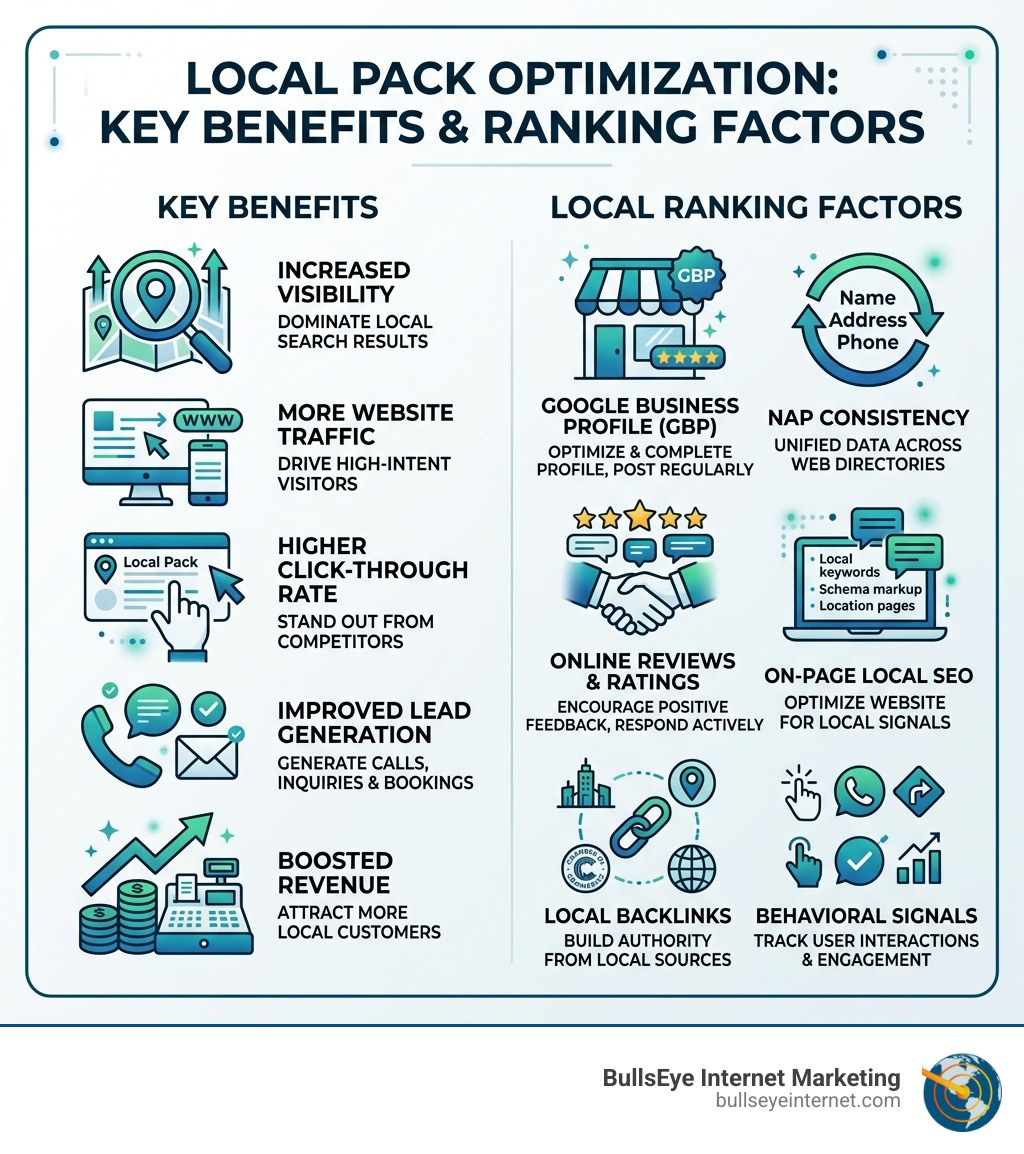
Here’s what it covers at a glance:
- Optimize your Google Business Profile (GBP) — complete every field, choose the right categories, and post regularly
- Build NAP consistency — your Name, Address, and Phone number must match exactly across every directory
- Generate and manage reviews — steady review velocity and high ratings are critical ranking signals
- Strengthen your website’s local signals — local keywords, schema markup, and location pages support your GBP
- Earn local backlinks — links from community sites, chambers of commerce, and local directories build authority
- Track behavioral signals — clicks, calls, and direction requests all influence your ranking
These are the core levers. The sections below go deeper on each one.
If you run a local business, the stakes here are high. Businesses in the Local Pack receive 126% more website traffic and 93% more user actions — calls, clicks, and direction requests — than businesses ranked just outside the top three. Meanwhile, 42% of all local searchers click directly on a Local Pack result. That’s a enormous share of potential customers who may never scroll down to find you.
Think of it this way: ranking outside the Local Pack is like having a great storefront hidden at the end of an alley with no signage. The customers are out there — they just can’t find you.
I’m Ronnie Katz, founder of BullsEye Internet Marketing, and I’ve spent over 20 years helping local businesses dominate search results through Google Business Profile optimization, local SEO, and lead generation strategies — Local Pack Optimization has been central to that work since Google first introduced local listings. Let’s walk through exactly what it takes to earn one of those top three spots.
Local Pack Optimization word roundup:
Core Ranking Factors for Local Pack Optimization
To win at Local Pack Optimization, we have to understand how Google’s “brain” decides who gets those three coveted spots. Unlike standard organic search, which focuses heavily on backlinks and content depth, the Local Pack relies on three primary pillars: Relevance, Distance, and Prominence.
The Three Pillars of Local Search
Google uses these factors to ensure that when a user in Miami searches for “emergency AC repair,” they don’t get a list of great HVAC companies in Orlando.
| Factor | What It Means | How to Influence It |
|---|---|---|
| Relevance | How well your profile matches the searcher’s intent. | Use precise GBP categories and keyword-rich descriptions. |
| Distance | How close your business is to the searcher or the specified location. | Ensure your service areas and physical address are verified. |
| Prominence | How well-known and trusted your business is online. | Focus on reviews, local citations, and quality backlinks. |
Behavioral Signals: The “Human” Factor
Beyond the basic pillars, Google watches how people interact with your listing. These are called behavioral signals. If searchers constantly click your “Call” button or request “Directions” to your office in Fort Lauderdale, Google sees your business as a popular, high-quality destination.
High click-through rates (CTR) and engagement tell the algorithm that you are the right answer for that specific query. This is why having an appealing, complete profile isn’t just for the customers—it’s for the algorithm too. For a deeper dive into these mechanics, check out The Definitive Guide to GMB Optimization.
Mastering Google Business Profile (GBP) for the 3-Pack
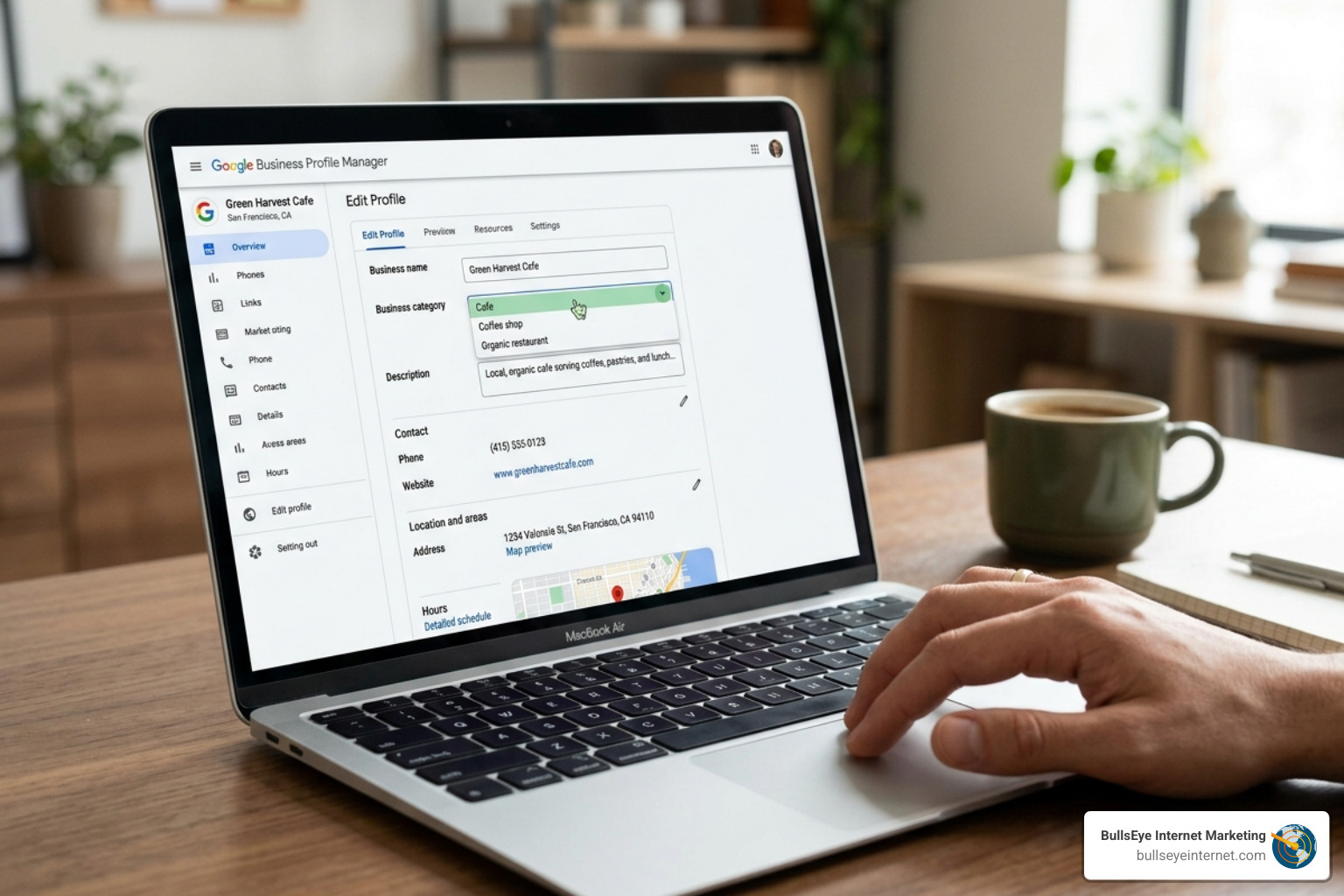
Your Google Business Profile (formerly Google My Business) is the foundation of your local presence. If your GBP is a mess, the rest of your SEO efforts won’t matter much.
Choosing Your Categories Wisely
This is arguably the most important step. Your Primary Category is the #1 influential factor for ranking in the Local Pack. If you are an “Elder Law Attorney” in West Palm Beach, don’t just pick “Lawyer.” Be as specific as possible. You can add up to nine secondary categories to cover other services, but your primary choice carries the most weight.
Completing the Profile
We often see businesses leave sections blank, which is a huge missed opportunity.
- Business Description: Write a compelling, 750-character summary of what you do. Include your main services and the cities you serve (like Hollywood or Coral Springs), but don’t stuff it with keywords until it sounds like a robot wrote it.
- Attributes: Are you women-led? Do you offer free Wi-Fi? Are you wheelchair accessible? These attributes help you show up for specific “niche” searches.
- Service Areas: If you are a Service-Area Business (SAB) like a plumber or locksmith, you must define your radius. You can list specific cities or zip codes across Broward or Miami-Dade counties.
For a step-by-step walkthrough, use our GBP Optimization Checklist and explore How to Optimize Your GMB Listing – 5 Methods That Guarantee Results.
Leveraging Reviews and Photos for Local Pack Optimization
Reviews are the “currency” of the Local Pack. Google doesn’t just look at your star rating; it looks at Review Velocity (how often you get new reviews) and Review Diversity (reviews across different platforms).
- Response Strategy: You must respond to every review—both the glowing five-star ones and the occasional grumpy one. This shows Google you are active and care about customer experience.
- Keyword-Rich Reviews: While you can’t tell customers what to write, reviews that mention your specific services (e.g., “best roofing repair in Boca Raton”) help boost your relevance.
- Visual Impact: Profiles with high-quality photos see significantly more engagement. Upload photos of your team, your office, and your completed projects. Pro tip: Use “geotagging” to embed location data into your images, signaling to Google exactly where that work was done.
Managing your reputation is a full-time job. Our Google My Business Reputation Management Guide can help you automate this process. For expert insights on multi-location strategy, this video on GBP, Map Pack Rankings, Multi-location With Greg Gifford is a must-watch.
On-Site and Off-Site Local SEO Tactics
Local Pack Optimization doesn’t stop at your Google profile. Your website and your presence across the broader web need to tell the same story.
NAP Consistency: The Golden Rule
NAP stands for Name, Address, and Phone Number. If your business is listed as “BullsEye Marketing” on Google but “BullsEye Internet Mktg” on Yelp, Google gets confused. Inconsistency breeds distrust in the algorithm. Ensure your NAP is identical—character for character—across your website, social media, and local directories. You can learn more about this in The Essential Guide to Local Citations.
On-Site Signals and Schema
Your website should act as a giant neon sign for Google.
- Location Pages: If you serve multiple cities like Delray Beach, Boynton Beach, and Lake Worth, create dedicated pages for each. Each page should have unique content, local testimonials, and an embedded Google Map.
- LocalBusiness Schema: This is a bit of “code” you add to your site that tells search engines exactly who you are and where you are located. It’s like giving Google a digital business card.
- Local Backlinks: A link from a local Chamber of Commerce or a neighborhood blog in Jupiter is often more valuable for local rankings than a link from a generic national site.
For a complete breakdown of these strategies, see our Local SEO Complete Guide and Local Search Domination: Google Maps SEO Secrets Revealed.
The “Openness” Filter and AI Overviews
Google recently updated its algorithm to prioritize businesses that are currently open. If you search for “coffee shop” at 11:00 PM, Google is less likely to show you a shop that closed at 5:00 PM. Keep your hours 100% accurate to avoid being filtered out.
Furthermore, with the rise of AI Overviews, Google is pulling data from high-authority profiles and websites to answer conversational queries. Maintaining a detailed, authoritative presence ensures you remain visible as search technology evolves.
Technical Foundations of Local Pack Optimization
If your website takes ten seconds to load on a smartphone, you’ve already lost the battle. Over 60% of local searches happen on mobile devices.
- Mobile Responsiveness: Your site must look and function perfectly on a phone.
- Core Web Vitals: These are Google’s metrics for speed and user experience. Fast-loading sites get a ranking “thumbs up.”
- HTTPS: Security is non-negotiable. If your site isn’t secure, Google won’t trust you enough to put you in the top three.
Frequently Asked Questions about the Map Pack
How long does it take to rank in the top 3?
There is no “magic button,” but typically, basic changes to a GBP can show results in 2 to 4 weeks. However, for highly competitive industries in major areas like Miami or Fort Lauderdale, a comprehensive strategy can take 3 to 6 months to achieve a stable top-3 position. Consistency is key. Check out our Google 3-Pack Tips Guide for more on timelines.
Can service-area businesses rank without a physical address?
Yes! If you work out of your home and travel to clients (like a mobile detailer or a plumber), you can hide your home address and set a “Service Area” instead. While businesses with physical storefronts sometimes have a slight proximity advantage, a well-optimized SAB profile can absolutely dominate the Local Pack. Learn more at How to Optimize Google Business Profile.
What are the most common mistakes to avoid?
The biggest “rank-killers” are:
- Keyword Stuffing: Adding “Best Plumber Miami” to your actual business name when it’s just “Joe’s Plumbing.” This can get your profile suspended.
- Inconsistent NAP: Having different phone numbers or addresses listed across the web.
- Ignoring Reviews: Letting negative feedback sit without a professional response.
- Wrong Categories: Choosing a broad category when a specific one exists.
A simple audit can fix most of these. See Why a Citation Audit is the Key to Local SEO Success to get started.
Maintaining Local Pack Dominance with BullsEye Internet Marketing
Winning at Local Pack Optimization is about more than just “tricking” an algorithm; it’s about proving to Google—and your customers—that you are the most relevant, prominent, and reliable choice in your neighborhood. From Miami to West Palm Beach, the businesses that show up in the top three are the ones that stay active, stay consistent, and stay focused on the user experience.
At BullsEye Internet Marketing, we specialize in making that happen. We don’t believe in long-term contracts because we believe our results should speak for themselves. Plus, we work with only one client per industry per geographic area, giving you a massive competitive advantage in your local market.
Whether you need help with Business Listing Optimization or a complete local SEO overhaul, we are here to help you get more calls and more sales. Ready to claim your spot in the 3-Pack? Let’s get to work.
