
How Google Determines Local Rankings
Local SEO is the process of optimizing your online presence to attract more customers from relevant local searches on Google and other search engines. When someone searches for “restaurants near me” or “plumber in Miami,” businesses optimized for local search appear in the map pack and local results.
What is Local SEO?
- Geographic targeting – Shows your business to searchers in specific locations
- Google Maps visibility – Appears in the map pack with three featured businesses
- High purchase intent – Captures customers ready to visit or call
- Mobile-first – Most local searches happen on smartphones
- Proximity-based – Rankings consider distance from the searcher
| Local SEO | Traditional SEO |
|---|---|
| Targets specific geographic areas | Targets broad, national audiences |
| Focuses on Google Business Profile | Focuses on website content |
| Emphasizes proximity and location | Emphasizes domain authority |
| Drives phone calls and foot traffic | Drives website traffic |
| Results in 1-2 months | Results in 4-6+ months |
Here’s why this matters for your business: 76% of consumers who search for something nearby visit a business within a day. That’s not just traffic—that’s potential customers with immediate purchase intent walking through your door or calling your phone.
The challenge? Most businesses struggle with local visibility. They have inconsistent information across directories, outdated Google Business Profiles, and websites that don’t signal their location to Google. Meanwhile, their competitors capture those high-intent local searches.
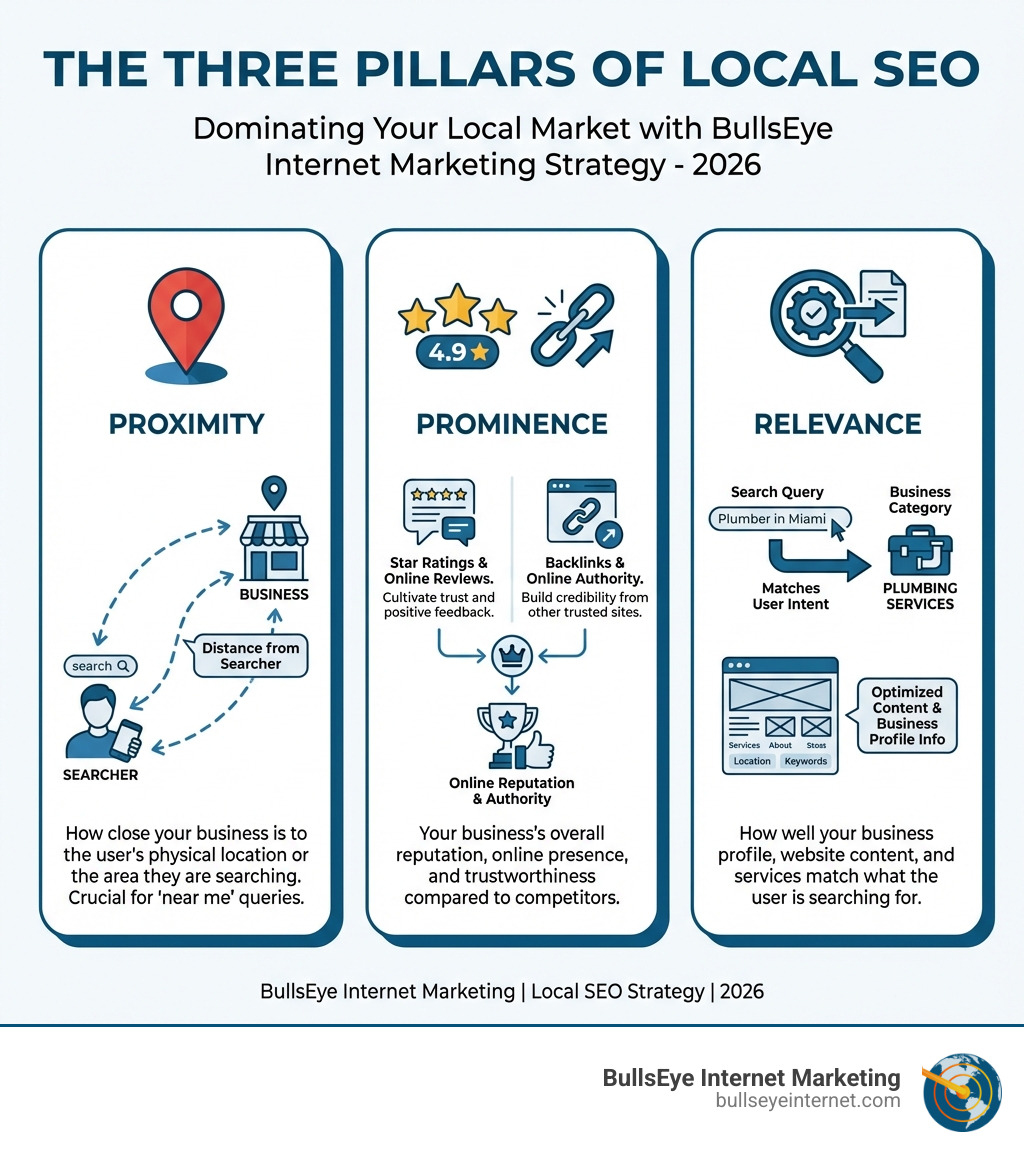
Local SEO works differently than traditional SEO. Google uses three main factors to determine local rankings: relevance (how well you match the search), distance (how close you are to the searcher), and prominence (how well-known and trusted you are). Master these three pillars, and you control your local market.
This guide walks you through every essential component—from claiming your Google Business Profile to managing reviews, building citations, and optimizing your website for local searches. You’ll learn what works, what wastes time, and how to track results that matter: more calls, more customers, more revenue.
I’m Ronnie Katz, and since 2006, I’ve helped hundreds of businesses dominate their local markets through proven Local SEO strategies at BullsEye Internet Marketing. I’ve seen how the right local optimization can transform a struggling business into the go-to choice in their community.
Similar topics to Local SEO:
- content marketing for plumbers
- dentist local content marketing
- search engine optimization service near me
When a customer searches for a business or service near their location, Google’s sophisticated algorithm swings into action. It aims to provide the most relevant, useful, and accurate local results possible. This is why understanding how Google processes local searches is crucial for any business hoping to capture its local market.
Google presents local search results in a few key ways:
- The Local Pack: This is the coveted “map pack” that often appears at the top of local search results. It typically features a map with three business listings, complete with basic information like name, address, phone number, and star ratings. These listings dominate visibility and get a significant share of clicks, especially on mobile devices.
- Google Maps: Beyond the Local Pack, Google Maps is the dedicated platform for geographical searches. Businesses with optimized profiles are easily findable here.
- Local Organic Results: These are the traditional “blue link” search results that appear below the Local Pack, but they are still influenced by location-specific factors, often featuring local businesses or content relevant to a specific area.
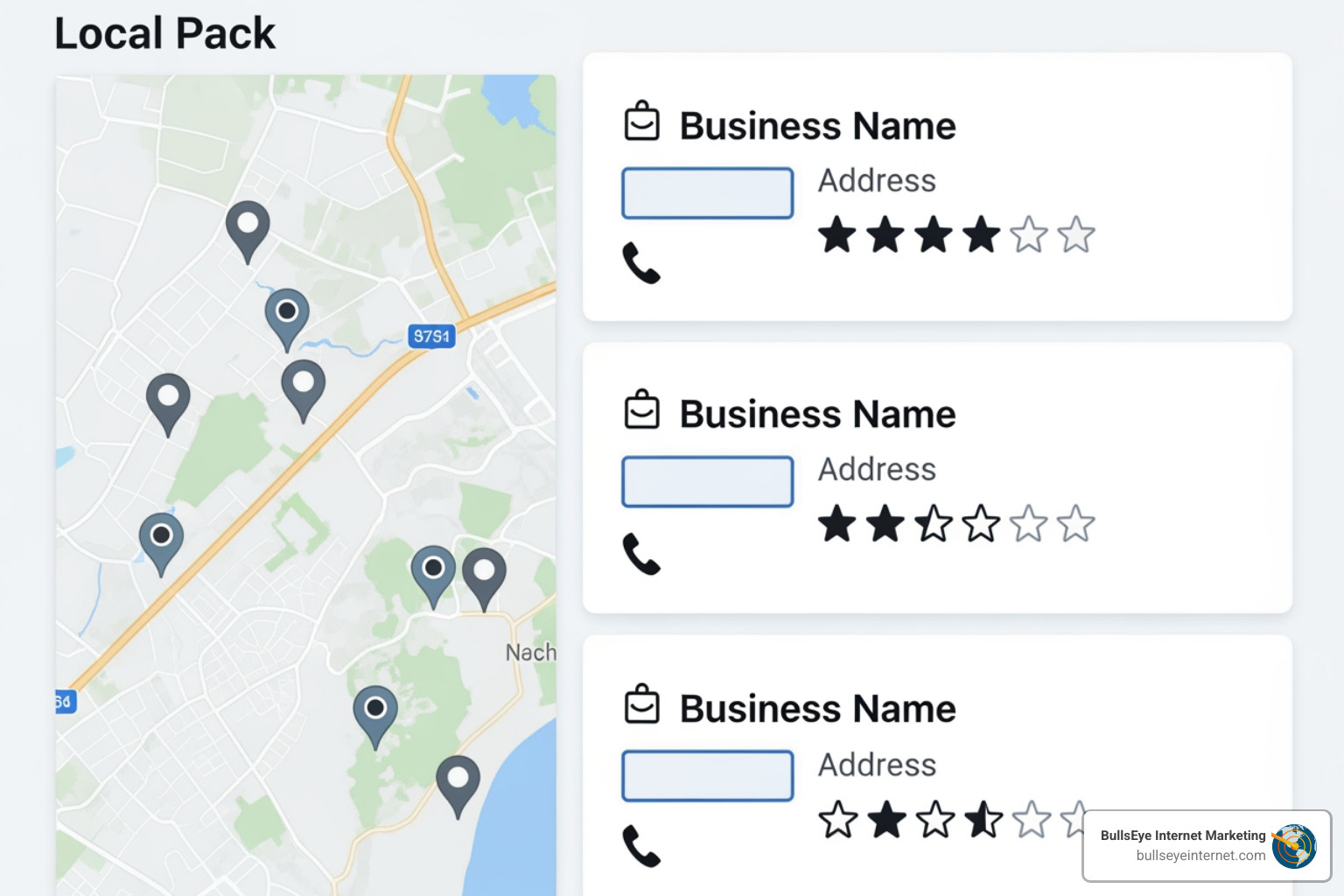
Google uses a unique set of signals to determine who shows up and where in these local results. While the exact algorithm is a closely guarded secret (to ensure fairness and prevent manipulation), Google openly states that three primary factors drive local rankings: Relevance, Distance, and Prominence. We’ll dive into these pillars in detail shortly.
For further guidance on how Google ranks businesses locally, you can always refer to Tips to improve your local ranking on Google.
The Three Pillars of Local Ranking
Understanding these three core pillars is like having a secret map to local search success. They are the foundation of Local SEO.
Relevance Explained: This refers to how well a business’s profile matches what a user is searching for. If someone searches for “Italian restaurant in Miami,” Google looks for businesses that clearly identify as Italian restaurants in Miami. Our goal is to ensure Google understands exactly what our business offers and how it relates to potential customer queries. This involves providing complete and accurate information across our online presence, especially within our Google Business Profile. Google’s aim is to match a searcher’s intent with the most appropriate local business.
Distance Explained: This is pretty straightforward: how far each potential search result is from the location term used in a search. If a user searches for “plumber in West Palm Beach,” Google prioritizes plumbers within or very close to West Palm Beach. If no location is specified, Google calculates distance based on what it knows about the searcher’s current location. This factor highlights the importance of having accurate location data and optimizing for the specific service areas we cover, whether it’s Broward County, Palm Beach County, or the entirety of South Florida.
Prominence Explained: Prominence refers to how well-known a business is. Think of it as a business’s offline reputation reflected online. Factors contributing to prominence include:
- Offline reputation: Well-known businesses are more likely to be prominent in local search results.
- Online reviews: The quantity, quality, and recency of reviews, especially on Google Business Profile, strongly correlate with higher local rankings. Positive reviews signal trustworthiness and customer satisfaction to Google.
- Backlinks: The number and quality of links from other reputable websites pointing to our business’s website. These act as votes of confidence.
- Citations: Mentions of our business’s Name, Address, and Phone number (NAP) across various online directories and websites. Consistent citations build credibility.
The Impact of “Near Me” Searches
The phrase “near me” has revolutionized local search. Searches for “near me” keywords have grown globally by over 400% year-over-year. This isn’t just a trend; it’s a fundamental shift in how people look for local businesses, driven largely by mobile devices.
- Growth of “near me” queries: This explosion in “near me” searches signifies a high level of purchase intent. When someone searches for “coffee shop near me” or “auto repair near me,” they’re often looking for an immediate solution and are ready to make a purchase or visit.
- Mobile search behavior: Most local searches happen on smartphones. Users are on the go, often looking for directions, contact information, or quick answers. This makes mobile optimization not just important, but absolutely crucial for Local SEO.
- Capturing immediate customer needs: For businesses in our service areas like Miami, Fort Lauderdale, or Boca Raton, being visible for these “near me” searches means capturing customers right when they need our services the most.
- Voice search implications: With the rise of voice assistants, “near me” searches are becoming even more conversational. Optimizing for natural language queries (e.g., “Hey Google, where’s the closest pizza place?”) is an evolving aspect of Local SEO.
The Core Components of an Effective Local SEO Strategy
Now that we understand how Google ranks local businesses, let’s explore the actionable strategies we can implement to improve our local visibility. An effective Local SEO strategy isn’t just about one thing; it’s a harmonious blend of several key components working together. These include optimizing our Google Business Profile, managing online reviews, building consistent local citations, refining our website for local queries, and ensuring our online presence is mobile-friendly.
Master Your Google Business Profile (GBP)
Your Google Business Profile (formerly Google My Business) is arguably the single most important asset for Local SEO. It’s our digital storefront on Google Search and Maps, and Google draws heavily from the information here.
Here’s how to master it:
- Claiming and verification: First things first, we must claim and verify our business profile. This signals to Google that we are authorized to represent the business and allows us to manage the information directly.
- Business name: Ensure our business name is accurate and consistent with our real-world branding.
- Address: Provide a precise physical address for our brick-and-mortar locations. For service-area businesses, we can hide the address while still defining our service area (e.g., all of Palm Beach County).
- Phone number (NAP): List a local phone number. Avoid toll-free numbers for local profiles.
- Categories: Select the most accurate primary category for our business, and then add relevant secondary categories. This helps Google understand exactly what we do.
- Services & products: Detail all the services and products we offer. This provides rich context for Google and potential customers.
- Business hours: Keep our regular and special hours (holidays, events) up-to-date. Accurate hours help customers know when they can visit.
- Photos and videos: Upload high-quality photos of our storefront, interiors, team, and products. Visuals help tell our story and make our profile more engaging.
- Google Posts: Use Google Posts to share updates, offers, events, and news. This keeps our profile active and fresh.
- Q&A feature: Monitor and respond to questions customers ask on our GBP. This shows we’re engaged and provides valuable information.
Essential GBP optimization tasks:
- Verify our business.
- Fill in every field completely and accurately.
- Choose the most specific categories.
- Add engaging photos and videos.
- Post regular updates.
- Respond to customer questions promptly.
- Ensure NAP (Name, Address, Phone Number) consistency across the profile.
The Power of Online Reviews and Reputation
Online reviews are the lifeblood of Local SEO. They are a critical ranking factor and play a massive role in building trust and social proof with potential customers.
- Reviews as a ranking factor: Google explicitly states that the quantity, quality, and recency of reviews impact local search rankings. Businesses with more positive reviews tend to rank higher.
- Building trust: 99% of consumers read online reviews before making a purchase decision. A strong collection of positive reviews builds immediate credibility.
- Social proof: When potential customers see others vouching for our business, they are more likely to choose us.
- Encouraging customer reviews: We should make it easy for satisfied customers to leave reviews. This can involve asking directly, sending follow-up emails with review links, or using signage in our physical locations. However, never offer incentives for reviews, as this violates Google’s guidelines.
- Responding to all reviews: This is non-negotiable. Responding to reviews, both positive and negative, shows we value customer feedback and are engaged. In fact, 92% of consumers consider business owner responses to reviews as part of quality customer service. A professional, empathetic response to a negative review can often mitigate its impact and even turn a negative experience into a positive perception.
- Review quality and quantity: Aim for a steady stream of high-quality, authentic reviews. A sudden influx of many reviews can sometimes appear suspicious to Google, so a consistent, organic approach is best.
Managing Citations for Consistent Local SEO
Citations are mentions of our business’s Name, Address, and Phone number (NAP) across the web. Think of them as digital breadcrumbs that help Google confirm our business’s existence and legitimacy.
- What are citations: A citation is any online mention of our business’s NAP, sometimes including a website link (NAP+W). These can appear on business directories, social media profiles, and other websites.
- NAP consistency: This is paramount. Inconsistent information (even minor differences like “St.” vs. “Street”) can confuse search engines and dilute our Local SEO efforts. Google uses these citations to verify our business details; discrepancies can hurt our rankings. As the experts say, Citation Inconsistency Is No.1 Issue Affecting Local Ranking.
- Structured vs. unstructured citations:
- Structured citations are formal business listings in online directories (e.g., Yelp, Yellow Pages, TripAdvisor, Facebook, Apple Maps, Bing Places).
- Unstructured citations are mentions of our NAP on websites not specifically dedicated to business listings, such as local blogs, news articles, or community event pages. Both types are valuable.
- Major data aggregators: These are large databases that supply business information to many online directories. Ensuring our data is correct with them can propagate accurate information widely.
- Industry-specific directories: Beyond general directories, listing our business on platforms relevant to our specific industry (e.g., Healthgrades for dentists, Avvo for lawyers) can provide highly relevant citations.
- Auditing and cleaning up citations: Regularly audit our existing citations to identify and correct any inconsistencies. There are tools available that can help with this, or we can manually check key directories. Removing or correcting outdated or duplicate listings is crucial for maintaining listing strength.
Optimizing Your Website for Local SEO
While your Google Business Profile is critical, your website also plays a significant role in Local SEO. It’s where potential customers often go for more detailed information and to convert.
- Location-specific pages: If we serve multiple locations (e.g., Miami, Fort Lauderdale, and West Palm Beach), creating dedicated landing pages for each service area is highly effective. Each page should have unique, valuable content custom to that specific location, showcasing local testimonials, staff, and services relevant to the area.
- Localized keywords: Incorporate local keywords naturally into our website content, including city names, neighborhoods, and regional terms relevant to our target audience in South Florida. For example, instead of just “plumbing services,” use “plumbing services in Fort Lauderdale.”
- Title tags and meta descriptions: Optimize the title tags and meta descriptions for each page with localized keywords. These are what users see in search results and can significantly impact click-through rates.
- On-page NAP: Ensure our Name, Address, and Phone number are clearly visible on our website, ideally in the footer or header, and on our contact page. This reinforces consistency and makes it easy for customers and search engines to find our information.
- Embedded Google Map: Embed a Google Map of our business location on our contact or “about us” page. This visually confirms our location and provides an easy way for customers to get directions.
- Mobile-first optimization: With the majority of local searches happening on smartphones, our website must be mobile-friendly. It should load quickly and be easy to steer on any device.
- Page speed: A fast-loading website is essential for user experience and search engine rankings. We optimize images, leverage browser caching, and minimize code to ensure our pages load swiftly.
- LocalBusiness schema: Implementing structured data markup (like LocalBusiness schema) on our website helps search engines better understand our business’s information, such as hours, address, and services. This can lead to improved search results, making our listings more prominent.
Tracking and Measuring Your Success
Implementing Local SEO strategies is only half the battle; the other half is tracking and measuring our performance to ensure our efforts are paying off. We need to know what’s working, what’s not, and where to focus our resources for maximum impact.
- Google Search Console: This free tool helps us monitor our website’s performance in Google Search. We can see which local keywords our site ranks for, identify any technical issues, and understand how Google views our pages.
- Google Business Profile Insights: Our GBP dashboard provides valuable data on how customers interact with our listing. We can see how many people viewed our profile, requested directions, called our business, or visited our website.
- Tracking keyword rankings: We monitor our rankings for specific local keywords (e.g., “dentist West Palm Beach,” “HVAC repair Broward County”). This helps us understand our visibility in local search results.
- Map pack visibility: Monitoring our appearance in the local 3-pack is crucial. This is where a significant portion of local search traffic goes.
- Website traffic: We analyze website traffic from local organic searches to see how many users are finding our site through local queries.
- Phone calls: Tracking calls directly from our GBP listing or from our website helps us measure direct leads generated by our Local SEO efforts.
- Direction requests: Monitoring how many users request directions to our business from our GBP provides insight into physical foot traffic driven by local search.
- Conversion tracking: We want to track actions that lead to sales, such as form submissions, appointment bookings, or direct purchases initiated by local search.
Key Performance Indicators (KPIs) for Local Search
To effectively measure our Local SEO success, we focus on specific Key Performance Indicators (KPIs):
- Local pack rankings: Our position within the Google 3-pack for target keywords.
- Organic rankings for local keywords: Our website’s position in the traditional organic search results for location-specific queries.
- Clicks-to-call from GBP: The number of phone calls initiated directly from our Google Business Profile.
- Website clicks from GBP: The number of users who clicked through to our website from our Google Business Profile.
- Direction requests: The number of users who requested directions to our physical location from our GBP.
- Review quantity and rating trends: The total number of reviews, our average star rating, and how these metrics change over time. An increase in both quantity and average rating indicates a healthy local reputation.
Essential Tools for Beginners
Starting with Local SEO doesn’t require a massive budget for expensive tools. Many essential resources are free and incredibly powerful.
- Google Business Profile: As discussed, this is our primary platform for managing our local presence. It’s free and packed with features.
- Google Search Console: Free for monitoring website performance and identifying issues.
- Google Analytics: Free for tracking website traffic, user behavior, and conversions.
- Free listing checkers: Various online tools allow us to quickly check our business’s NAP consistency across major directories.
Frequently Asked Questions about Local SEO
We often encounter common questions from business owners new to Local SEO. Let’s address some of the most pressing ones.
How long does it take to see results from Local SEO?
This is a common and fair question! The truth is, Local SEO is a medium-term strategy, not an overnight fix. While we might see initial traction and improvements in visibility within one to two months, significant ranking improvements and substantial increases in leads typically take four to six months or even longer.
The timeline varies based on several factors:
- Industry competitiveness: Highly competitive industries (like plumbing or legal services in South Florida) may take longer.
- Local market size: Smaller, less saturated markets might see faster results.
- Current state of our online presence: If our Google Business Profile is incomplete and our website needs a lot of work, it will naturally take longer than if we’re starting with a solid foundation.
- Consistency of effort: Local SEO is an ongoing process. Consistent optimization, review management, and content updates will yield better and faster results.
Google’s algorithm needs time to crawl, index, and trust our changes. Patience and consistent effort are key.
Can I do Local SEO for a business without a physical address?
Absolutely! This is a crucial point for many service-area businesses (SABs), like plumbers, electricians, landscapers, or caterers, who operate from a home office or don’t have a public storefront.
Here’s how to approach Local SEO without a physical address:
- Google Business Profile setup: When setting up our Google Business Profile, we select “Service-area business” instead of “Storefront.” This allows us to define the specific geographic areas we serve (e.g., all of Palm Beach County, specific ZIP codes in Miami-Dade) without displaying a public address. Our address will be hidden from public view, but Google will still use it for ranking purposes.
- Website optimization: Our website becomes even more critical. We create dedicated service-area pages, explicitly mentioning the cities and neighborhoods we serve within our content, title tags, and meta descriptions.
- Citations: We build citations on directories that support service-area businesses and ensure NAP consistency, even if it’s just our business name and phone number.
- Reviews: Encourage reviews that mention the specific services provided and the locations served.
The key is to clearly communicate our service areas to both Google and potential customers, even without a physical location for them to visit.
What’s the most important factor in Local SEO?
While it’s tempting to pinpoint one “most important” factor, Local SEO is a holistic effort where many elements work together. However, if we had to choose a foundational element, it would be a fully optimized and actively managed Google Business Profile.
Think of it this way: our Google Business Profile is often the first point of contact for a local searcher and the primary source of information Google uses for the Local Pack. Without a strong GBP, even excellent website optimization might not get us into those coveted top-three spots.
Beyond GBP, the “three pillars” (Relevance, Distance, Prominence) remain the overarching principles. A strong GBP contributes directly to all three:
- Relevance: A complete GBP helps Google understand what we do.
- Distance: Accurate location data (even if hidden for SABs) is fed by GBP.
- Prominence: Reviews, photos, and activity on our GBP all boost our prominence.
Therefore, while all components are vital, a robust Google Business Profile is the cornerstone upon which all other Local SEO efforts are built.
Local SEO: Key Takeaways & Next Steps – BullsEye Internet Marketing
We’ve covered a lot of ground today, from understanding how Google ranks local businesses to implementing the core components of an effective Local SEO strategy. We’ve learned that Local SEO is not just a buzzword; it’s a powerful and essential marketing discipline for any business looking to attract customers in its immediate geographic area, whether in Miami, Fort Lauderdale, or anywhere in between.
Local SEO is an ongoing process. The digital landscape is constantly evolving, with new algorithm updates and changing consumer behaviors. Consistent effort in optimizing your Google Business Profile, actively managing reviews, maintaining accurate citations, and refining your website for local queries will ensure your business remains visible and competitive.
The value of local visibility cannot be overstated. By mastering Local SEO, you’re not just getting more clicks; you’re attracting high-intent customers who are ready to engage with your business right now. You’re building trust, boosting your reputation, and ultimately driving more calls, foot traffic, and sales.
For businesses seeking a competitive edge without long-term contracts, BullsEye Internet Marketing provides expert services to dominate your local market. We specialize in generating calls and sales through Pay Per Lead, Google Business Profile Optimization, SEO, PPC, and conversion optimization, working with only one client per industry per geographic area for a true competitive advantage.
