
Why City Landing Pages SEO Is the Fastest Way to Win Local Customers
City landing pages SEO is the practice of creating dedicated, location-specific web pages that help your business rank in Google when nearby customers search for your services.
Here’s a quick answer if that’s all you need:
What are city landing pages and why do they matter for SEO?
- City landing pages are individual web pages built to target a specific city or service area — not your whole website, just one focused page per location
- They include location-specific content, keywords, reviews, maps, and contact info tailored to that city
- They help you rank in organic search results for “[service] + [city]” queries
- They work even if you don’t have a physical office in that city
- Businesses with 10-15 local landing pages typically see 55% more conversions — and those with 40+ pages can see up to 500% improvements
- They are different from a single “service areas” page, which is too vague to rank for individual city searches
Think about the last time you grabbed your phone and searched for a service near you. You probably typed something like “plumber in Dallas” or “roof repair near me.” You clicked one of the first results. You didn’t scroll to page two.
That’s exactly the moment city landing pages are built to capture.
The numbers back this up. Near me searches have grown 400% year over year. Local searches convert 18% faster than non-local ones, because the person searching is ready to buy — right now. And 80% of those searches happen on a mobile device.
If your business serves more than one city but only has one generic “service areas” page, you’re invisible to most of those searchers. A single page simply cannot rank for dozens of different city-based searches. Google needs a dedicated, relevant page for each location to understand that you serve that area.
That’s the core problem city landing pages solve — and this guide walks you through exactly how to do it right.
I’m Ronnie Katz, founder of BullsEye Internet Marketing, and since 2006 I’ve helped hundreds of businesses grow their local visibility using proven city landing pages SEO strategies that turn searchers into paying customers. Over the past 20 years, I’ve seen which tactics move the needle and which ones get sites penalized — and I’ll share all of it with you here.
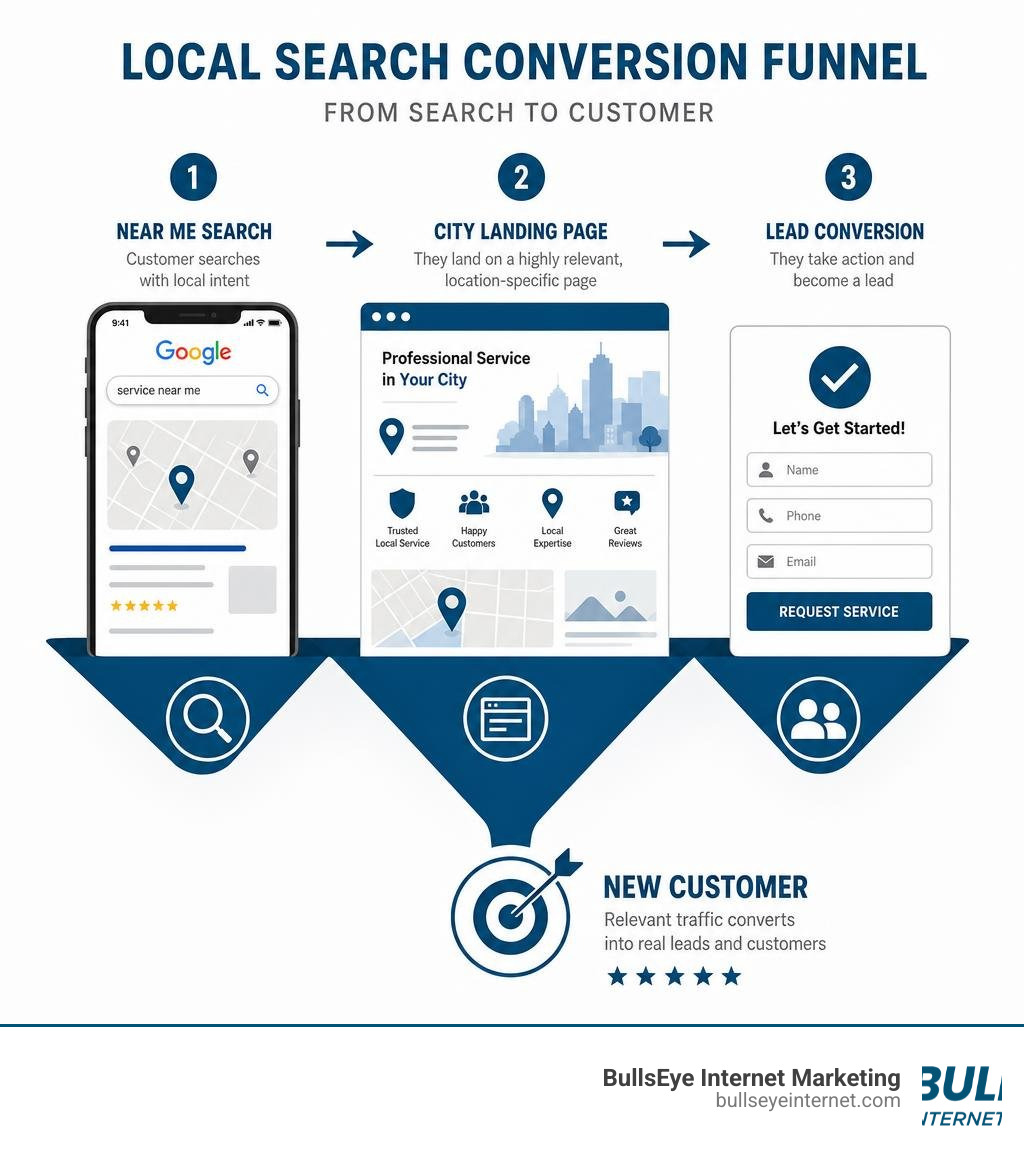
Discover more about city landing pages seo:
What Are Local Landing Pages and How Do They Differ From Service Pages?
To understand how to master city landing pages SEO, we first need to define what these pages are and distinguish them from standard service pages.
A standard service page is designed to explain what your business does. For example, if you run an HVAC company, you might have a page explaining your “Air Conditioning Repair” service. This page is typically educational, detailing your technical expertise, your process, and the brands you service. However, it usually targets a broad, non-location-specific audience.
A local landing page (often called a city page or geo-targeted page), on the other hand, is built to establish geographic relevance. It answers the question of where you perform that service. It is highly optimized for a specific geographic market—such as West Palm Beach, Fort Lauderdale, or Miami—and aligns directly with the user’s local search intent.
When a user searches for “AC repair in Delray Beach,” they aren’t looking for a generic essay on how air conditioners work. They want to know if you serve Delray Beach, how quickly you can get there, what your local customers say about you, and how to contact you immediately.
| Feature | Standard Service Page | Local Landing Page (City Page) |
|---|---|---|
| Primary Focus | What service you offer | Where you offer the service + local proof |
| Target Keyword | “Air Conditioning Repair” | “AC Repair Fort Lauderdale” |
| User Intent | Informational & General Commercial | High-intent, immediate local purchase |
| Map Integration | Rarely included | Embedded Google Map of the target city |
| Social Proof | General company testimonials | Testimonials from clients in that specific city |
| Internal Linking | Main service navigation | Linked from a “Service Areas” hub |
By separating your core service definitions from your geographic landing pages, you give search engines clear signals. Google can index your service pages for topical authority, while indexing your city landing pages for local relevance.
Why City Landing Pages SEO is Essential for Service Area Businesses
For service area businesses (SABs)—such as plumbers, electricians, roofers, and home care providers—ranking in surrounding cities is a major hurdle.
If your business is physically based in Fort Lauderdale, Google’s local algorithm naturally favors your business in the immediate vicinity of your physical office. This physical proximity constraint makes it incredibly difficult to appear in the Google Local 3-Pack for searches occurring 15 or 20 miles away in Coral Springs or Hollywood, even if those cities are well within your service radius.
This is where city landing pages SEO becomes your primary weapon. When you cannot rank in the Map Pack due to distance, optimized city landing pages allow you to dominate the organic search results directly below the map.
Many business owners wonder if they should build these location-specific pages at all, especially if they don’t have physical storefronts in those towns. This exact challenge is a frequent topic of debate among professionals, as seen in this Create multiple pages for each town I service? – Local Search Forum discussion. The consensus is clear: creating dedicated location pages is highly effective, provided you don’t just clone the exact same text and swap out city names. Search engines in 2026 are incredibly smart; they demand genuine local value, which we will teach you how to build.
Mastering City Landing Pages SEO: Best Practices for 2026
The search landscape in June 2026 requires a sophisticated approach to local search engine optimization. Simply spinning up thin, low-quality pages with a keyword stuffed into the title tag will no longer work. To build local search authority and drive high conversion rates, we must design city pages that act as standalone, highly authoritative homepages for each targeted market.

When we build city pages for our clients in South Florida, we treat each page as a premium asset. It must load instantly, look beautiful on mobile devices, and immediately satisfy both search engine crawlers and human visitors.
Key Benefits of Dedicated Location Pages for Lead Generation
The business case for investing in a robust regional local SEO strategy is undeniable. By expanding your digital footprint across your actual service area, you unlock several key advantages:
- Massive Conversion Increases: As noted in our research, companies that implement 10-15 high-quality local landing pages targeting valuable keywords typically experience conversion increases of 55%. For larger operations targeting 40+ locations, conversion improvements can skyrocket up to 500%.
- Capturing Urgent Mobile Search Traffic: With 80% of local searches occurring on mobile devices, users are often looking for immediate solutions while on the go. Dedicated city pages with click-to-call buttons and quick contact forms convert this mobile traffic at a much higher rate.
- Cost-Effective Lead Generation: Unlike Pay-Per-Click (PPC) campaigns where your leads stop the second you turn off your ad spend, organic city landing pages build compounding equity. Once they rank, they generate consistent, high-intent leads month after month for a fraction of the cost of paid ads.
For businesses operating in competitive regions like South Florida, ranking across multiple municipalities is the only way to scale. Whether you are seeking to dominate Google Maps and near-me rankings or looking to establish organic dominance for your South Florida business, dedicated city landing pages are the foundational element of your growth.
Essential Elements of a High-Converting Local Landing Page
To convert a local searcher into a paying lead, your page must establish trust within the first three seconds. This is achieved by combining technical SEO signals with strong elements of social proof.

Every high-converting city landing page we build includes these essential elements:
- Consistent NAP (Name, Address, Phone Number): Even if you are a service area business without a retail storefront in that city, you must clearly state your local contact details, the specific neighborhoods you serve, and your local operating hours.
- An Embedded Google Map: Embedding a customized Google Map that highlights your service area or shows recent job locations within that specific city signals strong geographic relevance to Google’s crawlers.
- Local Reviews and Social Proof: Do not use generic testimonials. If the landing page is targeting West Palm Beach, display reviews specifically from your clients in West Palm Beach. Mentioning local streets or neighborhoods within those reviews builds immense credibility.
- A Clear, Direct Call to Action (CTA): Place a prominent contact form and a click-to-call phone number at the very top of the page (above the fold) to accommodate users who want to book your services immediately.
For businesses targeting major Broward County hubs, aligning these elements is critical. Structuring these trust signals properly ensures that users in Fort Lauderdale, West Palm Beach, and surrounding areas immediately recognize your business as a trusted local provider.
Technical Requirements for High-Performing City Landing Pages SEO
Behind the beautiful design of your city page lies the technical framework that allows search engines to discover, index, and rank your content.
- LocalBusiness Schema Markup: This structured data code tells search engines exactly what your business does, your service areas, and your local reviews. Implementing specific
areaServedproperties within your schema helps search engines associate your website with your target cities. - Mobile Responsiveness and Page Speed: Since the majority of local queries are performed on mobile devices, your city pages must load in under two seconds on mobile connections.
- Clean URL Structure: Use logical, human-readable URLs that reinforce your geographic targeting. For example:
domain.com/service-areas/west-palm-beachis infinitely better thandomain.com/page-id?12345.
To understand the exact process of mapping these technical requirements, read our detailed guide on How a Local SEO Agency Creates Location-Focused Content That Ranks
How to Avoid Pitfalls: Duplicate Content, Thin Content, and Doorway Pages
The biggest mistake businesses make when scaling their local SEO strategy is using automated tools to spin up hundreds of identical pages, where the only difference is the city name.
While the Internet is made up of roughly 25% to 30% duplicate content, Google’s algorithms have become highly sophisticated at identifying and filtering out low-effort “doorway pages.” A doorway page is a low-quality page created solely to rank for a specific search query, offering no unique value to the user. If Google flags your city pages as doorway pages, your entire site’s rankings could suffer.
To protect your website from Google penalties, you must ensure that every city landing page you publish contains a substantial amount of unique, high-quality, and helpful content.
Strategies for Creating Unique Location-Specific Content
Creating unique content for 10, 20, or 50 different cities might sound daunting, but it is entirely manageable when you use a structured framework. Here are our favorite strategies for making every city page unique:
- Mention Local Landmarks and Geography: Talk about local areas, major roadways, or landmarks near your service zones. For example, if you serve Miami-Dade, mentioning neighborhoods like Coconut Grove or Coral Gables, or referencing local transit routes, immediately establishes unique local context.
- Showcase Local Projects and Case Studies: Write brief summaries of real jobs you’ve completed in that specific city. For example: “Last week, our team completed a full metal roof installation near the Palm Beach Yacht Club in West Palm Beach…”
- Include Localized FAQs: Answer questions that are highly relevant to that specific market. If you are a landscaping company in South Florida, your West Palm Beach page might answer questions about salt-tolerant plants, while an inland city page might focus on shade-loving varieties.
By integrating these hyper-local details, you naturally build pages that search engines love. For businesses in coastal markets, this strategy is incredibly powerful. Whether you are targeting Miami-Dade County, Broward County, or northern markets like Stuart and Jensen Beach in Martin County, a localized approach ensures your content resonates with both search engines and local residents.
To dive deeper into how we structure these localized content frameworks, explore our insights on The Role of a Local SEO Agency in Crafting Effective Local Content Strategies.
The Impact of City Pages on Google Local Pack, Organic Results, and AI Overviews
The search engine results page (SERP) is no longer a simple list of ten blue links. In 2026, a single local search query triggers a complex ecosystem of Google Map Pack results, traditional organic listings, and AI Overviews.
As illustrated above, while your physical office location dictates your visibility in the Local 3-Pack, your optimized city landing pages are what capture the highly prominent Organic Search slots directly below it. Furthermore, with 60% of searches now starting with AI or voice search, these pages serve a critical double duty.
Google’s AI Overviews and modern conversational answer engines rely heavily on semantically rich, highly structured, and entity-grounded content to formulate their answers. When an AI search engine crawls your site, a well-optimized city page provides the exact localized context, local client examples, and structured schema it needs to confidently recommend your business to users asking voice-based questions.
By reviewing real-world local campaigns, you can see how different businesses balance these search elements to dominate their local markets. Successful local landing pages leverage these elements to satisfy both search engines and AI discovery, ensuring maximum visibility across all search formats.
The Role of Internal Linking and Service Area Hubs
Your city landing pages should never exist as isolated “orphan pages” floating on your website. To pass search authority (link juice) throughout your site and help search engine crawlers discover your content, you must design a logical internal linking structure.
The best practice is to build a centralized Service Area Hub Page. This main page acts as a directory that lists all the counties and major municipalities you serve, linking directly to each individual city landing page. In turn, your individual city landing pages should link back to your primary service pages and your contact page.
This circular linking structure establishes a strong topical and geographic hierarchy, proving to search engines that you have deep regional authority. To learn more about how we integrate these internal linking models into broader local search campaigns, visit our comprehensive guide on Local SEO.
Measuring Performance and ROI of Your Local SEO Strategy
Like any marketing campaign, your city landing page strategy must be tracked and measured to ensure a positive return on investment (ROI). We recommend focusing on four primary metrics:
- Organic Traffic Growth (by Location): Use Google Analytics to monitor the volume of unique visitors landing directly on your city pages.
- Keyword Ranking Shifts: Track your target keywords (e.g., “roofing contractor Boynton Beach”) in Google Search Console to monitor your climb to page one.
- Conversion Tracking: Set up custom event tracking in Google Analytics to measure form submissions, click-to-call phone actions, and live chat starts originating from each city page.
- Cost Per Acquisition (CPA): Compare your organic city page lead costs against your paid advertising spend to see your long-term savings.
Choosing the right digital agency to build, monitor, and optimize these assets is critical to your success. If you are operating in South Florida, read our guide on From Miami to Greenacres: What to Look for in a Local SEO Partner to learn how to select a strategic partner who understands local market dynamics.
Frequently Asked Questions about City Landing Pages
Will Google penalize my site for having multiple city pages?
Google will not penalize your website for having multiple city pages as long as each page offers unique, genuine value to the user. Google only penalizes sites that use low-quality “doorway pages”—which are identical cloned pages with only the city names swapped out. By writing unique local FAQs, mentioning local landmarks, and showcasing real local reviews, you protect your site and build lasting search authority.
How many city landing pages should my business create?
We recommend starting with your highest-value target cities—typically 5 to 10 major markets where you actively want to win more business. Once those pages are ranking and converting, you can safely scale your service area footprint to 40+ pages. Remember: quality always beats quantity. It is far better to have 10 highly optimized, unique pages that rank on page one than 100 thin, duplicate pages that get ignored by search engines.
Can I rank in the Google Map Pack without a physical address in that city?
Generally, no. Google’s Map Pack algorithm relies heavily on physical proximity to the searcher or the searched location. However, this is precisely why city landing pages are so valuable. While your Google Business Profile captures Map Pack traffic near your physical office, your city landing pages allow you to rank in the organic search results and appear in AI search recommendations for all your surrounding service cities where you do not have a physical address.
Conclusion
Building high-converting city landing pages is the single most effective way for service area businesses to scale their local lead generation and claim market share across South Florida. But doing it manually, writing unique copy for dozens of cities, and keeping up with technical schema updates is incredibly time-consuming.
At BullsEye Internet Marketing, we are not your typical digital marketing agency. We do things differently to give our clients a massive unfair advantage:
- No Long-Term Contracts: We earn your business every single month based on real, measurable results—not legal handcuffs.
- Strict Exclusivity: We work with only one client per industry per geographic area. When you partner with us, we focus 100% of our local search power on helping you dominate your competitors. We will never help your local competitors outrank you.
Whether you serve Miami, Fort Lauderdale, West Palm Beach, or any of the beautiful surrounding communities throughout Palm Beach, Broward, and Miami-Dade counties, we are ready to help you own your local search market.
Are you ready to turn your website into a 24/7 lead-generation machine? Contact BullsEye Internet Marketing Local SEO Agency Services today to claim your exclusive local territory and start winning more calls and sales!
