
Why Businesses That Ignore Local SEO Are Losing Customers Right Now
If you want to boost local ranking and get in front of customers who are ready to buy, here’s what works in 2026:
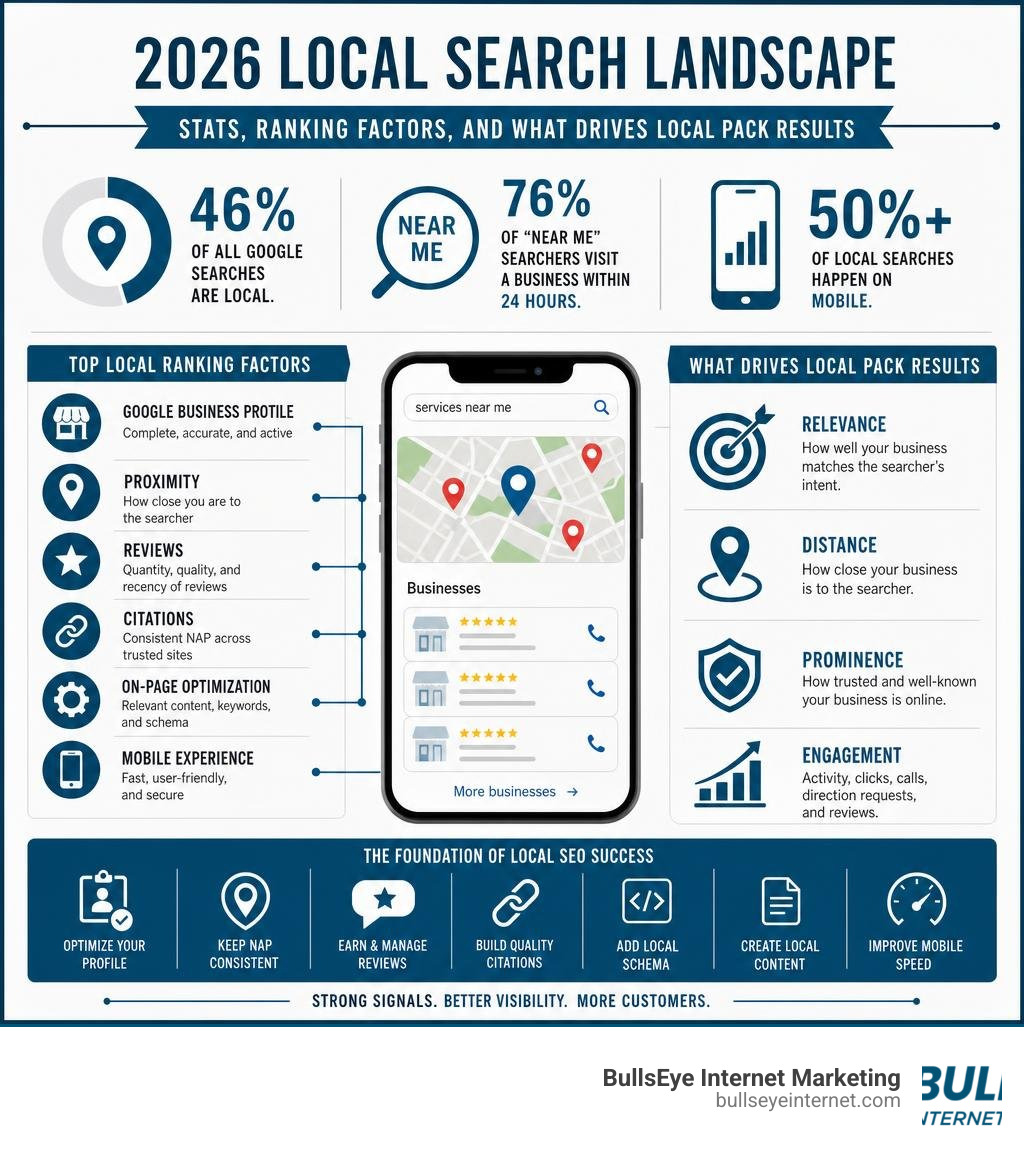
- Optimize your Google Business Profile — complete every field, pick the right primary category, and post regularly
- Keep your NAP consistent — same Name, Address, and Phone number everywhere online
- Get more reviews — ask customers after every visit, and respond to every single one
- Build local citations — get listed in trusted directories like Yelp, Apple Maps, and the BBB
- Add LocalBusiness schema — help search engines understand exactly who you are and where you are
- Create local content — use neighborhood-specific keywords and location pages
- Fix your mobile speed — over 50% of local searches happen on mobile
Imagine you run a great bakery in your neighborhood. Business is solid. But when someone nearby Googles “bakery near me,” your shop doesn’t show up. Your competitor — with a half-empty display case — does. That customer walks into their door, not yours.
That’s the reality for thousands of local businesses right now.
46% of all Google searches are local. And 76% of people who search “near me” visit a business within 24 hours. That’s not slow, top-of-funnel traffic. That’s someone who is ready to spend money today.
The problem isn’t that your business isn’t good enough. The problem is that Google doesn’t know enough about you to trust you with those customers.
Local SEO fixes that. It tells Google — and increasingly, AI tools like ChatGPT and Gemini — exactly who you are, where you are, and why you’re the best answer for local searchers. It’s not magic. It’s a system. And when you follow it consistently, the results compound fast.
I’m Ronnie Katz, founder of BullsEye Internet Marketing, and I’ve spent over 20 years helping local businesses boost local ranking, drive more calls, and turn search visibility into real revenue. In this guide, I’ll walk you through exactly what’s working in 2026 — no fluff, no guesswork.
Boost local ranking vocab to learn:
Traditional SEO vs. Local SEO: The Battle for Local Pack Dominance
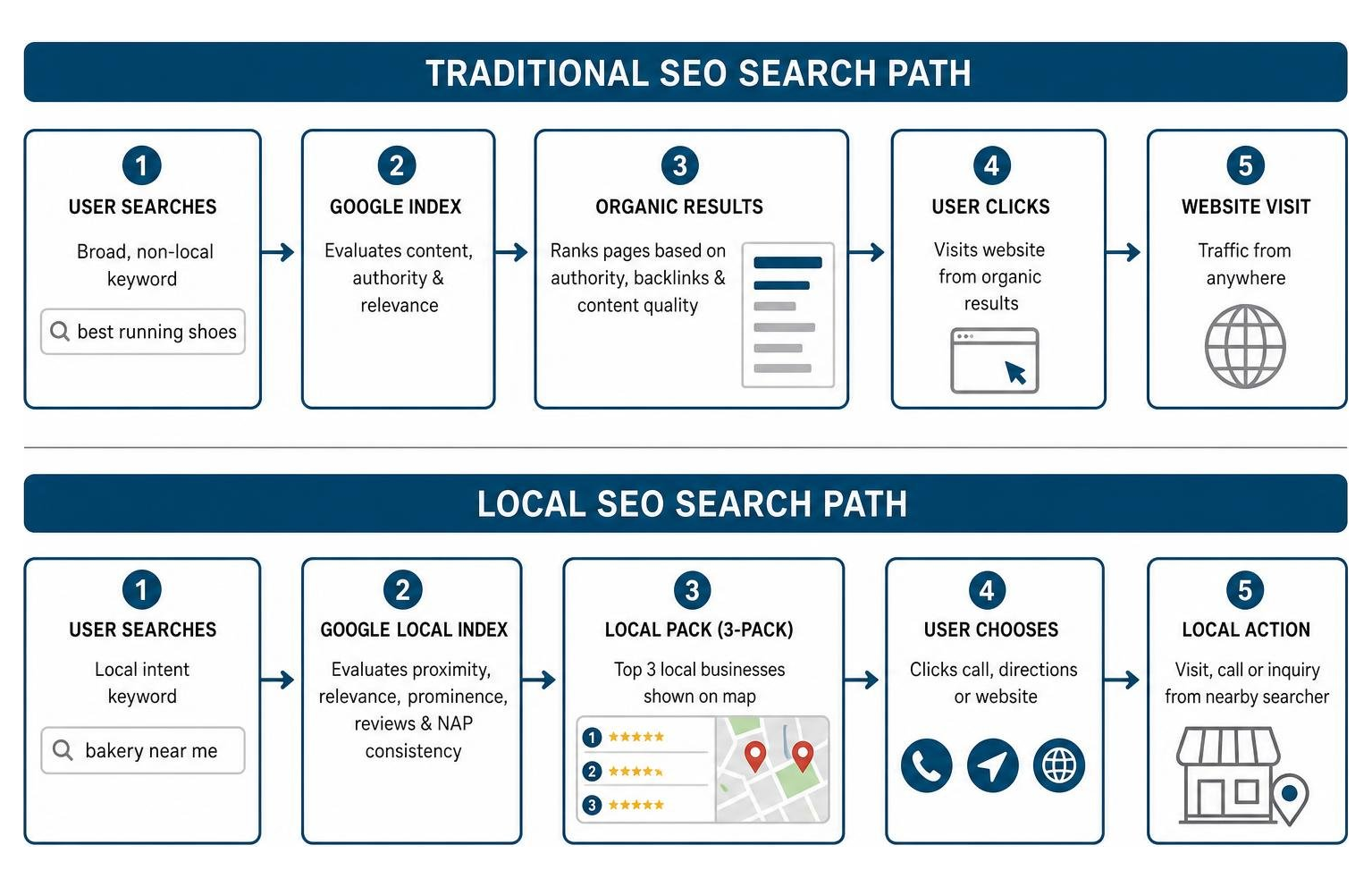
To win the digital street fight, you first need to understand the playground. Many business owners make the mistake of treating traditional organic SEO and local SEO as the exact same thing. While they share some DNA, their goals, search intent, and ranking factors are completely different.
Traditional SEO focuses on ranking a website for broad, non-geographic keywords. The goal is to drive global or national traffic to your site, regardless of where those users are sitting.
Local SEO, on the other hand, is laser-focused on geographic relevance. It aims to position your business in front of nearby users who are actively searching for physical storefronts or service-area providers. The ultimate prize in local search is the Google Map Pack (or “3-Pack”)—the highly visible map section that sits at the very top of Google’s search results.
| Feature | Traditional SEO | Local SEO |
|---|---|---|
| Primary Goal | High organic ranking on global SERPs | Dominating the Google Map Pack & local search |
| Key Target | Informational, transactional, broad intent | High-intent local searches (“near me”, “in Miami”) |
| Core Ranking Signals | Backlink authority, technical SEO, content depth | Proximity, relevance, prominence, reviews, NAP |
| Primary Platform | Your website’s domain | Google Business Profile, local directory networks |
| Competition Level | Global or national competitors | Local neighborhood and city-level competitors |
Understanding these differences helps you allocate your budget where it actually moves the needle. If you run a local plumbing service in Fort Lauderdale, you don’t need to write a 5,000-word blog post on the history of copper pipes to rank globally. You need to prove to Google that you are the most active, trusted plumber within a five-mile radius of your office. Exploring the Benefits of Local SEO for Your Business reveals how this hyper-focused strategy converts local searchers into paying clients faster than traditional marketing channels ever could.
Why Local Search Visibility Matters in 2026
If you are operating a business in South Florida, local search visibility isn’t just a marketing channel—it is your lifeline. The landscape has grown incredibly competitive. For instance, Miami-Dade ranked #1 in nation for small business growth, bringing an unprecedented wave of new merchants, service providers, and retailers to the region. At the same time, areas like Martin County are experiencing rapid community development, with families moving in due to top-rated institutions (as noted when the Martin County School District Ranks Among Florida’s Top … school systems).
This population boom means more people are turning to their mobile devices to find immediate local solutions. According to the latest 35+ Local SEO Statistics You Need for 2026 , over 50% of all local searches occur on mobile devices, and more than 1.5 million searches each month include the phrase “near me.” If your business is buried on page two or missing from Google Maps, you are effectively handing these high-intent customers over to your competitors on a silver platter.
The Three Pillars of Google’s Local Algorithm
How does Google decide which three businesses get featured in the coveted Map Pack? Unlike traditional organic search, which can feel like a mystery wrapped in an enigma, Google is relatively open about its local ranking algorithm. It relies on three core pillars: Proximity, Relevance, and Prominence.
To successfully boost local ranking, you must optimize your online presence to satisfy all three signals. For official guidelines on how Google evaluates these signals, you can review the direct Tips to improve your local ranking on Google – Google Business Profile Help . Additionally, our detailed Google 3-Pack Tips Guide offers practical ways to align your digital footprint with these algorithmic pillars.
Relevance and Distance Signals
Relevance is all about how well your business matches what the user is looking for. If someone searches for an “emergency locksmith in West Palm Beach,” Google is going to look for profiles that explicitly state they offer emergency locksmith services. This is why precise category selection is so vital; choosing the wrong primary category can completely tank your visibility.
Distance (or proximity) is the physical distance between your business and either the searcher or the geographic location specified in the query. While you cannot change your physical address, Google’s algorithm has become incredibly sophisticated in how it maps coordinates. It evaluates GPS coordinates down to five decimal places to determine your exact location.
However, be warned: if you share a physical building or suite with a similar business, Google’s “cluster filter” might hide one of your listings to prevent search results from looking repetitive. Ensuring your location is uniquely verified and free of overlapping coordinates is critical to avoiding this filter.
Prominence and Real-World Authority
Prominence measures how well-known and trusted your business is in the real world. Google evaluates prominence using information gathered from across the web, including links, articles, directory citations, and the overall volume and sentiment of your Google reviews.
Interestingly, the massive 2024 Google internal API leak confirmed what many local search specialists had long suspected: Google uses real-world behavioral data to influence rankings. A signal referred to as visitHistory suggests that Google may monitor physical foot traffic and user engagement patterns (like driving direction requests and phone calls) to verify that a business is actually popular offline. If people are constantly visiting your storefront or calling your line through Google Maps, the algorithm recognizes your real-world prominence and rewards you with better rankings.
Step-by-Step Playbook to Boost Local Ranking
Now that you know how the algorithm thinks, let’s look at the exact steps you can take to outmaneuver your competitors. This step-by-step playbook is designed to systematically build your relevance, proximity, and prominence.
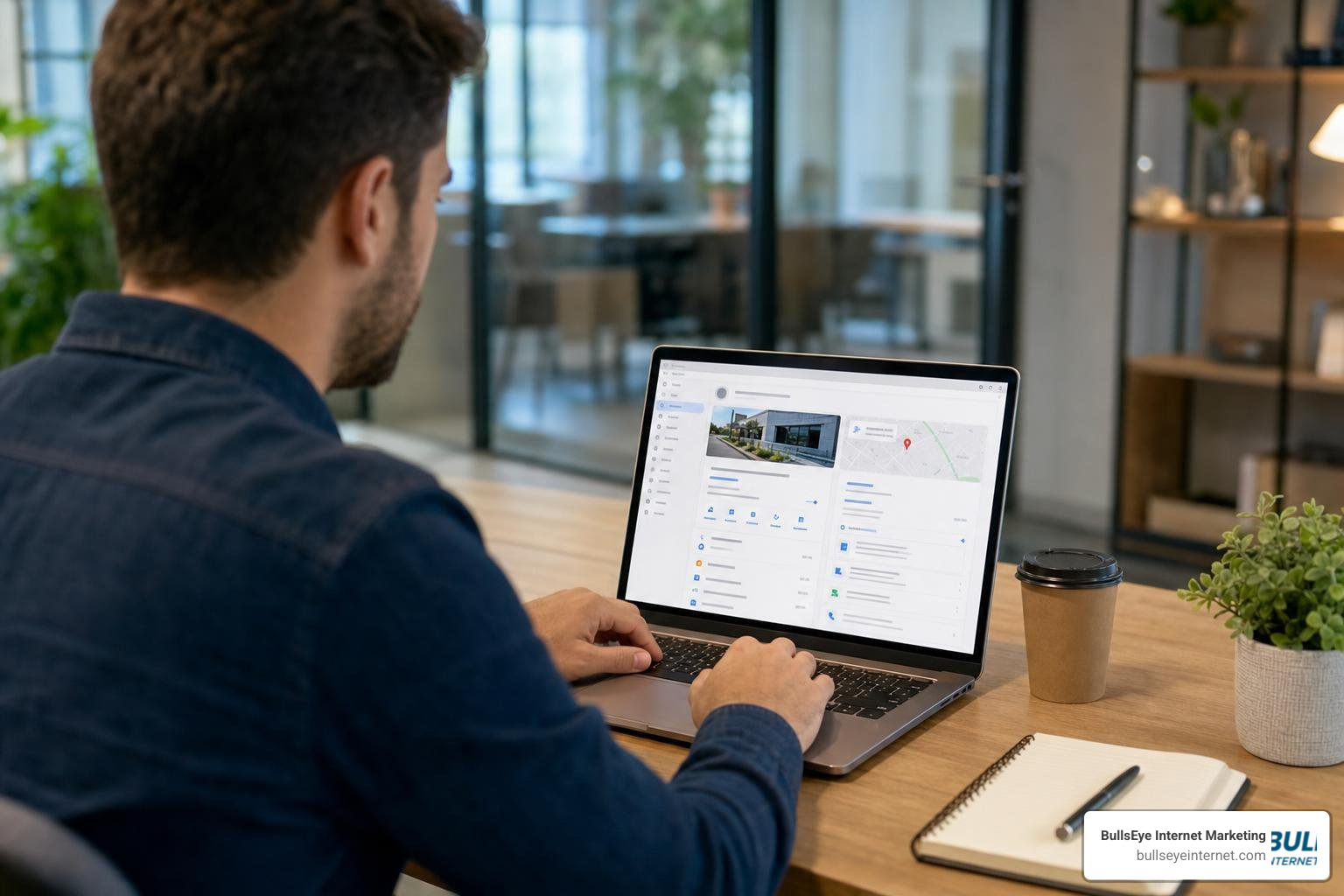
To get a complete overview of how these pieces fit together, you can read The Ultimate Local SEO Playbook: Boost Your Business’s Online Presence.
Optimize Your Google Business Profile to Boost Local Ranking
Your Google Business Profile (GBP) is the single most important asset in your local SEO arsenal. In fact, GBP optimization drives roughly 32% of all local ranking factors. Follow these steps to ensure your profile is running at 100% capacity:
- Select Your Primary Category Wisely: Your primary category carries immense weight. Analyze your top-ranking competitors to see what they use, and select the one that most accurately describes your core business.
- Add Secondary Categories: You can select up to nine secondary categories. Businesses that utilize four or more additional categories enjoy an average map ranking of 5.9.
- Write a Compelling Business Description: You have up to 750 characters. Do not stuff keywords here—it doesn’t directly impact rankings. Instead, write a clear, engaging description of who you are, what you do, and the South Florida communities you serve.
- Publish Weekly Google Posts: Use Google Posts to share updates, offers, and seasonal promotions. This signals to Google that your business is highly active.
- Upload High-Resolution Photos Monthly: Add real, geotagged photos of your team, your office, and your completed projects.
For a deeper dive into these optimization steps, check out our guide on How to Optimize Your Google Business Profile for Maximum Local Reach.
Build High-Quality Local Backlinks to Boost Local Ranking
While Google Business Profile is crucial, your actual website plays a massive role in supporting your local maps visibility. Building local backlinks and citations signals to Google that your business is deeply rooted in the local community.
Citations are online mentions of your business’s Name, Address, and Phone number (NAP) on third-party directories like Yelp, Apple Maps, YellowPages, and the BBB. Keeping this data consistent across major databases is essential. To streamline this process, you can leverage our professional Citation Submissions for Local SEO service.
Beyond standard directories, you should focus on building hyper-local backlinks. Here are a few highly effective strategies:
- Sponsor Local Events: Sponsoring a charity run in Broward County or a youth sports team in Palm Beach County is a fantastic way to earn high-authority, locally relevant links.
- Partner with Neighboring Businesses: Write collaborative guides or cross-promote non-competing businesses (like a local gym linking to a nearby healthy smoothie bar).
- Get Local Press: Reach out to South Florida community blogs and news outlets to share press releases about your community work or business milestones.
For additional strategies on establishing local website authority, read about how to Boost Local Business Website Ranking and see how targeted Local SEO Services Helps Users Find You in West Palm Beach .
Master Review Acquisition and Reputation Management
Online reviews are the second most important factor for both Local Pack rankings and AI-driven search recommendations. But having a high volume of reviews isn’t enough; Google’s algorithm also looks at review diversity and response velocity.
- Review Diversity: Do not focus solely on Google. Encourage some customers to leave feedback on Yelp, Facebook, or industry-specific platforms. A diverse review profile signals broad credibility.
- Response Velocity: Respond to all reviews—both positive and negative—within 24 to 48 hours. This shows Google (and potential customers) that you are active and engaged.
- Make it Easy with QR Codes: Place physical QR codes on your receipts, menus, or business cards that link directly to your GBP review form.
- Encourage Descriptive Reviews: When asking for feedback, politely suggest that customers mention the specific service they received and the city they are in (e.g., “We loved our kitchen remodel in Delray Beach!”). This naturally feeds localized keywords and user-generated content directly into your profile.
Advanced Technical SEO and Schema for Local Authority
Once your Google Business Profile and local backlinks are secured, it is time to look under the hood of your website. Technical SEO errors can quietly destroy your local rankings, even if your GBP is perfectly optimized.
If your website suffers from crawlability issues, slow mobile page speeds, or broken internal links, Google’s crawlers will struggle to index your local landing pages. If you’ve recently noticed a drop in your traffic, our guide on Bouncing Back After a Ranking Drop with Local Search Optimization can help you identify and repair these hidden technical issues.
Implementing LocalBusiness Schema Markup
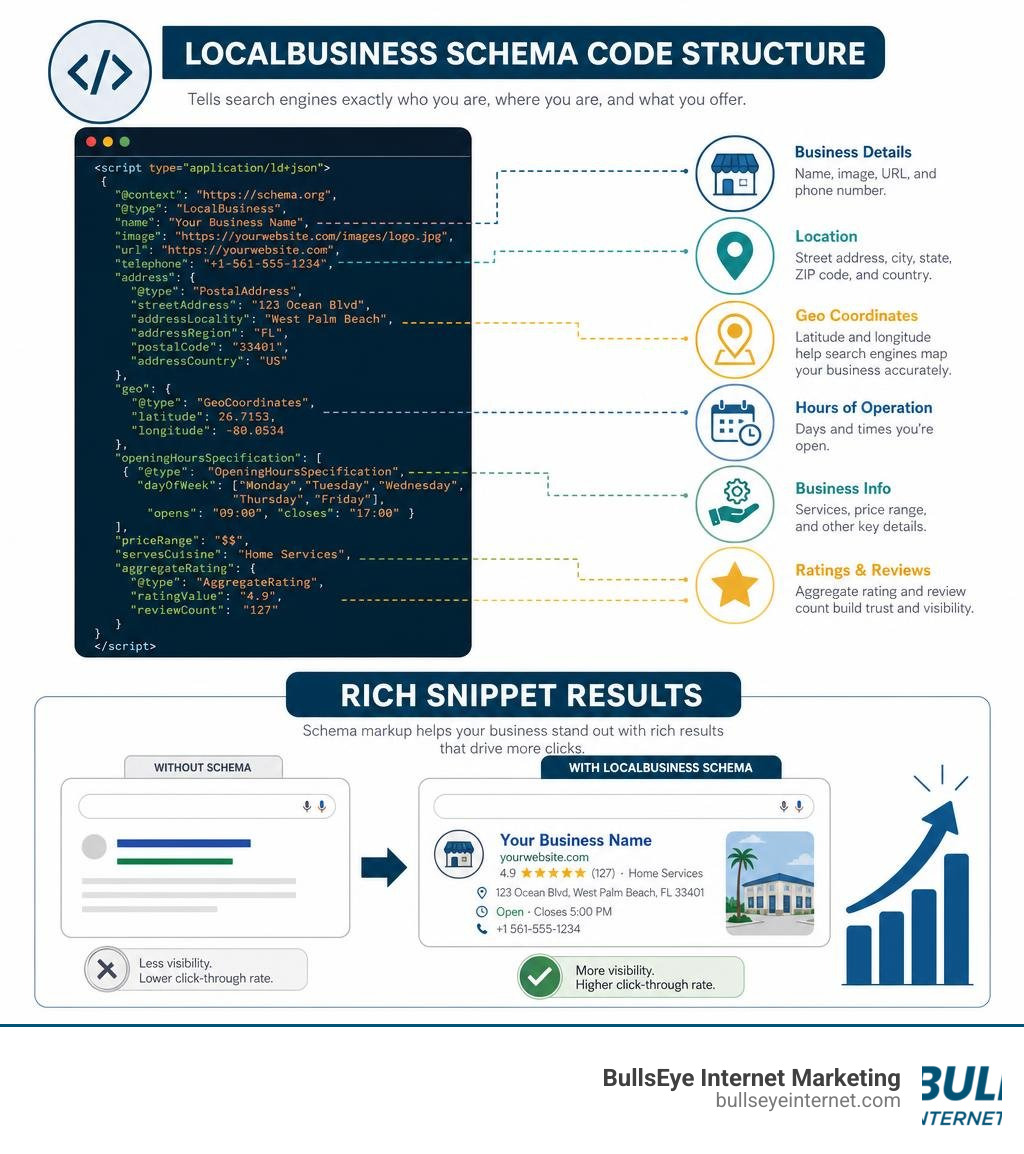
One of the most powerful—yet frequently overlooked—technical tools for local SEO is structured data, specifically LocalBusiness schema. Schema markup is a specialized code written in JSON-LD format that you embed into your website. It acts as a direct translator for search engines, telling them exactly what your business name is, where you are located, what hours you operate, and what services you offer.
By implementing LocalBusiness schema on your homepage and location-specific landing pages, you significantly reduce the risk of search engines misinterpreting your data. You can also implement FAQPage schema on your frequently asked questions sections. This can earn you rich results (or “rich snippets”) on Google’s search engine results pages, which dramatically increases your click-through rates.
Generative Engine Optimization (GEO) and AI Search
The search landscape is changing faster than ever. In 2026, people are no longer just searching through traditional search engines; they are using AI-driven search assistants like ChatGPT, Gemini, and Perplexity to find local recommendations. This shift has birthed a new discipline: Generative Engine Optimization (GEO).
AI search engines do not just look at keywords; they synthesize data from across the entire web to recommend the safest, most reliable local options. They prioritize “risk reduction,” meaning they prefer brands with stable, consistent facts, clean structured schema, and a steady stream of highly positive, recent reviews.
To ensure your business is recommended in AI-driven overviews, you must maintain a spotless digital footprint and write website content that directly answers conversational, long-tail questions (e.g., “Who is the best residential plumber open late in Coral Springs?”). For a comprehensive playbook on how to stay ahead of this trend, read the Comprehensive Guide to GEO SEO: Strategies to Dominate AI-Driven Local Search in 2026 .
Frequently Asked Questions About Local SEO
Navigating local search can bring up plenty of questions. Here are clear answers to the most common queries business owners ask us.
How long does it take to see results from local SEO?
Unlike paid advertising, which can be turned on and off like a faucet, local SEO is an organic growth strategy. The timeline to see measurable results depends heavily on your industry’s competitiveness, your market size, and the current health of your website.
In moderately competitive South Florida markets, you may begin to see initial ranking improvements and an increase in calls within 60 to 90 days. However, to achieve market-dominating, long-term results that compound over time, a comprehensive campaign typically takes 12 to 18 months of consistent optimization and review building.
Can I pay Google to improve my local ranking?
No. There is absolutely no way to request or pay Google to improve your organic local pack rankings. Google’s organic local algorithm is designed to remain fair and unbiased, prioritizing relevance, distance, and prominence above all else.
While you can run Google Local Services Ads (LSAs) or Google Map Ads to appear at the very top of search results as a sponsored listing, these are paid advertisements. Once you stop paying for those ads, your visibility disappears. True, lasting organic Map Pack presence can only be built through consistent, high-quality local SEO practices.
What is NAP consistency and why does it matter?
NAP stands for Name, Address, and Phone number. NAP consistency means ensuring that this core business information is formatted identically across every single platform online, including your website, social media profiles, local directories, and your Google Business Profile.
When search engines crawl the web and find conflicting information—such as a slightly different spelling of your business name or an old phone number on an outdated directory—it creates “data fragmentation.” Google interprets these conflicting signals as a sign of low credibility, which weakens your local search authority. Keeping your NAP uniform across the web builds trust with both search engines and potential customers.
Conclusion
At the end of the day, local SEO is not a one-time project. It is an ongoing business practice. As search algorithms continue to evolve and AI tools change how customers discover businesses, staying on top of your local search presence is the only way to protect your market share.
If you are ready to stop guessing and start growing, we are here to help. At BullsEye Internet Marketing, we specialize in helping South Florida businesses dominate their local markets. Whether you need expert Google Business Profile optimization, targeted pay-per-lead campaigns, or conversion-focused SEO, our goal is simple: to generate real calls and real sales for your business.
We do things differently than other agencies:
- No Long-Term Contracts: We believe in earning your business month after month based on real results.
- Strict Exclusivity: We work with only one client per industry per geographic area. When you partner with us, we focus 100% of our local search expertise on helping you beat your local competitors.
If you operate in South Florida—whether you are looking for dedicated Local SEO Services in Florida | Google Maps & Near-Me … , need strategic Local SEO for South Florida Businesses , or want to implement our comprehensive Local SEO for South Florida Businesses: 2026 Playbook —our team is ready to build a customized plan that delivers measurable growth.
Don’t let your competitors take the customers who are searching for you right now. Explore our premier Local SEO Services and Get started with business listing optimization today to claim your spot at the top of the map.
