
Why Social Media Risks for Leaders Demand a Clear Plan
Social media risks for leaders go far beyond an awkward post. A CEO, founder, or senior manager can create reputational, legal, security, financial, and employee-trust risks with one unreviewed message, compromised account, or convincing impersonator.
Leaders should protect themselves and the organization by:
- Separating approved business communication from personal opinions
- Requiring review for financial, legal, customer, or sensitive workforce statements
- Using strong account controls, including multi-factor authentication and limited admin access
- Monitoring for fake accounts, scams, deepfakes, and harmful false claims
- Creating a fast escalation plan for posts, leaks, hacks, and viral backlash
The stakes are real. In 2022, a fake account posted that a major pharmaceutical company’s insulin was free. Its share price fell more than 4% within hours, temporarily erasing over $15 billion in market value. Leaders also face disclosure and market-manipulation concerns when posts touch on revenue, deals, product launches, or other nonpublic information.
Social media can still build trust, reach customers, and show human leadership. But it should support real relationships and sound governance, not replace them. The goal is not to silence leaders. It is to make online communication intentional, secure, and consistent with the company’s values.
I am Ronnie Katz, founder and Principal CEO of BullsEye Internet Marketing, with more than 20 years of experience helping businesses improve online visibility, reputation, and conversion. In this guide, I will break down the social media risks for leaders and the practical controls that can protect your brand without making your leadership voice disappear.
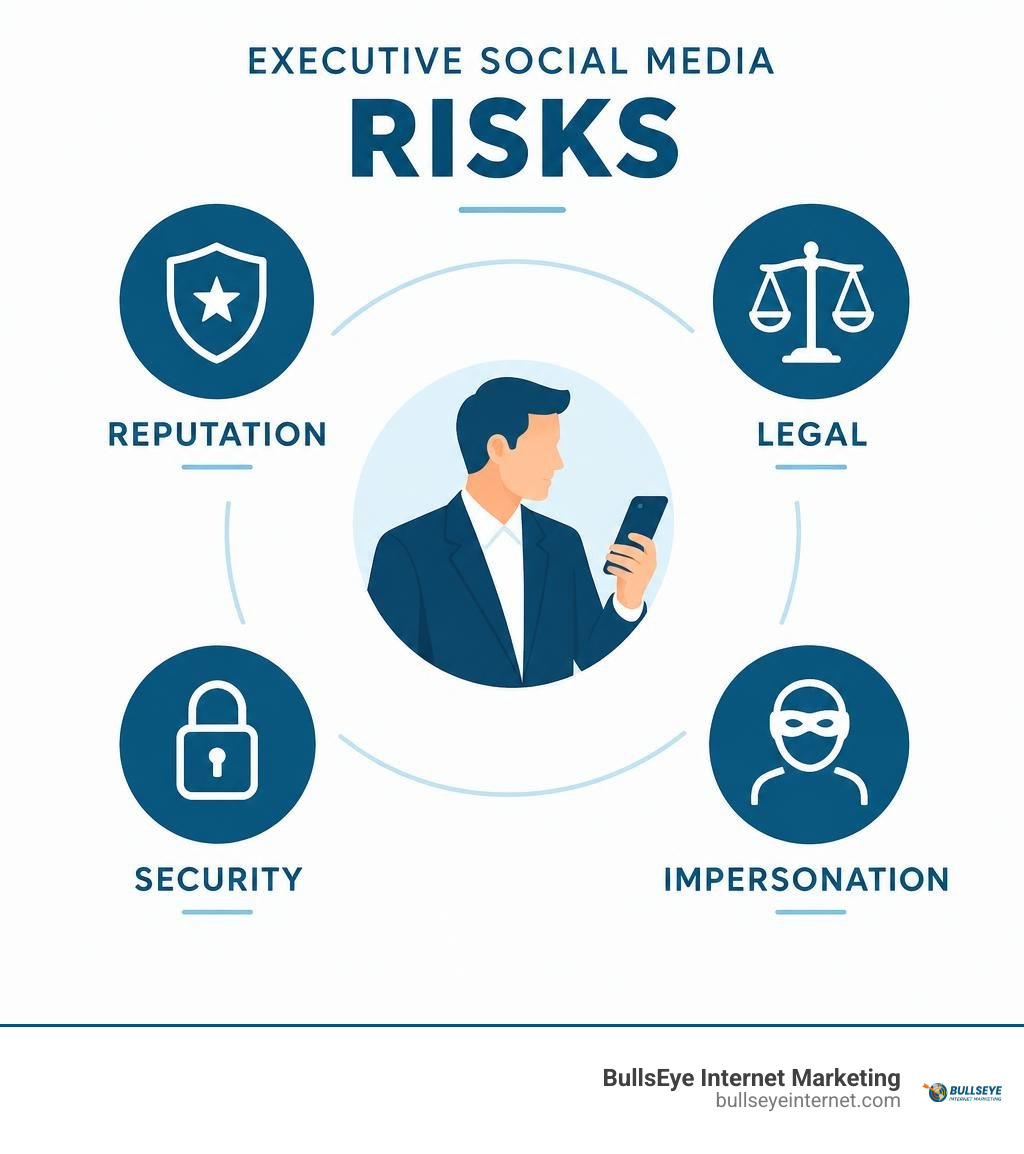
Quick social media risks for leaders terms:
Core Social Media Risks for Leaders in the Modern Enterprise
When an executive publishes a thought online, the boundary between personal expression and corporate representation dissolves instantly. This dynamic triggers reputational contagion, where an individual executive’s spontaneous remark, unvetted opinion, or security lapse cascades across the entire brand ecosystem.
Executive exposure extends far beyond public relations embarrassments. Threat actors systematically target leadership profiles to harvest personal details, guess security challenge answers, launch credential-harvesting phishing campaigns, and orchestrate deepfake impersonations. Establishing robust internet presence management is essential for controlling these digital attack surfaces.
| Risk Category | Personal Executive Profile Vulnerability | Enterprise-Wide Impact |
|---|---|---|
| Account Compromise | Weak MFA, credential reuse, targeted spear-phishing | Corporate data breaches, unauthorized public statements |
| Unapproved Disclosures | Casual comments regarding earnings, growth, or deals | Regulatory investigations, SEC enforcement, stock volatility |
| Reputational Contagion | Partisan political commentary, tone-deaf workplace remarks | Customer boycotts, employee disengagement, brand devaluation |
| Identity Abuse & Deepfakes | Publicly accessible voice and video assets scraped by scammers | Fraudulent vendor wire transfers, customer credential theft |
| Security Question Harvesting | Casual participation in viral quizzes, sharing personal trivia | Compromised password resets across administrative accounts |
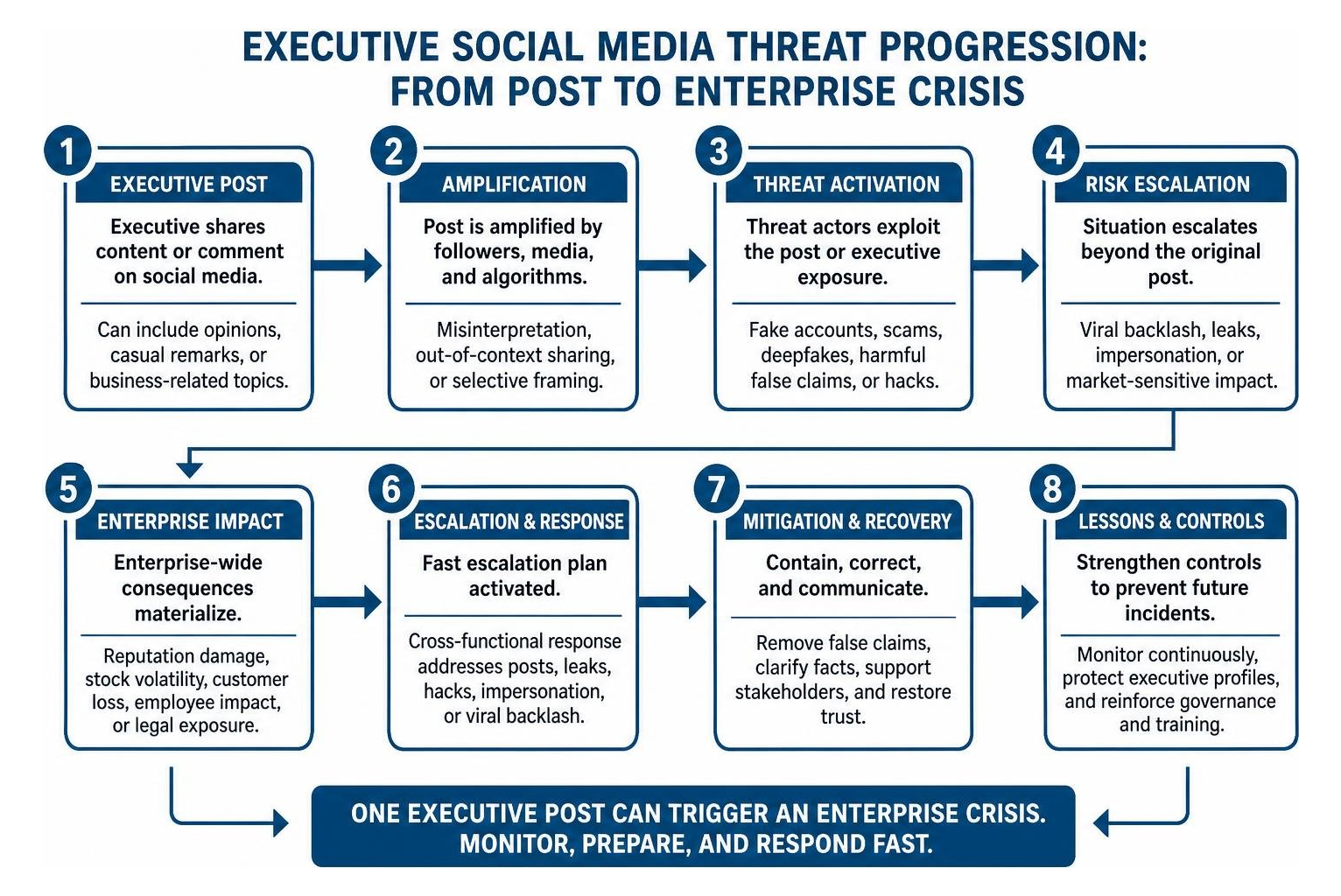
Assessing CEO Social Media Risks for Leaders and Public Disclosures
Executive communication carries direct regulatory weight. When corporate leadership engages on open platforms, spontaneous comments can cross the line into selective disclosure or market manipulation. A public data-storage executive once made unapproved forward-looking revenue forecasts during a casual live social media interview, forcing corporate legal counsel to issue immediate corrective regulatory filings to manage investor fallout.
Empirical studies demonstrate that active digital presence correlates with elevated corporate risk profiles. Research on CEO social media activity and insider trading highlights that executives active on digital platforms show higher risk preferences, with their open-market transactions yielding significantly higher abnormal returns over 3- to 6-month horizons compared to inactive peers. In corporate environments, understanding behavioral patterns is vital—much like how modern practices explore how law firms can use behavioral data to win more clients without crossing compliance boundaries.
Executive Brand Impersonation, Scams, and Disinformation
Synthetic media and generative AI have drastically lowered the barrier for threat actors to impersonate executive leadership. Fraudsters routinely establish spoofed profiles using authentic headshots and corporate branding assets to interact with customers, solicit sensitive internal credentials, or issue fake urgent directives to junior staff.
When an unauthorized profile impersonated a global pharmaceutical company on Twitter by declaring that insulin was suddenly free, the immediate market fallout wiped out $15 billion in valuation before verification controls took effect. Protecting corporate assets demands proactive vigilance, reflecting principles outlined in our guide on protecting your brand essential reputation management for Delray Beach businesses.
Mitigating Youth Mental Health and Social Media Risks for Leaders in Education and Healthcare
Leaders in educational institutions, family-oriented consumer brands, and healthcare networks operate under specialized institutional and ethical liabilities regarding digital channels. The public health conversation surrounding adolescent digital usage has reached critical legal and operational thresholds.
Research highlights significant concerns regarding adolescent digital usage:
- Up to 95% of youth aged 13–17 report using digital platforms, with nearly two-thirds using them daily and one-third reporting near-constant engagement.
- Teenagers spend an average of 3.5 hours per day on social applications.
- Adolescents spending more than 3 hours daily on these platforms face double the risk of experiencing depression and anxiety symptoms.
- Approximately 46% of adolescents report that social platforms worsen their body image perception.
State and municipal educational bodies, including actions across school districts in Florida, have initiated legal actions against major digital networks over youth mental health impacts, as detailed in recent reporting on Social Media Warning: Teen Mental Health Risks 2026. Furthermore, clinical leadership must maintain stringent patient confidentiality standards when navigating digital interactions (Ventola, 2014).
Balancing Authentic Presence with Digital Threat Containment

Modern executives face a clear operational tension: stakeholders expect transparent, accessible leadership, yet every unfiltered post expands the enterprise risk perimeter. Attempting to build authentic engagement by over-sharing personal reflections can quickly backfire into perceived corporate tone-deafness.
True digital leadership reinforces trust when actions, corporate messaging, and digital statements remain completely coherent. As detailed in resources on how to Be a Social-Media-Ready Leader, sustainable communication relies on emotional appropriateness rather than chasing viral engagement. Combining disciplined online presence with verifiable organizational excellence establishes genuine authority, a framework we explore in the authority playbook smart ways to boost your websites credibility.
Geopolitical Sensitivities and Workforce Policy Alignment
In volatile operational environments, unvetted executive commentary on complex international affairs, regional conflicts, or public policy disputes can trigger vendor boycotts, employee walkouts, and regulatory scrutiny. As enterprise reporting demonstrates in In geopolitical storm, companies urge staff to stay social media safe, multinational organizations must establish clear escalation playbooks that delineate personal expression from corporate positioning.
Organizations must implement practical safeguards across all operational tiers:
- Establish role-specific guidance distinguishing marketing teams, trading desks, and c-suite executives.
- Incorporate explicit profile disclaimers stating that personal opinions do not reflect enterprise policy.
- Build rapid internal escalation matrices to review sensitive public statements before publication.
- Conduct continuous digital hygiene training to prevent credential leaks and social engineering vulnerabilities.
Enterprise Governance Frameworks for Executive Social Compliance
Managing enterprise vulnerability requires shifting from informal posting guidelines to structured governance frameworks. Risk mitigation demands formal compliance architectures that integrate legal review thresholds, trading blackout windows, and automated record-retention tools.
Implementing strict corporate governance directly counteracts behavioral market risks. Mandatory blackout windows and structured executive compensation frameworks significantly reduce the likelihood of unapproved disclosures. Just as organizations use structured intelligence outlined in our digital marketing AI guide 2025, executive teams must deploy automated oversight to remain compliant with SEC rules and legal hold requirements.
AI-Powered Lexicon Monitoring and Compliance Technology
Modern enterprise risk teams leverage automated compliance connectors to ingest, archive, and monitor executive social output across approved platforms like LinkedIn and X. These systems utilize specialized, AI-driven lexicons to scan drafted messages for restricted financial metrics, confidential product codenames, forward-looking statements, and non-compliant promotional phrases.
Integrating specialized automated surveillance allows organizations to maintain compliant communications without enforcing prohibitive total bans. Working alongside an AI search expert ensures internal discovery systems capture communications accurately while minimizing false positive alerts.
Quantifying Protection: Metrics for Enterprise Risk Leaders
Enterprise risk leaders cannot manage what they do not systematically measure. Evaluating social media brand protection requires tracking actionable security and incident response metrics:
- Time to Detection (TTD): The average duration between the creation of an unauthorized impersonation profile and its identification by security monitoring tools.
- Time to Takedown (TTT): The elapsed time between threat confirmation and the complete removal of fraudulent assets by platform hosts.
- Volume of Impersonation Attempts: The total number of spoofed executive profiles, synthetic domains, and fraudulent accounts detected per quarter.
- Repeat Offender Rate: The frequency with which known bad actors re-establish unauthorized brand or executive assets following takedowns.
- Escalation-to-Resolution Time: The duration required for cross-functional legal, PR, and security teams to contain an emerging viral reputational incident.
- Estimated Harm Prevented: Quantified evaluation of credential harvesting, fraud attempts, or unauthorized wire directives neutralized before execution.
Frequently Asked Questions About Executive Social Media Exposure
How can organizations measure the effectiveness of executive social media protection?
Organizations measure effectiveness by tracking operational response metrics including Time to Detection (TTD), Time to Takedown (TTT), and the total volume of neutralized impersonation attempts. Furthermore, risk teams evaluate changes in net brand sentiment scores and monitor compliance audit logs for zero unapproved material disclosures.
What steps prevent executive accounts from triggering insider trading investigations?
To prevent regulatory scrutiny, enterprises must enforce mandatory trading blackout calendars that restrict executive open-market transactions during sensitive reporting windows. Organizations should also require compliance pre-clearance reviews for public communications mentioning performance metrics and maintain automated, immutable e-discovery archives of all executive posts and direct messages.
How should leaders handle real-time social media backlash or viral impersonation?
When facing viral incidents or hostile impersonations, leaders should immediately activate cross-functional crisis escalation pathways involving legal, security, and communications personnel. Official corporate channels should rapidly verify genuine assets, report unauthorized impersonators through established platform enforcement channels, and provide transparent, measured public statements rather than engaging defensively in comment threads.
Conclusion
Navigating digital communication as a modern executive requires balancing authentic engagement with rigorous risk governance. Unchecked social exposure creates severe attack surfaces—spanning market manipulation liability, deepfake impersonation, and reputational contagion. By deploying automated compliance monitoring, establishing clear publication thresholds, and maintaining operational discipline, leadership teams can safeguard enterprise assets while projecting a strong, credible voice.
At BullsEye Internet Marketing, we help enterprises build dominant, secure, and highly visible digital footprints. We provide performance-driven solutions across SEO, Google Business Profile optimization, and conversion marketing with no long-term contracts—operating with only one client per industry per geographic territory to deliver an uncompromising competitive advantage.
Discover how to protect and expand your digital authority through our strategic AI visibility optimization solutions.
References
Ventola CL. “Social media and health care professionals: benefits, risks, and best practices..” P & T : a peer-reviewed journal for formulary management, 2014. PMCID PMC4103576.
