
A Practical, Ethical Approach to Elder Law Marketing
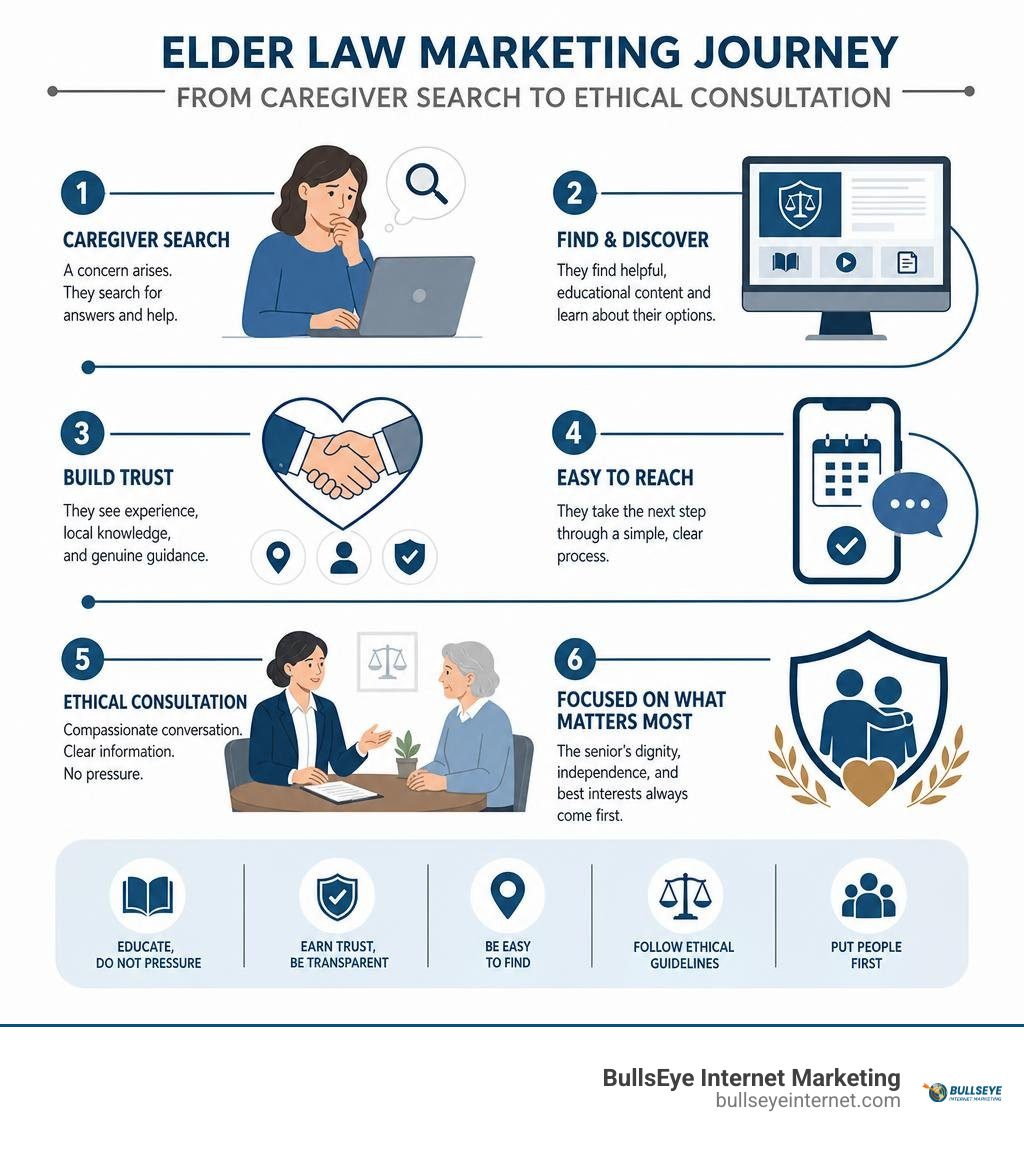
Effective elder law marketing reaches two people at once: the adult child who is often researching and making the first call, and the older parent who deserves clear information, dignity, and independent legal advice. To do it well without crossing ethics lines:
- Teach, do not pressure. Use plain-language content, workshops, and consultations to explain options.
- Build trust before asking for a commitment. Show local experience, accurate state-specific information, and responsive intake.
- Make help easy to find. Invest in local SEO, reviews, referral relationships, and fast follow-up.
- Keep legal advertising compliant. Avoid guarantees, fear-based claims, misleading Medicaid messages, and improper solicitation.
This is not typical high-volume legal marketing. Adult children often begin searching after a hospital discharge, dementia diagnosis, or a sudden long-term-care bill. They need fast, calm guidance. Meanwhile, the senior client must remain at the center of the attorney-client relationship.
The opportunity is substantial, but so is the responsibility. As the population ages and long-term-care planning becomes more urgent, firms that combine useful education, ethical communication, and measurable local visibility can earn more qualified consultations without treating vulnerable families like leads in a funnel.
I am Ronnie Katz, founder and Principal CEO of BullsEye Internet Marketing, with more than 20 years of experience helping businesses improve online visibility, traffic, and conversions. My work in elder law marketing includes SEO, local search, Google Business Profile optimization, paid campaigns, reputation management, and transparent performance reporting designed to generate qualified calls.
Elder law marketing terminology:
Navigating the Dual-Audience Trust Triangle: Caregiver vs. Senior

Elder law marketing differs fundamentally from personal injury, family law, or criminal defense. In most legal fields, the individual facing the legal challenge conducts the search and signs the retainer. In elder law, we operate within a complex dynamic known as the Trust Triangle, involving the adult child decision-maker, the aging parent client, and the professional referral source.
Demographics highlight why this dynamic is rapidly accelerating across the United States. Approximately 15 percent of the American population is 65 or older—representing more than 40 million Americans today. By 2030, that number will climb to 72 million, and the 65+ population is projected to nearly double by 2060. Every single day, 10,000 Baby Boomers turn 65, a trend continuing for nearly two decades. With 7 out of 10 older adults requiring institutionalized care before they die and private nursing home rooms averaging over $90,000 annually, families face staggering financial exposure.
Adult children make over 70% of initial contacts for elder law services. Furthermore, when adult children fill in lead forms on behalf of their aging parents, conversion rates are 3.5 times higher than when seniors inquire directly. Understanding how law firms can use behavioral data to win more clients allows your practice to recognize intent signals while honoring the autonomy of both family members.
Overcoming Caregiver Stress and Decision Inertia
The primary catalyst driving adult children to search for legal help is the Caregiver Crisis Moment. A 50-something daughter rarely wakes up casually wanting to discuss irrevocable trusts. Instead, she reaches out following a precipitating event:
- A parent experiences a sudden fall resulting in an unexpected hospital stay.
- A physician delivers a formal dementia or Alzheimer’s diagnosis.
- A facility social worker states that skilled rehabilitation is ending, presenting a $9,000-per-month long-term care quote.
- A parent receives an initial Medicaid denial notice.
At this juncture, caregivers experience intense emotional fatigue and cognitive overload. When marketing your practice, empathy and structural clarity must lead. Providing immediate, digestible answers regarding crisis Medicaid spend-down procedures, asset protection thresholds, and caregiver resources helps families transition from panic into proactive decision-making.
Preserving Client Autonomy and Bar Ethics
While the adult child often initiates contact and coordinates logistics, state bar ethics rules are clear: the aging parent remains the client. Marketing communications must uphold this distinction to prevent ethical missteps.
- Client Competency: Marketing materials must never suggest that adult children can sign estate documents or execute powers of attorney on behalf of a competent parent without lawful designation.
- Conflict of Interest: Intake workflows must clarify representation boundaries, ensuring that communication protocols avoid conflicts between the parent’s long-term care wishes and the child’s potential inheritance interests.
- Undue Influence & Confidentiality: Consultation landing pages should clearly explain that initial private assessments between the attorney and the senior client are standard practice, protecting client confidentiality and voluntary consent.
Core Pillars of a Modern Elder Law Marketing Strategy
Building an authority-first elder law practice requires a balanced multichannel framework. Relying solely on paid ads or cold outreach produces volatile lead quality. The most sustainable firms balance community education, robust referral relationships, and an authoritative digital presence.
| Marketing Channel | Typical Upfront Investment | Conversion to Consultation | Average Client Retention Rate | Scalability |
|---|---|---|---|---|
| In-Person Workshops | Moderate ($1,000 – $3,000 / event) | High (30% – 50%) | Very High (50% – 60%) | Medium (Constrained by calendar) |
| Professional Referrals | Low (Time & networking investment) | Very High (40% – 60%) | High (50% – 70%) | Steady & Compounding |
| Local SEO & Organic Search | Moderate / Consistent Monthly | Steady (15% – 25%) | Strong (40% – 55%) | High & Fully Automated |
| Targeted Paid Search (PPC) | High Ad Spend Variable | Fast (10% – 20%) | Moderate (30% – 45%) | Instantaneous Dial |
Firms recognized among the Best Elder Law Firms in America combine proactive outreach with deep community trust. To explore high-leverage paid strategies, see our guide on elder law advertising secrets.

Community Workshops and Educational Seminars
Community educational workshops remain one of the most reliable client acquisition channels for elder law practices. In-person seminars alleviate the intimidation barrier of booking a formal legal consultation, allowing hesitant families to evaluate your expertise in a safe, educational setting.
Data across legal education programs indicates that a well-executed workshop model can achieve a 60% client hire rate with average case fees exceeding $6,600. To maximize attendance and engagement:
- Venue Selection: Choose accessible community spaces with ample, flat parking, such as public libraries, civic centers, or local private dining rooms.
- Class Sizing: Cap attendees at 20 to 30 individuals to maintain an interactive, approachable atmosphere.
- Cadence & Seasonality: Host 1 to 2 workshops monthly. November and December serve as strong marketing months, as intergenerational holiday gatherings often bring parental physical or cognitive decline to light.
- Disciplined Follow-Up: Implement an automated confirmation sequence. Make a reminder call within 24 hours of registration, send an SMS reminder 24 hours before the event, and follow up within 48 hours post-event to schedule individual consultations.
Designing Ethical Lead Capture in Elder Law Marketing
Converting website traffic into retained clients requires intake systems built for stressed family members. If a caregiver visits your website at 11:00 PM following an emergency room visit, an unmonitored contact form often leads to lost opportunities. Discover how to build a client acquisition machine for your law practice by deploying automated self-scheduling tools, 24/7 web intake, and educational resource downloads.
Downloadable resources—such as state-specific Medicaid asset limits guides or estate representative checklists—capture contact information while providing immediate value.
Building Multi-Tier Referral Networks
B2B referral networking provides consistent case volume. Because Baby Boomers are projected to transfer over $30 trillion in assets to Gen X and Millennial heirs over the coming decades, financial advisors, CPAs, and healthcare professionals actively seek competent elder law partners.
Target these primary referral partners in your metropolitan area:
- Hospital Discharge Planners and Social Workers: Discharge coordinators require fast-turnaround Medicaid crisis attorneys who can prevent patient placement delays.
- Geriatric Care Managers & Aging Life Care Specialists: These professionals work directly with overwhelmed families and routinely recommend legal counsel for guardianship and long-term care navigation.
- Long-Term Care Administrators: Building relationships with 10 local nursing homes yielding just one referral each annually at a modest case fee creates a dependable baseline of institutional revenue.
- Estate Planning Attorneys and CPAs: General practitioners frequently encounter complex crisis Medicaid, special needs trusts, or contested guardianship cases that exceed their practice focus.
Local SEO, E-E-A-T, and AI Search Optimization for Elder Practices

Google categorizes elder law firmly within its Your Money or Your Life (YMYL) content framework. Because legal guidance directly impacts a family’s financial stability and physical care, search algorithms require exceptional levels of Experience, Expertise, Authoritativeness, and Trustworthiness (E-E-A-T).
For step-by-step guidance on structuring your organic search presence, review our guide on understanding estate planning SEO and our comprehensive step-by-step guide to local attorney SEO.
Structuring Content Architecture Beyond Single Practice Pages
A common structural mistake law firms make is grouping all elder services onto a single generic /elder-law/ page. To establish topical authority with search engines and AI models, firms need dedicated hub-and-spoke content architecture addressing distinct legal scenarios.
- Medicaid Planning Hub: Create separate, deep spoke pages for crisis Medicaid planning, pre-planning strategies, irrevocable asset protection trusts, Medicaid look-back rules, and spousal impoverishment resource allowances.
- Guardianship & Conservatorship Hub: Build detailed guides outlining emergency temporary guardianship, contested guardianship procedures, and alternatives like durable powers of attorney and health care advance directives.
- Special Needs & Government Benefits Hub: Dedicate pages to third-party and first-party Special Needs Trusts (SNTs), ABLE accounts, and Veterans Aid and Attendance pension benefits.
- County-Level Court Content: Detail local probate court filing fees, county courthouse locations, and procedural requirements to capture high-intent geographic search traffic.
Optimizing for AI Overviews and Search Engines
Search engines and AI-driven answer engines reward concise, authoritative answers. To earn visibility in AI overviews and featured snippets:
- Answer-First Formatting: Place clear 100-to-200-word definition blocks directly below H2 and H3 question headings before expanding into procedural nuances.
- Schema Markup: Implement rich
LegalService,Attorney,FAQPage, andMedicalAudiencestructured data markup across your website. - Google Business Profile (GBP) Optimization: Maintain accurate primary categories, upload photos of your physical office and team, populate the Q&A section with common caregiving inquiries, and actively manage client reviews. High-performing listings across directories like Best Elder Law Lawyers in Miami-Dade County, FL illustrate the power of well-managed local entity signals.
Practice Economics and Conversion Analytics
Marketing an elder law practice requires measuring specific pipeline milestones across extended decision cycles rather than viewing marketing as a single transactional event.
Measuring ROI and Conversion Cycles for Elder Law Marketing
The global elder law services market was valued at approximately $15.2 billion in 2023 and is projected to reach $24.8 billion by 2032. Capturing your local share of this market requires monitoring key unit economics:
- Case Values by Practice Area: Initial consultations typically range from $250 to $500, simple powers of attorney or basic wills from $300 to $1,500, comprehensive asset protection estate plans from $1,500 to $10,000+, and complex crisis Medicaid planning cases from $3,000 to $15,000+.
- Client Acquisition Costs (CAC): Digital search and PPC channels generally average between $500 and $1,000 per retained client, whereas ongoing email nurturing and past client referral programs acquire clients for under $100.
- Budget Allocation Benchmarks: Established elder law firms typically allocate 15% to 17% of gross revenue toward marketing and business development, while aggressive growth-oriented firms invest 25% to 30%.
For an in-depth breakdown of firm budget management, explore our comprehensive law firm marketing guide for 2026.
Staying Compliant with State Bar Advertising Rules
Maintaining compliance with state bar ethics rules protects your firm’s reputation and license while building trust with prospective clients.
- Avoid Guarantees in Medicaid Marketing: Never advertise slogans such as “Qualify for Medicaid 100% Guaranteed” or “Protect All Your Assets from the Nursing Home.” Use accurate, educational phrasing like “Strategies to Help Protect Family Assets While Navigating Medicaid Eligibility.”
- Fee Transparency: Clearly distinguish flat-fee consultation scopes from ongoing representation fees to avoid unexpected billing disputes with stressed caregivers.
- Ethical Review Management: When responding to online client reviews, never disclose confidential case details, familial disputes, or protected health information, even when addressing negative feedback.
Frequently Asked Questions About Elder Law Marketing
Who is the primary target audience for elder law advertising?
Elder law advertising must communicate with two distinct audiences simultaneously: the adult child caregiver (typically aged 45 to 60) and the aging senior parent (aged 70+). Over 70% of initial calls and web form inquiries come from adult daughters and sons navigating immediate parent health crises. Content must speak to the caregiver’s urgency while reassuring the senior that their autonomy, assets, and dignity will be protected.
What is the most cost-effective marketing channel for elder law firms?
Educational community workshops combined with targeted local SEO deliver the highest return on investment. In-person seminars regularly produce client hire rates of up to 60% by establishing direct personal authority with families who are hesitant to book a traditional legal consultation. Coupling workshops with optimized local search rankings ensures consistent inbound inquiry volume throughout the year.
How can elder law practices market Medicaid planning services ethically?
Ethical Medicaid planning marketing relies on transparent education rather than fear-based messaging. Marketing materials should explain statutory look-back rules, exempt vs. countable assets, and spousal impoverishment provisions accurately. Avoid using sensational claims or promising guaranteed qualification, and clearly display all required state bar legal advertising disclaimers.
Conclusion
Succeeding in elder law marketing requires balancing practical digital visibility with deep empathy for families navigating difficult life transitions. By establishing multichannel visibility—through community workshops, professional healthcare networks, optimized local search architecture, and ethical intake workflows—your law practice can build a dependable client acquisition system.
At BullsEye Internet Marketing, we deliver comprehensive digital growth solutions, including search engine optimization, Google Business Profile optimization, Pay Per Lead campaigns, and conversion rate enhancement. We work with only one client per practice area per geographic territory, giving your firm an exclusive competitive edge in your market without long-term contract lock-ins.
To build an ethical, high-converting marketing framework for your practice, explore our essential guide to advertising for lawyers or contact our team today to secure your local market exclusivity.
