
Why Marketing for Insurance Agents Makes or Breaks Your Business
Marketing for insurance agents is one of the most competitive challenges in any service industry — and getting it wrong is expensive.
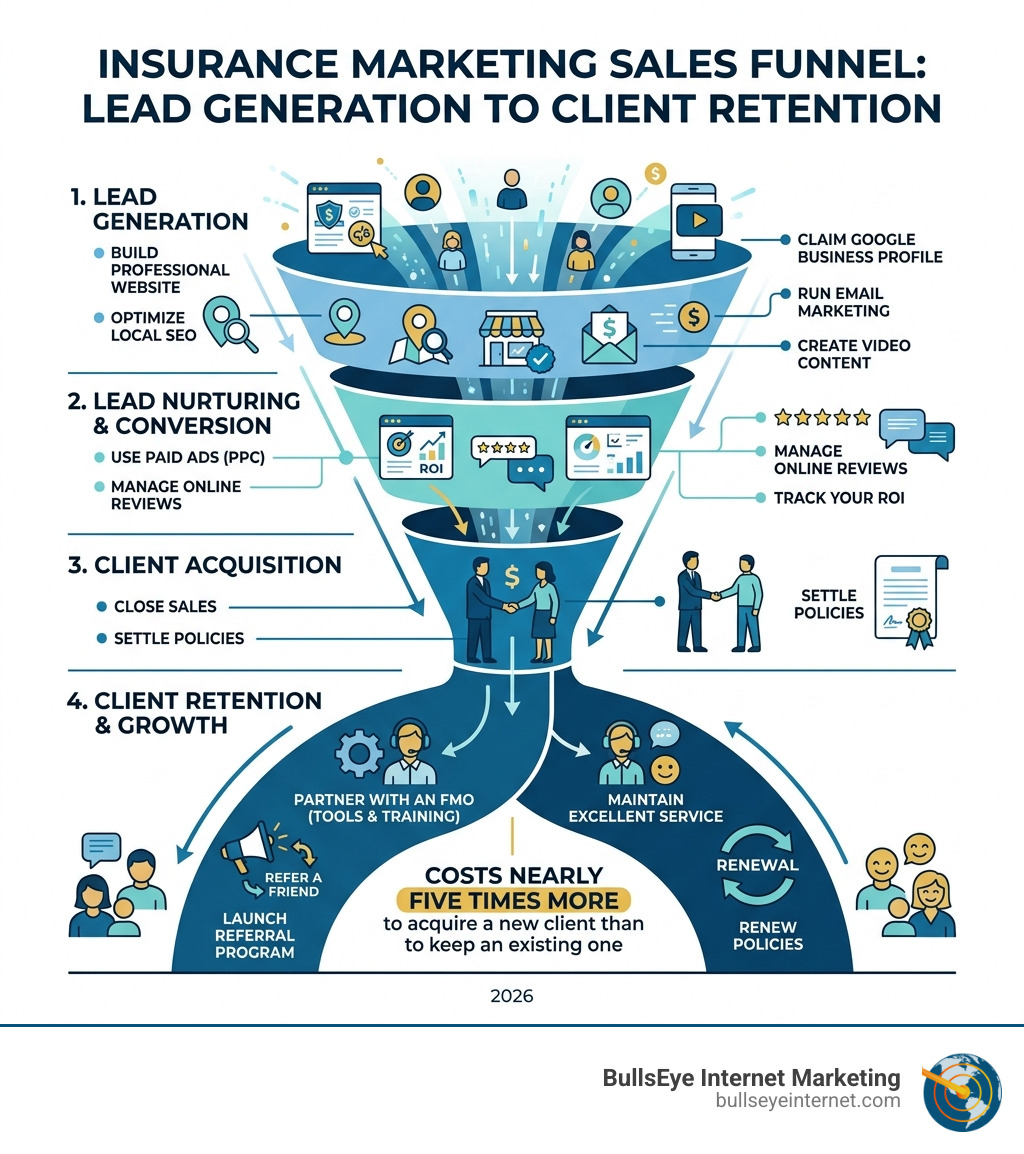
Here are the most effective strategies agents use to attract and keep clients:
- Build a professional website — your 24/7 digital storefront
- Optimize for local SEO — 46% of all Google searches are looking for local information
- Claim your Google Business Profile — critical for local visibility and trust
- Run email marketing campaigns — average return is $36 for every $1 spent
- Create video content — viewers retain 95% of a message watched vs. 10% when read
- Launch a referral program — referral leads increase conversion rates by up to 71%
- Use paid ads (PPC) — businesses report up to 200% ROI on Google Ads campaigns
- Manage online reviews — 97% of customers read reviews before choosing a local business
- Partner with an FMO — for tools, training, leads, and marketing support at no cost
- Track your ROI — measure cost per lead, conversion rates, and conversion value
The insurance industry is brutally competitive. It costs nearly five times more to acquire a new client than to keep an existing one — yet most agents spend the majority of their time and budget chasing cold leads with no strategy behind them.
Digital tools have completely changed how prospects find and choose an insurance agent. Consumers now research online, read reviews, watch videos, and expect a professional web presence before they ever pick up the phone. Agents who market themselves like it’s still 2005 are quietly losing business to those who don’t.
The good news? You don’t need a massive budget to compete. You need the right mix of strategies — and a clear understanding of what actually moves the needle.
I’m Ronnie Katz, founder of BullsEye Internet Marketing, and with over 20 years of experience in SEO, local search, and pay-per-lead marketing, I’ve helped businesses in highly competitive fields like marketing for insurance agents turn their online presence into a consistent source of qualified calls and sales. Below, I’ll walk you through exactly what works.
Marketing for insurance agents definitions:
1. Building a Foundation: Essential Tools for Marketing for Insurance Agents
Before you spend a single dollar on ads, you need a solid foundation. Think of your marketing tools like a carpenter’s toolbox; you wouldn’t try to build a house without a level and a hammer, and you shouldn’t try to build an insurance book without the right tech stack.
FMO Partnerships and Operational Tools
One of the most effective ways to jumpstart your efforts is through a Field Marketing Organization (FMO). Partnering with an FMO like Ritter or Integrity can provide access to a wealth of resources at no cost. These organizations often offer:
- Medicare-Tailored CRMs: Managing thousands of clients requires more than a spreadsheet. A specialized CRM allows you to store Medicare IDs, track policy history, and sync client data seamlessly.
- Quoting Engines: Speed is everything. Tools that allow you to compare plans and provide instant quotes are essential for conversion.
- Compliance and Recording: Regulations often require agents to record marketing and sales calls. Using integrated software ensures you stay on the right side of CMS requirements.
Developing a Target Buyer Persona
To market effectively, we must first know exactly who we are talking to. Developing a buyer persona helps us align our messaging with the specific demographics and coverage needs of our audience. Whether you are targeting young families for life insurance or seniors for Medicare, your “ideal client” profile should dictate every marketing decision you make.

Professional Website Options
Your website is your digital storefront. If it looks like it was built in 1998, prospects will assume your insurance knowledge is just as dated. In today’s market, your site must be mobile-responsive, as the majority of consumers now research insurance options on their smartphones.
We recommend looking into specialized platforms like AgentMethods or using Integrity’s PlanEnroll for agent-personalized websites. These platforms are designed specifically for the insurance industry, featuring:
- Lead Capture Forms: Don’t let visitors leave without a way to follow up.
- Mobile Responsiveness: Google prioritizes mobile-friendly sites in search results.
- User Experience (UX): A clean, intuitive layout that guides visitors toward requesting a quote or appointment.
2. Dominating Local Search and Digital Visibility
If a neighbor in Miami or West Palm Beach searches for “health insurance agent near me,” does your name show up? If not, you’re invisible to a massive segment of your market. Statistics show that 46% of Google searches seek local information, and roughly one-quarter of all clicks go to the top-ranked local business.
The Power of Google Business Profile
Your Google Business Profile (formerly Google My Business) is perhaps the single most important tool for local visibility. By claiming and optimizing your profile, you appear in the “Map Pack”—the list of local businesses that appears at the very top of search results. We focus heavily on optimizing these profiles to ensure our clients are the first ones prospects see.
Localized Keywords
To win at local SEO, we use “location signifiers.” Instead of just targeting “life insurance,” we target “life insurance in Fort Lauderdale” or “Medicare agent in Boca Raton.” This hyper-local focus reduces competition and attracts leads who are actually in your service area.
| Feature | Organic SEO | Local SEO |
|---|---|---|
| Primary Goal | Rank for broad industry terms | Rank for “near me” and city-specific terms |
| Key Tool | Quality Backlinks & Content | Google Business Profile & Reviews |
| Target Audience | National or Global | Geographic-specific (e.g., South Florida) |
| Search Result | Main blue links | Google Map Pack & Local Finder |
Managing Online Reputation and Reviews
Online reviews are the new word-of-mouth. Research shows that 97% of customers read online reviews for local businesses before making a decision. Furthermore, 85% of people trust these reviews as much as a personal recommendation from a friend.
To build authority, we recommend:
- Requesting Reviews: Don’t be shy. Ask happy clients to leave a review via email or text.
- Responding Quickly: 53% of reviewers expect a response to negative feedback within a week. Responding professionally to a bad review can actually increase consumer trust.
- Authority Building: High-quality reviews provide a “social proof” that signals to Google that you are a trustworthy authority in your field.
High-Conversion PPC and Paid Advertising
While SEO is a long-term play, Pay-Per-Click (PPC) advertising provides immediate results. By using Google Ads or Facebook Ads, you can jump to the front of the line. Businesses adopting PPC have seen an 80% increase in brand awareness via PPC and often achieve a 200% ROI.
The key to successful PPC in marketing for insurance agents is tracking your Cost Per Lead (CPL). We help agents refine their ad spend to ensure they aren’t just getting “clicks,” but actual phone calls from people ready to buy.
3. Content Strategies to Build Authority and Trust
Insurance is complicated, and people buy from those they trust to explain it. Content marketing—blogs, videos, and podcasts—positions you as the expert before you ever try to sell a policy.
Video Marketing for Insurance Agents
Video is the king of engagement. Viewers retain a staggering 95% of a message in video form, compared to just 10% when reading text.
- Educational Content: Create “How-To” videos on YouTube, such as “How to choose the right life insurance policy.”
- Testimonials: Video testimonials from satisfied clients carry immense weight.
- Explainer Videos: Use short clips to explain complex topics like Medicare Part D or deductibles.
Webinars and Podcasts
If you want to reach a niche audience, consider hosting a webinar or starting a podcast.
- Webinars: These are excellent for interactive learning. A topic like “Protecting your business from cyber attacks” can attract high-value B2B leads.
- Podcasts: This medium is more intimate than social media. It allows prospects to hear your voice and get a sense of your personality, building a level of trust that a static ad simply can’t match.
- Guest Blogging: Writing for other industry sites provides valuable backlinks to your website, which is a major signal to search engines that your site is an authority.
4. Lead Nurturing and Retention Tactics
Getting the lead is only half the battle. If you don’t nurture those leads, they will lapse. It is five times more expensive to find a new customer than to keep an old one.
Advanced Email Marketing for Insurance Agents
Email is far from dead. In fact, it remains one of the most profitable channels available, boasting a $36 ROI for every $1 spent on email marketing.
- Automation: Use automated sequences to send birthday greetings, Annual Notice of Change (ANOC) reminders, or educational newsletters.
- Segmentation: Don’t send a Medicare newsletter to a 30-year-old life insurance prospect. Segment your list so that every email is relevant to the recipient.
- Personalization: Use the client’s name and reference their specific policy types to increase engagement.
Referral Programs and Community Networking
Word-of-mouth is still the most powerful form of marketing. Referral programs can increase your conversion rates by 71% because people trust their friends and family more than any advertisement.
- Client Incentives: Offer small tokens of appreciation, like gift cards or discounts (where compliant), for successful referrals.
- Local Event Sponsorship: Getting involved in community events, youth sports, or local festivals in places like Miami or Boynton Beach builds brand recognition and shows you are invested in the community.
- LinkedIn Engagement: For B2B agents, LinkedIn is a goldmine. Engaging with local business owners and joining professional groups can lead to lucrative partnerships.
5. Measuring Success and Future Trends
You cannot manage what you do not measure. To ensure your marketing for insurance agents is actually profitable, you must track your ROI with financial clarity.
- ROI Tracking: Don’t just look at revenue. Look at net profit. Subtract your marketing costs from your total commission to see your true return.
- Customer Lifetime Value (CLV): A client who stays with you for 10 years is worth significantly more than the initial commission. Factor this into your acquisition strategy.
- AI and Chatbots: Looking toward 2025, AI is becoming a standard tool for customer service. Chatbots can handle initial inquiries, schedule appointments, and provide instant answers 24/7, seeing a 92% increase in engagement since 2019.
- Personalization: The future of insurance marketing is hyper-personal. Using data to offer the right coverage at the exact moment a client needs it (like after a home purchase) will be the hallmark of successful agents.
Frequently Asked Questions about Insurance Marketing
How do I measure the ROI of my marketing efforts?
To get a true picture, you need to look at your net profit, not just gross sales. Use management accounts (tools like Xero or QuickBooks) to track every dollar. Calculate your Cost Per Lead (CPL) and Cost Per Opportunity (CPO). Finally, set an attribution window—some leads might take six months to close, so don’t judge a campaign’s success too quickly.
What are the best social media platforms for agents?
It depends on your audience. Facebook is excellent for reaching consumers and seniors (Medicare). LinkedIn is the go-to for B2B insurance and professional networking. Instagram and TikTok are gaining ground for branding through short-form video content, which sees much higher engagement than text posts.
How can I generate leads compliantly?
Compliance is non-negotiable in insurance. Ensure any leads you purchase are verified by tools like TrustedForm or TCPA Guardian. If you are in the Medicare space, you must strictly adhere to CMS requirements for call recording and permission-based marketing. Always use opt-in forms for your email and text marketing to ensure you have documented consent.
Key Marketing Tools for Insurance Agents: BullsEye Internet Marketing
Marketing for insurance agents is a marathon, not a sprint. Success comes from combining a professional foundation with aggressive local visibility and consistent lead nurturing. Whether it’s through high-conversion PPC, a dominant Google Business Profile, or a robust referral program, the goal is to stay top-of-mind so your leads never lapse.
At BullsEye Internet Marketing, we specialize in helping agents navigate this complex landscape. We offer Google Business Profile Optimization, SEO, and PPC strategies tailored specifically for the insurance industry. Our unique advantage? We only work with one client per industry per geographic area, giving you a total competitive edge in your local market. Plus, we offer no long-term contracts—we believe in earning your business every single month through results.
Start generating high-quality calls and sales today with BullsEye Internet Marketing. Let us help you hit the target and grow your book of business in Florida and beyond.
