
The Local Marketing Reality Check: Why Most Small Businesses Are Invisible to Nearby Customers
Marketing for local businesses is one of the highest-ROI activities a small business owner can invest in — yet most local businesses are practically invisible when nearby customers search for them.
Here are the most effective local marketing strategies to win your neighborhood:
- Optimize your Google Business Profile — claim, verify, and complete every field
- Build local SEO — create location-specific pages with local keywords and schema markup
- Generate and manage reviews — nearly 95% of people read reviews before buying
- Run geo-targeted paid ads — Google Local Services Ads and Facebook radius targeting
- Build community partnerships — cross-promotions, sponsorships, and referral programs
- Stay active on social media locally — community groups, user content, local storytelling
- Use AI tools — automate email follow-ups and optimize for AI-powered search recommendations
Think about this: 72% of people who search for a local business end up visiting a store within five miles. And 85% of Gen Z shoppers say they buy local at least a few times a month.
Your customers are already searching for what you offer. The question is whether they find you — or your competitor down the street.
Most local business owners aren’t losing because they have a bad product or poor service. They’re losing because they’re invisible where it counts: Google Search, the Map Pack, and AI assistants that increasingly answer “who should I call?” before a customer ever visits a website.
This guide breaks down exactly what works in 2026 — no fluff, no agency jargon.
I’m Ronnie Katz, founder of BullsEye Internet Marketing, and since 2006 I’ve spent over 20 years helping local businesses increase their visibility, traffic, and conversions through every channel that matters for marketing for local businesses. If you’re tired of guessing what’s working and ready for a system that actually gets your phone ringing, you’re in the right place.
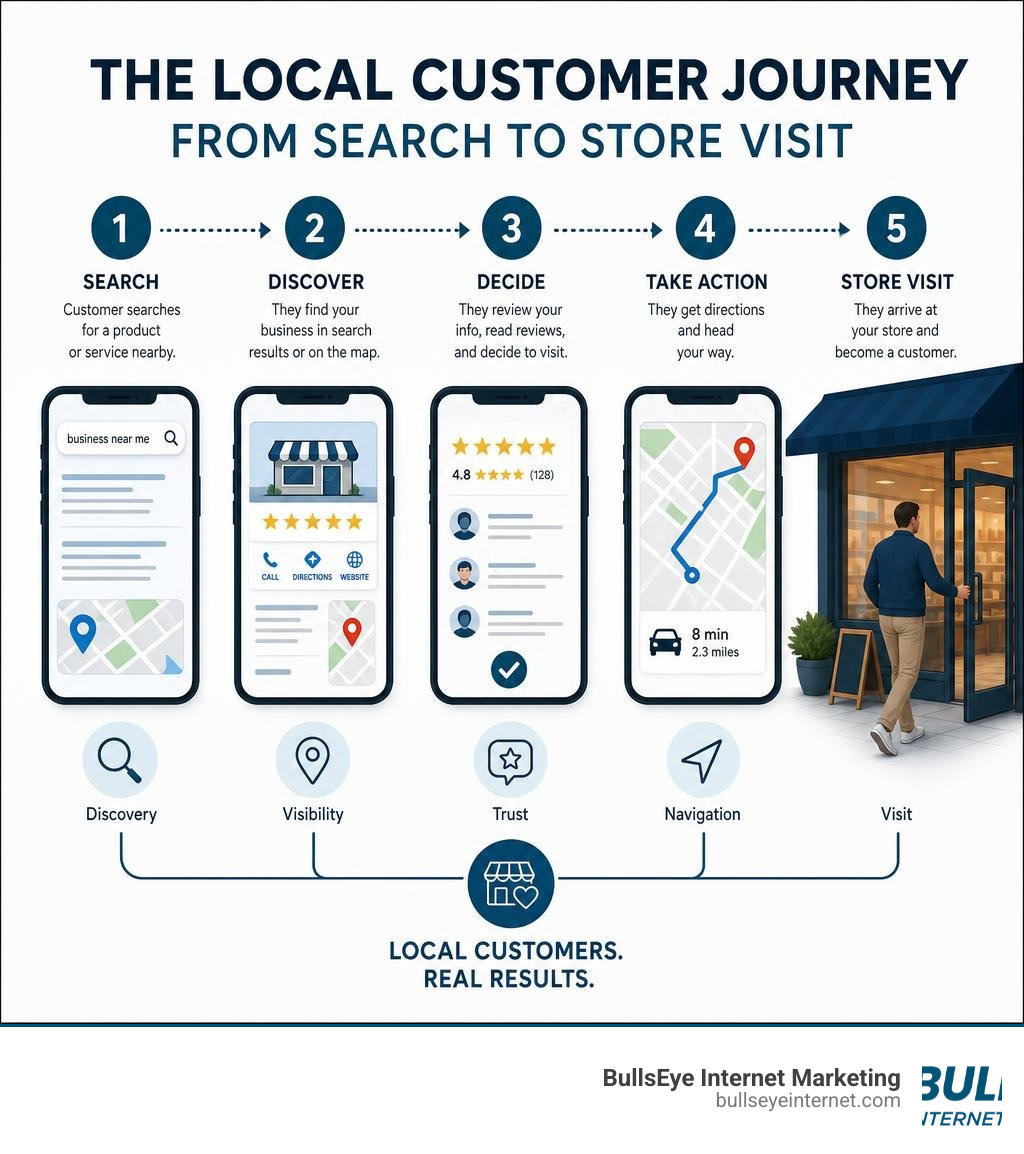
Marketing for local businesses terms explained:
Why Marketing for Local Businesses is Your Ultimate Competitive Advantage

Many local business owners look at massive national brands with multi-million dollar budgets and feel defeated before they even begin. But here is the secret: you have a structural, unfair advantage that national corporations cannot replicate.
National brands must speak to everyone, which means their messaging is often generic and diluted. They cannot build genuine relationships with neighborhoods in West Palm Beach or sponsor a local youth sports team in Boca Raton. They cannot share the specific, localized expertise that a homegrown business possesses.
When it comes to marketing for local businesses, you are not competing on global brand awareness; you are competing on proximity, trust, and immediate availability.
Consider the “trust threshold.” A study found that consumers are willing to travel up to 30 minutes to visit a local business in person. Why? Because over 80% of shoppers state that the experience a company provides is just as important as its products or services. Furthermore, more than 80% of retailers report that customers walk into their physical locations specifically to socialize with staff or ask for personalized, hands-on assistance. Big-box retailers and faceless e-commerce giants simply cannot compete with that level of human connection.
| Feature | Local Marketing | National Marketing |
|---|---|---|
| Primary Focus | Proximity, trust, immediate local intent | Mass reach, broad brand awareness |
| Conversion Rate | Exceptionally high (targeted 5-mile radius) | Lower on average (diluted audience) |
| Trust Factor | High (community reputation, local reviews) | Moderate (rely on national PR and ads) |
| Customer Experience | Personalized, face-to-face, relational | Standardized, transactional, automated |
| Budget Efficiency | Highly efficient (zero wasted geographic spend) | High waste (paying to reach unqualified areas) |
The Core Pillars of Marketing for Local Businesses
To build a local marketing engine that consistently drives calls and foot traffic, we must focus on four foundational pillars:
- Geographic Targeting: Stop wasting money showing ads to people who are too far away to buy. By narrowing your focus to a tight radius—often as small as 5 to 15 miles around your location—your budget goes exponentially further.
- Community Authority: Positioning your brand as a helpful, active neighbor. This means participating in local events, joining local chambers, and speaking directly to the unique needs of your neighborhood.
- Mobile Dominance: Over 60% of local searches happen on mobile devices, and for immediate-need services (like an emergency plumber or locksmith), that number climbs much higher. Your online presence must be lightning-fast and incredibly easy to navigate on a smartphone.
- Proven Local Marketing Strategies: Integrating both digital and offline systems so they support each other seamlessly.
6 High-ROI Strategies for Winning Your Local Market
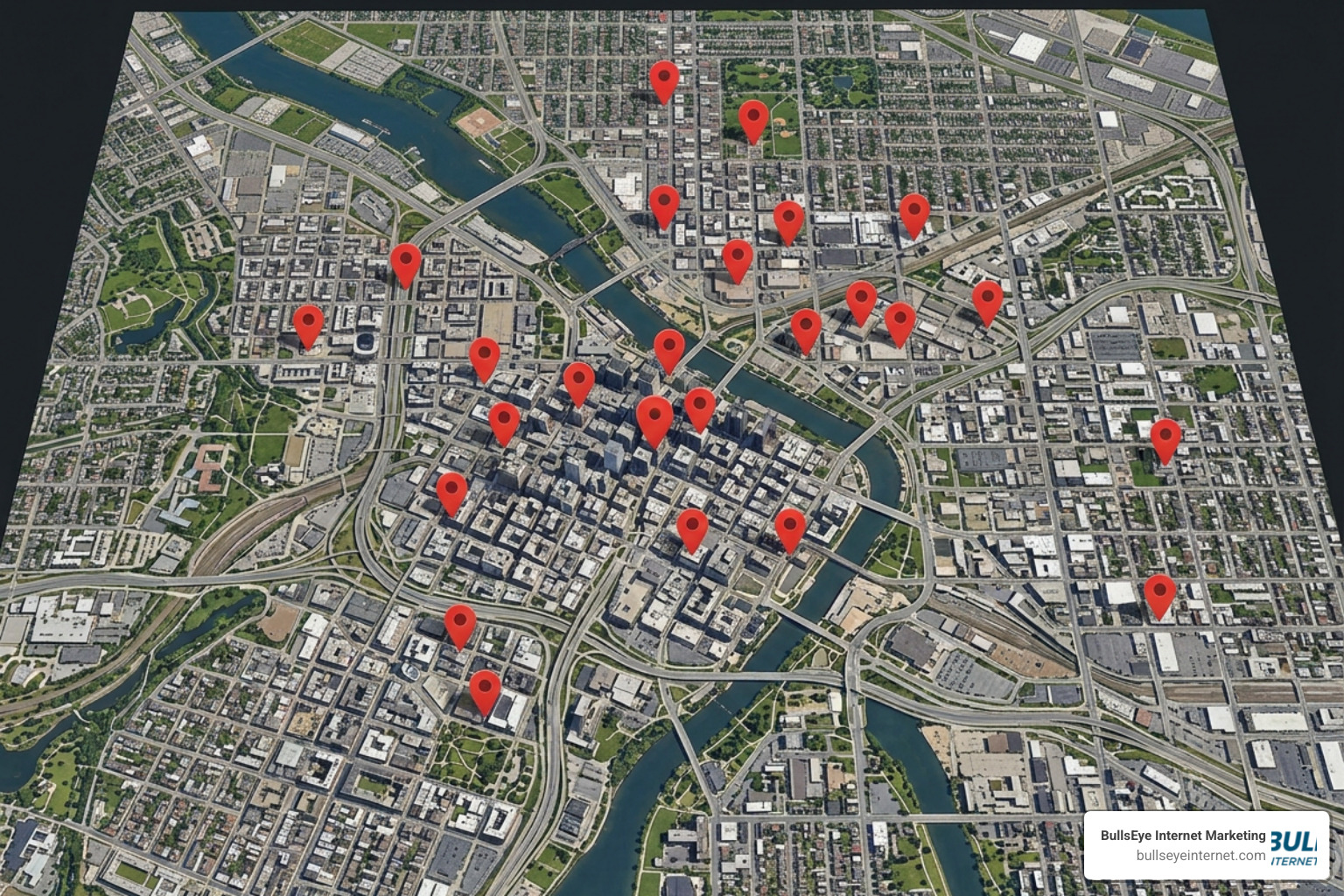
To build a predictable stream of leads, we focus on a balanced, multi-channel approach. If you rely entirely on one source of traffic, you are vulnerable to algorithm shifts or price hikes.
Here are the six high-ROI systems we recommend building to dominate your local market:
- Local SEO & Geo-Specific Content: Getting found when people search for your services organically.
- Paid Search & Local PPC: Capturing high-intent buyers at the exact moment they are ready to purchase.
- Review & Reputation Management: Building a trustworthy online image that converts searchers into callers.
- AI & Marketing Automation: Leveraging modern tools to scale your efforts and respond to leads instantly.
- Community Partnerships & Referrals: Building offline relationships that generate highly qualified word-of-mouth leads.
- Local Social Media Engagement: Staying top-of-mind with nearby families and businesses.
1. Master Local SEO and Geo-Specific Content
Organic search is the gift that keeps on giving. While paid ads stop delivering leads the second you turn off the budget, a strong organic presence compounds over time, providing a steady stream of free, high-intent traffic.
To win at local SEO, you must speak the literal language of your target neighborhoods. This starts with structured keyword research. Instead of trying to rank for broad, highly competitive terms like “plumbing services,” you should target highly specific, long-tail local keywords like “emergency drain cleaning in Fort Lauderdale” or “leaky pipe repair near Coral Springs.”
Once you have identified these terms, you need dedicated location pages. If your business serves multiple neighborhoods across Broward County or Palm Beach County, do not force Google to guess where you operate. Create unique, helpful service-area pages for each primary city. Each page should feature unique content, local landmarks, real customer testimonials from that specific area, and localized helpful tips.
To take your organic rankings to the next level, read our comprehensive guides on Local SEO for Small Businesses and explore our Local SEO Complete Guide to learn how to structure your site’s architecture for maximum visibility.
Finally, do not forget to implement Schema Markup (specifically LocalBusiness structured data) on your website. This is a snippet of code that acts as a direct translator for search engines, clearly telling Google your business name, physical address, phone number, operating hours, and services offered.
2. Dominate Paid Search with Local Ads and PPC
When a homeowner’s AC breaks down in the middle of a humid South Florida summer, they do not spend hours researching blog posts. They pull out their phone, search for “AC repair near me,” and click the first reputable business they see. To capture these high-intent, urgent buyers, you need a smart paid search strategy.
For local service providers (such as plumbers, electricians, roofers, and HVAC technicians), the single most cost-effective paid option is Google Local Services Ads (LSAs). Unlike traditional pay-per-click (PPC) ads where you pay for every click (even if they accidentally clicked and immediately left your site), LSAs operate on a pay-per-lead model. You only pay when a qualified customer actually calls or messages your business directly through the ad.
To understand how to leverage this game-changing platform, check out our guide on Google Local Services Ads for Home Services.
If you are running traditional Google Search Ads, precision is key. To keep your cost-per-lead low, you must:
- Use Negative Keywords: Actively exclude search terms that indicate someone is looking for a job, a DIY tutorial, or a competitor (e.g., “how to fix a pipe myself” or “free plumbing training”).
- Optimize for Mobile-First Landing Pages: Ensure your landing pages load in under 3 seconds, feature a prominent, clickable phone number at the top, and have simple lead forms with five fields or fewer.
- Highlight Local Credibility: Mention your local awards, community years of service, or specific local certifications directly in your ad copy.
To decide where to allocate your budget for the best return on investment, read our breakdown on Local SEO or PPC: Which Delivers Better Results for Home Service Businesses.
3. Build a High-Velocity Review and Reputation Engine
Your digital reputation is your most powerful conversion tool. You can have the best website and the largest ad budget in town, but if your business has a 3.2-star rating with only four reviews, searchers will scroll right past you to a competitor with a 4.8-star rating and hundreds of reviews.
The statistics are clear: nearly 95% of people read online reviews before making a purchase, and displaying reviews on your site can increase conversion rates by up to 270%.
But it is not just about the overall score; review recency and velocity are incredibly important. In fact, 48% of consumers only pay attention to reviews written within the past two weeks, and many believe that reviews older than three months are no longer relevant. Google also uses review frequency as a major ranking signal for the Map Pack.
To build a high-velocity review engine:
- Ask Systematically: Do not leave reviews to chance. Send an automated text message or email immediately after a job is completed with a direct link to your Google Business Profile review page.
- Respond to Every Review: 97% of consumers who read reviews also read the business’s responses. Respond to positive reviews with gratitude (and naturally slip in a service keyword), and address negative reviews professionally within 24 hours without getting defensive.
- Do Not Incentivize: Never offer discounts, free gifts, or financial compensation in exchange for positive reviews. It violates Google’s terms of service and can result in your profile being suspended.
4. Leveraging AI in Marketing for Local Businesses
The digital landscape is shifting. In 2026, customers are no longer just searching Google and clicking “ten blue links.” They are increasingly asking AI assistants like ChatGPT, Gemini, and Perplexity for direct recommendations (e.g., “Find a highly-rated family dentist in West Palm Beach that accepts my insurance”).
This shift is known as Answer Engine Optimization (AEO) or Generative Engine Optimization (GEO). To ensure AI models recommend your business, your website must be structured so machines can easily read and verify your data. You can learn more about this technical shift in the AI Marketing for Local Business: The Complete Guide | Pantora.
Beyond search optimization, AI can dramatically reduce the time and cost of running your local marketing. Small business owners can use free or low-cost AI tools to:
- Automate Email Sequences: Set up automated welcome and nurture sequences for new leads.
- Draft Hyper-Local Content: Quickly outline blog posts addressing local weather challenges or seasonal maintenance tips.
- Speed Up Review Responses: Use AI to draft personalized, professional responses to customer reviews in seconds.
5. Cultivate Community Partnerships and Referral Programs
Some of the most powerful marketing strategies do not happen on a screen. Building deep, authentic roots in your local community creates a protective barrier around your business that national competitors cannot penetrate.
According to the 10 Local Marketing Strategies That Work – SBA, collaborating with other non-competing businesses that serve the same target audience is an incredibly cost-effective way to scale your reach. For example, a local landscaping company can partner with an outdoor lighting specialist to cross-promote services, or a local restaurant can partner with a nearby theater for a “dinner and a show” special.
Getting involved in local business organizations, such as the Martin County Business Exchange | Top Businesses in Martin, helps you build high-value B2B relationships and referral networks. Additionally, joining local chambers of commerce and getting listed on local directories like the THE BEST 10 Marketing in WEST PALM BEACH, FL – Yelp provides powerful local trust signals and high-quality backlinks to your website.
Sponsor local youth sports teams, support local charity events, or host educational workshops at your facility. These activities build immense goodwill and position your business as a pillar of the community. To supercharge this word-of-mouth growth, implement a structured referral program that offers a clear, attractive reward (like a credit or gift card) to both the referrer and the referred client.
6. Engage Locally on Social Media
Social media is not just for global influencers; it is a powerful tool for local community engagement. The key is to stop trying to appeal to a global audience and focus entirely on your immediate geographic neighbors.
Use hyper-local targeting on platforms like Facebook and Instagram to run ads within a tight radius around your physical location or target zip codes. Showcase your team in action, share before-and-after photos of local projects, and tell the story of your business’s involvement in the community.
Encourage your customers to share their experiences online. User-generated content (such as a customer posting a photo of their newly remodeled kitchen and tagging your business) carries far more weight than any ad you could ever run. Participate actively in local community groups, neighborhood pages, and local B2B LinkedIn groups to answer questions and offer helpful advice without being overly salesy.
Optimizing Your Google Business Profile for Maximum Local Reach
Your Google Business Profile (GBP)—formerly known as Google My Business—is the single most important digital asset for any local business. Over 80% of local search clicks go directly to the “Map Pack” (the top three local business listings displayed alongside a map at the top of Google search results). If you are not in the Map Pack, you are missing out on the vast majority of local search volume.
To optimize your profile for maximum visibility:
- Maintain Perfect NAP Consistency: Your Name, Address, and Phone number (NAP) must be formatted exactly the same way across your website, GBP, social media profiles, and every online directory. Even minor discrepancies (like “Suite 100” vs. “#100”) can confuse search engines and hurt your rankings.
- Select the Correct Categories: Your primary category is the single most important ranking factor for local search. Choose the category that most accurately describes your core business (e.g., “Pest Control Service”). Then, select relevant secondary categories (e.g., “Termite Control Service,” “Animal Control Service”) to expand the searches you are eligible to show up for.
- Fill Out Every Single Field: Do not leave any section blank. Add your operating hours, list of services, products, business description (use up to 750 characters naturally incorporating your primary local keywords), and attributes (e.g., “locally owned,” “wheelchair accessible”).
- Post Weekly Updates: Use Google Business Profile Posts to share weekly updates, promotions, safety tips, and company news. Google treats active profiles favorably.
- Upload High-Quality, Real Photos: Profiles with real, high-quality photos receive significantly more direction requests and website clicks than those relying on stock imagery. Upload photos of your team, your completed projects, your office, and your branded vehicles regularly.
Frequently Asked Questions About Marketing for Local Businesses
How do we measure the success of our local marketing efforts?
To ensure your marketing budget is actually growing your bottom line, you must move away from vanity metrics (like impressions or social media likes) and focus on performance metrics that tie directly to revenue.
We recommend tracking:
- Lead Volume (by source): How many phone calls, form submissions, and text messages are coming in, and exactly which marketing channel generated them?
- Cost Per Qualified Lead (CPQL): How much are you spending to acquire a lead that actually fits your target customer profile?
- Google Business Profile Insights: Track direct calls, direction requests, and website clicks originating from your Map Pack listing.
- Lead-to-Customer Conversion Rate: How effectively is your team closing the leads that come in?
To build a structured dashboard for tracking these metrics, use our Local SEO Strategy Template Guide.
How long does it take to see results from local SEO vs. paid ads?
Local SEO and paid ads are complementary strategies that operate on entirely different timelines:
- Paid Ads (PPC & LSAs): Deliver near-instant results. You can set up a campaign today and start receiving qualified calls tomorrow. However, the traffic stops the moment your budget runs out.
- Local SEO: Is a long-term investment. While some basic GBP optimizations can show improvements within days, a comprehensive organic SEO strategy typically takes 3 to 6 months to start ranking competitively, and 6 to 12 months to build dominant, compounding authority.
To learn how to quickly bridge this gap and get immediate leads while your organic presence builds, read our guide on How to Beat the Competition in Your Area Using Google Local Services Ads.
Can a small business manage local marketing without an agency?
Yes, a small business owner can absolutely manage basic local marketing in-house if they have 5 to 10 hours a month to dedicate to learning and consistent execution. Free tools like Google Business Profile, Google Search Console, and basic email marketing platforms make it easier than ever to get started.
However, as your business grows, managing complex ad campaigns, technical SEO, and continuous content creation often becomes a full-time job that pulls you away from running your business. If you are trying to decide whether to keep your marketing in-house or partner with professionals, explore our Local Marketing Agency Complete Guide to weigh your options.
Conclusion: Ready to Dominate Your Local Market?
Building a highly visible, trusted local brand does not happen by accident. It requires a consistent, integrated system that gets your business found by local searchers, trusted by nearby families, and chosen over national competitors.
At BullsEye Internet Marketing, we do things differently. We do not believe in locking local businesses into rigid, long-term contracts. Instead, we prove our value month after month. To give our clients an unfair competitive advantage, we work with only one client per industry per geographic area. When you partner with us, we focus 100% of our local search expertise on helping you win your neighborhood—not your competitors.
If you are ready to stop managing disconnected marketing tactics and want a proven system that drives predictable calls and sales, let’s talk. Explore our exclusive Pay Per Lead Lead Generation model today and find out if your territory is still available!
