
Digital Marketing for Startup Growth Starts With Focus
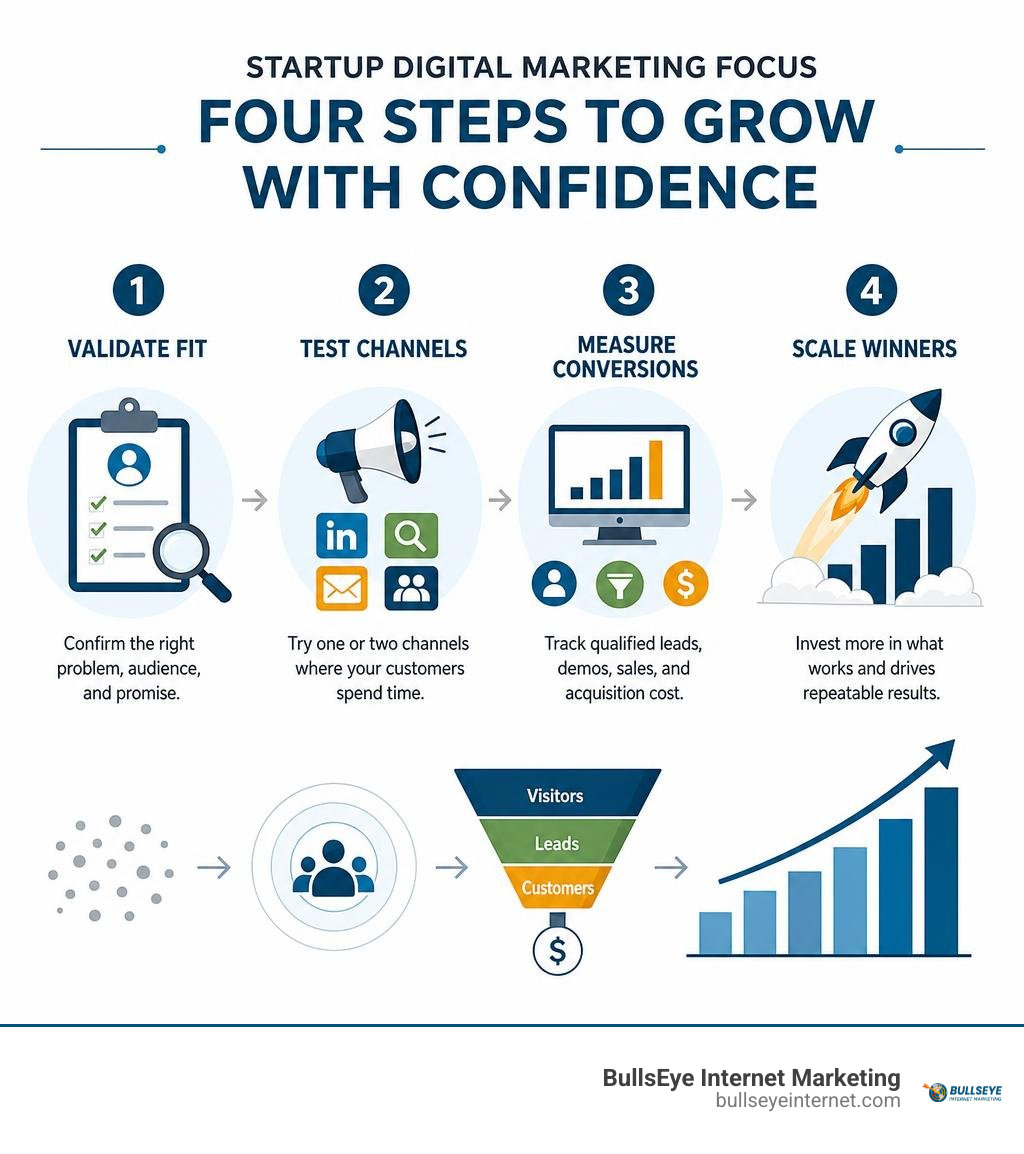
The fastest path to effective digital marketing for startup growth is simple: validate that customers want your solution, choose one or two places where those customers already spend time, and measure real outcomes before increasing spend.
Start here:
- Talk to potential customers and refine one clear problem, audience, and promise.
- Test a small number of channels, such as founder-led LinkedIn outreach, search content, email, referrals, or tightly targeted paid ads.
- Track qualified leads, demos, sales, and customer acquisition cost – not likes, impressions, or generic traffic.
- Double down only after a channel produces repeatable results.
Startups do not have the brand recognition, spare cash, or long planning cycles of established companies. That means marketing is not just promotion. Early on, it is a way to learn what buyers need, what messages earn attention, and what acquisition path can become repeatable. With 73% of seed-stage startups naming distribution as a major first-year challenge, disciplined testing matters more than being everywhere at once.
I am Ronnie Katz, founder and Principal CEO of BullsEye Internet Marketing. Since 2006, I have helped businesses improve visibility, traffic, conversions, and measurable returns through digital marketing for startup and growing-company needs.
Digital marketing for startup terms at a glance:
Startup Marketing Strategy vs. Traditional Marketing: Why Lean Beats Bloat
Traditional corporate marketing playbooks assume things startups simply do not have: established brand equity, massive operational budgets, historical customer datasets, and an appetite for twelve-month multi-channel brand campaigns. When an enterprise launches a campaign, it optimizes existing market share. When an early-stage startup builds a marketing strategy, it searches for survival and basic traction.
A true startup marketing strategy is a dynamic, high-velocity discovery roadmap. It defines the “what” and the “why” behind your offering, identifying where high-intent buyers congregate and how to capture them efficiently. Conversely, a tactical marketing plan details the exact calendar of execution—the posts, ad creatives, landing pages, and outreach sequences designed to hit immediate milestones.
When mapping out this strategy, classical frameworks like the 7 Ps of the marketing mix (Product, Price, Promotion, Place, People, Packaging, and Process) remain structurally useful, but only if viewed through a lean lens. For instance, “Packaging” and “Process” in the digital realm are not about glossy boxes; they represent your landing page UX, frictionless onboarding workflows, and the immediate credibility your digital footprint communicates.
Rather than deploying bloated enterprise campaigns, adopting 15 Scrappy Growth Hacking Strategies Every New Business Needs helps you discover actual market demand before committing significant capital. Research shows that 68% of startups that fail cite poor go-to-market execution as a primary cause rather than an inferior product. Lean execution protects your runway while you uncover what your audience truly cares about.
Validating Product-Market Fit Before Spending Marketing Dollars
Pouring marketing capital into an unvalidated offer is the quickest way to incinerate runway. In fact, 43% of startups fail from poor product-market fit—a distribution problem that often masquerades as a product defect. Before you scale paid acquisition or complex inbound funnels, you must confirm that a distinct market segment urgently wants what you have built.
A practical way to assess this readiness is the Sean Ellis Product-Market Fit survey. Ask your active users a simple question: “How would you feel if you could no longer use this product tomorrow?”
- Very disappointed
- Somewhat disappointed
- Not disappointed
If 40% or more of your surveyed users respond with “very disappointed,” you have reached the threshold where scaling customer acquisition becomes economically viable. If you fall below that benchmark, your primary objective remains customer discovery, not aggressive paid promotion.
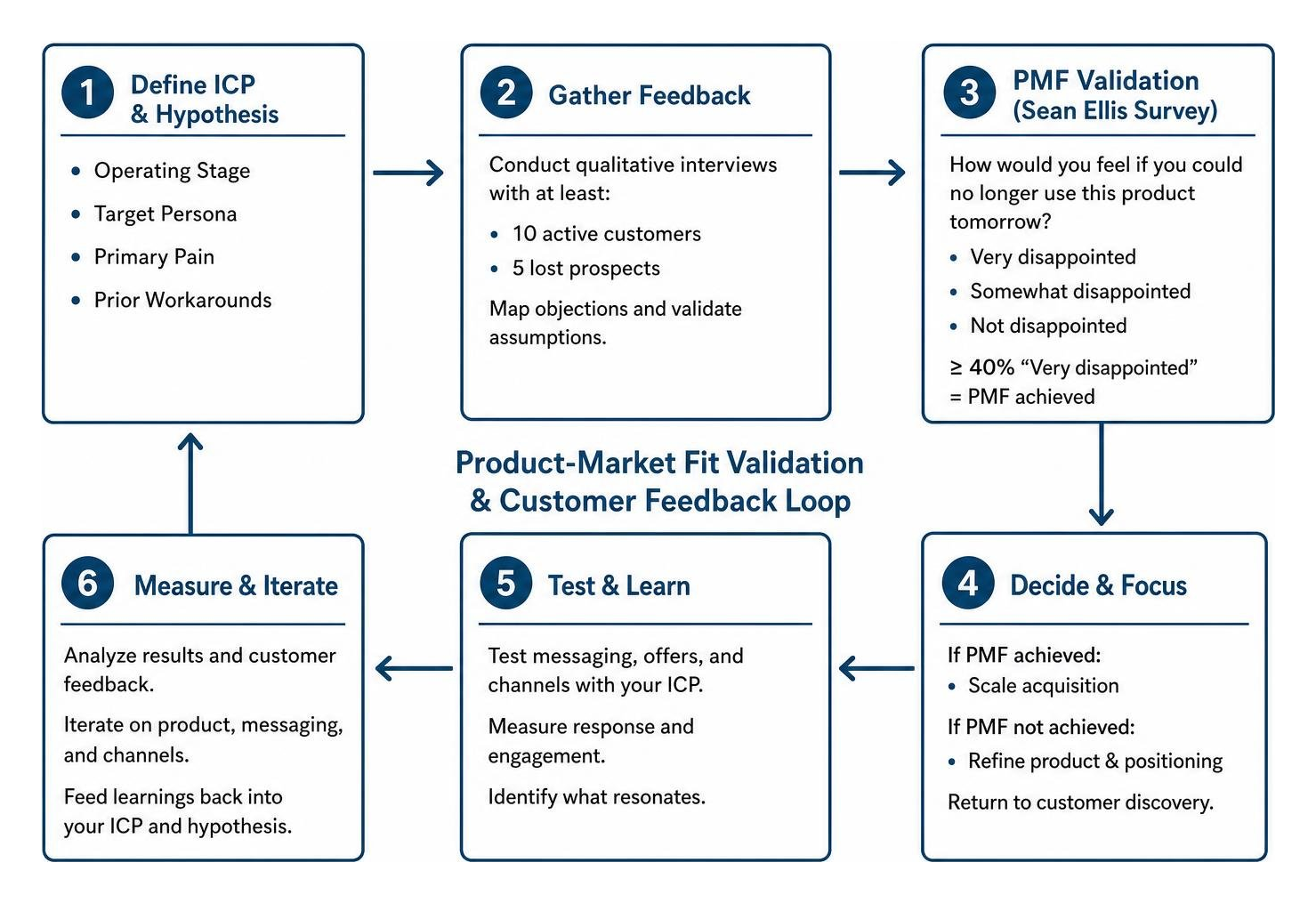
Conduct qualitative interviews with at least 10 active customers and 5 lost prospects. Map their specific objections and define a strict Ideal Customer Profile (ICP) using five key dimensions:
- Operating Stage: Company size, revenue range, or life stage.
- Target Persona: Exact job title or daily decision-maker role.
- Primary Pain: The expensive, recurring headache they need resolved now.
- Prior Workarounds: Failed solutions, spreadsheets, or competitor software they currently endure.
- Success Metric: The single operational or financial outcome that proves your product worked.
Dialing in these answers allows you to refine your positioning and discover How To Market Your New Business Without Selling Your Kidney before deploying aggressive marketing campaigns.
The 3 Critical Priorities in Early-Stage Digital Marketing for Startup Founders
For pre-revenue and seed-stage founders operating under runway constraints, every marketing task must directly serve one of three foundational priorities:
- Systematic Channel Validation: You are not running campaigns to win creative awards. You are running small, controlled experiments to identify at least one predictable, scalable acquisition channel where Customer Acquisition Cost (CAC) remains comfortably lower than Customer Lifetime Value (LTV).
- Building Repeatable Acquisition Systems: Founder hustle (closing deals through personal networks or manual direct messages) does not scale indefinitely. Every manual tactic that yields conversions must be systematized, documented into standard operating playbooks, and made repeatable for future team members.
- Establishing Founder-Led Content: In the early days, people buy into the founder’s vision and domain expertise long before they trust an unproven brand logo. Founder-driven storytelling cuts through digital noise and creates organic authority at negligible financial cost.
Core Channels of Digital Marketing for Startup Growth in 2026
The digital landscape in 2026 has evolved significantly. Search experiences are dynamic, buyer journeys are fragmented across micro-communities, and standard programmatic display advertising is increasingly ignored. To drive measurable pipeline, startups must focus on high-intent channels that compound in value over time.

Organic Search and Answer Engine Optimization (AEO)
Search remains indispensable—97% of people use search engines to find a business. However, modern search behavior requires a dual approach: traditional Search Engine Optimization (SEO) combined with Answer Engine Optimization (AEO).
With approximately 60% of Google searches ending without a click due to native AI Overviews summarizing answers directly on the search engine results page, the goal of organic content is no longer just ranking for generic terms. You must structure technical data, FAQs, and informational assets so that large language models cite your business as the definitive source.
When an AI engine synthesizes a direct answer for a high-intent commercial query, being the cited authority delivers pre-qualified prospects directly to your funnel. Startups should target long-tail, high-intent problem queries rather than competitive head terms. If you are starting fresh, establishing a solid technical and architectural foundation through The Ultimate Seo Starter Guide For New Businesses ensures your pages are crawlable, fast, and structured for modern search algorithms.
Founder-Led Distribution and B2B Social Channels
Organic reach on corporate brand pages has declined across major networks, but personal profiles continue to experience significant algorithmic priority. For B2B companies, LinkedIn is the undisputed center of gravity: 80% of B2B social media leads originate on the platform, and founder profiles routinely receive up to 561% more reach than corporate company pages.
Founder-led distribution involves turning your daily business building, product breakthroughs, customer problem analyses, and industry contrarian takes into public thought leadership.
To execute this without burning hours every day:
- Block two hours at the start of each week to draft 3 core insights derived directly from recent sales conversations or client onboarding sessions.
- Engage thoughtfully on 10 to 15 posts from industry peers and target buyers daily.
- Repurpose high-performing social observations into structured blog posts and email newsletter campaigns.
For specialized guidance on tailoring this approach to professional buyers, review our deep dive on b2b startup marketing to align social distribution with longer enterprise sales cycles.
High-ROI Digital Marketing for Startup Budgets on Search and Paid Ads
Paid advertising is an amplifier of verified messaging, not a substitute for product-market fit. When utilized correctly, paid search and targeted social ads offer rapid qualitative feedback on value propositions, headlines, and audience angles.
For early-stage startups, the most cost-effective paid media framework combines:
- High-Intent Search Ads: Capturing prospects actively searching for immediate solutions to their problems on Google Ads rather than displaying interruptive banner ads to cold audiences.
- Micro-Budget Message Testing: Deploying small test budgets ($500 to $1,500) across 3 to 4 distinct ad creatives and value propositions to identify which specific hook delivers the highest click-to-lead conversion rate.
- Tight Retargeting Campaigns: Retargeting visitors who landed on your pricing or product pages but did not convert. Because retargeting focuses strictly on warm traffic, it maintains high conversion rates with minimal monthly spend.
Founders often delay paid media out of fear of burning capital, but understanding Why Your Startup Needs A Digital Ad Strategy Yesterday will clarify how micro-budget campaigns de-risk your messaging before you scale up your marketing operations.
The 90-Day Channel Commitment Framework: Avoiding the Multi-Channel Trap
One of the most dangerous traps for early-stage founders is “channel dabbling”—running Google Ads for 10 days, publishing two blog posts, sending 50 cold emails, launching a TikTok account, and abandoning all of them because none yielded an immediate flood of revenue.
Every marketing channel requires a minimum baseline of volume, optimization, and time before it produces compounding returns. Spreading your attention across five channels simultaneously guarantees that none receive the focus required to break through.
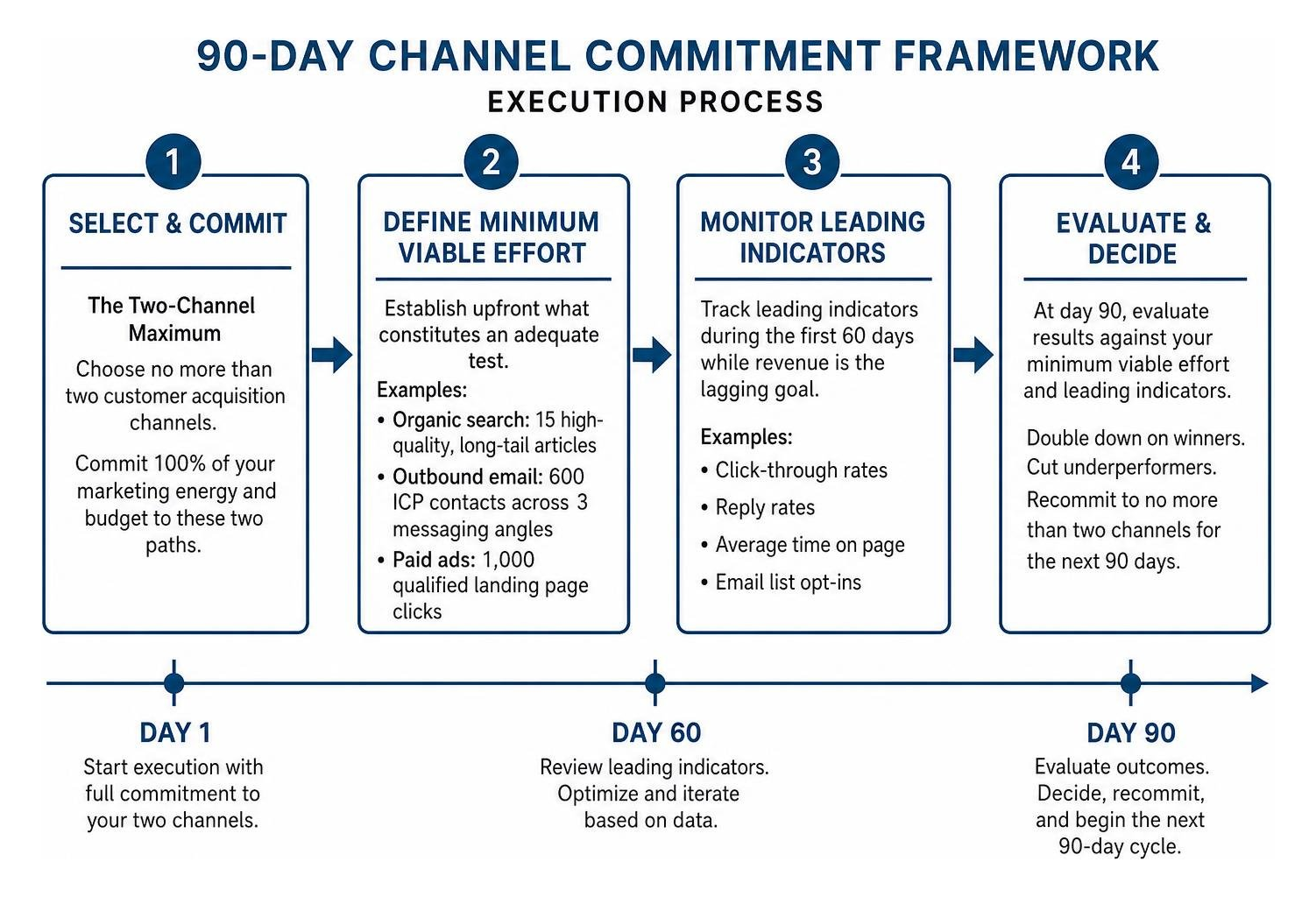
The 90-Day Channel Commitment Framework enforces strict focus through four rules:
- The Two-Channel Maximum: Select no more than two customer acquisition channels at any given time (e.g., Google Ads retargeting + Founder-led LinkedIn, or SEO/AEO + Cold Email). Commit 100% of your marketing energy and budget to these two paths.
- Define Minimum Viable Effort: Establish upfront what constitutes an adequate test. For organic search, that might be 15 high-quality, long-tail articles. For outbound email, it might be 600 verified ICP contacts across 3 messaging angles. For paid ads, it could mean driving 1,000 qualified landing page clicks.
- Monitor Leading Indicators: While revenue is the lagging goal, track leading indicators during the first 60 days—such as click-through rates, reply rates, average time on page, and email list opt-ins.
- Establish Strict Kill/Scale Criteria: On day 90, evaluate your unit economics. If a channel demonstrates clear traction and manageable acquisition costs, scale it. If it fails to meet your predetermined baseline despite thorough optimization, kill it and rotate in a new channel for the next 90-day sprint.
Maintaining this discipline prevents unsustainable customer acquisition costs. Read our tactical guide on how to Stop Killing Your Startup With High Customer Acquisition Costs to protect your margins during channel validation.
Budget Allocation by Stage: The 70/20/10 Allocation Rule
How you distribute marketing capital must adapt as your company transitions from initial discovery to active scale. The 70/20/10 Budget Framework provides a reliable structure:
- 70% on Proven Core Channels: Allocate the vast majority of your budget to the 1 or 2 channels that have demonstrated positive ROI and repeatable customer generation.
- 20% on High-Potential Experiments: Dedicate a smaller portion of capital to testing emerging channels (e.g., AEO content optimization, new ad formats, or strategic co-marketing partnerships).
- 10% on Infrastructure and Tooling: Reserve funds for foundational software, CRM automations, landing page optimization tools, and conversion tracking infrastructure.
| Startup Growth Stage | ARR Range | Typical Monthly Marketing Budget | Primary Marketing Focus | Team Structure |
|---|---|---|---|---|
| Pre-PMF (Seed) | $0 – $500K | $2,000 – $5,000 | Customer Discovery & Founder-Led Outreach | Founder + Specialized Contractors |
| Early Traction | $500K – $2M | $10,000 – $25,000 | Channel Validation & Core SEO/PPC Scaling | Fractional CMO or In-House Generalist |
| Growth & Scale | $2M – $10M+ | $30,000 – $100,000+ | Multi-Channel Dominance & Funnel Optimization | Full In-House Team + Channel Agencies |
Avoiding premature spend is critical; see our recommendations on how to Stop Wasting Capital On Bad Marketing Services For Startups to preserve your runway for efforts that directly drive growth.
Building the Team: In-House Hires vs. Agency Execution
Founders frequently struggle with the timing and structure of their first marketing hire. Bringing on a full-time Chief Marketing Officer (CMO) too early can burn $150,000 to $200,000+ in annual salary without the execution bandwidth needed to build daily pipeline. Conversely, hiring an entry-level specialist often leads to disjointed execution without strategic oversight.
Before making your first hire, ensure you have personally closed your first 10 to 20 customers. You must understand your customer’s objections, primary desires, and buying triggers so you can effectively evaluate external marketing talent.
| Dimension | In-House Full-Time Hire | Specialized Agency Execution |
|---|---|---|
| Speed to Launch | Slow (3 to 6 months to recruit and onboard) | Rapid (Campaigns live within 1 to 2 weeks) |
| Cost Predictability | High fixed overhead (Salary, benefits, equity, tooling) | Flexible monthly operational expense without long commitments |
| Skill Breadth | Usually limited to 1 or 2 core competencies | Full multidisciplinary team (SEO, PPC, CRO, Design) |
| Strategic Focus | 100% dedicated to your single brand | Broad perspective across multiple market campaigns |
| Risk Profile | High financial risk if marketing strategy pivots | Low risk when backed by performance-focused terms |
At BullsEye Internet Marketing, we operate with an approach specifically aligned with growing businesses: we provide targeted execution across Pay-Per-Lead, Google Business Profile Optimization, SEO, PPC, and Conversion Rate Optimization. We work with only one client per industry per geographic market to deliver an exclusive competitive advantage, and we back our work with no long-term contracts, ensuring that our performance keeps us accountable every single month.
Measuring What Matters: From Pirate Metrics to Unit Economics
Vanity metrics like social media impressions, generic page views, and raw newsletter subscribers do not pay software server bills or employee payroll. Early-stage startups must track their growth funnel using Dave McClure’s classic AARRR (Pirate Metrics) framework, connecting marketing directly to bottom-line unit economics:
- Acquisition: How many qualified users arrive from your core target channels? (Focus on cost-per-click and landing page conversion rate).
- Activation: Do users experience the core value proposition during their initial visit or trial? (Focus on Product Qualified Leads or demo completions).
- Retention: Do customers return and continue using the product over 30, 60, and 90 days? (Focus on churn rate).
- Revenue: What does it cost to acquire a paying customer versus the revenue they generate? (Focus on CAC payback period and LTV:CAC ratio).
- Referral: Do existing customers actively invite peers or recommend your service? (Focus on viral coefficient and referral loop velocity).
A healthy startup unit-economic profile targets an LTV:CAC ratio of at least 3:1, meaning the lifetime value of a customer is three times greater than the total cost to acquire them. Furthermore, keep your CAC payback period under 12 months (and ideally under 6 months for bootstrapped models) to maintain positive operational cash flow.
For a deeper look into structuring these funnels, explore A Comprehensive Guide To Startup Advertising Strategies to optimize your customer acquisition economics.
Frequently Asked Questions about Startup Digital Marketing
How much should an early-stage startup spend on digital marketing per month?
Pre-product-market fit startups should allocate between $2,000 and $5,000 per month, primarily directed toward software tools, qualitative customer testing, and micro-budget ad experiments. Once product-market fit is validated ($500K+ ARR), early traction startups typically spend $10,000 to $25,000 monthly to scale proven channels, expanding to $30,000 to $100,000+ at Series A and beyond.
When is the right time to start investing in SEO and AEO?
Foundational technical SEO, clean site architecture, and AEO formatting should be implemented the day your public website launches. Content marketing generates roughly 3x more leads than outbound marketing at 62% less cost, but organic search compounds over 6 to 12 months. Building early authority around high-intent, long-tail queries ensures you capture compounding search traffic by the time your product is ready for broader market scale.
What is the most common mistake startups make when running paid ads?
The most frequent error is scaling paid ad budgets prematurely to compensate for an unvalidated product or unclear messaging. Paid ads amplify what is already converting; they cannot force a market to buy a product it does not want. Startups should validate messaging organically and with small, controlled ad budgets before attempting to scale spend.
Conclusion
Building a successful digital marketing engine for your startup does not require enterprise-scale capital or an army of agencies. It requires disciplined focus: validating that real buyers want your solution, dedicating your resources to a maximum of two high-leverage channels, monitoring unit economics, and executing consistently.
By avoiding multi-channel distraction, anchoring your content for modern search and AEO, and scaling only what produces measurable revenue, you position your business for sustainable long-term growth. When you are ready to implement high-converting search visibility, local domination, and paid lead generation without locking your company into rigid long-term retainers, explore our tailored digital marketing services to gain an exclusive edge in your market.
