
Why Google SGE Optimization Matters for Your Business
Google SGE optimization means adapting your website’s content and structure to appear in Google’s AI-generated search summaries. Here’s what you need to know:
Quick Answer: How to Optimize for Google SGE
- Structure Content for AI – Use clear headings, short paragraphs, and bulleted lists
- Answer Questions Directly – Place key answers at the top of content sections
- Implement Schema Markup – Add structured data (FAQPage, HowTo, Article schemas)
- Demonstrate E-E-A-T – Show expertise through author bios, citations, and first-hand experience
- Optimize Technical SEO – Ensure fast load times, mobile-friendliness, and clean site architecture
- Focus on User Intent – Create comprehensive, conversational content that directly addresses search queries
Google’s Search Generative Experience (SGE) has fundamentally changed how people find information. With over 86% of Google results now including SGE, AI-generated summaries appear at the top of search pages. This creates a new challenge: your content must satisfy both human readers and the AI algorithms that synthesize information.
The impact is immediate. When AI overviews appear, up to 60% of searches may end without a click, and the #1 organic result can see a 34% drop in traffic. The good news? Websites cited in AI summaries gain significant credibility, even without an immediate click.
Traditional SEO isn’t dead. It’s evolving. SGE rewards content that’s structured, authoritative, and directly answers user questions. The sites winning in this new landscape are those adapting their content strategy to meet AI requirements while maintaining quality for human readers.
I’m Ronnie Katz, founder and Principal CEO of BullsEye Internet Marketing, and I’ve been helping businesses steer online visibility since 2006. As search evolves with AI technologies, my focus on Google SGE optimization has helped clients maintain and grow their online presence by adapting cutting-edge techniques to this new search landscape.
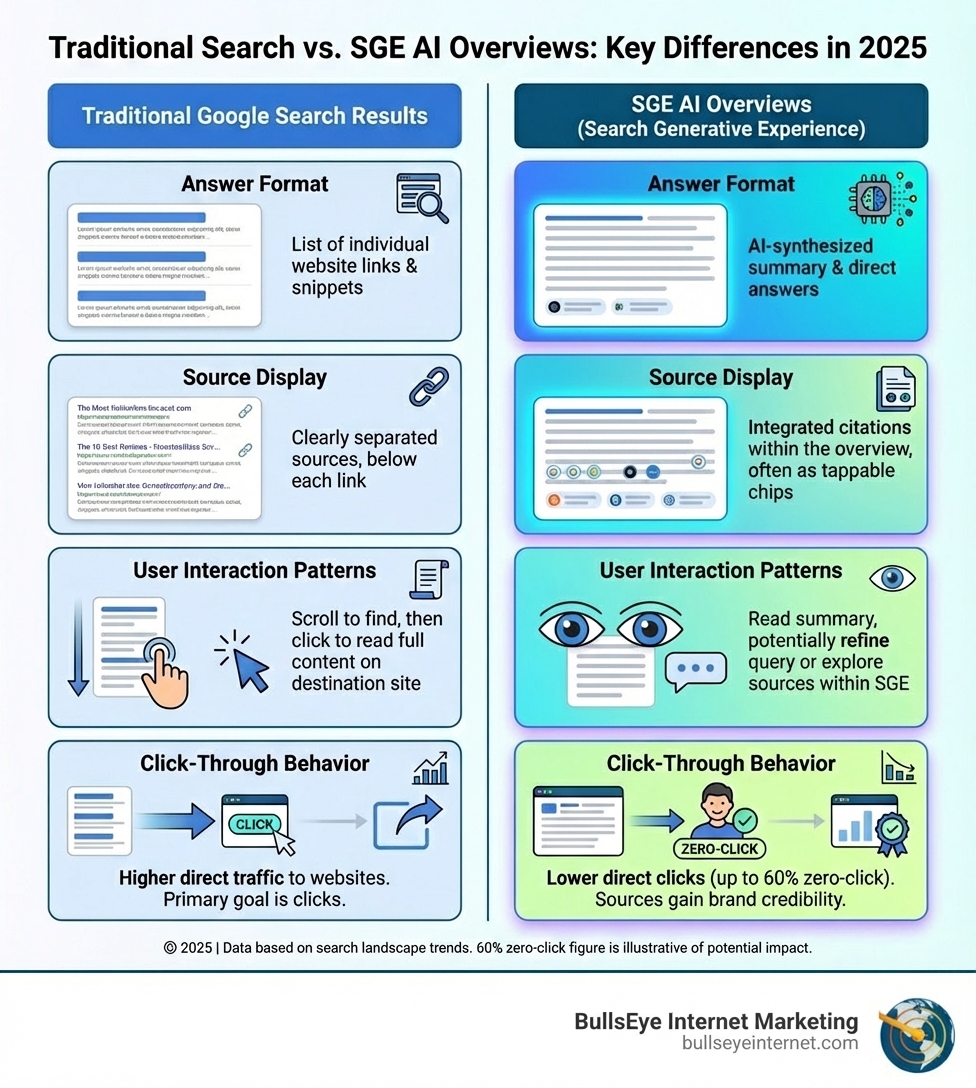
Google SGE optimization terms made easy:
Understanding Google SGE and Its Impact on Search
Google’s Search Generative Experience (SGE) updates how we interact with search engines. It uses generative AI to provide direct, synthesized answers on the results page. Think of it as a knowledgeable assistant summarizing key takeaways in a conversational format.
This isn’t just about faster answers; it’s about understanding user intent. Generative AI goes beyond keyword matching to analyze query context, anticipate follow-up questions, and deliver personalized results. As Google itself states, SGE “completely changes the look of the search engine results page. By integrating generative AI, SGE changes how users interact with and find information online.”

Instead of users sifting through links, Google’s AI presents an “AI Overview” at the top of the SERP. These summaries reference 3-8 sources to create a concise answer. This means our content must be digestible for both human readers and AI algorithms that extract and summarize information.
How SGE Differs from Traditional Search Results
The shift from traditional search to SGE is profound, moving from a “list of links” model to an “answer engine” approach. Let’s break down the key differences:
| Feature | Traditional Search Results | Google SGE (AI Overviews) |
|---|---|---|
| Format | List of blue links (organic results, ads, featured snippets). | AI-generated summary at the top, often with bullet points, followed by source links and traditional results. |
| User Interaction | Users click through multiple links to find answers. | Users receive direct answers on the SERP, can ask follow-up questions in a conversational mode. |
| Source Reliance | Users directly engage with individual website content. | AI synthesizes information from multiple sources; users may not click through to all original sources. |
| Query Type | Keyword-focused matching. | Understands context and nuance, focuses on user intent, natural language, and conversational queries. |
| Click-Through Rate | Direct clicks to websites are the primary goal. | Higher potential for “zero-click searches” as answers are provided directly, potentially reducing clicks to websites. |
While traditional search provided a directory, SGE aims to be a knowledgeable companion. This means our content must be structured to cater to an “algorithmic reader” as much as a human one.
Query Types That Trigger SGE
Not all searches will yield an AI Overview, but certain types of queries are more likely to trigger them. Understanding these patterns is crucial for Google SGE optimization:
- Informational Queries: These are “what,” “how,” “why,” and “when” questions where users seek detailed explanations or step-by-step instructions. For example, “how to start a vegetable garden” or “what are the benefits of meditation.” As of mid-2024, AI overviews appeared on roughly 45-60% of informational queries.
- Question-Based Searches: Users are increasingly phrasing their searches as direct questions. SGE is designed to directly answer these.
- Long-Tail Keywords: More specific, multi-word queries that often reveal a deeper user intent are prime candidates for SGE. The more detailed the query, the more likely SGE will attempt to synthesize a comprehensive answer.
- “Your Money or Your Life” (YMYL) topics: Google has been more cautious with SGE in sensitive areas like health, finance, and safety, where accuracy is paramount. However, the foundational principles of E-E-A-T (Experience, Expertise, Authoritativeness, Trustworthiness) are even more critical here.
We’ve observed that queries requiring synthesis of multiple facts or a comparison of options are also strong triggers for AI Overviews.
The Potential Benefits and Drawbacks for Websites
SGE presents both opportunities and challenges for website owners and marketers.
Benefits:
- Increased Credibility: Being cited as a source in an AI Overview can significantly boost your brand’s authority and trustworthiness. Even if a user doesn’t click immediately, seeing your brand listed as a reference builds recognition.
- Improved Content Visibility: For some queries, SGE can increase the visibility of your content by highlighting key takeaways, leading to higher engagement with the AI overview itself and potentially follow-up clicks.
- Content Findy: SGE can expose users to your content who might not have found it through traditional organic listings, especially if your content offers a unique perspective or a highly relevant snippet.
- User Interaction: The conversational nature of SGE encourages users to engage more deeply with search, potentially leading to more refined follow-up queries that could still direct traffic to your site.
Drawbacks:
- Decreased Organic Traffic (Zero-Click Searches): This is the most significant concern. Studies indicate that up to 60% of searches now end without a click when an AI overview is present, and the #1 organic result can see a 34% drop in clicks. This means users get their answers directly from Google, bypassing your site.
- Brand Messaging Control: Google’s AI synthesizes information from various sources, meaning it forms its own “perception” of your brand or product. Ensuring your messaging is accurately and positively represented requires a proactive approach to your online presence.
- Competition for “Position Zero”: While being cited is good, the ultimate goal is to be the primary source for the AI’s summary, which is a highly competitive space.
- Adaptation Costs: Optimizing for SGE requires a strategic shift in content creation and technical SEO, which can involve significant effort and resources.
For us at BullsEye Internet Marketing, these shifts highlight the critical need for a robust AI Search Ranking Factors strategy, focusing on quality and relevance above all else.
Your Core Google SGE Optimization Strategy
To thrive with SGE, we must evolve our SEO approach. It’s not enough to just rank; we need to be understandable and quotable by AI. Our core Google SGE optimization strategy has three pillars: building topical authority, structuring content for AI, and creating conversational, data-driven content.
This landscape demands a focus on E-E-A-T (Experience, Expertise, Authoritativeness, Trustworthiness), user intent, and our Generative Engine Optimization (GEO) strategy. GEO is our specialized approach for optimizing content for AI-driven search engines, ensuring our clients’ content is favored by these systems.
This proactive approach is part of our AI Search Best Practices playbook.
Building Topical Authority and Demonstrating E-E-A-T
Google’s AI values credible sources, making E-E-A-T paramount. The “Experience” in E-E-A-T, which highlights first-hand knowledge, is particularly important.
- Pillar Pages and Topic Clusters: We build topical authority by creating comprehensive “pillar pages” that cover a broad subject, then linking them to numerous “topic cluster” pages that dig into specific sub-topics. This interconnected content signals to Google’s AI that we are an authoritative source on the entire subject matter.
- Author Bios and Credentials: Ensure that every piece of content, especially on YMYL topics, features detailed author bios. These bios should highlight the author’s qualifications, professional experience, and any relevant industry accolades. This is how we showcase the “Expertise” and “Experience” behind our content.
- Citing Reputable Sources: Just as in academic writing, citing reputable sources and linking to original research or studies builds “Authoritativeness” and “Trustworthiness.” This helps Google’s AI verify the accuracy of our claims.
- First-Hand Experience: Content that demonstrates genuine, first-hand experience (e.g., “When we implemented this strategy for our client in Miami, we observed…”) carries significant weight. It adds a layer of credibility that generic, rehashed content cannot match.
- Trust Signals: Beyond citations, we foster trust through transparent business practices, clear privacy policies, positive customer reviews, and secure website infrastructure. These signals reassure both users and AI of our reliability.
How to Structure Content for AI Summarization and Google SGE Optimization
AI models love structure. To optimize for AI summarization, we must make our content easy for AI to scan, understand, and extract key information.
Here’s our list of content structure best practices:
- Clear Headings (H1, H2, H3, etc.): Use a unique H1 for the main topic and logical, hierarchical subheadings (H2, H3, etc.) to break down content. These act as signposts for both human readers and AI, clearly outlining the content’s organization.
- Short Paragraphs: Break long blocks of text into concise, digestible paragraphs. AI summaries often pull short, punchy sentences or phrases.
- Bulleted and Numbered Lists: AI overviews frequently feature lists (around 70-80% of them, in fact!). Using bullet points and numbered lists for steps, features, or benefits makes content highly scannable and quotable for AI.
- FAQ Sections: Implement dedicated FAQ sections. Users often ask questions, and AI is trained to answer them. Structuring these with clear questions and concise answers is a direct path to SGE inclusion.
- Direct Answers Up Front: Adopt an “inverted pyramid” style of writing. Place the most important information, direct answers to common questions, or key definitions at the very beginning of a section or article. This allows AI to quickly grasp the core message.
- Logical Flow: Organize content in a logical sequence that anticipates a user’s learning journey. If it’s a “how-to” guide, follow the steps chronologically. If it’s an explanatory piece, build from basic concepts to more complex ones.
By following these guidelines, we make our content “AI-friendly,” increasing its chances of being selected and summarized by SGE.
Creating Conversational, Data-Driven Content
Google’s SGE aims for a conversational experience, so our content should reflect that. We want to sound like a knowledgeable, helpful friend, not a dry encyclopedia.
- Natural Language Processing (NLP) Keywords: Move beyond exact-match keywords. We use NLP keywords, which include variations, synonyms, and contextual words that reflect how people naturally speak and ask questions. This means integrating question-based phrases and longer, conversational keywords seamlessly into our content.
- Answering Questions Directly: Our content should anticipate user questions and answer them clearly and concisely. Think about the “People Also Ask” (PAA) section in traditional search results and aim to answer those questions within our content.
- Original Research and Insights: Google’s AI values unique, valuable content. Conducting original research, surveys, or case studies (especially for our clients in Florida, like those in Miami or West Palm Beach) and presenting the findings in our content can make us a highly desirable source.
- Statistics and Data: Back up claims with credible statistics and data points. AI is designed to synthesize facts. Presenting data clearly, perhaps with graphs or tables, improves our content’s “Authoritativeness” and makes it more likely to be cited.
- Conversational Tone: Write in a friendly, informative, and accessible tone. Avoid excessive jargon unless it’s clearly defined. This not only makes content more engaging for human readers but also aligns with the conversational nature of SGE.
This approach ensures our content isn’t just informative but also engaging and digestible for both human users and AI. It’s a key part of our strategy to help businesses succeed in the evolving digital landscape, as outlined in our Digital Marketing AI Guide 2025.
Technical SEO and Content Adaptation for SGE
While quality content is king, technical SEO remains the queen, especially for Google SGE optimization. A technically sound website ensures that Google’s AI can easily crawl, understand, and extract information from our pages. This includes structured data, site speed, crawlability, and mobile-friendliness.
Our focus is on creating an optimal environment for AI to process and synthesize our content. This technical foundation is critical for any successful AI Search Optimization Complete Guide strategy.
The Critical Role of Structured Data and Schema Markup
Structured data, implemented through schema markup, is like giving Google’s AI a cheat sheet for your content. It explicitly tells search engines what your content is about, the entities involved, and their relationships.
- Schema Types: We use various schema types to provide context:
- Article Schema: For blog posts, news articles, and guides.
- FAQPage Schema: Crucial for our FAQ sections, directly feeding questions and answers to SGE.
- HowTo Schema: Ideal for step-by-step guides, allowing AI to easily extract instructions.
- Product Schema: For e-commerce pages, detailing product name, price, reviews, etc.
- Review Schema: For customer reviews and ratings.
- WebPage, Service, and Organization Schema: To provide foundational information about our business and its offerings.
- Entity Recognition: Schema markup helps Google’s AI understand the entities (people, places, things, concepts) mentioned in our content and their connections. This entity-based SEO is vital for SGE to accurately synthesize information.
- Rich Snippets: Proper schema markup can also lead to rich snippets in traditional search results, which often serve as a precursor to SGE inclusion.
- Testing Structured Data: We regularly use Google’s Rich Results Test to validate our schema markup and ensure it’s correctly interpreted by Google. You can do the same here: Test your structured data with Google’s Rich Results Test.
By clearly labeling our content with structured data, we make it significantly easier for SGE to understand and use our information.
Technical SEO Best Practices for Google SGE Optimization
A fast, accessible, and user-friendly website is not just good for humans; it’s essential for AI. Google’s AI prioritizes content from websites that offer an excellent user experience.
- Core Web Vitals: We optimize for Google’s Core Web Vitals (Largest Contentful Paint, Cumulative Layout Shift, and Interaction to Next Paint). These metrics measure loading performance, visual stability, and interactivity. Sites that score well here are favored by Google.
- Page Load Speed: A slow website hinders Google’s crawlers. We optimize page load speed by compressing images, enabling browser caching, and minifying CSS and JavaScript.
- Mobile-Friendliness: Given Google’s mobile-first indexing, our websites must be fully responsive and optimized for mobile devices. This means ensuring content displays correctly and navigation is intuitive on smaller screens.
- Clean Site Architecture and Crawlability: A logical site structure with clear internal linking helps Google’s AI understand the hierarchy and relationships between our pages. We ensure our content is easily crawlable by avoiding
nosnippettags (unless specifically intended) and regularly submitting updated sitemaps.
These technical foundations ensure our content is not only finded but also preferred by Google’s AI for inclusion in SGE. For example, ensuring our clients’ sites in Broward County load quickly helps us outrank competitors. You can check your site speed here: Check your site speed with Google PageSpeed Insights.
Leveraging Multimedia and Rich Media
In an age where information is consumed visually, high-quality multimedia content is a necessity for Google SGE optimization. AI can process and understand visual information, and rich media improves user engagement, a key signal for Google.
- High-Quality Images: Use relevant, high-resolution images that add value to the content.
- Image Alt Text: Always include descriptive alt text that accurately describes the image and incorporates relevant keywords. This helps Google’s AI understand the image’s context.
- Optimized File Sizes: Compress images to reduce file size without compromising quality, contributing to faster page load speeds.
- Video Content: Embed relevant videos (e.g., how-to tutorials, product demonstrations, expert interviews).
- Video Transcripts and Captions: Provide full transcripts and closed captions for all videos. This is crucial for accessibility and allows Google’s AI to extract keywords and understand the video’s content.
- Infographics: Infographics are excellent for presenting complex data or processes in a visually engaging way. They are highly shareable and can be easily understood by AI.
By integrating rich media thoughtfully, we improve the user experience and provide Google’s AI with more diverse content formats to draw from.
Measuring SGE Performance and Preparing for the Future
The world of search is constantly evolving, and SGE represents a significant leap forward. To succeed, we must not only implement Google SGE optimization strategies but also diligently measure their impact and remain agile in our approach.
This ongoing analysis and adaptation are central to our AI SEO Consulting Ultimate Guide.
Key Metrics to Monitor for SGE Visibility
Measuring SGE performance requires looking beyond traditional ranking metrics. We need to understand how our content is interacting with AI Overviews.
- Impressions vs. Clicks: Using tools like Google Search Console, we monitor impressions and clicks for our target keywords. A high impression count with a lower click-through rate (CTR) for queries triggering SGE might indicate that our content is appearing in the AI Overview, but users are finding their answer directly without clicking through.
- Average Position: While traditional average position still matters, we need to consider the “position zero” of the AI Overview. Our goal is to be cited within that overview, even if our organic ranking is lower.
- Citation Count: This is a new, crucial metric. We track how often our website is cited as a source within SGE’s AI Overviews. This often requires manual checks for key queries or using specialized third-party SGE monitoring tools. Being cited, even without a click, builds significant brand authority.
- Engagement Metrics: Beyond clicks, we look at on-page engagement metrics like time on page, bounce rate, and scroll depth. If users do click through from SGE, we want to ensure our content is satisfying their needs.
- AI Impressions (Future KPI): As SGE evolves, we anticipate new KPIs directly related to AI interactions, such as “AI impressions” or “AI click-through rates” to measure how often our content is presented or engaged with by the generative AI itself.
We analyze search queries using tools like Google Search Console to find relevant keywords and phrases, which helps us understand user intent and refine our content strategy. Analyze search queries: Use tools like Google Search Console
The Evolving Landscape of AI and Search
The future of SEO is not just about search engine optimization; it’s about Search Experience Optimization. As AI becomes more sophisticated, it acts as an “algorithmic reader and presenter,” curating information for users.
- New KPIs: We will see a shift in what defines success. While traffic remains important, metrics like “citation count,” “brand mention frequency within AI answers,” and “user satisfaction with AI-generated answers sourced from our content” will gain prominence.
- Adaptable Strategies: The AI landscape is dynamic. What works today might need refinement tomorrow. Our approach at BullsEye Internet Marketing is built on continuous learning, A/B testing, and rapid adaptation to Google’s updates and new capabilities in AI search.
- Continued Importance of Quality Content: At its heart, AI still needs high-quality, authoritative, and helpful content to synthesize. Content remains king, but context is queen. Our focus will always be on creating valuable, engaging, and trustworthy content that satisfies user needs.
Frequently Asked Questions about Google SGE
We understand that the shift to SGE brings many questions. Here are some of the most common ones we encounter:
Will SGE completely replace traditional organic search results?
No, SGE is designed to improve, not replace, traditional search results. It creates a hybrid model where AI Overviews appear alongside, or above, the familiar list of organic links. Google’s goal is to provide more direct answers while still offering users the option to dig deeper into source websites. We believe that optimizing for both SGE and traditional organic results is crucial for comprehensive online visibility.
How can I ensure my brand is accurately represented in SGE answers?
Ensuring accurate brand representation in SGE answers is paramount. Our strategy focuses on:
- Demonstrating strong E-E-A-T: By consistently publishing high-quality, accurate, and authoritative content, we build a strong online reputation that Google’s AI will recognize and respect.
- Consistent Brand Messaging: Ensure your brand’s messaging is consistent across all online platforms. Google’s AI synthesizes information from many sources, so a unified message helps prevent misinterpretation.
- Managing Online Reputation: Proactively manage online reviews and mentions. A strong positive online reputation contributes to overall brand trustworthiness, which influences how AI perceives and represents your brand.
- Encouraging Positive Reviews: Especially for local businesses in areas like Miami, Kendall, or West Palm Beach, positive customer reviews on Google Business Profile and other platforms are vital trust signals.
How can I access and test Google’s SGE features?
Google initially rolled out SGE as an opt-in experiment through Search Labs. While it’s now integrated into mainstream Google search as “AI Overviews” or “AI snapshots” for many queries, you can still monitor its behavior. To see how your content performs, we recommend:
- Monitoring Specific Queries: Manually search for your target keywords and phrases to observe if and how AI Overviews are triggered, and if your content is cited.
- Google Search Console: Keep a close eye on your Google Search Console data for changes in impressions, clicks, and average position, particularly for informational queries.
Conclusion: Accept the Future of Search with Confidence
The future of search is undeniably AI-driven, and Google SGE optimization is not just an option but a necessity for businesses aiming to maintain and grow their online presence. This new era demands a proactive, user-centric approach that prioritizes high-quality, structured, and authoritative content that is easily digestible by both humans and intelligent algorithms.
At BullsEye Internet Marketing, we empower businesses across the United States, including our home state of Florida in Miami, Broward, and Palm Beach Counties, to steer this evolving landscape with confidence. By focusing on meticulous content structuring, robust technical SEO, and building undeniable topical authority, we ensure our clients are not just found, but are the preferred source of information by Google’s AI.
The changes brought by SGE are significant, but with the right strategy and continuous adaptation, they present an immense opportunity. Let us help you transform your online presence and secure your path to AI search visibility.
Learn more about Answer Engine Optimization (AEO) & Geo LLM SEO
