
Why LSA for HVAC Companies Is the Highest-ROI Lead Channel Right Now
LSA for HVAC companies puts your business at the very top of Google search results — above traditional ads, above the map pack, and above every organic listing — with a green “Google Guaranteed” badge that signals instant trust to high-intent buyers.
Here’s the quick answer on what LSA delivers for HVAC businesses:
- What it is: Google Local Services Ads (LSA) is a pay-per-lead program where you only pay when a real customer contacts you through your ad
- Average cost per lead: ~$51 per lead for HVAC (vs. ~$91 for traditional Google Ads)
- Median ROAS: 6.9x — meaning $1 spent returns roughly $7 in closed revenue
- Top performers: 15.6x ROAS or higher
- Average booking rate: ~44% of leads convert to paying customers
- Average cost per paying customer: ~$233
The data is hard to argue with. Based on analysis of over 600 HVAC and plumbing advertisers, LSA leads cost roughly half what traditional Google Ads leads cost — and they convert at a higher rate because the searcher already has intent to hire, not just browse.
That said, results vary widely. Bottom-quartile HVAC advertisers see only a 2x ROAS. The difference between 2x and 15x usually has nothing to do with the ads themselves — it comes down to how fast you answer the phone, how many reviews you have, and whether you’re managing your account properly.
This guide covers all of it.
I’m Ronnie Katz, founder of BullsEye Internet Marketing, and since 2006 I’ve helped HVAC businesses and other contractors use tools like LSA for HVAC companies to generate consistent, measurable leads without wasting budget on clicks that never convert. In the sections ahead, I’ll walk you through exactly how to set up, optimize, and scale your LSA campaigns the right way.
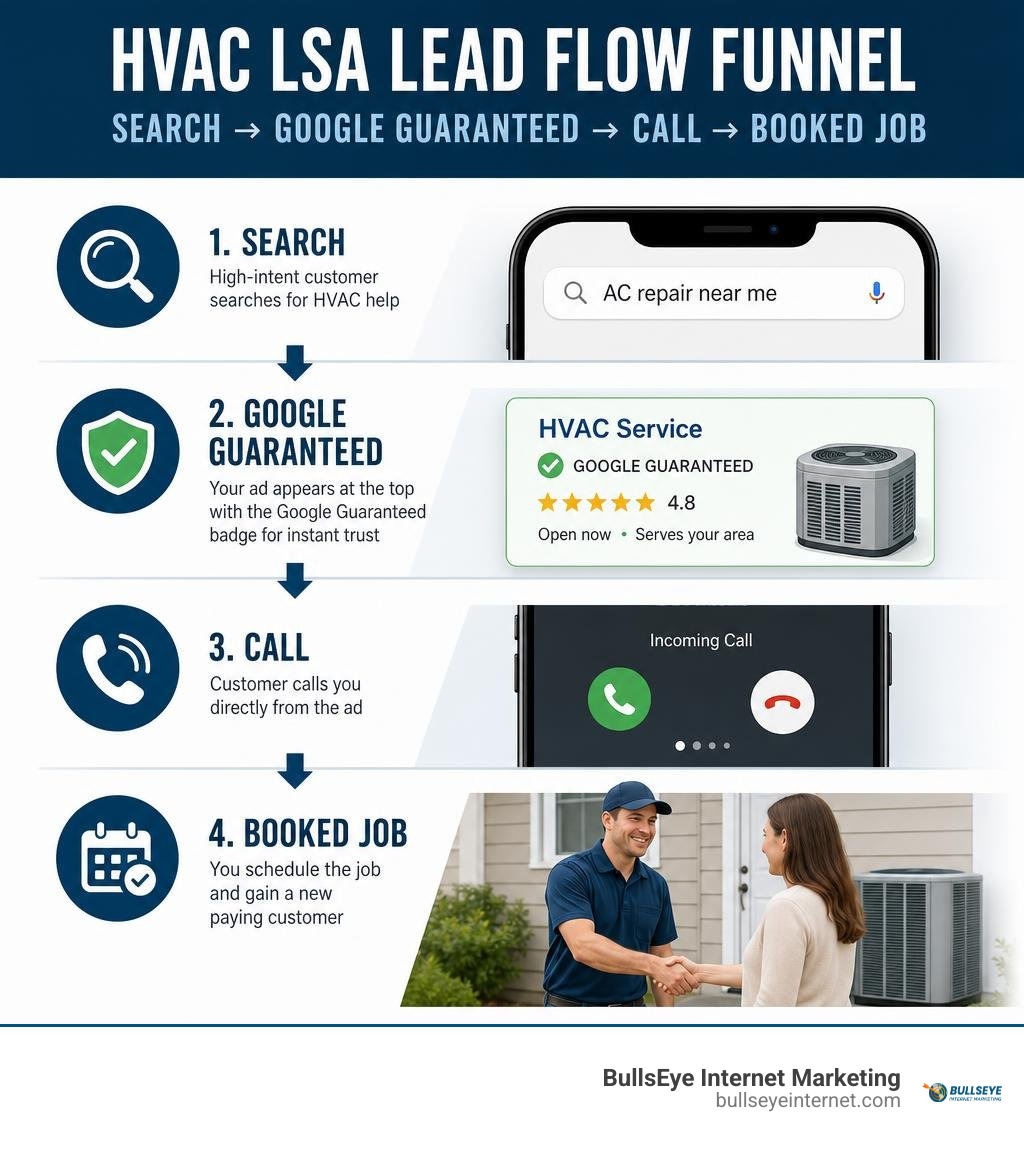
LSA for HVAC companies glossary:
Benchmark Analysis: What ROAS Should You Expect from LSA for HVAC Companies?
When evaluating Local Services Ads for Heating and Air Conditioning Companies, understanding return on ad spend (ROAS) is essential for evaluating performance. Across hundreds of active contractor accounts, the empirical median monthly spend sits right around $4,277. However, the resulting closed revenue varies significantly depending on how well an HVAC business manages lead intake and account health.
Tracked performance across more than $18 million in ad spend shows that the overall average closed ROAS across home services sits at 7.84x. When we isolate heating, ventilation, and air conditioning contractors, the median ROAS is roughly 6.9x. That means for every dollar invested, the typical HVAC business collects $6.90 in realized job revenue.
Key Performance Tiers and Revenue Metrics
Performance in LSA for HVAC companies tends to group into distinct tiers:
- Top Quartile (15.6x+ ROAS): Top contractors achieve 15.62x ROAS or better. They achieve this by combining fast call answering times with systematic follow-ups, aggressive lead disputing, and high review velocity.
- Median Tier (~6.9x ROAS): The average contractor generates a healthy return, booking roughly 43.9% of inbound calls into paid jobs at an average customer acquisition cost (CAC) of $233.
- Bottom Quartile (~2.0x ROAS): Bottom-performing contractors hovering around 1.96x ROAS usually struggle with operational bottlenecks—such as missed phone calls, slow response times, or incomplete profile setups—rather than poor lead quality from Google.
Because average HVAC repair and replacement tickets often range from $500 to over $10,000, even a moderate conversion rate yields strong campaign economics when closed revenue is mapped accurately inside your CRM.
Cost Per Lead: LSA vs. Traditional Google Ads
The primary difference between Local Services Ads and traditional Google Search Ads (PPC) is the payment structure. Pay-per-click charges you every time a searcher clicks your link—regardless of whether they call or fill out a form. LSA operates strictly on a pay-per-lead model, meaning you only pay when a customer calls you directly or sends a direct message request.
| Metric | Google Local Services Ads (LSA) | Traditional Google Search Ads (PPC) |
|---|---|---|
| Pricing Model | Pay Per Lead (Calls/Messages) | Pay Per Click (Site Visits) |
| Average Cost | $51.00 per lead | $90.92 per lead (equivalent) |
| Search Placement | Top of SERP (Above PPC) | Below LSA, Above Map Pack |
| Trust Badge | Google Guaranteed Green Check | None (Sponsored Label) |
| Average Closed ROAS | 6.9x – 9.55x | 3.0x – 5.0x |
| Lead Protection | Dispute & credit system for bad leads | No refund for unwanted clicks |
As shown in our detailed guide on Cracking the HVAC PPC Code: A Guide to Leads That Don’t Cost a Cold Fortune, traditional PPC leads often exceed $90 to $120 per lead in competitive metropolitan markets. In contrast, HVAC LSA leads average $51 per lead—a 42% to 50% savings right out of the gate.
Core Factors Driving LSA Ranking and Lead Volume
Google’s ranking algorithm for LSA does not work like traditional PPC where the highest bidder automatically gets the top spot. Instead, Google uses a balanced formula designed to connect searchers with reliable local contractors:
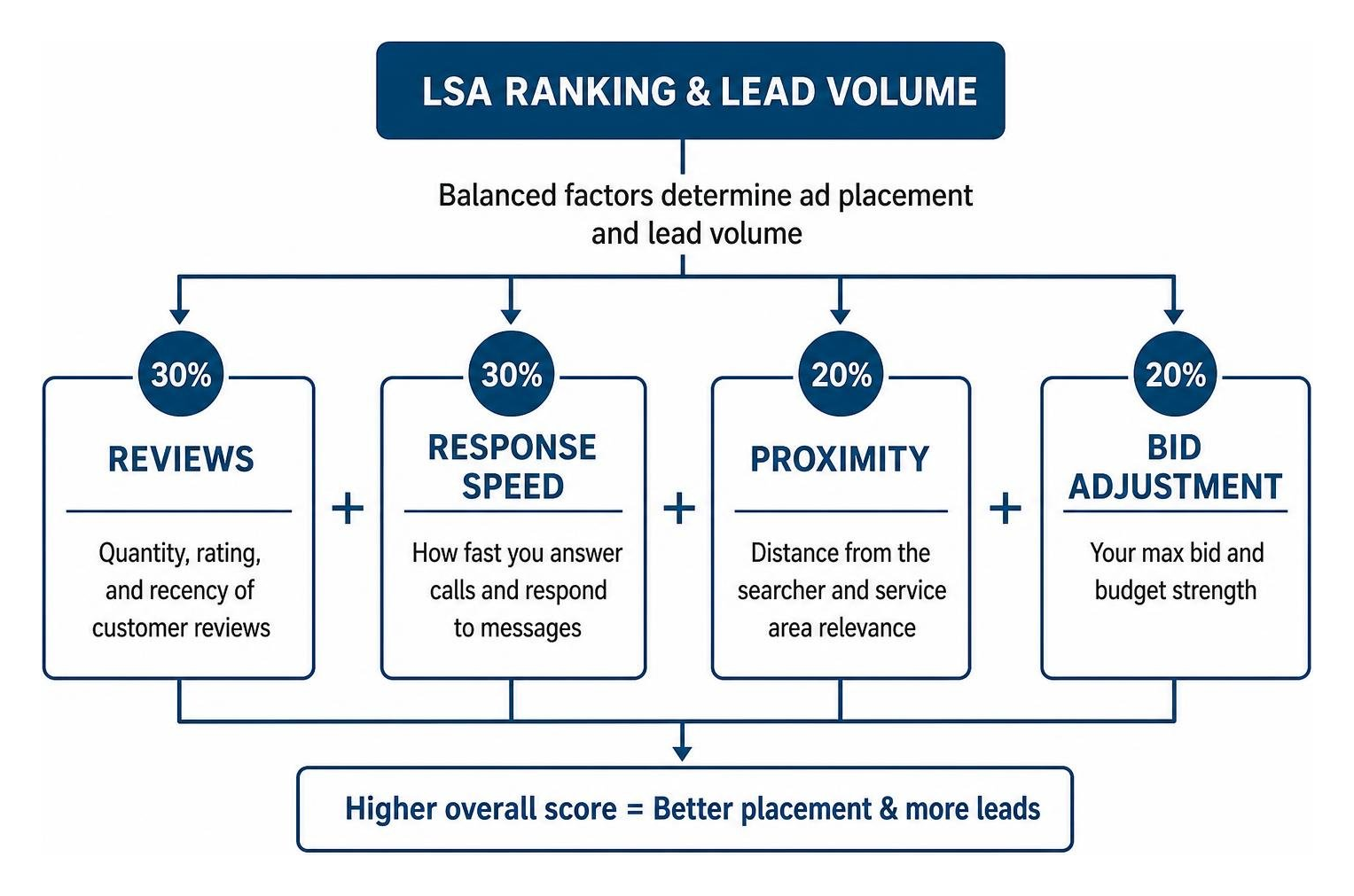
Google prioritizes key factors including customer feedback, geographical proximity, business hours, and operational responsiveness. To understand why these placements are so crucial, explore Why Google Local Service Ads Are Essential for Home Service Businesses.
Speed to Answer and Booking Conversion Rates
Response speed is one of the most critical ranking factors in the LSA ecosystem. Google tracks how consistently your team answers incoming phone calls and how quickly you respond to message requests.
Contractors who pick up incoming calls within one hour convert approximately 31% of those calls into booked appointments. If a call goes to voicemail and receives a next-day callback, that booking rate plummets to 15%. To protect your LSA ranking:
- Aim for a call answer rate above 95% during active profile hours.
- Answer incoming calls within 30 seconds whenever possible.
- Set up dedicated customer service representative (CSR) workflows or an after-hours answering service to capture evening and weekend calls.
- Update lead statuses to “Booked” directly inside the LSA dashboard to signal positive conversion data back to Google’s ranking engine.
Review Velocity and Star Rating Impact in LSA for HVAC Companies
Reviews serve as the main trust signal for prospective clients. Nearly 29% of searchers click on LSA results over any other paid placement, compared to just 11% for traditional text ads.
To maintain visibility, Google requires a baseline 4.0-star rating. However, staying competitive usually requires maintaining a 4.7+ star rating with steady review volume:
- Under 20 Reviews: Profile struggles to gain consistent impression share against established competitors.
- 20 to 50 Reviews: Competitive in smaller suburban markets.
- 50 to 100 Reviews: Strong positioning across mid-sized territories.
- 100+ Reviews: Dominant placement in high-density competitive areas.
Google values review velocity (how frequently you receive new reviews) just as much as overall review volume. Generating 5 new reviews every week keeps your profile fresh and sends strong ranking signals to Google.
Navigating Google Guaranteed and the ‘Get Competitive Quotes’ Feature
The green “Google Guaranteed” badge acts as a trust marker. It signals to homeowners that Google has screened your company and offers up to $2,000 in consumer coverage if a customer is unsatisfied with work quality. To navigate these requirements effectively, review our breakdown on The Green Light: Navigating Google’s LSA Screening Requirements.
Eligibility Requirements and Verification Steps
Getting approved for LSA requires passing background checks and credential verifications:
- Background Checks: Google’s third-party background check process evaluates business owners and all field technicians who enter customer homes. Processing typically takes 3 to 7 business days per employee.
- Licensing: You must submit active state and local HVAC contractor license documentation.
- Insurance: Proof of general liability insurance with coverage (typically $500,000 or higher) is required.
- Certifications: EPA 608 certifications must be verified for technicians handling refrigerants.
For a comprehensive walkthrough of setting up these profiles from scratch, reference external industry resources like the Google Local Services Ads for HVAC: Complete Setup Guide.
AI Search Updates and Competitive Quote Dynamics in LSA for HVAC Companies
Google’s LSA ecosystem continues to evolve alongside advances in AI and consumer behavior. One major update is the rollout of the “Get Competitive Quotes” feature. When a customer uses this option, Google selects up to four top-rated pros in the area and transmits the customer’s request to all four simultaneously.
This turns message leads into a speed race. The contractor who responds first usually wins the job. Furthermore, search experiences are expanding beyond traditional pages into AI answer engines like Gemini and Perplexity. Adapting to these shifts requires adopting an “Omni SEO” mindset—providing clear technical documentation, transparent service descriptions, and detailed FAQs on your website so AI platforms highlight your business as a trusted local authority. For more context on these trends, read about What the LSA and AI Changes Mean for Your Business.
HVAC LSA Performance Benchmarks by BullsEye Internet Marketing
Running a successful LSA campaign requires active management. Treating LSA as a “set-and-forget” platform leads to missed calls, spent budget on invalid leads, and dropped search rankings.
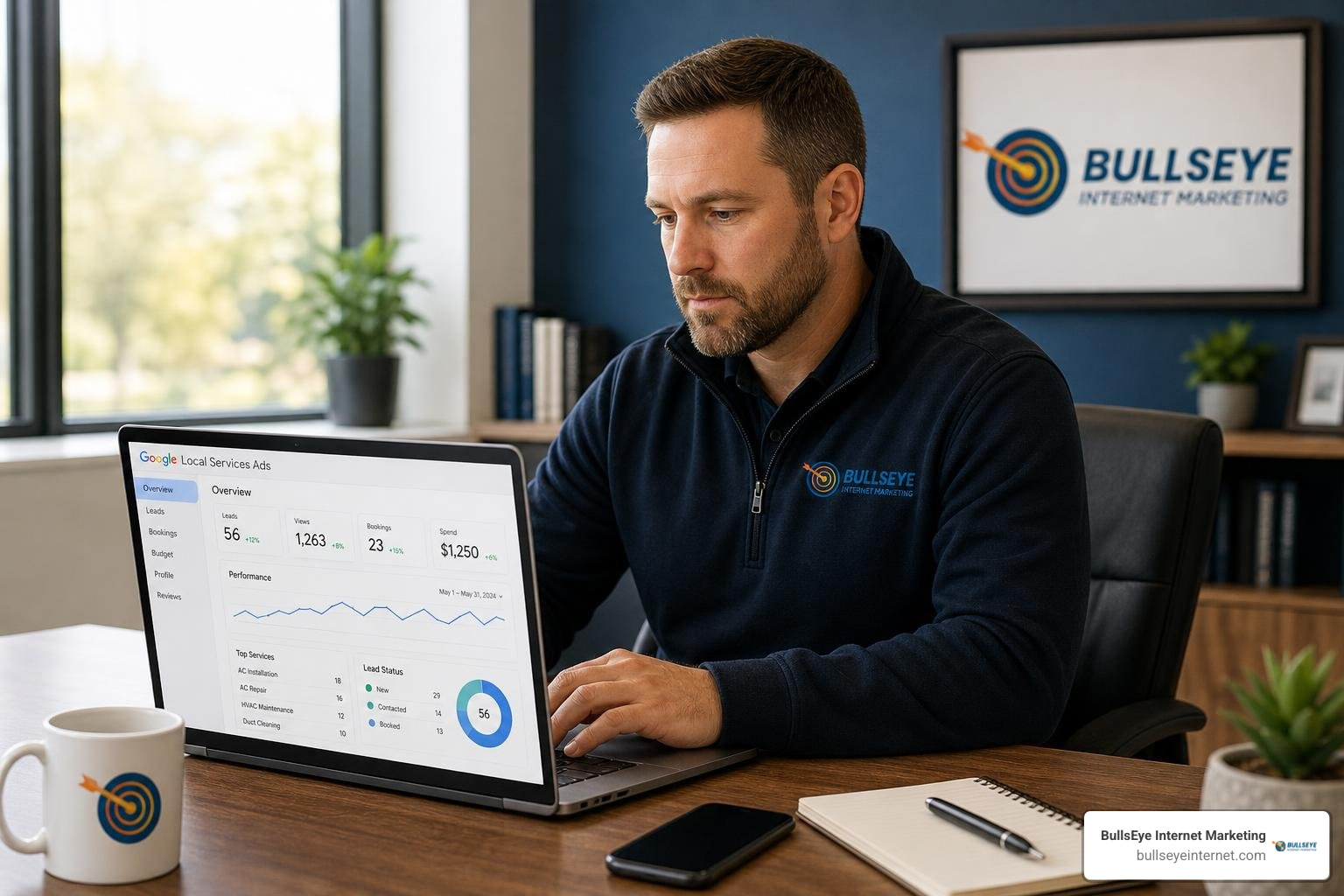
Streamlining Response Workflows and CRM Tracking
To maximize ROI, your LSA account should connect directly with your field service management CRM (such as ServiceTitan or Housecall Pro). Tracking true cost per acquisition (CPA) requires monitoring the full lead pipeline:
Google records and transcribes incoming LSA calls for quality assurance. Reviewing these calls helps spot operational bottlenecks—like CSRs missing sales opportunities or failing to collect contact details—before they impact your booking rate.
Disputing Unqualified Leads to Reclaim Ad Budget
One major advantage of LSA is the ability to dispute invalid leads for full account credit within a 30-day window. Contractors who systematically audit and dispute invalid leads recover 6% to 7% of their total ad spend.
Accepted grounds for lead disputes include:
- Requests for services you do not offer (e.g., commercial refrigeration when you only handle residential AC).
- Calls originating from outside your selected geographic service area.
- Spam calls, automated robocalls, or wrong numbers.
- Price shoppers who hung up before providing details (where no interaction occurred).
For additional strategies on managing contractor campaigns, consult resources such as Google Local Services Ads for Contractors.
Budget Optimization and Seasonal Strategy for HVAC Businesses
To get the best results from LSA, align your budgets with local market conditions and seasonal demand spikes. For a broader overview of structure, check out our Google Local Services Ads Complete Guide.
Market-Based Budget Allocation
Setting an adequate budget prevents your ad from pausing prematurely during peak search hours.
Here are recommended weekly starting budgets based on target market size:
- Small Markets (Population < 150,000): $200 – $400 / week
- Medium Markets (Population 150,000 – 500,000): $400 – $800 / week
- Large Metro Areas (Population > 500,000): $800 – $1,500+ / week
You can set your bidding mode to “Maximize Leads” (where Google automatically sets bids to get the most volume within budget) or use bid adjustments to bid aggressively on high-value categories like full system replacements.
Managing Peak Season Spikes and Off-Season Demand
HVAC lead volume is highly seasonal, driven by summer cooling needs and winter heating demand. Interestingly, benchmark data shows that while call volume fluctuates heavily between seasons, monthly ROAS remains relatively consistent (staying within a tight 1x to 2x variation band year-round).
During shoulder seasons (spring and fall), keep budgets active to capture profitable maintenance tune-ups and duct cleaning leads. When heatwaves or cold snaps hit, expand your weekly budget limits or set them to “Open” to prevent losing impression share during peak demand windows.
Frequently Asked Questions About HVAC Local Services Ads
What is considered a bad ROAS for HVAC LSAs?
Any closed ROAS below 4.0x is considered underperforming for an HVAC LSA campaign. Because LSA leads carry high user intent and average $51 per lead, falling below 4x usually points to internal operational breakdowns—such as missed phone calls, slow response times, or unmonitored review profiles—rather than lack of market demand.
How long does Google Guaranteed approval take for HVAC contractors?
The approval process typically takes 2 to 4 weeks from initial application submission to ad launch. Background check processing for owners and field technicians takes roughly 3 to 7 business days, while verification of contractor licenses, EPA certifications, and general liability insurance adds another few days.
Can I run LSA and traditional Google Search Ads simultaneously?
Yes, running both channels simultaneously is a smart strategy. Combining LSA with traditional PPC allowed us to saturate the Search Engine Results Page (SERP)—occupying both the top pay-per-lead badges and traditional search listings. Running both campaigns signals strong commercial activity to Google, which can help maintain high lead volume across both channels.
Scaling Your HVAC Business with Expert LSA Management
Navigating Local Services Ads, background verifications, dispute audits, and real-time response management requires constant attention. At BullsEye Internet Marketing, we specialize in driving high-intent phone calls and booked sales for HVAC contractors through pay-per-lead optimization, SEO, PPC, and Google Business Profile management.
Our agency operates with a commitment to our clients:
- No Long-Term Contracts: We earn your business every month based on campaign results.
- Geographic Exclusivity: We work with only one client per industry per geographic area, giving you an exclusive competitive advantage in your territory.
Ready to dominate your local market with Google Guaranteed leads? Maximize your lead volume with Google Local Services Ads and start scaling your HVAC business today!
