
Why Your Ad Budget Might Be Bleeding Money Right Now
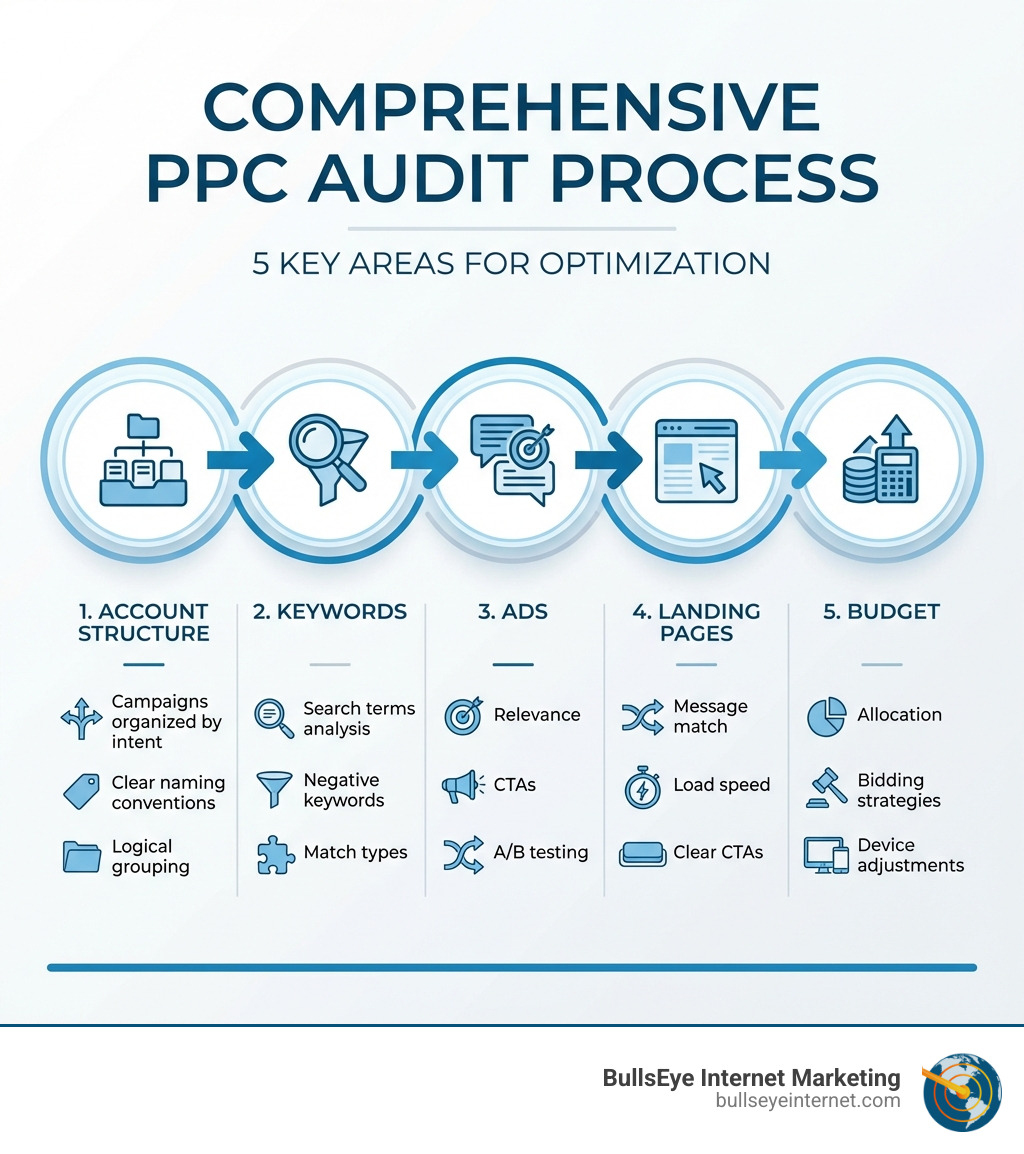
How to do ppc audit effectively starts with these five essential steps:
- Verify conversion tracking is accurate – Check that your tracking tags are firing correctly and measuring the right actions
- Review account structure – Ensure campaigns and ad groups are organized logically by product, service, or intent
- Analyze keyword performance – Use the Search Terms Report to identify wasted spend on irrelevant queries
- Evaluate ad copy and landing pages – Confirm your message matches user intent from search to conversion
- Assess budget allocation – Identify where money is being spent and reallocate to high-performing areas
Pouring money into PPC campaigns without regular audits is like navigating a maze blindfolded. You’re moving, but are you actually getting closer to your goal?
If you’re frustrated with high acquisition costs and wondering where your ad budget is actually going, you’re not alone. Research shows that 72% of companies haven’t reviewed their ad campaigns in over a month. Meanwhile, many businesses are quietly wasting thousands in ad spend on irrelevant keywords, broken tracking, and misaligned targeting settings.
A PPC audit is your diagnostic tool—a systematic review that uncovers where you’re throwing cash down the drain and where hidden opportunities are waiting. It’s not just about cutting costs. It’s about making every dollar work harder by identifying what’s actually driving results versus what’s just generating expensive clicks that go nowhere.
I’m Ronnie Katz, and since 2006 I’ve helped hundreds of businesses stop wasting money on ineffective PPC campaigns by showing them exactly how to do ppc audit reviews that reveal their biggest opportunities for growth. In this guide, I’ll walk you through the exact process we use at BullsEye Internet Marketing to turn underperforming campaigns into profit-generating machines.
Why a PPC Audit is Your Campaign’s Secret Weapon
Regular PPC audits are crucial for campaign success. As Mitch Cartwright notes, “Audits serve as a diagnostic tool, allowing you to get under the hood of your campaigns to assess what is working and what is costing your business money.”
Audits help review the entire customer journey, finding missed opportunities and ensuring campaigns align with business goals. This proactive approach decreases cost per acquisition (CPA) while increasing click-through rate (CTR) and ROI.
Neglecting audits leads to wasted ad spend. Amy McClain-Ponder warns that without audits, you risk “wasting precious resources on underperforming campaigns.” We often find campaigns quietly wasting thousands on irrelevant traffic from broad-match keywords or misaligned landing pages.
What is a PPC Audit and Why is it Crucial?
A PPC audit is a detailed review of your pay-per-click account to assess performance and identify improvements. It helps:
- Find overlooked performance issues
- Reduce wasted ad spend by eliminating inefficiencies
- Streamline budget allocation to high-performing campaigns
- Identify low-quality placements delivering irrelevant traffic
- Align campaigns with business objectives
The Optimal Time to Conduct a PPC Audit
While quarterly audits are recommended, key moments for an audit include:
- When taking on a new client or account
- Before building new campaigns
- When new leadership takes over
- Before peak seasons (especially for seasonal Florida businesses)
- At regular intervals (quarterly or biannually)
- When performance unexpectedly dips
The Ultimate PPC Audit Checklist: A 10-Step Walkthrough
A comprehensive PPC audit checklist reveals inefficiencies and highlights opportunities for ROI gains, changing guesswork into data-driven strategy.
Step 1: Verify Your Conversion Tracking and Attribution
You can’t optimize what you can’t measure. Check:
- Conversion Tracking Accuracy: Verify conversions are properly tracked in the Goals and Conversions section. Use Google’s Tag Assistant to debug tag firing.
- Google Analytics 4: Ensure GA4 is linked and conversions are set up correctly.
- Transaction Values: Track transaction-specific values for e-commerce or qualified leads for lead generation.
- Attribution Models: Review how credit is assigned across customer journey touchpoints.
Only 29% of audited accounts have correctly implemented conversion tracking.
Step 2: Analyze Account and Campaign Structure
A disorganized account leads to budget waste and poor performance.
Look for:
- Campaign Organization: Organize by intent or theme
- Ad Group Themes: Tightly themed with relevant keywords
- Naming Conventions: Clear, logical naming for easy management
- Logical Segmentation: Structure allows bid and budget management by business segment
Step 3: How to do a PPC audit on keyword performance
Keywords connect your business with customers. Focus on:
- Keyword Relevance: Use Search Terms Report to identify irrelevant queries
- Search Intent: Analyze keywords by conversions and cost per conversion
- Match Types: Strategic use of broad, phrase, and exact match
- Quality Score: Assess CTR, Ad Relevance, and Landing Page Experience
Step 4: Scrutinize Ad Copy and Ad Extensions

Audit:
- Ad Relevance: Ensure copy addresses search queries
- Headlines and CTAs: Compelling headlines with clear calls-to-action
- Ad Extensions: Implement all relevant extensions (sitelinks, callouts, location)
- Competitor Analysis: Use Google Ads Transparency Center for insights
Step 5: Evaluate Budget Allocation and Bidding Strategies
Review:
- Budget Allocation: Move funds from underperforming to high-performing campaigns
- Bidding Strategies: Ensure automated bid strategies align with goals
- Device Performance: Apply bid adjustments based on device performance
Step 6: Conduct a Landing Page Analysis
Scrutinize:
- Message Match: Landing page aligns with ad copy and keywords
- Page Load Speed: Pages loading over 3 seconds increase bounce rates
- Mobile Responsiveness: Essential for Florida’s mobile-heavy market
- Clear CTA: Prominent call-to-action guiding users
- Trust Signals: Include testimonials, reviews, and security badges
How to Do a PPC Audit to Eliminate Wasted Spend
Identifying and eliminating “bleed” – areas where budget is spent without returns – requires refining targeting and mastering negative keywords.
How to do a PPC audit for targeting and audience settings
Audit:
- Geotargeting: Refine to specific areas like Miami-Dade, Broward, or Palm Beach County
- Ad Scheduling: Run ads when your audience is most likely to convert
- Audience Segmentation: Layer remarketing lists, in-market, and custom audiences effectively
- Demographics: Add filters for age, gender, income for niche products
Mastering Your Negative Keyword Strategy
Negative keywords protect your budget:
- Exclude Irrelevant Queries: Review search terms report regularly
- Filter Low-Intent Traffic: Add “free,” “careers,” “DIY” as negatives
- Competitor Terms: Exclude competitor brands unless strategically targeting
- Shared Lists: Implement across multiple campaigns efficiently
Identifying and Pruning Low-Quality Placements
Not all placements are equal. Pinpoint low-quality placements by:
- Analyzing placement reports for high impressions but low conversions
- Identifying sites with poor engagement metrics
- Building exclusion lists for underperforming placements
From Audit to Action: Implementing Changes and Tracking Progress
A PPC audit is only valuable if its findings lead to action. The real gains come from turning insights into specific changes and tracking how those changes impact results.
Prioritizing Your Findings
After a comprehensive audit, you may have a long list of potential improvements. To avoid getting stuck, use a simple impact/effort matrix to decide what to tackle first.
| Category | Description |
|---|---|
| Quick Wins | High-Impact, Low-Effort: Fast fixes like adding negative keywords, pausing obvious underperformers, or adjusting bids on top-converting keywords. |
| Major Initiatives | High-Impact, High-Effort: Bigger projects such as restructuring campaigns, rebuilding tracking, or designing new landing pages. |
| Incremental Improvements | Low-Impact, Low-Effort: Smaller tweaks like new ad variations, minor bid adjustments, or additional extensions. |
| Re-evaluate | Low-Impact, High-Effort: Tasks that require a lot of time but offer limited upside; these usually fall to the bottom of the list or are dropped. |
Focus first on quick wins that immediately reduce wasted spend or boost conversions. Then schedule the larger initiatives that will drive long-term growth.
Creating a Roadmap and Measuring Success
Once priorities are clear, turn your audit into a simple, actionable roadmap:
- List each task, its owner, and a due date in your project management tool.
- Roll out changes in batches so you can see which ones move the needle.
- For each batch, note the baseline metrics (CPC, CTR, conversion rate, CPA, ROAS) before making updates.
- Monitor performance over the following weeks and compare against the baseline.
This before-and-after analysis lets you clearly communicate ROI improvements and ensures your PPC audit translates into measurable, sustainable gains.
Why a PPC Audit is Your Campaign’s Secret Weapon
Benefits of audits; Signs of underperformance; When to conduct an audit; New client onboarding; Before peak season; Regular intervals; Maximizing ROI; Decreasing CPA; Increasing CTR.
What is a PPC Audit and Why is it Crucial?
Diagnostic tool; Performance assessment; Strengths and weaknesses; Uncovering inefficiencies; Finding growth opportunities; Aligning with business goals.
The Optimal Time to Conduct a PPC Audit
[LIST] of key moments for an audit; Onboarding a new account; Pre-campaign launch; Quarterly health check; Before seasonal peaks; When performance dips unexpectedly.
The Ultimate PPC Audit Checklist: A 10-Step Walkthrough
This section will be the core of the article, breaking down the audit process into manageable steps.
Step 1: Verify Your Conversion Tracking and Attribution
You can’t optimize what you can’t measure; Conversion tracking accuracy; Broken tags; Google’s Tag Assistant can help with debugging; Google Analytics 4 (GA4); Attribution models; Transaction-specific values; Lead quality vs. quantity.
Step 2: Analyze Account and Campaign Structure
[IMAGE] of a well-structured Google Ads account hierarchy; Foundational blueprint; Campaign organization; Ad group themes; Naming conventions; Logical segmentation; Customer intent stages.
Step 3: How to do a PPC audit on keyword performance
Keyword relevance; Search intent alignment; Search Terms Report; Match types; Broad match pitfalls; Single Keyword Ad Groups (SKAGs); Quality Score components.
Step 4: Scrutinize Ad Copy and Ad Extensions
[IMAGE] comparing a good and a bad PPC ad; Ad relevance; Headline performance; Unique Value Proposition (UVP); Strong Call-to-Action (CTA); A/B testing; Ad extensions; Sitelinks; Structured snippets; Google Ads Transparency Center.
Step 5: Evaluate Budget Allocation and Bidding Strategies
Budget pacing; Wasted spend; Reallocating funds; Automated bid strategies; Manual bidding; Target CPA vs. Target ROAS; Device performance bid adjustments.
Step 6: Conduct a Landing Page Analysis
Message match; Ad-to-page consistency; User experience (UX); Page load speed; Mobile responsiveness; Clear CTA; Trust signals; A/B testing landing pages.
How to Do a PPC Audit to Eliminate Wasted Spend
This H2 directly targets the primary keyword and a major user pain point.
How to do a PPC audit for targeting and audience settings
[IMAGE] of Google Ads location targeting options; Geotargeting precision; Excluding irrelevant locations; Ad scheduling (dayparting); Audience segmentation; Remarketing lists; In-market audiences; Demographic layering.
Mastering Your Negative Keyword Strategy
Defensive backbone; Irrelevant search queries; Filtering out low-intent traffic; Job seekers; Price shoppers; Competitor brand terms; Shared negative lists.
Identifying and Pruning Low-Quality Placements
Display Network; YouTube placements; App placements; Irrelevant traffic; Poor user engagement; Pinpointing low-quality placements; Placement exclusion lists.
From Audit to Action: Implementing Changes and Tracking Progress
Prioritization matrix; Creating an action plan; Implementing changes; Monitoring performance; Reporting results.
Prioritizing Your Findings
[TABLE] comparing Impact vs. Effort for audit tasks; Quick wins (High-Impact/Low-Effort); Major initiatives (High-Impact/High-Effort); Incremental improvements (Low-Impact/Low-Effort); Re-evaluating tasks (Low-Impact/High-Effort).
Creating a Roadmap and Measuring Success
Project management tools; Setting deadlines; Assigning responsibility; Tracking key metrics post-change; Before-and-after analysis; Communicating ROI improvements.
Common PPC Audit Mistakes to Avoid
Misinterpreting data; Ignoring business context; Over-relying on a single template; The “set-it-and-forget-it” mentality; Forgetting to check for outdated scripts or rules; Not following Google’s ad policies.
Conclusion: Achieve PPC Excellence with Regular Audits
Regular PPC audits are not a one-time exercise. They are an ongoing commitment to keeping your campaigns efficient, profitable, and aligned with your business goals. By systematically reviewing account structure, keywords, ads, landing pages, budget, and targeting, you can uncover hidden opportunities, cut wasted spend, and steadily improve your return on ad spend.
At BullsEye Internet Marketing, we help businesses across Florida and all 50 U.S. states do exactly that. Our focus on PPC, SEO, Google Business Profile Optimization, Pay Per Lead, and conversion optimization is backed by a simple promise: no long-term contracts and only one client per industry per geographic area. That means you get a real competitive advantage and a partner focused on generating calls and sales, not impressions for their own sake.
If you are ready to move from guesswork to a predictable, data-driven PPC strategy, start by putting this audit process into action. Then, when you are ready to scale further, learn more in our complete PPC management guide to see how we support growth at every stage.
Why Your Ad Budget Might Be Bleeding Money Right Now

How to do ppc audit effectively starts with these five essential steps:
- Verify conversion tracking is accurate – Check that your tracking tags are firing correctly and measuring the right actions.
- Review account structure – Ensure campaigns and ad groups are organized logically by product, service, or intent.
- Analyze keyword performance – Use the Search Terms Report to identify wasted spend on irrelevant queries.
- Evaluate ad copy and landing pages – Confirm your message matches user intent from search to conversion.
- Assess budget allocation – Identify where money is being spent and reallocate to high-performing areas.
Pouring money into PPC campaigns without regular audits is like navigating a maze blindfolded. You’re moving, but are you actually getting closer to your goal? Many businesses waste thousands in ad spend on irrelevant keywords, broken tracking, and misaligned targeting.
A PPC audit is your diagnostic tool—a systematic review that uncovers where you’re wasting money and where hidden opportunities lie. It’s not just about cutting costs; it’s about making every dollar work harder.
I’m Ronnie Katz, and since 2006, I’ve helped hundreds of businesses stop wasting money on ineffective PPC campaigns. In this guide, I’ll walk you through the exact process we use at BullsEye Internet Marketing to turn underperforming campaigns into profit-generating machines.
Why a PPC Audit is Your Campaign’s Secret Weapon
A PPC audit is your campaign’s secret weapon. As marketing expert Mitch Cartwright says, “Audits serve as a diagnostic tool, allowing you to get under the hood of your campaigns to assess what is working and what is costing your business money.”
Regular audits provide a clear roadmap for improvement. They help you review the entire customer journey, find missed opportunities, and ensure your campaigns align with business goals. This proactive approach can decrease your cost per acquisition (CPA) while increasing your click-through rate (CTR) and overall return on investment (ROI).
Neglecting these check-ups leads to wasted ad spend. As Amy McClain-Ponder highlights, you risk “wasting precious resources on underperforming campaigns and missing out on valuable opportunities to boost your ROI.” We often find campaigns that look fine on the surface but are quietly wasting thousands on irrelevant traffic or misaligned landing pages.
What is a PPC Audit and Why is it Crucial?
A PPC audit is a detailed review of your pay-per-click account to assess performance and find areas for improvement. It’s a health check-up for your advertising that helps you:
- Find performance issues: Get a big-picture view that’s often missed in day-to-day management.
- Reduce wasted ad spend: Identify and eliminate campaigns or keywords that aren’t delivering results.
- Streamline your budget: Reallocate funds from underperforming areas to high-performing ones.
- Identify low-quality placements: Pinpoint websites or apps driving irrelevant traffic.
- Align with business goals: Ensure your campaigns support your objectives, whether you’re targeting customers in Miami, Fort Lauderdale, or Palm Beach.
The Optimal Time to Conduct a PPC Audit
While a quarterly PPC audit is a good starting point, certain situations demand immediate attention. Consider an audit:
- When taking on a new client: To understand the account’s history and potential.
- Before building a new campaign: To avoid repeating past mistakes.
- When starting a new role: Fresh eyes can spot issues others might have missed.
- Before peak season: For seasonal businesses, like those in Florida, an audit ensures you’re ready for high-traffic periods.
- At regularly scheduled intervals: Quarterly or biannual check-ins maintain account health.
- When performance dips unexpectedly: A sudden drop in conversions or a spike in costs is a clear signal that it’s time for a review.
The Ultimate PPC Audit Checklist: A 10-Step Walkthrough
Now that we understand the “why” and “when,” let’s dive into the “how.” This comprehensive PPC audit checklist is your map to revealing inefficiencies and highlighting opportunities for massive ROI gains.
Step 1: Verify Your Conversion Tracking and Attribution
You can’t optimize what you can’t measure. If your conversion tracking is off, you’re flying blind.
- Check Accuracy: Go to the Goals and Conversions section in your ad platform. Look for “inactive” or “unverified” statuses and investigate. Use Google’s Tag Assistant to verify tags are firing correctly.
- Use GA4: Ensure your Google Ads account is linked to Google Analytics 4 (GA4), as Universal Analytics is obsolete.
- Track What Matters: For e-commerce, track transaction-specific values. For lead generation, track qualified leads, not just form submissions.
- Review Attribution: Understand how different attribution models assign credit to touchpoints in the customer journey.
Step 2: Analyze Account and Campaign Structure
A disorganized account structure wastes your budget. Performance suffers when the structure doesn’t reflect buyer intent.
Look for:
- Logical Organization: Campaigns should be organized by theme, service, or intent (e.g., “Plumbing Services Fort Lauderdale” vs. “Emergency Plumbing Hollywood”).
- Themed Ad Groups: Ad groups should contain a small, highly relevant set of keywords.
- Clear Naming Conventions: Use consistent, descriptive names for campaigns and ad groups for easy management.
- Smart Segmentation: Structure your account to allow for easy management of bids and budgets for different business segments, like services in Miami-Dade and Palm Beach Counties.
Step 3: How to do a PPC audit on keyword performance
Keywords are the heart of your search campaigns. Poor keyword relevance is a silent account killer.
Your audit should focus on:
- Keyword Relevance: Use the Search Terms Report to see the exact queries that triggered your ads and identify irrelevant terms.
- Search Intent: Bid on keywords that match the user’s intent, analyzing them based on conversions and cost per conversion.
- Match Types: Strategically use broad, phrase, and exact match types to control traffic quality.
- Quality Score: A low Quality Score increases your costs. Assess Expected Click-Through Rate (CTR), Ad Relevance, and Landing Page Experience to find areas for improvement.
Step 4: Scrutinize Ad Copy and Ad Extensions
Weak or misaligned ad copy will tank performance, no matter how good your keywords are.
Audit your ads by checking:
- Ad Relevance: Does the ad copy directly address the search query?
- Headlines and CTAs: Are headlines compelling and do they include a strong, clear call-to-action (CTA)?
- A/B Testing: Are you running multiple ad variations to find the best-performing message?
- Ad Extensions (Assets): Are you using all relevant extensions like sitelinks, callouts, and location extensions? For a local business in West Palm Beach, location extensions are vital.
- Competitor Ads: Use the Google Ads Transparency Center to see what your competitors are doing.
- Ad Policies: Check for compliance with Google’s ad policies to avoid ad disapprovals.
Step 5: Evaluate Budget Allocation and Bidding Strategies
Even a well-structured campaign will fail if the budget and bidding strategy don’t align with your goals.
Your audit should involve:
- Budget Pacing & Allocation: Is your budget going to the highest-performing campaigns? Move ad dollars from underperforming areas to those that bring in the most revenue.
- Bidding Strategies: Is your bid strategy right for your goals (e.g., Target CPA for leads, Target ROAS for e-commerce)? If you’re using an automated bid strategy, ensure it’s properly configured.
- Device Performance: Review performance across desktop, mobile, and tablet, and apply bid adjustments where needed.
Step 6: Conduct a Landing Page Analysis
Your landing page should deliver exactly what the ad promises. A weak landing page can sabotage even the best PPC efforts. It’s vital to audit the entire customer journey, not just your PPC ads.
We scrutinize:
- Message Match: Does the landing page headline and content directly align with the ad copy and keywords that brought the user there? Inconsistent messaging leads to high bounce rates.
- User Experience (UX): Is the page easy to steer? Is the information clear and concise? For users in Florida, a page that is confusing or slow will quickly be abandoned.
- Page Load Speed: A page that takes longer than three seconds to load will see a significant increase in bounce rate. We check load times and recommend improvements.
- Mobile Responsiveness: With a growing percentage of searches on mobile devices, especially in our service areas like Fort Lauderdale and Kendall, landing pages must be perfectly optimized for mobile.
- Clear CTA: Is there a prominent and compelling Call-to-Action that guides the user to the next step?
- Trust Signals: Does the landing page include elements like testimonials, reviews, security badges, or a clear privacy policy to build trust?
- A/B Testing Landing Pages: We encourage testing different landing page variations to continuously improve conversion rates.
How to Do a PPC Audit to Eliminate Wasted Spend
A primary goal of any PPC audit is to identify and eliminate “bleed”—areas where your budget is being spent without generating meaningful returns. This often comes down to refining your targeting and mastering negative keywords.
How to do a PPC audit for targeting and audience settings
You could have the most fantastic ad campaign with the most well-researched keywords and the highest-quality ad copy. However, if your target audience can’t see it, it’s all for nothing. Audience and location targeting are two areas where we often find wasted budget hiding in plain sight.
We carefully audit:
- Geotargeting Precision: Are you targeting too broadly? If your services are local to areas like Miami-Dade, Broward, or Palm Beach County, refine your targeting to specific cities (e.g., Doral, Hollywood, Boca Raton) or a radius around your business.
- Ad Scheduling (Dayparting): Analyze performance by hour and day to ensure ads run when your target audience is most likely to convert.
- Audience Segmentation: We evaluate the use of remarketing lists, in-market audiences (users actively researching products/services), affinity audiences (based on interests), and custom audiences. Are we layering these effectively to reach the most qualified prospects?
- Demographic Layering: We consider adding demographic filters (age, gender, income) to further refine audience targeting, especially for niche products or services.
Mastering Your Negative Keyword Strategy
Negative keywords are your best defense against clicks from unqualified searchers. They are essential for protecting your budget. If the previous account manager was not utilizing negatives, your work is cut out for you.
Our strategy involves:
- Excluding Irrelevant Search Queries: We regularly review the search terms report to identify irrelevant terms that triggered our ads but didn’t lead to conversions. These are quickly added to our negative keyword lists. For example, if we’re selling luxury homes in Coral Gables, we’d add “cheap,” “rental,” or “jobs” as negatives.
- Filtering Out Low-Intent Traffic: We proactively add common negative terms like “free,” “careers,” “jobs,” or “DIY” if they don’t align with our business model.
- Avoiding Competitor Brand Terms: Unless there’s a specific competitive strategy, we often add competitor brand names to negative lists to avoid paying for clicks from users loyal to another brand.
- Utilizing Shared Negative Lists: For accounts with multiple campaigns, we implement shared negative keyword lists to efficiently manage exclusions across the entire account.
Identifying and Pruning Low-Quality Placements
Not all ad placements are created equal, especially on the Display Network and YouTube. A proper audit can help you pinpoint these low-quality placements and stop wasting money.
We look for:
- Irrelevant Traffic: Are our display ads showing on apps or websites that have no relevance to our target audience? We analyze placement reports for high impressions/clicks but low conversions.
- Poor User Engagement: We identify placements with low CTRs or high bounce rates, indicating a poor fit.
- Placement Exclusion Lists: We actively build exclusion lists for underperforming or inappropriate placements to ensure our ads are only shown in high-quality environments.
From Audit to Action: Implementing Changes and Tracking Progress
A PPC audit is only valuable if its findings lead to action. The journey from audit to optimization is where real growth happens.
Prioritizing Your Findings
After a comprehensive audit, you’ll likely have a long list of potential improvements. To avoid feeling overwhelmed, use a prioritization matrix based on impact and effort to focus on what matters most.
| Category | Description |
|---|---|
| Quick Wins | High-Impact, Low-Effort: Fixes like adding negative keywords or adjusting bids. |
| Major Initiatives | High-Impact, High-Effort: Tasks like restructuring an entire account or building new landing pages. |
| Incremental Improvements | Low-Impact, Low-Effort: Small tweaks like ad copy variations. |
| Re-evaluate | Low-Impact, High-Effort: Tasks that may not be worth the time investment. |
Creating a Roadmap and Measuring Success
Once you’ve prioritized, create a clear action plan with specific tasks, responsibilities, and deadlines. Use project management tools to track progress. After implementing changes, monitor key metrics to analyze the before-and-after impact. This allows you to quantify the ROI of your efforts and demonstrate the value of the audit.
Common PPC Audit Mistakes to Avoid
Even with a checklist, it’s easy to make mistakes. Here are common pitfalls to avoid:
- Misinterpreting Data: Don’t just look at numbers; understand their context. A high click-through rate is meaningless if it doesn’t lead to conversions.
- Ignoring Business Context: An audit must align with your overall business goals. A generic approach won’t work.
- Over-relying on a Single Template: Every account is unique. Customize your audit to fit the specific needs of your campaigns and industry.
- The “Set-It-and-Forget-It” Mentality: PPC is not static. Regular monitoring and optimization are crucial for sustained success.
- Forgetting Scripts or Rules: Check for outdated automated rules or scripts that could be interfering with your current strategy.
- Ignoring Ad Policies: Always ensure your ads and landing pages comply with Google’s ad policies to prevent account issues.
Conclusion: Achieve PPC Excellence with Regular Audits
Performing regular PPC audits is not a one-time task; it’s an ongoing commitment to the health and profitability of your advertising campaigns. It’s how we ensure your campaigns are not just running, but truly thriving. By systematically reviewing your account’s structure, keywords, ads, landing pages, budget, and targeting, you can identify hidden opportunities, eliminate wasted spend, and drive significant improvements in your ROI.
At BullsEye Internet Marketing, we specialize in helping businesses across Florida, from Miami to Palm Beach, achieve this level of PPC excellence. Our expertise in PPC, coupled with our commitment to working with only one client per industry per geographic area, ensures you gain a competitive advantage. We believe in transparency and measurable results, helping you turn every ad dollar into a powerful investment.
Ready to stop guessing and start growing? Learn more in our complete PPC management guide and find how we can help you master your paid search strategy.
