
Build a Search Presence That Brings Personal Injury Cases
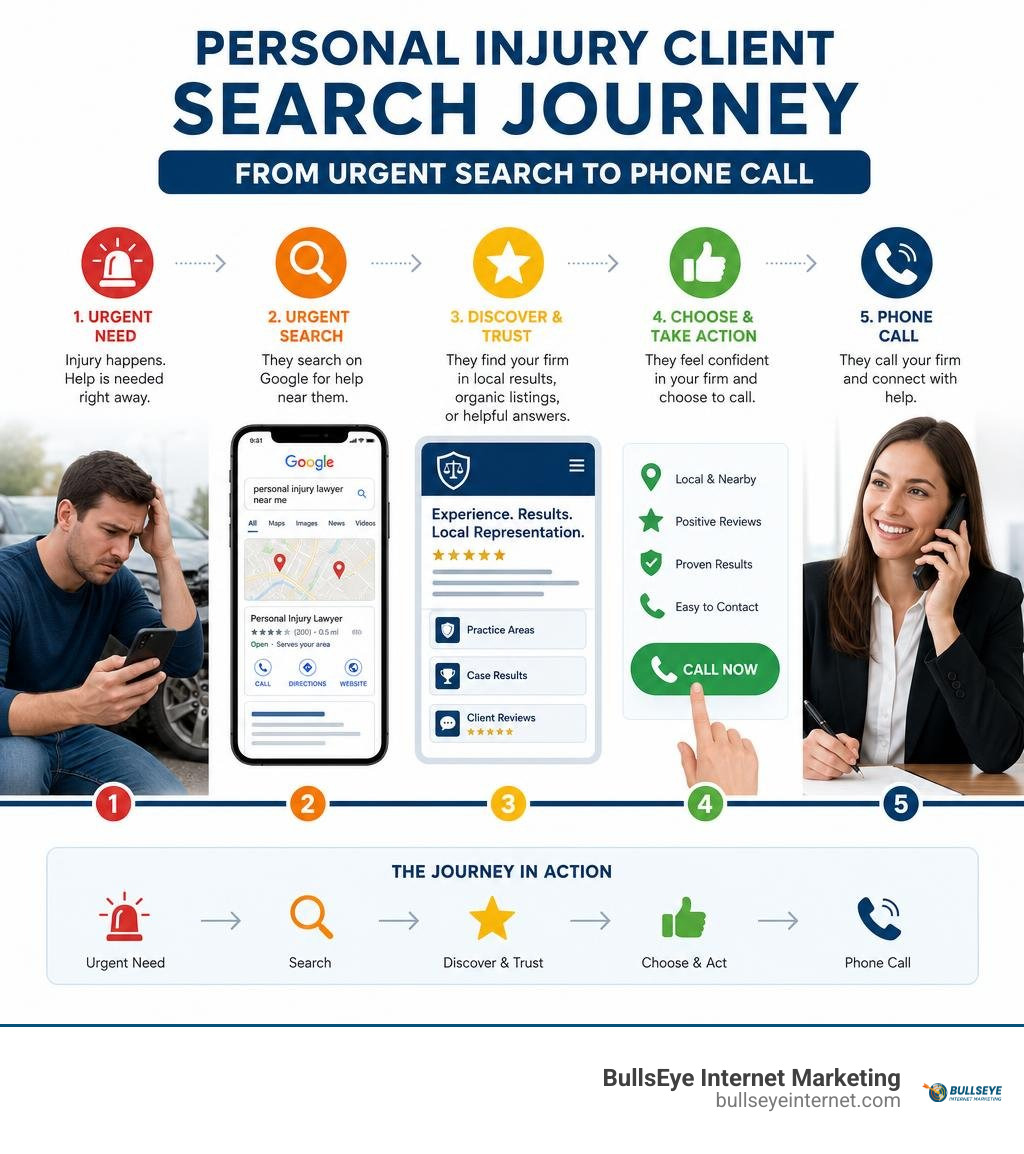
SEO for personal injury works when your firm earns visibility in three places: Google’s local results, organic listings, and AI-generated answers. Start with fast mobile pages, complete practice-area and location pages, a well-managed Google Business Profile, credible attorney and case-result information, and a steady flow of real reviews. Then measure calls and qualified leads, not rankings alone.
This matters because injury clients search with urgency. Most begin online, mobile accounts for more than 68% of personal injury search sessions, and many prospects would rather call right away than complete a form. In a market where a single paid click can cost hundreds of dollars – and sometimes far more – organic visibility can become a durable source of cases rather than another recurring ad expense.
Search has also become more complex. Your firm must be easy for Google, Google AI Overviews, ChatGPT, and Perplexity to understand and cite. That means clear answers, proven legal credentials, useful local information, trustworthy references, and an intake path that works the moment someone needs help.
I am Ronnie Katz, founder and Principal CEO of BullsEye Internet Marketing. With more than 20 years in online marketing, I help businesses improve visibility, traffic, and conversions through SEO for personal injury, local search, Google Business Profile optimization, and measurable lead-generation strategy.
SEO for personal injury vocab to learn:
Why SEO for Personal Injury Is Non-Negotiable in 2026
The legal landscape in 2026 is an ultra-competitive digital ecosystem. The U.S. personal injury legal market commands over $58 billion in annual revenue, and roughly 97% of prospective clients start their search for an attorney online. More critically, 62% of claimants contact an attorney directly from the first page of search results and virtually never click through to page two. If your firm does not control prime digital real estate on Google, you simply do not exist to the vast majority of injured individuals in your community.
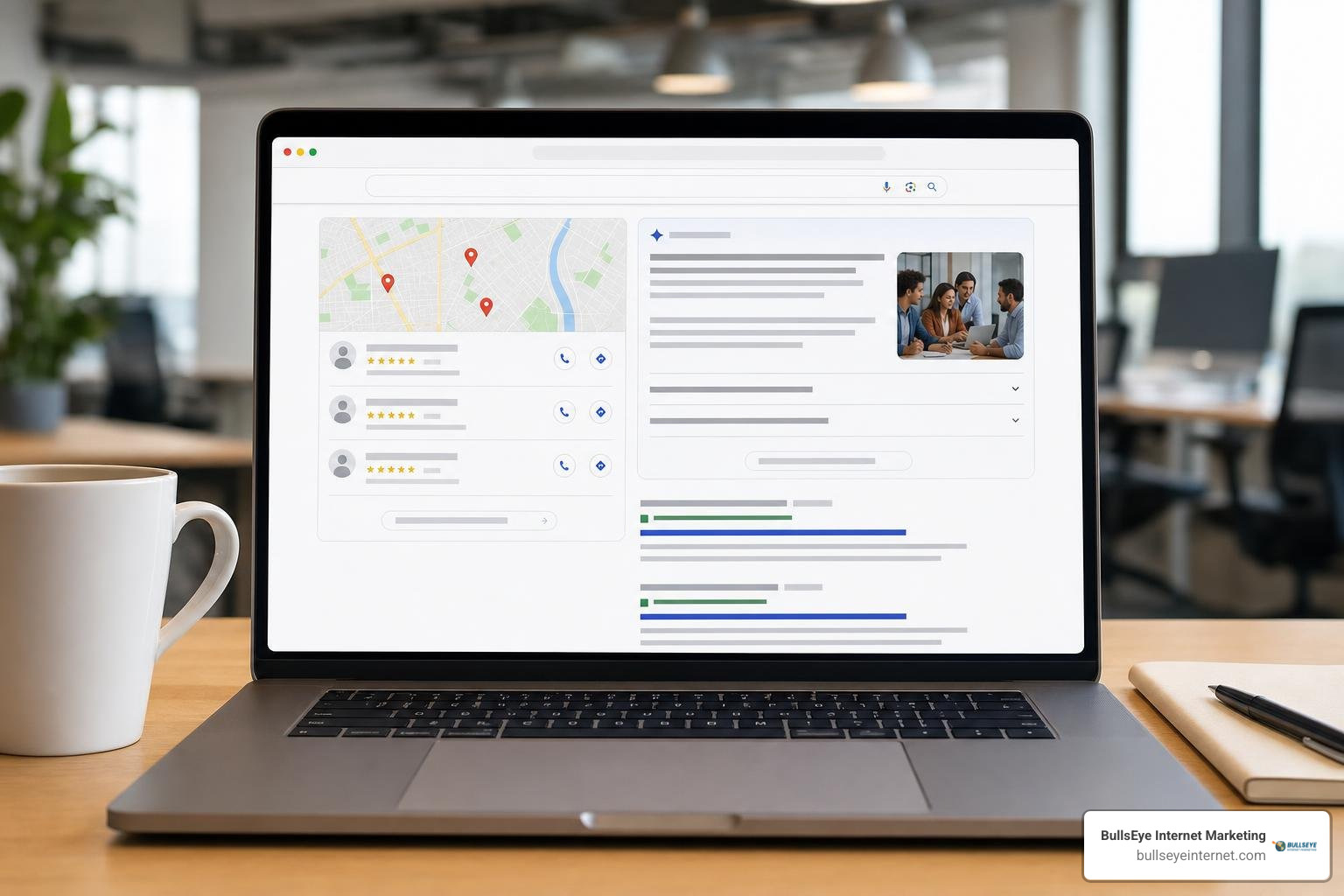
Winning these high-intent prospective clients requires mastering every layer of the search engine results page (SERP). Today’s search environment blends Local Services Ads (LSAs), paid search ads, the Google Local Pack, AI Overviews, and traditional organic listings. Understanding the ultimate guide to personal injury lawyer marketing allows your practice to capture prospects at the exact moment of intent. The top three organic listings alone capture 55% to 62% of all available clicks, with position one claiming 27.6% of traffic. When your firm achieves organic visibility, you build an evergreen client-acquisition engine that generates cases 24 hours a day, 7 days a week.
The High-Stakes Economics of Legal Search
Personal injury law features some of the most intense search auction dynamics on the web. According to search advertising data, 78 of the top 100 most expensive pay-per-click terms in the world are legal queries. In competitive markets, a single click on a Google Ad for competitive phrases like car accident attorney can cost between $250 and $500, with extreme auctions reaching upwards of $1,000 per click.
These staggering costs reflect massive lifetime case values. A single catastrophic injury or commercial truck accident settlement can generate hundreds of thousands—or millions—of dollars in legal fees. However, relying solely on paid search leads to an expensive cycle where your incoming case pipeline stops the minute you pause ad spend. Understanding how to drive more leads with car accident lawyer SEO allows your practice to acquire high-value cases at a fraction of the acquisition cost of paid ads.
Core Ranking Factors and E-E-A-T Standards in SEO for Personal Injury
Google classifies personal injury law strictly under its “Your Money or Your Life” (YMYL) content standards. Because legal advice directly impacts a person’s physical health, safety, and financial future, search engines apply aggressive quality evaluations centered on E-E-A-T: Experience, Expertise, Authoritativeness, and Trustworthiness.
To establish bulletproof E-E-A-T signals, top-performing firms implement concrete trust assets:
- Verified Attorney Profiles: 93% of top-ranking injury law firms explicitly link individual attorney bios directly from their primary practice area pages, displaying detailed state bar admissions and professional associations.
- Documented Case Results: Publishing specific, factual settlement and verdict figures validates real-world courtroom experience and case competence.
- Legal Authority Signals: Inclusion in respected external directories—such as listings for verified attorney directories—reinforces your firm’s professional standing across geographic service areas.
Optimizing for AI Search Engines and Google AI Overviews
Search behavior has fundamentally evolved with the rollout of conversational answer engines like ChatGPT Search, Perplexity, and Google AI Overviews. By late 2025, AI Overviews stabilized across roughly 15.7% of all queries, impacting high-volume legal informational searches. Securing visibility in these AI snapshots requires a shift toward Answer Engine Optimization (AEO), ensuring search engines can easily parse, extract, and cite your firm’s content.

Recent search studies reveal that Google AI Overviews cite URLs from traditional top-10 organic results only 38% of the time, frequently drawing answers from deeper niche pages that provide superior direct clarity. Even more telling, conversational engines like ChatGPT cite pages ranked position 21 or lower nearly 90% of the time. These engines prioritize clear semantic definitions, brand reputation, and authoritative citations over raw backlink numbers.
Extractable Formatting and Conversational Query Targeting
To ensure AI engines cite your practice area pages and guides, you must structure content using modular, direct-answer formatting. Our insights in the law firm marketing guide 2026 show that AI models favor content structured to deliver immediate value within the first 60 to 80 words of any section.
Follow this extractable content structure to capture AI search visibility:
- Direct Question Headings: Use clear H2 and H3 headers matching natural conversational queries (e.g., “What is the Statute of Limitations for a Car Accident Claim in Florida?”).
- Immediate Factual Summary: Provide a concise, jargon-free direct answer immediately beneath the header before diving into nuances.
- Structured Breakdowns: Organize complex statutory rules, damage calculations, and fault guidelines into bulleted lists or comparison tables.
Multimodal Assets and Brand Mention Signals
AI engines rely heavily on multi-platform verification to determine which law firms are true local authorities. Video search integration has become essential: YouTube has overtaken traditional web forums as the primary external media source cited within generative AI legal summaries. Embedding short, 3- to 5-minute educational videos explaining accident claims on your practice pages substantially increases your citation frequency across AI engines.
Furthermore, search models evaluate unlinked brand mentions across news outlets, podcasts, community publications, and legal forums. When reputable third-party platforms reference your firm’s attorneys in connection with personal injury topics, AI engines register those entities as authoritative legal sources.
High-Converting Content Architecture and Keyword Strategy
Winning organic personal injury traffic requires building a structured topical universe rather than publishing disjointed blog posts. To convert incoming traffic into actual retained cases, your website must balance high-intent commercial keywords with deep informational clusters, as detailed in internet marketing for lawyers: the ultimate guide to digital growth.
Pillar-Cluster Content Structures for Practice Areas
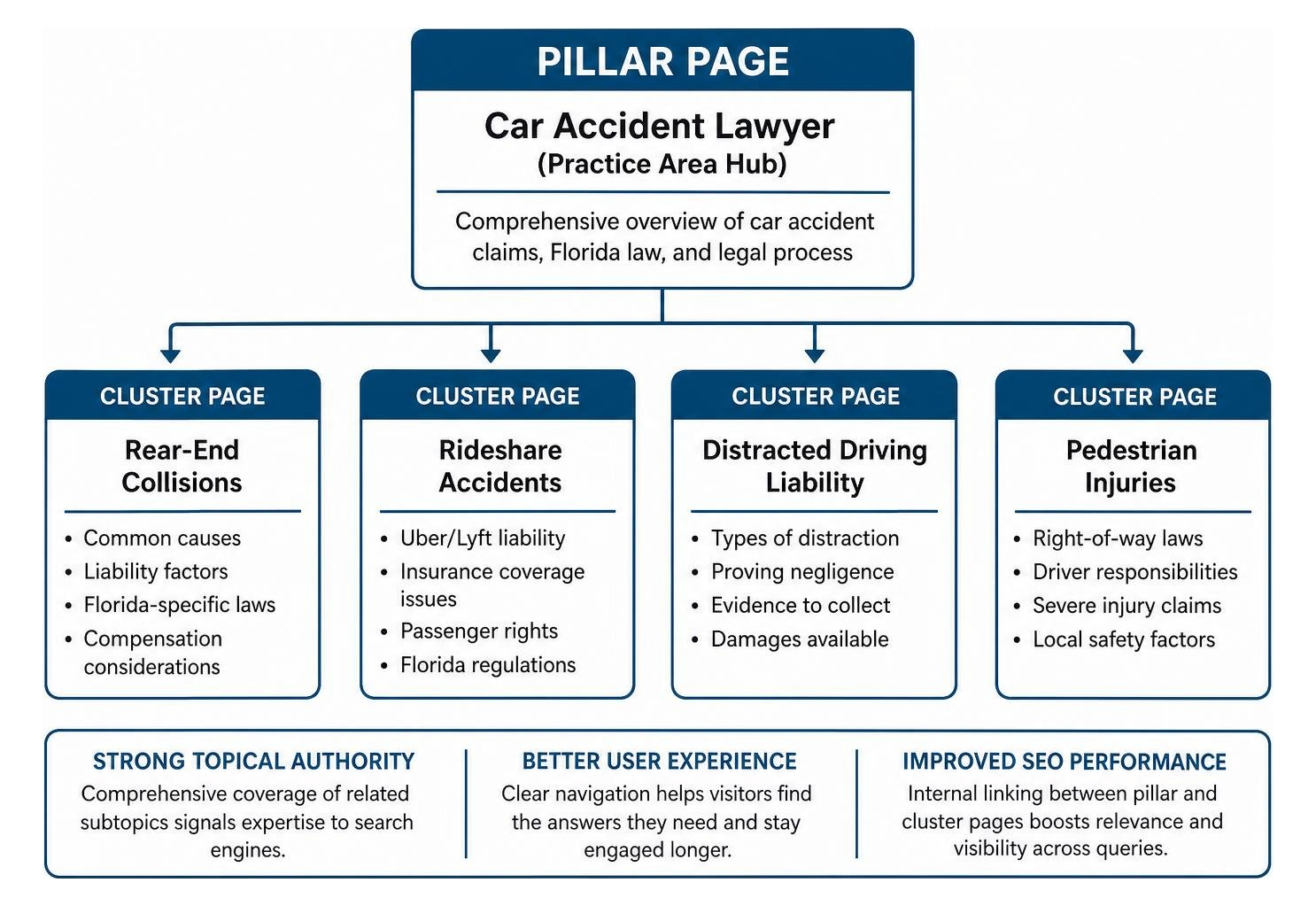
A high-performing legal site structure relies on dedicated practice area pillar pages supported by tightly focused sub-topic cluster pages. For example, your primary “Car Accident Lawyer” pillar page serves as the comprehensive regional hub, internally linking to specific long-tail cluster articles covering rear-end collisions, rideshare accidents, distracted driving liability, and pedestrian injuries.
This architecture signals comprehensive topical authority to Google while establishing seamless user navigation. For regional practices, establishing geographic relevance across surrounding cities and counties is crucial, as explored in the sunshine state of search: boosting your Florida law firm’s online visibility. Every sub-page must offer unique local statutory details, municipal court considerations, and real-world legal guidance rather than thin, boilerplate duplicate copy.
Case Results, Testimonials, and Conversion Architecture
Attracting traffic is only half the battle; converting injured callers into signed contingency agreements requires deliberate Conversion Rate Optimization (CRO). Personal injury prospects are often in physical pain or under extreme financial distress, meaning your conversion pathways must be frictionless.
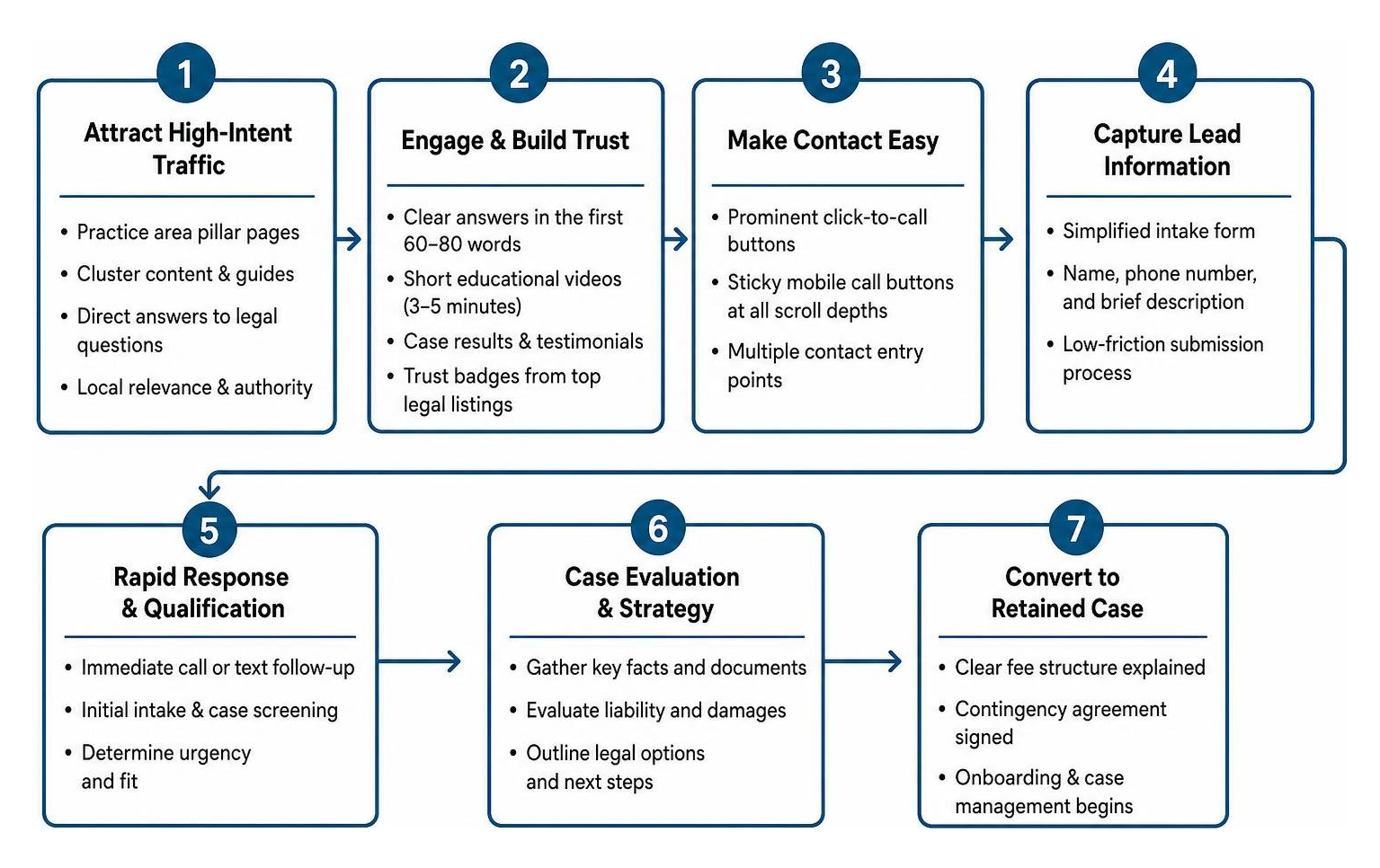
Key CRO elements every personal injury website must feature include:
- Prominent Click-to-Call Buttons: Over 47% of prospective injury clients prefer calling immediately over filling out a form. Sticky mobile call buttons must remain visible across every scroll depth.
- Simplified Intake Forms: Keep preliminary forms short, asking only for a name, phone number, and brief description of the incident.
- Prominent Trust Badges: Prominently display documented settlement figures and high-rating badges from top legal listings adjacent to intake buttons to eliminate hesitation.
Winning the Local Map Pack and Technical Foundation
The Google Local Pack is the single most valuable piece of digital visibility for an injury firm, capturing 42% to 46% of all clicks on local search queries. Winning the Local 3-Pack requires an active, fully optimized Google Business Profile (GBP) paired with consistent local citations and review generation, as outlined in our step-by-step guide to local attorney SEO.
Firms with 50 or more Google reviews appear in the Local Pack 3.4 times more frequently than firms with fewer than 10 reviews. Furthermore, review recency is an active ranking signal: reviews older than 3 months carry approximately 40% less algorithmic weight. Establishing automated post-case review workflows via SMS and email ensures a steady, ongoing review velocity. Proactively managing your local footprint helps you implement proven attorney marketing solutions: how to stop chasing clients and start attracting them.
Technical Health, Site Speed, and Schema Markup
Technical SEO provides the foundation that allows search engines to crawl, understand, and rank your content effectively. Sites that fail Core Web Vitals or load slowly on mobile devices lose rankings and drive impatient claimants straight to competing firms.
- Page Speed Thresholds: Maintain desktop load times under 2.5 seconds and mobile load times under 3.5 seconds using compressed WebP images, minified JavaScript, and high-performance server hosting.
- Structured Data (Schema.org): Implement clean JSON-LD structured data across your entire site. Essential legal schemas include
LegalService,Attorney(with bar credentials),LocalBusiness,FAQPage, andAggregateRating. - Mobile-First Indexing: With over 68% of personal injury searches happening on mobile devices, responsive mobile design and clear typography are essential ranking requirements.
Authoritative Link Building vs. High-Risk Tactics
Backlinks remain one of Google’s primary ranking signals, but legal SEO requires strict adherence to quality over volume. Low-quality links, private blog networks (PBNs), and automated link spam can trigger severe algorithmic penalties that wipe out your search visibility.
Focus instead on high-authority, editorial link acquisition:
- Legal Directory Citations: Maintain accurate, verified profiles on leading legal directories like Justia, FindLaw, and Avvo.
- Local Community Sponsorships: Sponsor local charity 5K runs, civic events, youth sports, and high school scholarships across your service territory to earn authentic local
.organd.edubacklinks. - Digital PR and Legal Commentary: Provide expert legal analysis on breaking news stories to journalists and regional publications through platforms like Connectively (formerly HARO).
Comparing Organic Search ROI Against Legal PPC Advertising
While Pay-Per-Click (PPC) advertising offers immediate traffic, organic search builds lasting equity and significantly higher long-term return on investment. Over a three-year period, organic search delivers an average of 5.2 times the ROI of paid advertising.
| Marketing Metric | Organic SEO Strategy | Pay-Per-Click (PPC) Advertising |
|---|---|---|
| Cost Dynamics | Predictable monthly management investment | Escalating auction costs ($250–$1,000+ per click) |
| Long-Term Asset Value | Builds compounding digital equity and rankings | Traffic stops entirely the moment ad spend ends |
| Click Capture | Captures 55%–62% of top-of-page organic clicks | Captures 10%–20% of paid search clicks |
| User Trust Perception | High trust; viewed as an earned market authority | Moderate trust; clearly labeled as a sponsored ad |
| 3-Year ROI Potential | 5.2× higher ROI through compounding traffic | Linear ROI capped by monthly media spend |
For a deeper dive into optimizing paid legal channels alongside organic campaigns, review our analysis on winning the paid search game in personal injury law.
Budgeting and Realistic Timelines for SEO for Personal Injury
Building organic dominance in personal injury law requires a realistic perspective on timelines and capital allocation. Because you are competing against established firms with years of accumulated domain authority, SEO is an investment in market infrastructure.
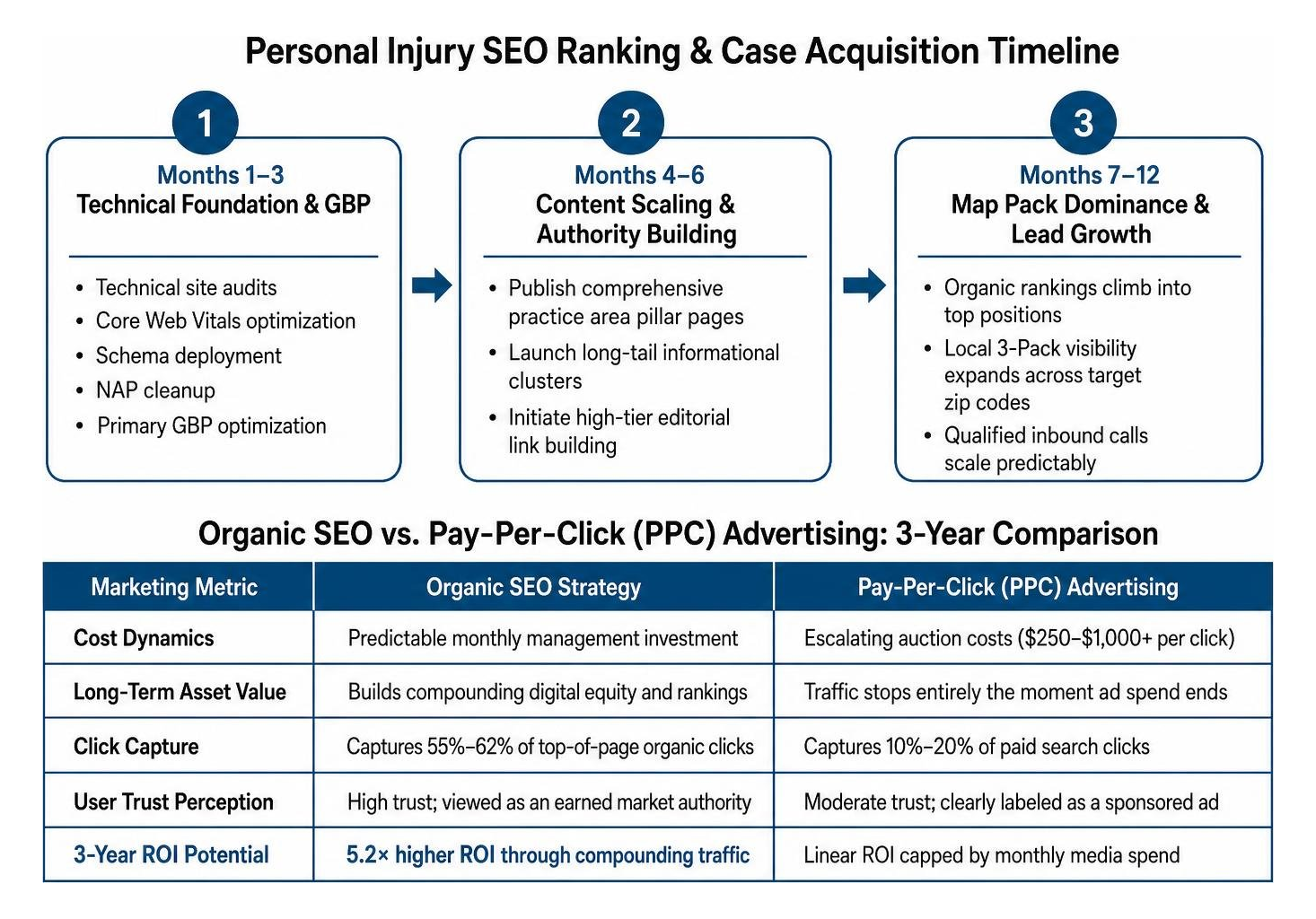
- Months 1 to 3 (Technical Foundation & GBP): Complete technical site audits, Core Web Vitals optimization, schema deployment, NAP cleanup, and primary GBP optimization.
- Months 4 to 6 (Content Scaling & Authority Building): Publish comprehensive practice area pillar pages, launch long-tail informational clusters, and initiate high-tier editorial link building.
- Months 7 to 12 (Map Pack Dominance & Lead Growth): Organic rankings climb into top positions, Local 3-Pack visibility expands across target zip codes, and qualified inbound calls scale predictably.
Understanding the strategic value of an experienced partner is why why hiring a legal SEO specialist is your best growth strategy.
Frequently Asked Questions About Personal Injury SEO
How long does it take for personal injury SEO to generate signed cases?
Personal injury SEO typically begins generating initial qualified inquiries within 4 to 6 months, with substantial signed case volume and top-tier Local Pack rankings developing between months 8 and 12. Because personal injury search is highly competitive, search engines take time to crawl new content, assess user interaction signals, index structured schema, and calculate domain authority.
Why are personal injury keywords the most expensive in search marketing?
Personal injury keywords command the highest advertising prices because the corresponding case settlements are among the largest in the legal industry. A single commercial truck collision or catastrophic medical malpractice case can produce hundreds of thousands or millions of dollars in attorney contingency fees. This massive upside leads law firms to bid aggressively for transactional search terms.
How does Google’s YMYL classification affect injury law websites?
Under Google’s “Your Money or Your Life” (YMYL) guidelines, search quality evaluators and ranking algorithms hold legal websites to the highest standards of factual accuracy, author credibility, and user security. Law firms must demonstrate transparent E-E-A-T signals, including clearly listed attorney bar numbers, active state bar admissions, verifiable case results, clear editorial policies, and secure HTTPS website encryption.
Conclusion
Dominating search engine results for personal injury law is one of the most profitable investments a practice can make. By pairing a fast, technically sound website with deep practice-area content, active Google Business Profile management, and bulletproof E-E-A-T signals, your practice can consistently attract high-value cases.
At BullsEye Internet Marketing, we help law firms build sustained competitive advantages through SEO, Google Business Profile optimization, Pay-Per-Click management, and conversion rate optimization. To protect our partners, we offer no long-term contracts and strictly enforce market exclusivity—working with only one client per industry per geographic area.
To take full control of your local market and scale your caseload sustainably, explore our comprehensive resource on an essential guide to advertising for lawyers and schedule your strategic consultation today.
