
Why Every Business Needs a PPC Audit
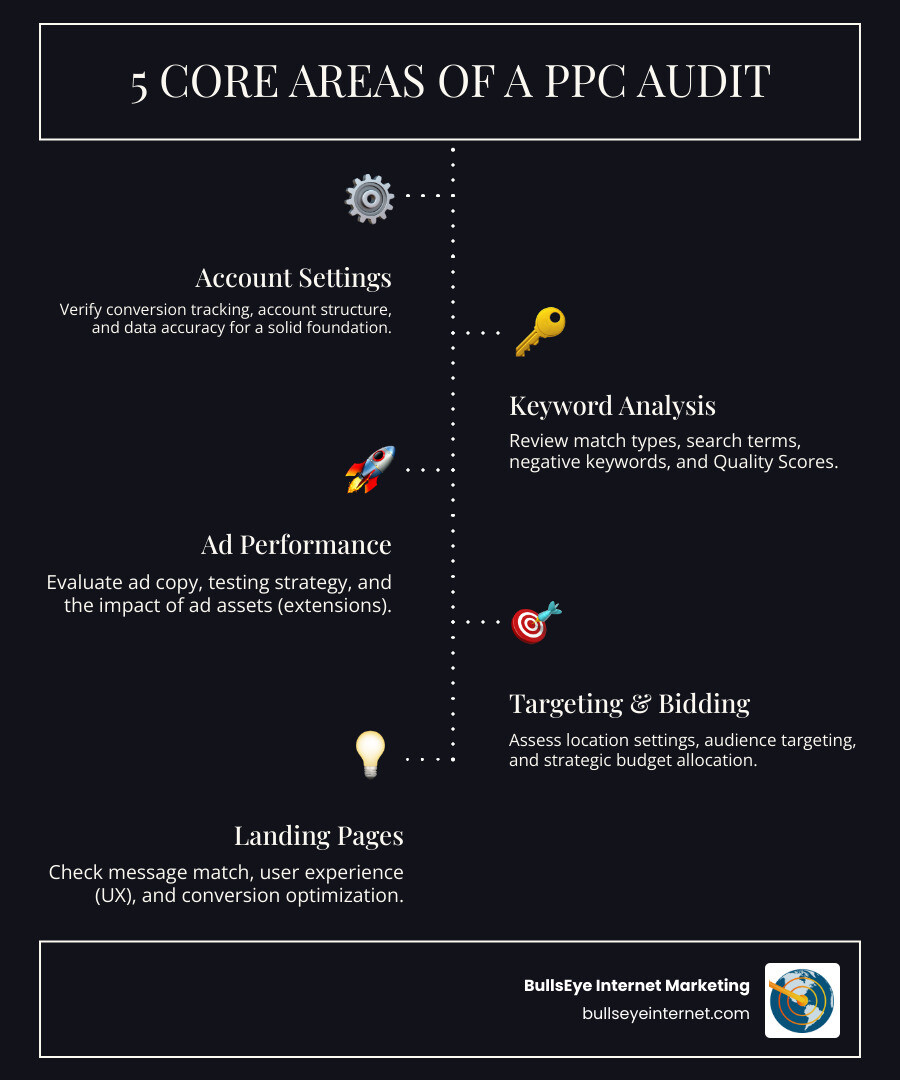
A PPC Audit is a comprehensive review of your pay-per-click advertising campaigns to assess performance, identify issues, and uncover opportunities for improvement. Here’s what it involves:
- Account Settings & Tracking: Verify conversion tracking, account structure, and data accuracy
- Keyword Analysis: Review match types, search terms, negative keywords, and Quality Scores
- Ad Performance: Evaluate ad copy, testing strategy, and ad assets (extensions)
- Targeting & Bidding: Assess location settings, audience targeting, and budget allocation
- Landing Pages: Check message match, user experience, and conversion optimization
Running a PPC Audit matters because most businesses waste a significant portion of their ad spend, sometimes up to 68%, on ineffective campaigns. Regular audits help you reduce wasted spend, improve your return on ad spend (ROAS), and make data-driven decisions that get your phone ringing with qualified leads across the United States, especially in competitive local markets like South Florida, Broward County, Miami-Dade County, and Palm Beach County.
If your campaigns are not delivering the results you expected, or if your cost per acquisition keeps creeping up, a thorough audit reveals exactly where your money is going and how to fix it. You will see which keywords are bleeding your budget, which ads are falling flat, and which targeting settings are showing your ads to the wrong people.
The good news is that most accounts have quick wins hiding in plain sight. Issues like incorrect conversion tracking (affecting 71% of accounts), bloated ad groups with too many keywords, or missing negative keywords can be fixed fast, often delivering immediate improvements to your ROI.
I’m Ronnie Katz, founder and Principal CEO of BullsEye Internet Marketing, and I’ve been helping businesses maximize their online visibility and conversions since 2006. Over the past 18+ years, I’ve conducted countless PPC Audits that have helped clients identify and eliminate wasted spend while dramatically improving campaign performance.
What is a PPC Audit and Why is it Crucial for Your Business?
At its core, a PPC Audit is a thorough evaluation of the structure and performance of a paid ad account across platforms like Google Ads. Think of it as a comprehensive health check-up for your advertising efforts. It digs into the setup of key account components and settings to uncover potential errors and areas ripe for optimization. As one expert put it, audits serve as a “diagnostic tool, allowing you to get under the hood of your campaigns to assess what is working and what is costing your business money.”
The importance of a PPC Audit cannot be overstated. Even the most seasoned marketers can overlook performance issues in the day-to-day management of campaigns. An audit provides an invaluable opportunity to step back and assess the bigger picture, revealing hidden opportunities for improvement and helping us find unrealized potential.
The benefits of conducting regular PPC Audits are manifold:
- Find Overlooked Performance Issues: We can identify problems that might be silently draining your budget or hindering your campaign’s effectiveness.
- Reduce Wasted Ad Spend: By pinpointing irrelevant clicks, inefficient targeting, or underperforming ads, we can cut down on expenditures that yield no results. In fact, studies suggest that, on average, a significant portion of ad spend, up to 68%, can be wasted if not properly managed.
- Maximize marketing ROI: By optimizing campaign elements, we can significantly boost the return on your advertising investment. Clients who partner with us often see a substantial return on their initial investment, sometimes as high as 4.5 times.
- Streamline Your Budget: Audits help us understand where your budget is best spent, allowing for more strategic allocation to high-performing areas and reducing spend on low-quality placements.
- Identify Low-Quality Placements: Some ad placements, whether on websites or apps, can deliver irrelevant traffic or poor user engagement. A proper audit helps us pinpoint and exclude these placements, ensuring your ads reach a more receptive audience.
- Increase Conversions and Improve Key Metrics: By optimizing keywords, ad copy, and landing pages, we can drive higher click-through rates (CTR), lower cost-per-acquisition (CPA), and ultimately, more conversions.
- Stay Ahead of the Competition: An audit allows us to analyze what others in your industry are doing, helping us refine our strategy and ensure your campaigns stand out, especially within competitive markets like South Florida, including Miami, Fort Lauderdale, and West Palm Beach.
A PPC Audit transforms your advertising from a guessing game into a data-driven strategy, ensuring every dollar spent works harder for your business.
The Ultimate PPC Audit Checklist: A Step-by-Step Guide
Conducting a comprehensive PPC Audit can seem like a daunting task, but with a structured approach, it becomes a powerful tool for driving campaign success. This checklist provides a roadmap to ensure we cover all critical areas, leading to actionable insights and data-driven decisions.

Step 1: Verify Foundational Account Settings and Tracking
The bedrock of any successful PPC campaign is accurate tracking and a well-organized account structure. Without these, we’re flying blind, unable to truly understand what’s working and what isn’t.
First and foremost, we must address conversion tracking. This is paramount. Neglecting to track conversions is one of the biggest mistakes a PPC manager can make because, without this data, it’s impossible to understand whether all our hard work is paying off. We’ve seen how critical this is; a study found that only 29% of all accounts reviewed had correctly implemented conversion tracking. This means a vast majority of businesses are operating without a clear picture of their campaign’s effectiveness.
We carefully check your tracking statuses to ensure every valuable action – whether it’s a phone call, a form submission, or an online purchase – is being recorded accurately. If we find any discrepancies, Google’s Tag Assistant can be an invaluable tool for debugging and correcting issues.
Next, we examine your logical account structure. A disorganized account makes data analysis meaningless and practically impossible. We ensure your campaigns and ad groups are structured logically, perhaps by product, service, or geographic area (e.g., specific campaigns for Miami, Fort Lauderdale, or Palm Beach County). Consistent, specific, and descriptive campaign naming conventions are crucial here, providing context and clarity for all our efforts. This attention to detail ensures that your data is not just collected, but understandable and actionable.
Step 2: The Keyword Component of Your PPC Audit
Keywords are the heartbeat of your PPC campaigns. They connect searchers with your business. A thorough PPC Audit demands an in-depth review of your keyword strategy to ensure we’re attracting the right audience efficiently.

We start with a comprehensive keyword performance review. We analyze which keywords are driving conversions and which are simply draining your budget. A well-run Google Ads account typically includes keywords set to a variety of match types – broad, phrase, and exact. Each serves a unique purpose; for example, broad match can be great for finding new search queries, while exact match helps ensure we’re only connecting with the most highly-qualified searchers. If we find an over-reliance on broad match, we’ll suggest incorporating more modified broad, phrase, and exact-match keywords to save money and target traffic more precisely.
The Search Terms Report is a critical tool in this step. It shows us the actual queries people are typing into Google that trigger your ads. This report is invaluable for identifying irrelevant searches that need to be added as Negative keywords, preventing wasted ad spend. Negative keywords are our best defense against impressions and clicks from unqualified searchers. We also use this report to spot new, relevant keyword opportunities we might have missed, effectively identifying keyword gaps in your current strategy.
Finally, we dig into Quality Score analysis. Your Google Ads Quality Score serves as a litmus test for your ad performance, gauging factors like relevance and click-through rate. A higher Quality Score translates to lower costs-per-click and prime ad placement. We aim for a score of 7 or higher; if we find keywords with a Quality Score below 7, especially those with high spend, we investigate the mismatch between the keyword, your ad, and your landing page to make necessary improvements.
Step 3: Auditing Ad Copy, Structure, and Assets
Even the best keywords won’t perform if your ads aren’t compelling. This step focuses on ensuring your ad creative and its presentation are optimized for maximum engagement.
First, we look at ad group organization. An ad group consists of one or more ads targeting similar audiences. We ensure your ad groups are tightly themed, categorizing ads based on a unified purpose. A general rule of thumb is that an ad group should never contain more than 15-20 keywords to maintain focus and allow for more custom ad copy.
Then, we scrutinize your ad copy relevance and calls-to-action (CTAs). Good ad copy is incredibly important. It needs to be relevant to the keywords, compelling, and include a clear CTA that guides the user to the next step. We also ensure your ads comply with Google’s ad policies to avoid disapprovals. To find winning combinations, we implement A/B testing, typically running two to three distinct ad variations per ad group. This “sweet spot” allows for effective testing without overcomplicating management.
Finally, we examine ad assets (formerly ad extensions). These are no longer just a nice-to-have; they officially impact ad rank and are a must for creating competitive ad copy. Extensions provide more real estate on the search results page, helping your ads stand out and giving users more information upfront. We check to ensure you’re utilizing relevant assets like Sitelinks, Callouts, Structured Snippets, and Location extensions, which are particularly important for local businesses in areas like Broward County or Palm Beach County.
Step 4: Reviewing Targeting, Bidding, and Budget Allocation
Even with perfect ads and keywords, your campaigns won’t succeed if they’re not reaching the right people at the right time and within a smart budget. This step ensures precision in delivery.
We begin with location targeting. For businesses serving specific areas like Miami, Fort Lauderdale, or the wider South Florida region, targeting the right locations can significantly impact clicks and conversions. We ensure your location targets are precise, with no strange or contradictory overlaps that could lead to wasted spend outside your service areas.
Next, we analyze device performance. We review how your campaigns perform on desktops, tablets, and mobile phones, as performance can vary significantly. If we find that mobile campaigns are outperforming others, we might suggest adjusting bids to capitalize on that trend. Similarly, ad scheduling is reviewed to ensure your ads are appearing during optimal times when your target audience is most active and likely to convert.
We also dig into audience and demographic layers, ensuring your ads are speaking to the right “vibe” of your customer. Are we reaching the ideal age groups, genders, or income brackets? Are there specific audiences that could be more effectively targeted?
Your bidding strategy is crucial and must align perfectly with your campaign goals. We evaluate whether you’re using the right bidding strategy – whether it’s manual control for specific, high-value keywords or automated strategies for broader reach. We also examine budget pacing to ensure your daily and monthly spend is optimized, avoiding situations where you run out of budget too early or spend too slowly. A critical part of this is identifying spend on low-quality placements – those websites or apps that deliver irrelevant traffic without conversions. By excluding these, we prevent unnecessary budget drain.
Step 5: Assess Landing Page and Post-Click Experience
The journey doesn’t end with a click. What happens after a user clicks your ad is just as important as the ad itself. A poor post-click experience can negate all the good work done in previous steps.
We carefully check for message match between your ad and your landing page. If your ad promises “best deals on air conditioning repair in Broward County,” the landing page must deliver exactly that. A mismatch often leads to high bounce rates and low conversion rates, even if your click-through rate is good.
User experience (UX) is paramount. Your landing page should be seamless, designed to give users a great experience. This includes ensuring page speed and mobile-friendliness are top-notch, especially since a growing percentage of searches occur on mobile devices. A slow-loading or clunky mobile page will quickly send potential customers away.
A clear and compelling call-to-action (CTA) is also vital. Your CTA button is a crucial element on your landing page – it’s what you want visitors to do. We ensure it’s simple, concise, and strategically placed. To continually improve, we advocate for A/B testing different versions of your landing pages to find which elements drive the most conversions.
Finally, we link your account to Google Analytics for deeper post-click analysis. Google Analytics offers powerful insights beyond what advertising platforms provide, consolidating all your data in one central location. This allows us to analyze user behavior after the click, such as average time on site or bounce rate, giving us a complete picture of the customer journey and pinpointing areas for improvement.
Timing, Frequency, and Common Pitfalls
Knowing how to perform a PPC Audit is one thing, but knowing when and how often to do it is equally important for sustained campaign health.
When is the optimal time to conduct a PPC audit?
We recommend performing a PPC Audit at several key junctures:
- When taking on a new account: This is always a good idea to understand its history, identify existing issues, and establish a baseline for future performance.
- Before building a new campaign: An audit of existing efforts can inform strategy and prevent repeating past mistakes.
- When starting a new role or with new leadership: It provides a clear picture of current performance and helps align strategies with new objectives.
- Before peak season: Optimizing campaigns before high-traffic periods ensures you’re ready to maximize opportunities and avoid costly errors when it matters most.
- When performance drops: If you notice a significant decline in key metrics, an audit can quickly diagnose the root cause.
How frequently should PPC audits be conducted?
While the specific frequency depends on factors like account size, budget, and industry volatility, many experts recommend performing a thorough, deep-dive PPC Audit at least once every six months to maintain account hygiene. For larger, more dynamic accounts, or during critical business periods, lighter, more focused checks can be beneficial on a quarterly basis. The goal is to avoid a “set it and forget it” mentality; advertising landscapes are constantly changing, and your campaigns need to evolve with them.
Here’s a list of common mistakes to avoid when performing a PPC Audit:
- Ignoring conversion tracking: As we’ve emphasized, without accurate conversion data, you can’t measure true success. This is perhaps the most critical oversight.
- The “set it and forget it” mindset: PPC campaigns are not static. They require continuous monitoring and optimization. Thinking that a campaign, once launched, will run perfectly indefinitely is a recipe for wasted spend.
- Relying on a single match type: Using only broad match keywords can lead to a flood of irrelevant traffic, while relying solely on exact match might restrict reach too much. A balanced strategy with various match types is essential.
- Neglecting the landing page: The landing page is where conversions happen. Overlooking its relevance, user experience, and mobile-friendliness means you’re investing in clicks that won’t convert. If you’re working with poor landing pages, you will never win.
- Misinterpreting data: It’s crucial to understand the context of your data, including seasonality and market trends. Comparing apples to oranges (e.g., Christmas performance to summer performance) can lead to flawed conclusions.
- Overlooking external factors: Economic conditions, industry trends, and even local events (relevant for our South Florida clients) can impact campaign performance. An audit should consider these broader influences.
By understanding these pitfalls, we can approach our PPC Audits with greater precision and effectiveness, ensuring we uncover meaningful insights every time.
From Audit to Action: Tools and Next Steps to Maximizing ROI
The real magic happens after the PPC Audit is complete – when insights are transformed into actionable strategies that drive tangible results. We believe in empowering our clients with clarity and a clear path forward.
While many specialized tools exist, the core of any PPC Audit relies on fundamental platforms: the advertising interface itself (like Google Ads), Google Analytics for deeper post-click insights, and robust spreadsheets for data organization and analysis. These tools, combined with expert knowledge, form the backbone of our audit process.
To help you get started, we offer a comprehensive resource that distills our expertise: Access our free PPC audit template here. This template guides you through the essential checks and considerations, allowing you to systematically evaluate your campaigns.
Once the audit is complete and we have a list of potential improvements, we use a prioritization framework called the ICE method (Impact, Confidence, Ease). This helps us determine which fixes to implement first:
- Impact: How significant will this change be if successful?
- Confidence: How sure are we that this change will work?
- Ease: How difficult or time-consuming will this change be to implement?
This allows us to create a strategic action plan, focusing on “quick wins” that yield high impact with relatively low effort, followed by more complex, long-term optimizations. Each step in the plan includes a timeline and assigned responsibilities, ensuring accountability and progress.
At BullsEye Internet Marketing, we specialize in generating calls and sales through effective digital marketing strategies, including PPC. Our unique selling proposition is working with only one client per industry per geographic area, giving you a competitive advantage in your local market, whether you’re in Miami-Dade County, Palm Beach County, or any of the vibrant cities we serve. We offer no long-term contracts because we believe our results speak for themselves. We’re dedicated to turning audit insights into actual profit for businesses across the United States, particularly in Florida, from Biscayne Gardens to West Palm Beach.
By carefully conducting PPC Audits and implementing data-driven optimizations, we help businesses like yours reduce wasted spend, improve campaign performance, and ultimately achieve their business goals. Our expertise ensures that every dollar you invest in PPC is maximized, bringing you closer to your revenue targets.
Ready to transform your PPC campaigns and see a significant return on your investment? Learn more about our PPC management services and how we can help you turn those audit insights into tangible success.
