
When Every Second Counts: Finding the Right Mental Health Call for Help
Mental health calls can be the difference between life and death — so knowing exactly who to call, and when, matters enormously.
Here is a quick-reference guide to the most important mental health helplines in the U.S.:
| Service | Number | Best For | Hours |
|---|---|---|---|
| 988 Suicide & Crisis Lifeline | Call or text 988 | Suicide, mental health crisis, substance use | 24/7 |
| NAMI HelpLine | Text NAMI to 62640 | Emotional support, mental health info | Mon–Fri, 10am–10pm ET |
| SAMHSA National Helpline | 1-800-662-4357 | Substance use, treatment referrals | 24/7 |
| Veterans Crisis Line | Call 988, press 1 | Veterans and active military | 24/7 |
| Maternal Mental Health | 1-833-852-6262 | Pregnant and postpartum individuals | 24/7 |
| Local Crisis Lines | Search by county | County-specific mental health support | Varies |
In an immediate, life-threatening emergency, always call 911.
Every 11 minutes, someone in the United States dies by suicide. For people between the ages of 10 and 34, it ranks among the leading causes of death. Behind each of those numbers is a person who may have needed someone to pick up the phone — and a system that may or may not have been ready to help.
The landscape of mental health crisis support has changed dramatically since the launch of the 988 Suicide & Crisis Lifeline in 2022. But many people still don’t know what number to call, what to expect when they do, or what happens afterward. And for communities with fewer mental health professionals, the gap between need and access can be especially wide.
I’m Ronnie Katz, founder of BullsEye Internet Marketing, and while my expertise centers on helping businesses grow online, I’ve spent years studying how people search for critical services — including mental health calls — and what makes those resources findable when someone needs them most. Understanding this landscape is the first step toward connecting people with the help they deserve.
Quick Mental health calls terms:
The Essential Directory of Lifelines and Support Services
Comparing 988, NAMI, and Local Crisis Lines
When a mental health challenge arises, choosing the right resource is crucial. The services available across the United States differ significantly in their scope, purpose, and operational hours.
The 988 Suicide & Crisis Lifeline is the national standard for immediate, high-stakes support. It is free, confidential, and available 24/7/365 via call, text, or online chat. Staffed by trained crisis counselors, 988 is designed to de-escalate acute distress, including suicidal ideation, substance use crises, and severe emotional panic. Services are highly accessible, including dedicated support for veterans (press 1) and Spanish speakers (text or chat “AYUDA”). For more details on its structural operations, you can consult the 988 Frequently Asked Questions | SAMHSA.
In contrast, the NAMI HelpLine (National Alliance on Mental Illness) is not a crisis hotline. Instead, it is a peer-led support and information resource. Operating Monday through Friday from 10 AM to 10 PM Eastern Time, NAMI connects callers with trained specialists who have lived experience with mental health conditions. It is an excellent tool for individuals seeking guidance on navigating treatment systems, finding local support groups, or understanding a new diagnosis.
For localized, hands-on support, county-specific crisis lines and regional organizations are invaluable. In Florida, particularly across South Florida, several key resources bridge the gap between national networks and local clinical care:
- Broward County: Residents can access support and local educational resources directly through If in Crisis – NAMI Broward County.
- Palm Beach County: Local peer support, advocacy, and educational program directories are available at NAMI Palm Beach County: Mental Health Support, Education ….
- Miami-Dade County: Comprehensive behavioral health services and safety-net care coordination are managed by Free Mental Health Services | Miami | South Florida | Thriving Mind.
- Mobile Crisis Services: Throughout Florida, the state utilizes Mobile Response Teams | Florida DCF to provide 24/7 on-site, face-to-face evaluation and crisis intervention, helping individuals avoid unnecessary psychiatric hospitalizations.
How 988 is Transforming Emergency Response
The introduction of 988 was intended to revolutionize how the U.S. handles mental health emergencies by diverting these sensitive situations away from the traditional 911 emergency system.
Historically, dialing 911 for a mental health crisis meant that armed law enforcement officers were often the first to arrive on the scene. This approach frequently escalated tense situations, sometimes with tragic outcomes. 988 provides an alternative, routing callers directly to compassionate, clinical professionals rather than dispatching lights and sirens.
To improve routing accuracy while maintaining privacy, the telecom industry has been transitioning to georouting technology. Unlike precise GPS geolocation, georouting identifies the caller’s general location based on nearby cell towers without transmitting their exact address. This allows the call to be routed to a local crisis center in their immediate vicinity rather than the area code assigned to their phone number. Under federal guidelines, non-nationwide wireless providers have until December 14, 2026, to fully implement this georouting capability.
Despite these advancements, the intersection of 988 and law enforcement remains a point of intense discussion. While federal administrators emphasize that the vast majority of 988 calls are resolved over the phone without emergency services, investigative reports reveal a significant rise in active rescues. Data published by Dramatic Rise in Police Interventions on 988 Callers – Mad In America indicates that roughly 7.8% of all 988 contacts resulted in police or EMS interventions. This rate is nearly four times higher than early estimates, raising concerns among privacy advocates about caller trust and involuntary psychiatric interventions.
Understanding the Surge in Mental Health Calls
The Link Between Professional Shortages and Emergency Calls
When communities lack preventative mental health care, the burden inevitably shifts to emergency service systems. This systemic failure is most visible in areas designated as Mental Health Professional Shortage Areas (MH HPSAs).

A comprehensive study examining emergency dispatch data in New York City highlighted the direct correlation between workforce shortages and 911 reliance. Out of nearly 19.8 million calls received by the NYPD during the study period, approximately 969,644 calls (5%) were classified as EDP (emotionally disturbed person) calls.
Adjusted data from this research revealed that neighborhoods designated as MH HPSAs experienced a 27% increase in expected mental health-related 911 calls compared to non-shortage areas. The disparity was even more pronounced in neighborhoods with extreme shortages: areas with a population-to-psychiatrist ratio exceeding 100,000:1 saw a 31% increase in emergency calls, while neighborhoods with zero full-time equivalent (FTE) psychiatrists accepting Medicaid patients saw a 33% spike. This demonstrates that when clinical care is unavailable, 911 becomes the default mental health provider of last resort.
Socioeconomic Drivers and Helpline Limitations
Workforce shortages do not exist in a vacuum; they are compounded by deep-seated socioeconomic challenges. Poverty, housing instability, and food insecurity are powerful drivers of psychological distress.
When basic needs are unmet, mental health crises multiply. Helplines frequently find themselves acting as makeshift social service agencies. For example, during the 2024-2025 period, the UK-based charity Mind handled 160,856 enquiries across its helpline teams. Frontline workers reported a dramatic rise in calls where emotional distress was tied directly to survival needs—such as individuals with no food in their homes or elderly residents living without heat. Similar accounts are detailed in the report Heartbreaking calls of woman with no food and suicidal man on bridge – The Mirror.
These trends highlight a fundamental limitation of traditional helplines: while a crisis counselor can offer emotional validation and coping strategies, they cannot directly resolve structural issues like homelessness, systemic poverty, or long-term clinical neglect.
Innovations in Emergency Dispatch and Alternative Response Models
How 911 Centers Triage Mental Health Calls
Recognizing that traditional policing is often poorly suited for psychiatric crises, progressive municipalities are redesigning their 911 dispatch protocols. By integrating mental health options directly into call scripts, dispatchers can identify and route these emergencies to specialized clinicians from the very first moment of contact.
Austin, Texas, was a pioneer in this space, becoming the first major U.S. municipality to add “mental health” as an explicit option alongside police, fire, and EMS in its 911 answering script. Under this system, calls are routed to the clinician-led Clinician Loop (C3) team housed directly within the 911 call center.
Similarly, Marion County, Indiana, implemented its MESA (Mobile Emergency Security Assistance) protocol. Dispatchers explicitly ask callers to identify if their emergency is a mental health crisis, allowing immediate diversion to specialized teams. This operational shift is explored in detail within the feature Behind the scenes of mental health calls at Austin’s 911 call center | TPR.
The Effectiveness of Clinician-Led and Co-Responder Teams
The shift toward clinician-led and co-responder models has yielded highly encouraging results, demonstrating that mental health professionals can safely resolve crises without relying on traditional law enforcement.
In Austin, the C3 team handled 4,849 mental health calls over a one-year period and successfully diverted 87% of them, meaning no police response was required on-scene. Approximately 40% of those diverted calls were resolved entirely over the phone through skilled emotional support and safety planning.
In Marion County, the clinician-led response team has successfully responded to hundreds of emergencies, connecting individuals with local resources on a personal level while significantly reducing the strain on local police departments. This model’s local implementation and community impact are outlined in Mental health emergency option is available for 911 callers in Marion County. By dispatching mental health professionals instead of armed officers, these programs prioritize therapeutic de-escalation over physical coercion.
Post-Crisis Care and Systemic Disparities
Post-Crisis Support and Managing Repeat Callers
A successful crisis intervention does not end when the phone call is disconnected. Robust post-crisis care and follow-up support are essential to preventing future emergencies and helping individuals achieve long-term stability.

One of the greatest challenges facing emergency dispatch systems is supporting “familiar callers”—individuals who repeatedly contact 911 or local crisis lines due to chronic, unaddressed psychiatric or social needs. Rather than treating each call as an isolated emergency, innovative programs now develop individualized response plans for these repeat users.
By coordinating with outpatient clinics, housing services, and local peer support groups, care teams can proactively address the root causes of a caller’s distress. This continuity of care helps reduce reliance on emergency services and ensures that individuals are connected to ongoing community support.
Addressing Disparities in Who Accesses Mental Health Calls
While mental health crises can affect anyone, systemic disparities heavily influence how different populations interact with crisis response systems. These differences are especially stark when analyzing race, geography, and socioeconomic status.
A scoping review published in the Community Mental Health Journal highlights critical barriers faced by Black Americans seeking crisis support. Due to historical mistrust of formal institutional systems and fear of punitive law enforcement responses, Black adults are statistically far more likely to recommend calling 911 or visiting an emergency room over utilizing a dedicated mental health hotline.
Furthermore, when Black individuals do contact hotlines, their calls are disproportionately escalated to 911 for “active rescue”—accounting for 53% of escalated calls despite representing a much smaller percentage of the overall population. This is compounded by infrastructure gaps: counties with large Black populations often face severe staffing shortages, with some showing only a 41% readiness rate for 988 implementation. These disparities are thoroughly analyzed in Bridging the Crisis Gap: A Scoping Review of Psychological Distress and Help-Seeking Behaviors in Black Americans Using Crisis Hotlines | Community Mental Health Journal | Springer Nature Link.
Policy Recommendations for Long-Term Solutions
Frontline mental health workers, clinical researchers, and policy advocates agree that emergency services cannot solve the mental health crisis alone. To build a sustainable care system, policymakers must address the root causes of psychiatric distress and system underfunding.
Key recommendations include:
- Expanding the Mental Health Workforce: Increasing funding for psychiatric residency programs, clinical social work scholarships, and loan repayment initiatives, with a specific focus on placing professionals in designated MH HPSAs.
- Standardizing 911 Clinician Diversion: Providing federal and state grants to help municipal call centers implement clinician-led teams modeled after successful programs in Austin and Marion County.
- Investing in Community-Based Preventative Care: Funding local walk-in clinics, peer-run respite centers, and mobile response teams to resolve crises before they escalate to emergency levels.
- Improving Data Transparency: Requiring crisis lines and emergency dispatch centers to collect and publish disaggregated demographic data to identify and eliminate racial and geographic disparities in crisis care.
Frequently Asked Questions about Crisis Lines
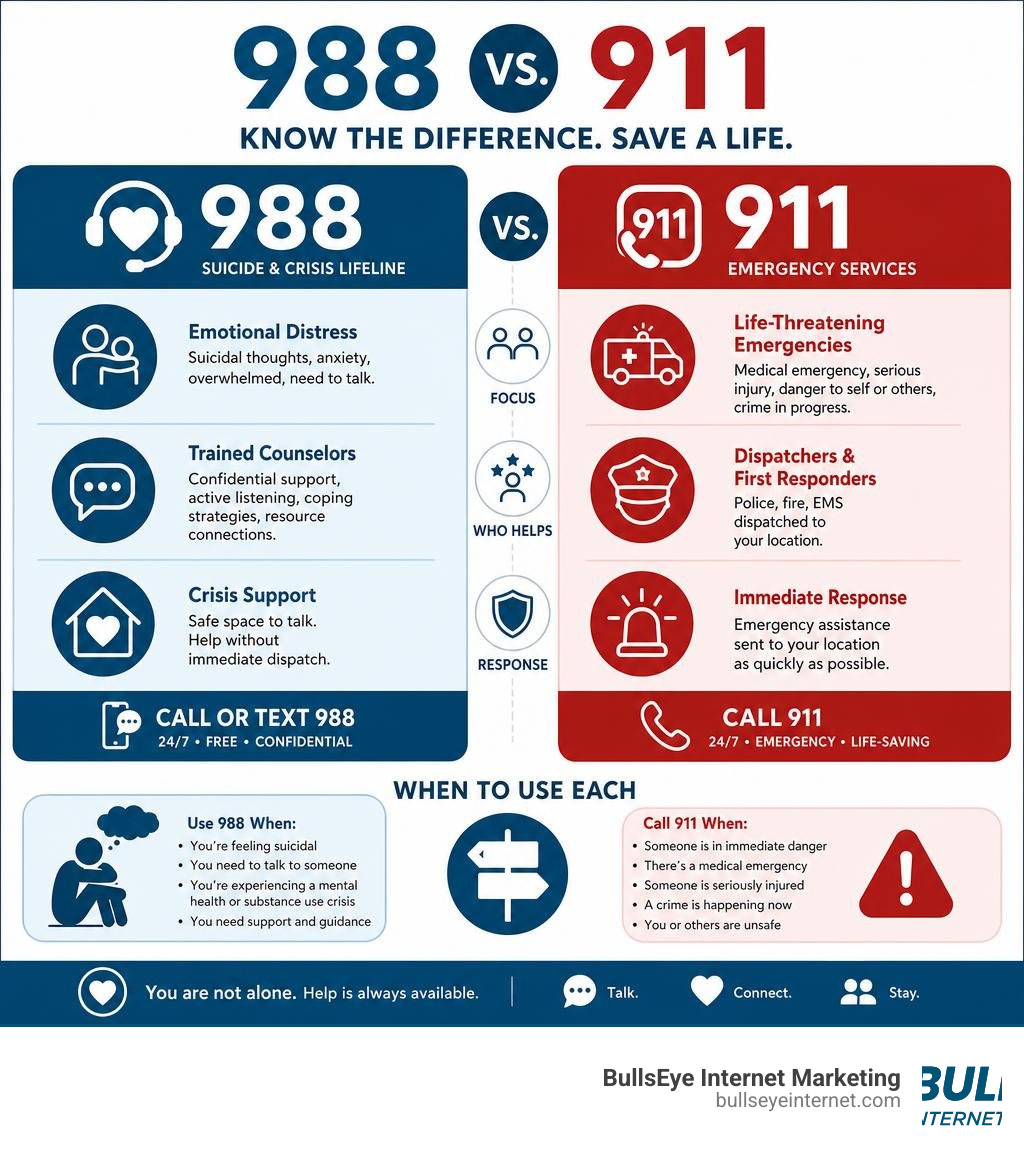
What is the difference between 988 and 911?
988 is a dedicated, confidential line for mental health, suicide, and substance use crises, connecting callers directly with trained clinical counselors. 911 is reserved for immediate, life-threatening emergencies requiring physical intervention from police, fire, or medical personnel.
Will calling a mental health hotline result in police showing up?
In the vast majority of cases, no. 988 and local helplines resolve most calls over the phone. However, if a counselor believes there is an imminent threat to life—such as an active suicide attempt or severe medical emergency—they may coordinate with 911 to dispatch emergency responders.
How can I find local mental health resources in my county?
For national directories, you can visit the Mental Health Resources page on the CDC website, or review national state-by-state data via Ranking the States | Mental Health America.
If you live in Florida, you can connect directly with county health departments and local resources:
- Miami-Dade County: Access wellness programs and public health services through Mental Health – Florida Department of Health in Miami-Dade County.
- Martin County: Find local mental health support services via Mental Health – Florida Department of Health in Martin County.
Conclusion
Navigating a mental health crisis requires a compassionate, coordinated, and highly visible support system. Just as individuals in distress need clear, immediate pathways to care, the organizations and clinicians providing these vital services must be easily discoverable online by those searching for help.
At BullsEye Internet Marketing, we specialize in helping essential service providers, medical practices, and local businesses connect with the people who need them most. Through targeted search engine optimization, Google Business Profile management, and high-performing pay-per-lead strategies, we ensure your services are highly visible when searchers look for help in their local communities.
We work with only one client per industry per geographic area, offering a distinct competitive advantage with no long-term contracts. If you want to expand your local reach and ensure your organization is the first one people find during critical search moments, explore our specialized BullsEye Internet Marketing Pay-Per-Call Services today. Let’s work together to make sure that when someone reaches out, your business is there to answer the call.
