
Why Next Gen SEO is Reshaping Digital Visibility
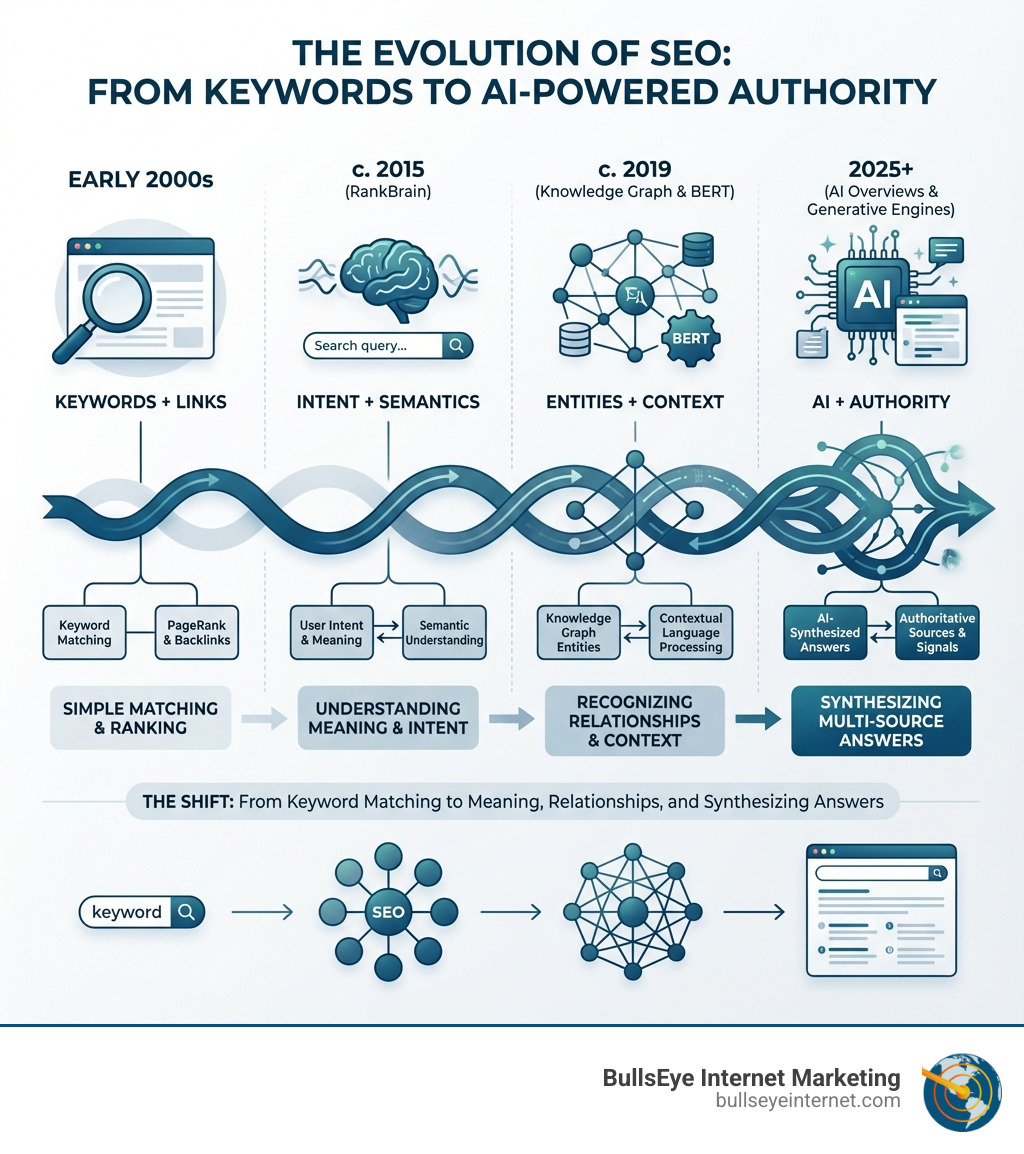
Next gen SEO evolves traditional SEO for an era where AI platforms like Google’s AI Overviews and ChatGPT deliver information directly. The focus shifts from ranking web pages to making your content findable, understandable, and citable by AI systems that generate answers, often eliminating the need for a click.
What You Need to Know About Next Gen SEO:
- Traditional SEO = Ranking web pages in search results
- Next Gen SEO = Being cited and featured by AI systems that synthesize answers
- The Shift: From keyword-based optimization to context, entities, and semantic understanding
- Three Core Pillars: SEO (traditional search), AEO (answer engines), and GEO (generative AI platforms)
- Why It Matters: Over 50% of searches now show AI Overviews, and traditional search volume is predicted to drop 25% by 2026
The search landscape has fundamentally changed. Google’s integration of AI, particularly through AI Overviews, is altering user interaction with search results. These AI-driven tools favor conversational and contextual understanding, rendering old tactics like keyword stuffing and simple backlink chasing obsolete.
What’s replacing it? A focus on semantic clarity, topical authority, and multi-platform optimization. Search now extends beyond Google’s traditional results to platforms like TikTok, YouTube, and Amazon, which have become powerful search engines. The future belongs to brands that prove their value to both traditional search engines and the AI systems that generate answers.
This shift creates both risk and opportunity. Companies that ignore Next gen SEO risk becoming invisible as AI platforms cite competitors instead. But early adopters are seeing 185% higher brand authority scores and 240% improved pipeline quality by optimizing for this new reality.
I’m Ronnie Katz, founder and CEO of BullsEye Internet Marketing. Since 2006, I’ve helped businesses adapt to search engine evolution. Today, I specialize in helping companies thrive in Next gen SEO by integrating AEO, GEO, and AI-driven strategies for visibility across all modern search platforms. Let’s explore how to position your business to win in this new era.
Next gen SEO basics:
The Fundamental Shift: From Keywords to Context and Entities
For years, SEO was about keywords. Now, Google understands meaning through entities—people, products, and concepts in its Knowledge Graph. This seismic shift marks a “post-keyword era” where topical depth and authority are paramount. Our goal is to ensure your content is not just found, but truly understood by search engines and AI.
To succeed, we must align content with Google’s entity-understanding pipeline through schema and NLP alignment. Each page should reinforce your identity, offerings, and their connections. This entity-first approach transforms your content from a collection of keywords into a rich, interconnected information source that AI can easily digest. To dive deeper into this shift, explore Entity-first SEO: How to align content with Google’s Knowledge Graph.
What is Semantic SEO?
Semantic SEO is optimizing content for meaning and context, not just keywords. It helps search engines and AI understand your content’s true topic. For example, it clarifies whether a search for “apple” refers to the fruit or the company.
Search engines use sophisticated Natural Language Processing (NLP) technologies, including advancements like Google’s RankBrain, BERT, and MUM algorithms, to process language and understand intent. These technologies allow search engines to grasp the nuances of human language and interpret complex queries. Our strategy involves optimizing your content so these algorithms can precisely map it to user intent, ensuring your message resonates. For more on optimizing for meaning, check out Semantic SEO: How to optimize for meaning over keywords.
How Entity-First Indexing is Reshaping Search
“Entity-first indexing,” a term from Cindy Krum, describes how Google processes information by prioritizing its understanding of entities. Google’s Knowledge Graph stores data about these entities and their relationships. By optimizing for entities, we clarify meaning, helping AI systems accurately place your content within their semantic networks.
Instead of just ranking pages for keywords, Google now evaluates how well content covers an entity, its attributes, and its values. This understanding populates SERP features like Knowledge Panels, “People Also Ask” sections, and AI Overviews. For a business in Miami, we link your services as entities to the location and local needs, boosting visibility in these valuable, entity-driven features.
To stay competitive, we need to focus on three pillars for entity optimization:
- Precision: Every page should be unambiguously about one canonical entity, ensuring its title, H1, and schema
mainEntityOfPageall align. - Coverage: Your entire site should collectively represent the entities and sub-topics that define your niche, effectively building a mini Knowledge Graph for your brand.
- Connectivity: Entities gain strength through context via internal links and schema relationships, helping Google understand how concepts fit together.
This approach is vital for findability in the evolving search landscape. For more insights on how we approach this, explore our LLM SEO services.
The Role of Structured Data (Schema Markup)
Structured data (schema markup) is a key tool for clarifying context for AI. Using vocabulary from Schema.org, we embed code that gives search engines explicit clues about your content’s meaning, marking up entity-attribute-value relationships.
This is crucial for Next gen SEO because AI systems rely heavily on structured data to accurately interpret information for rich results and AI-generated answers. For example, using FAQ schema can help your content appear in “People Also Ask” sections. For businesses in Florida, whether you’re a local service provider in Miami-Dade County or a retail store in Palm Beach County, implementing structured data for your organization, products, and services can significantly improve your visibility. Google explicitly recommends using structured data, and we follow their guidance on structured data to ensure best practices.
The Three Pillars of Next Gen SEO: SEO, AEO, and GEO
The future of search optimization requires a unified, holistic approach. We call this Extended SEO (XEO), which integrates three critical pillars: traditional SEO, Answer Engine Optimization (AEO), and Generative Engine Optimization (GEO). When combined, they ensure your content reaches your audience wherever and however they search.
| Feature | Traditional SEO (2015) | Answer Engine Optimization (AEO) (2020) | Generative Engine Optimization (GEO) (2025) |
|---|---|---|---|
| Goal | Rank in SERPs for keywords | Appear in AI-based direct answer results | Be cited or summarized by AI tools |
| Primary Channel | Google’s 10 blue links | Featured Snippets, PAA, AI Overviews, Voice Assistants | ChatGPT, Gemini, Perplexity, AI Overviews |
| Content Style | Keyword-rich, long-form articles, landing pages | Q&A format, concise answers, structured content | Factually accurate, semantically rich, first-party expertise |
| Key Tactics | On-page, technical, backlinks, keyword research | Structured data (Schema), conversational queries, content clarity | Entity optimization, E-E-A-T, source attribution, trust signals |
As you can see, a layered strategy using all three ensures you meet your audience wherever and however they search. This is why we integrate these approaches for our clients across Florida, from Miami to West Palm Beach, providing a truly comprehensive digital visibility strategy. For more details on our specialized services, explore our AEO & GEO services.
Answer Engine Optimization (AEO): Winning in the Zero-Click Future
In the “zero-click future,” users get answers directly on the SERP, making Answer Engine Optimization (AEO) crucial. AEO optimizes your content to appear in direct answers like AI Overviews, Featured Snippets, and voice assistant responses, often eliminating the need for a click.
For businesses in Florida, this means creating content that directly answers common questions about your services or products in a clear, concise, and structured way. We focus on Q&A content formats, anticipating the exact questions your potential customers are asking. By structuring your content with clear headings and using conversational language, we increase the likelihood of your information being pulled into these prominent answer boxes. This includes optimizing for voice search, where users speak their queries, demanding natural language responses.
Generative Engine Optimization (GEO): Getting Cited by AI
Generative AI platforms like ChatGPT and Google’s AI Overviews synthesize information from multiple sources. Generative Engine Optimization (GEO) is the process of making your content so authoritative that these AI systems cite or summarize it when answering relevant questions.
To achieve this, we focus on several key strategies:
- Factual Accuracy: AI values correct and verifiable information. We ensure your content is carefully researched and factually sound.
- Demonstrating E-E-A-T: Experience, Expertise, Authoritativeness, and Trustworthiness are more important than ever. We help you showcase your team’s credentials and real-world experience. For a law firm in Broward County, we’d highlight attorney bios and case studies.
- Building Trust Signals: This includes transparent author attribution, clear contact information, and consistent branding.
- First-Party Expertise: Content created by genuine experts within your organization is highly valued by AI systems.
The stakes are high: traditional search volume is predicted to drop 25% by 2026, replaced by traffic from generative engines. If your content isn’t optimized for AI citation, you risk becoming invisible. We help our clients in areas like Miami and Palm Beach County implement these strategies to ensure their content is not just visible, but cited by AI. To learn more about this vital aspect of Next gen SEO, read The Complete Guide to Generative Engine Optimization (GEO).
The Enduring Importance of Foundational SEO
While AEO and GEO are cutting-edge, foundational SEO remains critical. It’s the strong foundation for your business, while AI strategies are the modern improvements. Without solid technical SEO, on-page optimization, and a healthy backlink profile, even brilliant AI-optimized content may not be found.
Our approach to foundational SEO includes:
- Technical SEO: Ensuring your website is crawlable, indexable, and performs optimally.
- On-page Optimization: Crafting compelling meta titles, descriptions, and high-quality content that provides value to users.
- Site Speed and Mobile-First Indexing: Google prioritizes fast, mobile-friendly websites. We optimize Core Web Vitals to ensure an excellent user experience.
- Backlinks as Authority Signals: Earning high-quality backlinks from reputable sites still signals authority and trustworthiness.
These elements are the bedrock upon which successful Next gen SEO is built. For a comprehensive understanding of these basics, refer to What is technical SEO? The definitive guide.
AI’s Transformative Role in Search and Strategy
AI is revolutionizing SEO strategy, not just user search behavior. Google’s AI Mode, which blends generative responses with web links, is a prime example. This deep AI integration enables predictive SEO, helping us anticipate algorithmic changes, trends, and competitor moves before they affect rankings.
This evolution empowers us to transform raw data into strategic competitive advantages. For our clients in South Florida, this means leveraging AI to uncover opportunities that manual analysis simply can’t. We’re not just reacting to changes; we’re using AI to proactively shape our strategies for maximum impact. Find more about our specialized AI services at More info on our AI Search services.
How AI is Changing SEO Workflows
AI-powered SEO tools are making our workflows faster, more accurate, and more strategic. Tasks that once took weeks, like manual keyword analysis or content gap identification, can now be done by AI in minutes.
Here’s how AI is changing our SEO workflows:
- Automated Content Gap Analysis: AI tools perform deep, semantic breakdowns of topics, identifying subtopics and questions that top-ranking pages are missing.
- Semantic Keyword Research: AI helps us move beyond simple keyword volume to understand user intent, related entities, and conversational queries.
- Competitive Analysis: AI allows us to monitor competitor strategies in real-time, identify their weaknesses, and uncover opportunities.
- Predictive Analytics: AI helps us forecast emerging trends and algorithmic shifts, allowing us to adapt our strategies proactively.
These tools don’t replace human expertise; they augment it, freeing us to focus on interpreting insights and building winning strategies. For a more in-depth look at the tools and strategies we recommend, visit our AI SEO Consulting Ultimate Guide.
Understanding Google’s AI Overviews and AI Mode
Google’s AI Mode, featuring prominent AI Overviews powered by Gemini models, marks a significant shift in the SERP landscape. Rolled out to all U.S. users in May 2024, with a broader international rollout planned, these AI-generated summaries are becoming the norm, potentially replacing the traditional “10 blue links.”
The impact on organic traffic is substantial. AI Overviews can “siphon” clicks from traditional organic results, reducing visibility for brands that rely solely on siloed pages. This necessitates a focus on making your content not just rank, but be selected and synthesized by the AI. We must understand how content is chosen for these overviews, which often involves LLM-powered query expansion, where the AI answers questions users haven’t even explicitly asked. This requires a strong emphasis on topical depth and authority.
What is Relevance Engineering for Next gen SEO?
Relevance Engineering is a framework that blends semantic SEO, deep content architecture, and AI comprehension to future-proof your strategy. It involves designing content to be inherently relevant and trustworthy for both human readers and the sophisticated AI systems that interpret and summarize information.
This approach focuses on:
- Semantic SEO: As discussed, optimizing for meaning, context, and entities.
- Topically Deep Content Architecture: Building comprehensive content clusters that cover a topic exhaustively, demonstrating true mastery and authority.
- AI Comprehension: Structuring content in a way that AI models can easily understand and extract information from, often leveraging structured data.
- Creating Citation-Worthy Content: Ensuring your content is so authoritative and well-structured that AI platforms naturally choose to cite it as a source.
By implementing Relevance Engineering, we help our clients in Florida ensure their content is not just findable, but also highly credible and useful in the AI-driven search environment. For more information on how we apply this framework, explore our guide on How to Future-Proof Your SEO Strategy with Relevance Engineering.
Implementing a Unified Optimization Strategy
Thriving in the era of Next gen SEO requires a holistic, unified strategy. We integrate SEO, AEO, and GEO, moving beyond silos to prioritize user experience (UX), E-E-A-T, multimodal search, emerging channels, and privacy-first principles. This ensures your brand is visible wherever customers are searching.
This integrated approach is particularly vital for businesses in our service areas of Florida. Whether a potential customer is asking a voice assistant for “the best AC repair in Miami” or searching for “top real estate agents in West Palm Beach” on TikTok, our unified strategy ensures your brand is present, authoritative, and helpful.
Prioritizing User Experience and E-E-A-T
User experience (UX) is no longer just a ranking factor; it’s a key determinant of search success. Google prioritizes page experience metrics like Core Web Vitals and mobile usability. In 2024, Interaction to Next Paint (INP) replaced First Input Delay (FID) as the core responsiveness metric, underscoring Google’s focus on a seamless user journey. We ensure client websites are fast, interactive, and stable on all devices.
Equally important is E-E-A-T: Experience, Expertise, Authoritativeness, and Trustworthiness. Google now places a stronger emphasis on “Experience” alongside the traditional E-A-T. This means demonstrating real-world, first-hand knowledge. For a medical practice in Broward County, this would involve showcasing doctor credentials and patient testimonials. For a local restaurant, it means highlighting chef experience. Authenticity and user-first content are paramount. For detailed insights on demonstrating these qualities, refer to Google’s E-E-A-T guidelines.
Optimizing for Voice, Visual, and Multimodal Search
Search behavior is diversifying. The rise of smart devices has fueled voice search, while multimodal search—combining text, images, and video—is also growing. This requires a flexible approach to content optimization.
- Voice Search: Users employ conversational keywords and ask full questions. We optimize content to answer these natural language queries directly and concisely.
- Google Lens Optimization: With billions of visual searches monthly, optimizing images with descriptive alt text, high-quality visuals, and relevant metadata is crucial. For an e-commerce business in Miami, this means ensuring product images are perfectly optimized for visual findy.
- Video SEO: YouTube is the second-largest search engine. We optimize video titles, descriptions, and transcripts to ensure your video content is findable.
- Multimodal Content: We create content that works seamlessly across various formats, such as blog posts with embedded videos and infographics, to cater to diverse search behaviors.
Leveraging Emerging Search Channels
Beyond Google, platforms like TikTok, YouTube, and Amazon are now major search engines. Consumers use these channels for product findy, entertainment, and information. Our unified strategy includes optimizing for these diverse environments.
- TikTok SEO: For businesses targeting younger demographics, optimizing content with relevant hashtags and engaging short-form videos can drive significant findy.
- YouTube as a Search Engine: As mentioned, video content optimization is key. For a business in Florida, educational videos or local guides can capture a massive audience.
- Amazon Search Optimization: For e-commerce businesses, optimizing product listings with relevant keywords and high-quality images is essential for visibility within Amazon’s algorithm.
- Social Media Search: People use social platforms to find local businesses and recommendations. We ensure your brand is optimized for findability on the platforms your audience uses.
Preparing for a Privacy-First World
As Google adapts to stricter privacy regulations and phases out third-party cookies, privacy-conscious strategies are essential. Building robust first-party data collection methods is now paramount.
Our approach includes:
- First-Party Data Strategies: We help you collect data directly from your audience through email sign-ups and customer accounts, allowing for personalized marketing without third-party tracking.
- Contextual Targeting: We focus on placing your content in relevant contexts where your target audience is already engaged.
- Audience Building: Cultivating a loyal audience through valuable content ensures you maintain a connection beyond search engine algorithms.
This shift means moving beyond cookies and focusing on building direct relationships with your audience. For more on navigating this landscape, consult our Digital Marketing AI Guide.
Frequently Asked Questions about Next Gen SEO
What are the key differences between AEO and GEO?
AEO (Answer Engine Optimization) focuses on providing the direct answer in features like Google’s AI Overviews and voice search, often using structured, Q&A-style content to satisfy a query on the SERP. The goal is to win the zero-click search.
GEO (Generative Engine Optimization) is broader, aiming for your content to be cited as a source by AI platforms like ChatGPT or Gemini. This requires deep, authoritative, and factually accurate content that AI systems trust enough to synthesize into their responses.
In short, AEO is about being the answer, while GEO is about being the source for the answer. Both are crucial for Next gen SEO.
How can I get my content featured in Google’s AI Overviews?
Focus on creating high-quality, comprehensive content that directly answers user questions. Key steps include:
- Achieve Top Organic Rankings: AI Overviews often source from pages that already rank well.
- Answer Questions Directly: Use Q&A formats and provide clear, concise answers.
- Use Clear Structure: Employ logical headings (H1, H2, H3), lists, and tables to make information digestible for AI.
- Implement Structured Data: Use schema markup (e.g., FAQ, How-to) to clarify your content’s meaning for AI.
- Demonstrate Strong E-E-A-T: Prove your Experience, Expertise, Authoritativeness, and Trustworthiness. AI must trust your information.
- Build Topical Depth: Cover topics comprehensively, including related subtopics.
Is traditional SEO dead?
No, traditional SEO is not dead; it has evolved into the essential foundation for Next gen SEO. Core principles like technical optimization, site speed, user experience, and authority building are more important than ever. However, these elements are now the baseline. Next gen SEO builds on this foundation by integrating AEO and GEO to capture direct answers and get cited by AI. A strong SEO foundation is still paramount, but it’s no longer the entire strategy.
Conclusion: Thriving in the New Era of Search
The digital landscape is undergoing a profound change, driven by the rapid advancements in artificial intelligence. As we’ve explored, Next gen SEO is not just an incremental update; it’s a fundamental shift from keyword-based ranking to a holistic strategy focused on context, entities, and AI comprehension. The future of search is here, and it demands a unified approach that seamlessly integrates traditional SEO with Answer Engine Optimization (AEO) and Generative Engine Optimization (GEO).
For businesses in Florida, from the vibrant markets of Miami to the growing communities in Martin County, this means prioritizing quality, demonstrating deep expertise, and building authority across all digital touchpoints. It’s about ensuring your content is not just findable, but also trusted and cited by the AI systems that are increasingly shaping how users find information. The brands that accept this evolution today will be the ones that thrive tomorrow, securing their visibility and relevance in an ever-more competitive digital ecosystem.
At BullsEye Internet Marketing, we specialize in guiding our clients through this complex, yet exciting, new era of search. We develop custom strategies that leverage the power of AI to drive calls and sales, ensuring your business is not just found, but remembered.
Get a free consultation on our Answer Engine Optimization services and let’s position your business for unparalleled success in the Next gen SEO landscape.
